
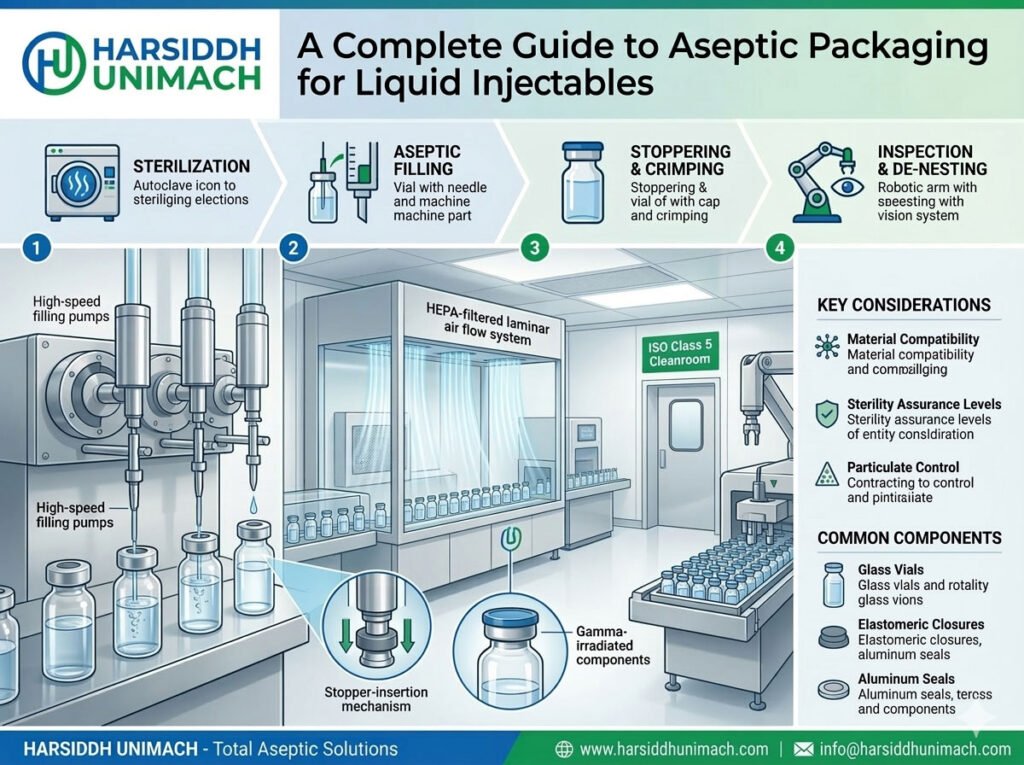
When a patient receives an injection, the drug goes straight into the bloodstream. It bypasses the skin, the gut and most of the body’s natural defences. That is why aseptic packaging for liquid injectables is among the most tightly controlled activities in pharmaceutical manufacturing. One contaminated vial can cause sepsis, a product recall or a regulatory shutdown.
This guide covers what aseptic packaging is, how it differs from terminal sterilization, the process steps from container preparation to final sealing, the regulatory expectations, and how to choose equipment that keeps your line compliant.
What Is Aseptic Packaging for Liquid Injectables?
Aseptic packaging means filling a sterile drug product into sterile containers and closing them in a controlled environment, so that no microorganisms enter at any point. The drug, the container and the closure are each sterilized separately. They are then brought together under conditions that prevent re-contamination.
It is used for injectables that cannot survive terminal sterilization, such as:
- Heat-sensitive small molecules
- Biologics, monoclonal antibodies and vaccines
- Peptides and protein formulations
- Many ophthalmic and parenteral solutions in ampoules and vials
Terminal sterilization (autoclaving the sealed container) is preferred wherever the product tolerates it. For everything else, aseptic processing is the only route, and the quality of your equipment and environment decides the outcome.
Aseptic Processing vs. Terminal Sterilization
| Factor | Aseptic Processing | Terminal Sterilization |
|---|---|---|
| Sterilization stage | Components and product sterilized separately, then combined | Sealed container sterilized after filling |
| Suitable for | Heat-sensitive drugs and biologics | Heat-stable products |
| Contamination risk | Depends on environment, equipment and operators | Lower, since the final pack is sterilized |
| Regulatory scrutiny | Very high (media fills, environmental monitoring) | High, but process is simpler |
| Equipment complexity | High | Moderate |
Because aseptic processing has no final kill step, every upstream control matters. The sections below follow the product through each of those controls.
The Key Stages of Aseptic Packaging
1. Container Washing and Preparation
Sterile filling starts with clean containers. Glass ampoules and vials carry particles, residues and endotoxins from manufacturing and transport. Washing removes them with multiple cycles of purified water, filtered compressed air and finally Water for Injection (WFI).
Plants typically choose between rotary and linear washers depending on throughput and container variety. Our engineering comparison, Rotary vs Linear Vial Washing Machines, explains the trade-offs. For a step-by-step view, see Sterile Container Washing Process Explained and How Automatic Linear Vial Washers Improve Sterility.
Machines to consider:
- Automatic Linear Tunnel Type Vial Washing Machine
- Automatic Rotary Ampoule Washing Machine
- Automatic Rotary Vial Washing Machine
Browse the complete range in our Washing Machine category.
2. Depyrogenation and Sterilization
After washing, containers pass through a sterilizing and depyrogenating tunnel. Dry heat at high temperature destroys microorganisms and breaks down endotoxins (pyrogens), which survive ordinary sterilization. Containers leave the tunnel in a unidirectional Grade A airflow and move straight to the filling zone without exposure to lower-grade air.
Rubber stoppers are sterilized separately, usually by steam, and transferred through validated routes. Our sister site covers this equipment in its Sterilizing Tunnel for Ampoules and Vials page.
3. Sterile Filtration of the Drug Solution
The bulk solution is passed through a 0.22-micron sterilizing-grade filter. This step is critical. Filter integrity must be tested before and after use, and the filtered solution is held in a sterile tank for as short a time as practical before it reaches the filling machine.
4. Aseptic Filling
Filling is the most sensitive step, because the product and the open container meet here. Accuracy and sterility both matter:
- Dose accuracy: Servo-driven pumps and peristaltic or piston systems give repeatable volumes. High-value biologics need very tight tolerances, and our guides on Vial Filling Machine Fill Accuracy and Minimizing Product Loss for High-Value Biologics show how to get there.
- Nozzle design: Diving nozzles reduce foaming and splashing, which also lowers the chance of product reaching the neck of the container. See Vial Filling Machine Nozzle Selection.
- Minimal intervention: The fewer times operators touch the filling zone, the lower the risk. This is why modern lines use barrier technology (covered below).
Equipment worth reviewing:
- Automatic Injectable Liquid Vial Filling and Stoppering Machine
- Automatic Servo Based Vial Filling Machine
- Automatic Servo Based Ampoule Filling and Sealing Machine
- Automatic Eight Head Closed Ampoule Filling and Sealing Machine for high-volume ampoule production
- Automatic Pre-Filled Syringe (PFS) Filling and Stoppering Machine
For the machine station layout, read Vial Filling Machine Diagram: Understanding Every Station and Vial Filling Machine Working Principle.
5. Nitrogen Flushing
Oxygen degrades many injectables through oxidation. An inert nitrogen purge replaces the air in the headspace just before closure and extends shelf life. We explain the mechanism in The Role of Nitrogen Flushing in Preserving Injectable Drug Stability and How Nitrogen Flushing Improves Sterility and Stability in Ampoule Filling Machines.
6. Stoppering, Sealing and Capping
A vial is only as sterile as its closure. Stoppers must seat fully, and the aluminium cap must be crimped with the right force. Too little force allows leakage, and too much cracks the glass or damages the stopper. Ampoules are closed by flame-sealing the neck, and the seal must be smooth and complete.
Related reading:
- Vial Filling Machine Stoppering: How Stopper Placement Affects Container Closure Quality
- Vial Capping Machine: How Crimping Force Affects Container Closure Integrity
- Vial Cap Sealing Machine Working Principle
Capping options include the Automatic Four Head Vial Cap Sealing Machine and the Automatic Six Head Vial Cap Sealing Machine. See all models under Capping Machines.
7. Inspection and Labeling
Every sealed unit is inspected for particles, cracks, fill-level deviations and cosmetic defects. Parenteral products must be essentially free of visible particulate matter, so inspection is a regulatory requirement as well as a quality check. Our article on Best Practices for Ampoule and Vial Inspection and the guide to Vial Filling Machine Inspection Points are good starting points.
Inspection equipment includes the Semi Automatic Visual Vial Inspection Machine and the Semi Automatic Visual Ampoule Inspection Machine, with more in Inspection Machines.
Labeling follows inspection. Wrong or missing labels on injectables are a serious patient-safety issue, which is why we wrote Top 10 Labeling Mistakes Manufacturers Should Avoid. See the Automatic Vial Sticker Labeling Machine or the full Labeling Machines category.
Barrier Technology: RABS and Isolators
The biggest source of contamination in an aseptic suite is people. Barrier systems physically separate operators from the Grade A filling zone.
- RABS (Restricted Access Barrier Systems): Rigid walls with glove ports. Interventions are possible through gloves, and doors are opened only under strict rules.
- Isolators: Fully enclosed, decontaminated chambers (often with vaporized hydrogen peroxide) that offer the highest level of separation.
Regulators increasingly favour barrier technology over open cleanrooms. Our article The Rise of RABS and Isolators in Modern Pharmaceutical Vial Filling Machines explains how to decide between them.
Regulatory Expectations You Must Meet
Aseptic manufacturing is governed by overlapping standards. The main ones are:
- EU GMP Annex 1 (Manufacture of Sterile Medicinal Products): The revised version stresses a documented Contamination Control Strategy (CCS), quality risk management and barrier technology.
- US FDA Aseptic Processing Guidance and 21 CFR Parts 210 and 211: Cover cleanroom classification, media fills, environmental monitoring and personnel qualification.
- WHO GMP and Schedule M (India): Define sterile area requirements for Indian manufacturers, including those exporting to regulated markets.
- ISO 14644: Defines cleanroom classification and particle limits.
The cleanroom grades are:
| Grade | Typical Use |
|---|---|
| Grade A | Filling zone, stopper bowls, open-container handling (unidirectional airflow) |
| Grade B | Background environment for Grade A |
| Grade C/D | Preparation and washing areas, less critical steps |
For a deeper look at compliance, read the cGMP Compliance Guide: Essential Features for Sterile Vial Filling Machinery and The Importance of GMP Compliance in Pharmaceutical Machinery.
Validation: Proving the Process Works
Regulators accept sterility only when it is demonstrated. The core validation activities are:
- Equipment qualification (IQ/OQ/PQ): Confirms the machine is installed correctly, operates within limits and performs consistently. See Automatic Vial Filling Equipment Validation & Qualification and Vial Filling Machine Validation: Key Parameters.
- Media fills (process simulation): Growth medium replaces the drug and runs through the full process, including worst-case interventions. Any contamination points to a flaw in the aseptic process.
- Environmental monitoring: Regular air, surface and personnel sampling in classified areas.
- Cleaning and sterilization validation: Proves that product-contact parts are properly cleaned and sterilized. Our Vial Filling Machine Cleaning and Sterilization guide covers the practical side.
- Container closure integrity (CCI) testing: Verifies the sealed container keeps microbes out for its entire shelf life.
Common Aseptic Packaging Mistakes
Even well-funded plants make avoidable errors. The most frequent are:
- Too many interventions: Each manual intervention adds contamination risk. Design the line so that routine adjustments need no access to Grade A.
- Poor changeover practice: Rushed format changes introduce cross-contamination and setup errors. See Vial Filling Machine Changeover Best Practices and Ampoule Filling Machine Changeover.
- Weak maintenance: Worn seals, pumps and nozzles are early warning signs. Use our Vial Filling Machine Maintenance: 7 Best Practices and Ampoule Filling Machine Maintenance Checklist.
- Vial breakage at high speed: Broken glass is both a sterility and a safety event. Read Top 5 Causes of Vial Breakage on High-Speed Filling Lines.
- Buying on price alone: The cheapest line can cost the most once validation failures and downtime are counted. See Aseptic Vial Filling Line Cost: Key Cost Drivers.
Ampoules or Vials: Which Container Suits Your Product?
Both are used for liquid injectables. Ampoules are single-use and sealed by melting the glass neck, which gives a very strong seal but means opening can release glass particles. Vials use rubber stoppers and aluminium caps and allow multi-dose use and lyophilization. The right choice depends on your product, volume and market. Ampoule vs Vial Filling: Key Differences Explained compares them in detail.
How to Choose the Right Aseptic Filling Line
Use these questions when evaluating equipment:
- What is your container format and batch size? Small R&D or pilot runs call for compact machines. Commercial volumes need multi-head or monoblock lines. See Small Vial Machine vs High-Speed Vial Lines.
- How sensitive is the product? Biologics and vaccines need low-shear dosing and minimal product loss. See Vial Filling Machine Solutions for Biologics, Vaccines and Temperature-Sensitive Drugs.
- Will you run multiple sizes? Check how easily the line handles format changes: Vial Filling Machine Flexibility.
- Is the machine built for cGMP? Look for SS 316L contact parts, smooth cleanable surfaces, full documentation and validation support.
- What does the full line look like? Washing, sterilizing, filling, stoppering, capping, inspection and labeling should work as one connected system.
For complete integrated solutions, explore the Automatic Liquid Vial Filling Line (Compact Line) and the Automatic Ampoule Filling Line (Compact Line). The category pages for Injectable Liquid Vial Filling Lines and Injectable Ampoule Filling Lines list every configuration. For individual machines, see Vial Filling Machines and Ampoule Filling Machines.
A detailed selection framework is in How to Choose the Right Injectable Liquid Vial Filling Line for Your Pharmaceutical Plant. If you prefer to compare models by category, our sister site lists Vial Filling Machines for Liquid Vials and Ampoule Filling Machines for Closed Ampoules.
The Future of Aseptic Packaging
The industry is moving toward closed, automated and data-driven processing. Fully automated lines, robotic handling, in-process weight checks and electronic batch records all reduce human intervention and strengthen data integrity. Read our outlook in The Future of Sterile Filling: Moving Toward Fully Automated Lines. Serialization adds a further layer. See How Serialization Is Transforming Pharmaceutical Packaging.
Conclusion
Aseptic packaging for liquid injectables is a chain of connected controls: clean containers, sterile components, filtered product, accurate filling, secure closure, barrier protection and proven validation. A weakness at any link puts the whole batch at risk. Choosing well-engineered, cGMP-ready equipment, and maintaining and validating it properly, is the most reliable way to protect patients and your licence to operate.
Need Help Planning Your Aseptic Filling Line?
Harsiddh Unimach Pvt. Ltd. designs and manufactures washing, filling, capping, inspection and labeling machines for injectable manufacturers. Our engineers can recommend a configuration for your container, batch size and compliance needs. Contact our team or browse the Store to start.
FAQs
1. What is the difference between aseptic and sterile packaging?
Sterile means free of viable microorganisms. Aseptic describes the process of keeping a sterile product sterile while it is filled and sealed, with no final sterilization of the finished container.
2. Why is nitrogen used in injectable vials and ampoules?
Nitrogen displaces oxygen in the headspace and protects oxygen-sensitive drugs from oxidation, which extends shelf life.
3. What is a media fill?
It is a process simulation in which sterile growth medium is filled instead of the drug. If any unit shows microbial growth, the aseptic process has a problem that must be investigated.
4. Are isolators better than RABS?
Isolators give the highest level of operator separation, but they cost more and need more complex decontamination. RABS is a good middle path for many plants. The right choice depends on risk, budget and product.
5. Which regulations apply to aseptic filling in India?
Indian manufacturers follow Schedule M and WHO GMP. Plants exporting to the EU or US must also meet Annex 1 and FDA requirements.