
Injectable medicines are among the most demanding products to manufacture. They must be sterile, free from visible particles, accurately dosed and sealed in containers that protect them until the moment of use. The vial filling machine sits at the centre of this process — the point where sterile product and sterile container finally meet.
Understanding how a vial filling machine works, and how it fits into the wider pharmaceutical process, helps production teams operate it correctly, helps quality teams assess risks, and helps buyers choose the right equipment. In this guide, we explain the working principle of a vial filling machine in detail and then follow the complete process flow, from product compounding to batch release.
For a station-by-station visual of the full line, see our companion article: vial filling machine diagram — understanding every station in the filling line.
The Working Principle in Brief
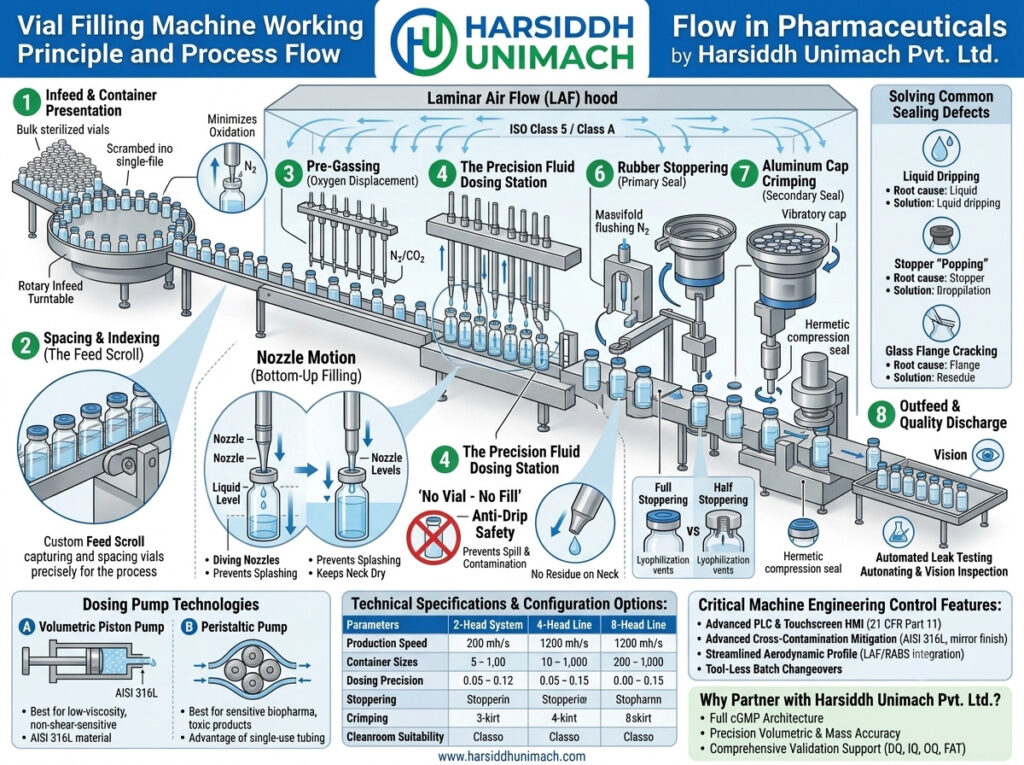
A vial filling machine transports sterile vials into position beneath filling nozzles, dispenses a precisely measured volume of sterile liquid into each vial using a dosing pump, and immediately closes the vial with a rubber stopper — all under Grade A conditions and synchronised by a central drive and control system.
Four functions make this possible:
- Vial handling – moving vials smoothly and positioning them accurately.
- Dosing – measuring and delivering the correct volume.
- Product protection – nitrogen purging and drip-free filling.
- Closing – placing and seating the rubber stopper.
1. Vial Handling: How Vials Move Through the Machine
Infeed
Sterile vials arrive from the depyrogenation tunnel onto an infeed turntable. The turntable rotates gently, guiding vials towards the machine’s transport system in a single line.
Transport mechanisms
Two main approaches are used:
- Linear (intermittent) machines: an infeed worm (a helical screw) separates the vials and spaces them at a fixed pitch. Vials move along a conveyor and are stopped in groups under the nozzles by star wheels or gates. After filling, the group moves on and the next group enters. This design is simple, flexible and suits small to medium outputs.
- Rotary (continuous motion) machines: vials are transferred into pockets on a rotating star wheel. Nozzles move with the vials for part of the rotation, filling them without stopping. This gives higher speeds and smooth handling.
Machines like the Automatic Motion Vial Filling Machine illustrate how smooth, synchronised motion improves both speed and gentleness. To compare machine designs, read our guide to the types of vial filling machines used in pharmaceutical manufacturing.
No-vial-no-fill
Sensors detect each vial before it reaches the nozzle. If a vial is missing or incorrectly positioned, that nozzle does not dispense — preventing product loss and contamination of the machine.
2. Dosing: How the Volume Is Measured
The dosing system draws product from a sterile holding vessel and delivers it to the filling nozzles. Each nozzle usually has its own pump, so a two-head machine has two pumps, a four-head machine has four, and so on.
Piston pumps
A piston moves within a precision cylinder. On the suction stroke, product is drawn in; on the delivery stroke, it is pushed out through the nozzle. The stroke length determines the volume. Servo-driven pistons allow volume and speed to be adjusted from the HMI. See our servo based piston filling machine.
Peristaltic pumps
Rollers compress a flexible tube, pushing a fixed volume of product forward with each rotation. The product only contacts the tubing, which can be single-use. This makes peristaltic dosing popular for biologics, potent drugs and multi-product facilities. See our peristaltic based liquid filling machine.
What affects accuracy
Fill accuracy depends on pump condition, product viscosity and temperature, air in the product line, nozzle design and machine speed. Our article on what factors affect dose precision explores this in detail.
3. Product Protection During Filling
Diving nozzles
Filling nozzles are mounted on a carriage that moves vertically. Instead of filling from above, the nozzles dive into the vial — close to the bottom — and rise as the liquid level increases. This bottom-up filling minimises foaming, splashing and air entrapment, and keeps the vial neck dry. Read more about how diving nozzles improve injectable filling performance.
Drip control
At the end of each dose, the pump performs a small suck-back motion to draw the last drop back into the nozzle. This prevents drips on the vial neck, stopper seating area or machine surfaces.
Nitrogen purging
For oxygen-sensitive products, nitrogen is introduced before filling (to displace air from the empty vial) and after filling (to blanket the headspace before stoppering). Gas flow is controlled by regulators and solenoid valves timed to the machine cycle. Learn more about the role of nitrogen flushing in preserving injectable drug stability.
4. Closing: How Stoppering Works
Immediately after filling, vials move to the stoppering station. Sterile rubber stoppers are fed from a vibratory bowl, which orients them and sends them down a chute.
Two common stoppering methods are used:
- Pick-and-place stoppering: a vacuum head picks a stopper from the chute and presses it into the vial neck.
- Rotary stoppering wheel: stoppers are transferred onto a rotating wheel and pressed onto passing vials.
Stoppers may be fully inserted for liquid products or partially inserted for products that will be freeze-dried. Sensors check stopper presence and position, rejecting vials with missing or raised stoppers.
Filling and stoppering are often combined on a single machine, such as the Two Head Liquid Vial Filling & Stoppering Machine or our liquid vial filling machine with rubber stoppering.
The Drive and Control System
All of these actions must happen at exactly the right moment. In traditional machines, a single main motor drives cams that synchronise transport, nozzle movement and pumps mechanically. In modern machines, independent servo motors drive each function under electronic control. Benefits include:
- Fill volumes, nozzle profiles and speeds stored in product recipes
- Faster, more repeatable changeovers
- Precise synchronisation at higher speeds
- Detailed alarms and production data
Safety and quality interlocks — no-vial-no-fill, no-stopper detection, guard door switches and emergency stops — protect product, equipment and operators.
The Complete Process Flow in Pharmaceutical Manufacturing
The vial filling machine is only one stage in the journey of an injectable product. Here is the complete process flow.
Stage 1: Compounding
The formulation is prepared by dissolving or mixing the active ingredient and excipients in WFI under controlled conditions. In-process tests confirm concentration, pH and appearance.
Stage 2: Sterile filtration
For aseptically filled products, the bulk solution is passed through a sterilising-grade filter into a sterile holding vessel. Filter integrity is tested before and after use.
Stage 3: Container and component preparation
While the product is being prepared, vials and stoppers are made ready:
- Vial washing: vials are cleaned inside and out with water and air on a washer such as our rotary vial washing machine.
- Depyrogenation: washed vials pass through a sterilizing tunnel for ampoules and vials that dries, sterilises and cools them.
- Stopper preparation: stoppers are washed, siliconised and sterilised, or supplied ready-to-use.
- Product path sterilisation: tubing, pumps and nozzles are sterilised before the batch.
Stage 4: Filling and stoppering
Sterile vials, sterile stoppers and sterile product come together in the Grade A zone, where the vial filling machine fills and stoppers each vial as described above. In-process fill weight checks are performed at defined intervals.
Stage 5: Capping
Stoppered vials are sealed with aluminium crimp caps to secure the stopper and provide tamper evidence. See our 1, 4, 6 and 8 head vial cap sealing machines.
Stage 6: Inspection
Every vial is inspected for particles, cracks, fill level and closure defects, followed by statistical sampling to confirm inspection effectiveness.
Stage 7: Labelling and packaging
Approved vials are labelled with product details, batch number and expiry date using equipment such as our labeling machines for vials, then cartoned and packed.
Stage 8: Quality control and release
Samples are tested for sterility, endotoxins, assay and other specifications. After review of the batch record and test results, the batch is released for distribution.
Process Flow Summary
| Stage | Main Activity | Key Equipment |
|---|---|---|
| 1. Compounding | Prepare bulk solution | Manufacturing vessel |
| 2. Sterile filtration | Remove microorganisms | Sterilising filter, holding vessel |
| 3. Container preparation | Wash and depyrogenate vials | Vial washer, sterilising tunnel |
| 4. Filling and stoppering | Dose and close vials | Vial filling and stoppering machine |
| 5. Capping | Secure stopper with seal | Vial cap sealing machine |
| 6. Inspection | Detect defects | Visual inspection machine |
| 7. Labelling and packing | Identify and pack product | Vial labelling machine |
| 8. QC and release | Test and approve batch | Laboratory, QA review |
Variations of the Working Principle
Sterile powder filling
For antibiotics and other sterile powders, the liquid dosing system is replaced by a vacuum-pressure powder wheel. Vacuum draws powder into precisely sized bores, and compressed air discharges each dose into a vial before stoppering. See our injectable dry powder vial filling with rubber stoppering machine (single wheel).
Lyophilised products
For freeze-dried products, vials are partially stoppered after filling, loaded into a freeze dryer, and fully stoppered inside the dryer at the end of the cycle before capping.
Laboratory and pilot machines
Small-scale machines apply the same working principle in compact form for R&D and clinical batches. An example is the Laboratory Vial Filling Machine.
Key Parameters to Control
- Fill volume – verified by regular weight checks
- Nozzle dive depth and rise speed – to prevent foaming
- Suck-back – to prevent drips
- Nitrogen flow and timing – for oxygen-sensitive products
- Machine speed – balanced against accuracy and stopper seating
- Stopper seating height – consistent and fully inserted (or correctly partial for lyophilisation)
- Environmental conditions – Grade A airflow and monitoring throughout filling
GMP Expectations for the Filling Process
Regulators look closely at how the filling step is designed and controlled. Typical expectations include:
- Minimal interventions: the machine should be designed so operators rarely need to reach into the Grade A zone.
- Environmental monitoring: viable and non-viable particles are monitored during filling.
- Aseptic process simulation: media fills demonstrate that the process can consistently produce sterile product.
- Validated cleaning and sterilisation of all product-contact parts.
- Documented in-process controls, such as fill weight checks and stopper verification.
A well-designed vial filling machine makes all of these easier to achieve.
Common Problems and Their Causes
- Fill weight variation: air in the product line, worn pump parts or inconsistent product temperature.
- Foaming or splashing: nozzles not diving correctly or fill speed too high.
- Drips on the vial neck: suck-back not set or worn nozzle.
- Missing or raised stoppers: incorrect stopper feed, worn pick-up heads or misaligned stoppering station.
- Vial breakage: misaligned star wheels, incorrect change parts or excessive speed.
Frequently Asked Questions
What is the working principle of a vial filling machine? It positions sterile vials under filling nozzles, dispenses a measured dose using a pump, protects the product from oxygen and drips, and immediately closes each vial with a rubber stopper.
What is the difference between linear and rotary vial filling machines? Linear machines stop groups of vials under the nozzles intermittently, while rotary machines fill vials continuously as they move on a rotating star wheel.
Why do filling nozzles dive into the vial? Bottom-up filling reduces foaming and splashing and keeps the vial neck dry, which supports proper stoppering.
What comes after vial filling? Stoppering, then capping, inspection, labelling, packing and finally quality control testing and batch release.
Can the same machine fill powders? Not usually. Sterile powders require a powder filling machine with a vacuum-pressure dosing wheel instead of a liquid pump.
Ready to choose a vial filling machine for your plant? Explore our injectable liquid vial filling line range, see all vial filling machines for liquid vials, contact our team or send an inquiry.