
Sterility in injectable manufacturing is never the result of a single step. It is built up, layer by layer, across the entire process: clean components, depyrogenated containers, sterile-filtered product, controlled environments, trained people and validated equipment. If any layer is weak, the others must work harder — and the risk to patients rises.
The vial washer is the first of these layers. Before a vial is sterilised, filled or stoppered, it must be free from particles, residues and as much microbial and endotoxin load as possible. An automatic linear vial washer is designed to do exactly that, consistently and with minimal human contact, before handing vials directly to the depyrogenation tunnel.
In this article, we explain how automatic linear vial washers contribute to sterility assurance, which design features make the difference, how washing performance is validated and what manufacturers can do to keep their washers performing at their best. If you are still deciding between washer types, read our guide on rotary vs linear vial washing machines for sterile production.
Where Washing Fits in the Sterility Chain
It is important to be clear about what a washer does — and does not — do. A vial washer does not sterilise vials. Its job is to:
- Remove visible and sub-visible particles such as glass fragments, dust and fibres
- Reduce bioburden — the number of microorganisms on the vial surfaces
- Reduce endotoxin and chemical residues left from manufacturing and packaging
- Deliver vials in a clean, wet-free and controlled condition to the depyrogenation tunnel
The tunnel then sterilises and depyrogenates the vials using dry heat. Its validated performance assumes that vials arrive with a controlled, low level of contamination. If washing is poor, particles survive the tunnel, and higher bioburden or endotoxin loads place more demand on the depyrogenation step.
In other words, the washer sets the starting conditions for everything that follows. For a full overview of how containers, product and closures come together, see our complete guide to aseptic packaging for liquid injectables.
How an Automatic Linear Vial Washer Works
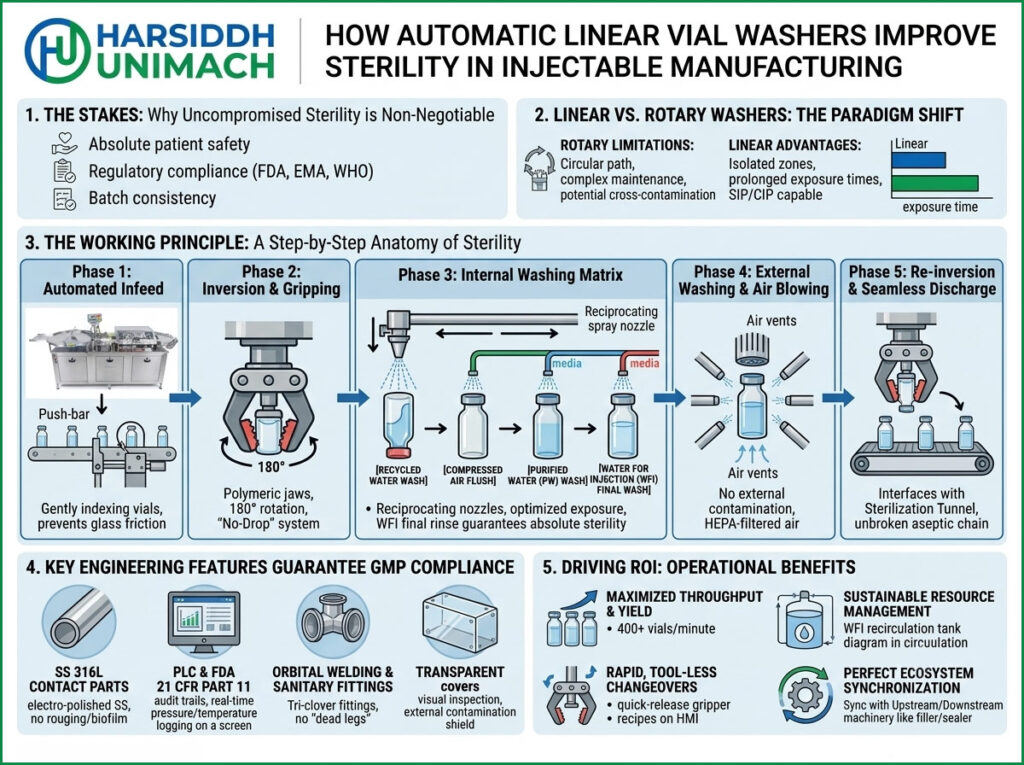
In a linear washer, vials travel along a straight path through a series of cleaning stages:
- Infeed: vials are fed from a turntable or tray onto the machine’s infeed.
- Ultrasonic pre-cleaning: in many designs, vials pass through a water bath where ultrasonic energy loosens particles clinging to the glass.
- Row pick-up and inversion: a gripper or walking-beam system picks up vials in rows and inverts them, mouth down.
- Internal and external washing: needles enter each inverted vial to deliver alternating jets of water and compressed air, while external nozzles clean the outside.
- Final rinse and air blow: a final rinse with water of the specified quality is followed by filtered compressed air to remove residual water.
- Return upright and discharge: vials are turned upright and transferred directly into the sterilising tunnel.
For a step-by-step technical walkthrough, read the definitive guide to the automatic linear vial washer process flow. Examples include the Automatic Linear Vial Washer, the Automatic Linear Tunnel Type Vial Washing Machine, our linear vial washer and our linear vial washing machine.
Seven Ways Linear Vial Washers Improve Sterility
1. Ultrasonic cleaning removes stubborn particles
Some particles cling tightly to glass through static or surface adhesion and resist ordinary water jets. Ultrasonic energy creates microscopic cavitation bubbles in the bath water; as they collapse, they dislodge these particles from inner and outer surfaces. This pre-cleaning step significantly improves the effectiveness of the jet washing that follows and reduces the particle load reaching later stages.
2. Multiple, well-sequenced washing stations
Linear washers have room for several washing stations along their length. A typical sequence alternates:
- Recirculated, filtered water for initial rinsing
- Compressed air to blow out loosened contaminants
- Fresh purified water or WFI for final rinsing
- Filtered compressed air for drying
Each station builds on the last. Early stations remove most of the contamination; later stations, using the cleanest water, remove what remains. Because fresh water is used only in the final stages, contamination is progressively diluted and removed rather than redistributed. Our guide to the sterile container washing process explains each step in detail.
3. Inverted washing for complete drainage
Vials are washed upside down. Water and loosened particles drain out of the vial by gravity immediately, instead of collecting at the bottom. Needles reach deep inside the vial to direct jets at the base and walls, while drainage carries contamination away. This simple principle is one of the most important contributors to effective cleaning.
4. High-quality final rinse and filtered air
The quality of the final rinse defines the cleanliness of the vial surface. For parenteral products, final rinsing is typically performed with Water for Injection. The compressed air used inside vials must be oil-free and passed through sterile-grade filters so that drying does not reintroduce contamination. Pressure regulators and monitoring help ensure each medium is delivered consistently.
5. Gentle, controlled handling reduces new particles
Washing is pointless if the machine generates new particles. Glass-to-glass contact, impacts and scraping produce fragments and scratches. Well-designed linear washers use row grippers, controlled indexing and smooth transfers to minimise contact and breakage. Sensors stop the machine if a vial falls or jams, preventing damaged glass from progressing.
6. Direct, protected transfer into the tunnel
One of the biggest sterility advantages of a linear washer is its straight-line connection to the depyrogenation tunnel. Washed vials move directly from the washer outfeed into the tunnel infeed, often under unidirectional filtered airflow. There is no manual handling, no open trays and no extra transfer step where airborne contamination could settle on clean, wet vials. See our sterilizing tunnel for ampoules and vials and the wider sterilizers range.
7. Automation minimises human intervention
People are the largest source of contamination in pharmaceutical cleanrooms. An automatic linear washer integrated with the tunnel and filler reduces the need for operators to handle vials at all. Modern contamination control strategies — including the expectations set out in current GMP guidance for sterile products — place strong emphasis on reducing manual interventions, and automated washing lines support that goal.
Design Features That Support GMP and Sterility
When evaluating a linear vial washer, look for features that protect cleanliness:
- SS 316L contact parts for water and product-contact components, with smooth, polished surfaces
- Drainable design with sloped surfaces and no stagnant water pockets
- Separate circuits so final rinse water is not contaminated by earlier wash stages
- Filtration in recirculation loops to remove particles from reused water
- Sterile-grade air filters on compressed air supplied to vials
- Pressure and flow monitoring with alarms for each washing medium
- Temperature control where heated water is used
- Interlocks that stop the machine if a critical parameter goes out of range
- Enclosed washing zones to contain spray and aerosols
- Easy access for cleaning, inspection and maintenance
- Documented materials of construction and full IQ/OQ support
Browse our vial washing machines, our complete range of washing machines and the washing machine category.
Validating Washer Performance
Because washing is a critical step, its performance must be validated and monitored.
Particle challenge studies
Vials are deliberately contaminated with test particles and then washed. The number of particles remaining is compared with the starting level to demonstrate the washer’s particle reduction capability. Studies are repeated across vial sizes and machine speeds within the validated range.
Verification of critical parameters
Water and air pressures, flow rates, temperatures and the sequence and timing of each station are verified during qualification. These parameters become the validated settings for routine production.
Water and air quality
The quality of purified water, WFI and compressed air supplied to the washer is tested and monitored as part of the site’s utilities programme.
Ongoing monitoring
During routine use, critical parameters are monitored by the machine’s sensors and recorded. Results from final product inspection — particularly particle rejects — provide ongoing evidence of washing effectiveness. A rise in particle rejects is often the first sign that the washer needs attention. See our best practices for ampoule and vial inspection.
Common Risks and How to Control Them
| Risk | Effect on Sterility | Control Measure |
|---|---|---|
| Blocked or bent needles | Vial interiors not fully cleaned | Inspect needles at every changeover |
| Clogged filters | Lower jet pressure, particle carry-over | Monitor pressure, replace filters on schedule |
| Incorrect water quality | Residues or contamination on vials | Utilities monitoring, alarms |
| Contaminated compressed air | Particles or oil introduced during drying | Sterile-grade filtration, regular testing |
| Vial breakage | New glass particles | Correct change parts, gentle handling |
| Poor drainage | Residual water carries contaminants | Correct inversion, adequate air blow |
| Unprotected transfer to tunnel | Recontamination of clean vials | Direct infeed under filtered airflow |
| Skipped maintenance | Gradual performance loss | Preventive maintenance by running hours |
Linking Washing to the Rest of the Line
A linear washer is most effective as part of an integrated sterile line:
- Washing – linear vial washer
- Depyrogenation – sterilising tunnel
- Filling and stoppering – in the Grade A zone, for example with the Automatic Injectable Liquid Vial Filling and Stoppering Machine or our liquid vial filling machine with rubber stoppering
- Capping
- External washing – an automatic external vial washing machine cleans the outside of sealed vials before labelling
- Inspection – using a visual ampoule and vial inspection machine
- Labelling and packing
Matching washer capacity to the tunnel and filler ensures vials flow smoothly without accumulation or exposure.
Best Practices for Maintaining Washer Performance
- Inspect and clean needles at every changeover; replace bent or damaged needles immediately.
- Monitor pressures and flows for each medium and investigate any drift.
- Change filters in water and air lines according to a defined schedule.
- Maintain the ultrasonic bath — check transducers, drain and clean the bath at defined intervals.
- Verify change parts for each vial size before production.
- Follow a preventive maintenance plan based on running hours.
- Trend particle rejects at inspection to detect early signs of washing problems.
- Train operators to recognise abnormal washer behaviour and respond correctly.
- Keep critical spares — needles, filters, seals and valves — in stock.
Questions to Ask When Buying a Linear Vial Washer
- What particle reduction has the washer demonstrated in challenge studies?
- Is ultrasonic pre-cleaning included, and how is the bath maintained?
- How many washing stations are there, and what is the media sequence?
- How is the final rinse kept separate from recirculated water?
- How are water and air pressures monitored and alarmed?
- How does the washer connect to the tunnel, and is the transfer protected by filtered airflow?
- What documentation is supplied for qualification?
The Business Value of Better Washing
Improved washing does more than support compliance. It reduces particle rejects at inspection, lowers the risk of batch failures and investigations, and protects the brand reputation that depends on consistently clean injectables. In many plants, investing in a well-designed linear washer pays back through fewer rejects and smoother audits alone.
Frequently Asked Questions
Does a vial washer sterilise vials? No. A vial washer removes particles and reduces bioburden and residues. Sterilisation and depyrogenation take place in the tunnel that follows.
Why is ultrasonic cleaning used in linear vial washers? Ultrasonic energy dislodges particles that cling tightly to glass, improving the effectiveness of the jet washing stages.
Why are vials washed upside down? Inverted washing lets water and loosened particles drain out immediately, preventing contamination from collecting at the bottom of the vial.
What water is used for the final rinse? For parenteral products, final rinsing typically uses Water for Injection, followed by sterile-filtered compressed air.
How is washer performance validated? Through particle challenge studies, verification of critical parameters such as pressures and flows, and monitoring of water and air quality.