
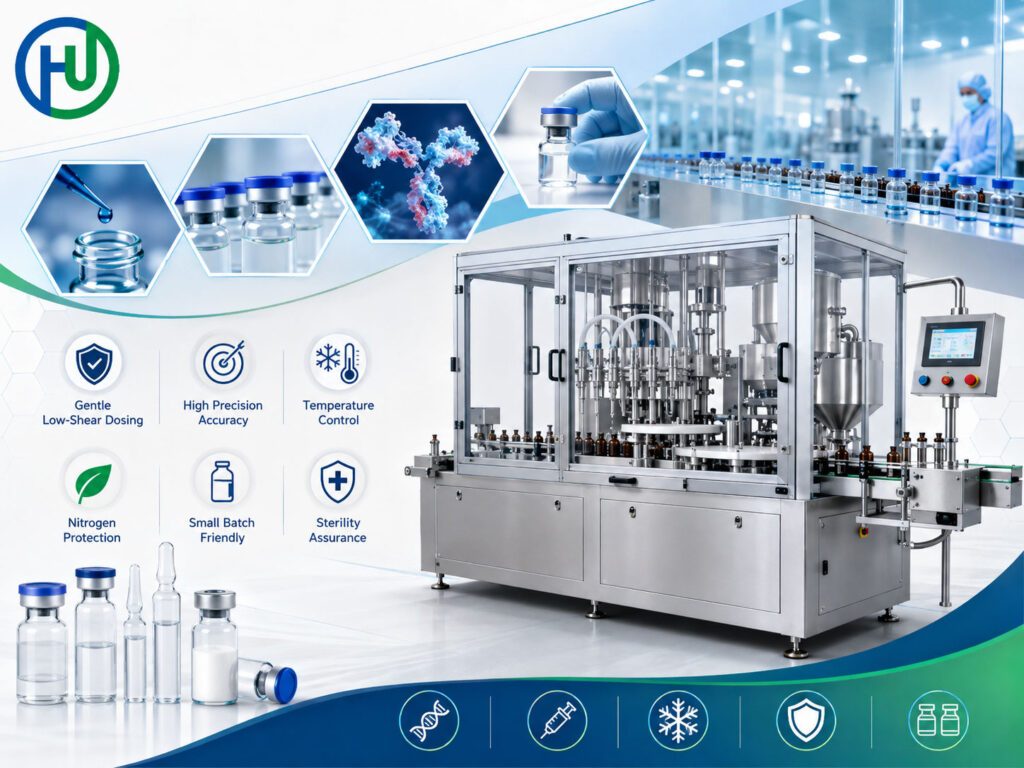
Biologics, vaccines and other temperature-sensitive injectables are some of the most important, and most delicate, products in modern medicine. Monoclonal antibodies, recombinant proteins, peptides, enzymes, vaccines and many newer therapies are complex molecules that can be damaged by heat, agitation, air, light and contact with certain surfaces. They are also often expensive and produced in limited quantities.
Filling these products into vials requires more than a standard liquid filler. The machine and process must protect the molecule from the moment it leaves the bulk container until the vial is sealed, while maintaining sterility, accuracy and efficiency.
This article explains the specific challenges of filling biologics, vaccines and temperature-sensitive drugs, and the vial filling machine features and process strategies that address them.
Why These Products Are Different
| Product Characteristic | Filling Challenge |
|---|---|
| Complex molecular structure | Can unfold or aggregate under stress |
| Shear sensitivity | Fast flow and narrow passages may damage molecules |
| Interface sensitivity | Air-liquid interfaces and foaming can cause aggregation |
| Temperature sensitivity | Exposure to room temperature or heat can degrade product |
| Oxygen and light sensitivity | Oxidation or photodegradation |
| High value | Every vial counts; product loss is costly |
| Small batch sizes | Set-up losses and changeovers matter more |
| Multi-product facilities | Cross-contamination must be prevented |
| Sterility | No terminal sterilisation; aseptic filling required |
Solution 1: Gentle Dosing Technology
Peristaltic pumps
Peristaltic pumps move liquid by gently squeezing flexible tubing. They:
- Avoid metal-to-metal contact with the product
- Offer generally low shear
- Use single-use or easily replaceable tubing, eliminating cleaning carry-over
See the Automatic Peristaltic Based Liquid Filling Machine and the peristaltic based liquid filling machine.
Low-shear piston pumps
Well-designed piston pumps, including rotary piston designs, can also handle sensitive products gently, especially for larger volumes or more viscous formulations.
For a detailed comparison, read peristaltic vs piston pumps: choosing the right filling system for your vial line.
Servo-controlled motion
Servo drives allow gentle acceleration and deceleration of dosing, smooth needle movement and individual head trimming. Read how servo-driven vial filling systems outperform mechanical lines. See the Automatic Servo Based Vial Filling Machine.
Solution 2: Foam and Interface Control
Foaming and splashing create air-liquid interfaces that can damage proteins. Machines reduce foaming through:
- Diving needles that start filling near the bottom of the vial and rise with the liquid
- Speed profiles – slow start, controlled middle, slow finish
- Appropriate needle sizes to avoid high exit velocities
- Clean cut-off without drips or splashes
Read vial filling machine nozzle selection: how diving nozzles improve injectable filling performance.
Solution 3: Temperature and Time Management
Many biologics and vaccines must be kept cold, typically refrigerated, and their exposure to room temperature during filling is limited by validated time windows.
Strategies include:
- Holding the bulk product cold until filling begins, for example in temperature-controlled containers or cooled holding vessels
- Short fluid paths so product spends little time in tubing at room temperature
- Efficient set-up so filling starts quickly after the bulk is released
- Defined maximum hold times at room temperature, supported by stability data
- Avoiding heat sources near the product path
- Moving filled vials promptly to capping, inspection and cold storage
The filling machine itself cannot keep product cold for long, so process design and scheduling are as important as equipment features.
Solution 4: Oxygen and Light Protection
- Nitrogen purging of vials before and after filling protects oxygen-sensitive products; read the role of nitrogen flushing in preserving injectable drug stability
- Light protection – reduced or filtered lighting in filling areas, amber vials or protective secondary packaging for photosensitive products
Solution 5: Single-Use and Low Hold-Up Fluid Paths
Single-use assemblies, including tubing, connectors, filters and needles, supplied pre-sterilised, offer major benefits for biologics:
- No cleaning validation for product contact parts between batches
- No carry-over between products in multi-product facilities
- Faster set-up and changeover
- Low hold-up volume, reducing product loss
Read minimizing product loss: precision dosing strategies for high-value biologics.
Solution 6: Barrier Technology and Aseptic Design
Because biologics and vaccines cannot be terminally sterilised, aseptic filling is essential. Barrier technologies reduce contamination risk by separating operators from open vials:
- RABS – rigid barriers with glove ports in a high-grade cleanroom
- Isolators – sealed enclosures with automated bio-decontamination
Read the rise of RABS and isolators in modern pharmaceutical vial filling machines.
For isolators, check compatibility of product contact materials and single-use components with the decontamination agent, and ensure residual decontaminant does not affect sensitive products.
Solution 7: Precision at Small Volumes and Small Batches
Biologics are often filled in small volumes and small batches:
- High accuracy at low fill volumes, demonstrated during trials and qualification
- Low priming volumes to save product
- Flexible formats for different vial sizes
- Quick changeovers between products
Smaller machines with few heads can be more efficient than large high-speed lines for these products.
Solution 8: Partial Stoppering for Lyophilised Products
Many biologics and vaccines are freeze-dried (lyophilised) for stability. For these products:
- Vials are filled and partially stoppered, leaving vent openings
- Vials are loaded into the freeze dryer
- After drying, stoppers are pushed fully home inside the freeze dryer
- Vials are then capped and sealed
Filling machines must place stoppers accurately in the partial position so they stay in place during transport to the freeze dryer and seat correctly afterwards.
Solution 9: Pre-Filled Syringes
Many biologics are also supplied in pre-filled syringes, which offer accurate dosing for patients and can reduce overfill compared with vials. See the Automatic Pre-Filled Syringe (PFS) Filling and Stoppering Machine and the pre-filled syringe filling and stoppering machine.
Solution 10: Gentle Handling After Filling
Protection does not end at the filling needle:
- Stoppering with accurate placement and minimal agitation
- Capping on a vial cap sealing machine with correctly set crimping force
- Inspection on a visual ampoule and vial inspection machine, noting that some protein products can show natural particles or opalescence that inspectors must be trained to distinguish from defects
- Labelling on a vial sticker labeling machine, with labels suitable for cold storage and condensation
- Prompt transfer to cold storage
Vaccine-Specific Considerations
Vaccines share many challenges with other biologics, but also have some of their own:
- Suspensions and adjuvants – some vaccines contain adjuvants or particles that must stay uniformly suspended. Gentle, continuous mixing of the bulk and short, well-designed fluid paths help keep every vial consistent.
- Multi-dose vials – some vaccines are supplied in multi-dose vials with preservatives, requiring accurate fill volumes that allow the stated number of doses to be withdrawn.
- Campaign production – vaccines may be produced in large campaigns, sometimes at short notice, so lines must combine reliability with the ability to scale output.
- Global supply – packaging and labelling must meet the requirements of many different markets.
Product Compatibility of Contact Materials
Biologics can interact with the surfaces they contact. Tubing, filters, needles, stoppers and vials should be evaluated for:
- Adsorption – loss of protein onto surfaces, which matters especially at low concentrations
- Extractables and leachables – substances that could migrate from materials into the product
- Particle shedding – from tubing or seals under repeated pump action
- Compatibility with sterilisation and decontamination methods
These evaluations are usually part of product development and should be considered when selecting fluid path components and machine materials.
Common Problems and Solutions
| Problem | Likely Cause | Solution |
|---|---|---|
| Foaming in vials | Fast dosing, needle too high | Diving needles, slower start, adjusted speed profile |
| Fill variation at small volumes | Air in tubing, worn tubing, unstable supply | Proper priming, scheduled tubing changes, stable bulk pressure |
| Visible particles or aggregates | Shear, interfaces, temperature exposure | Gentler dosing, shorter hold times, review fluid path design |
| Product loss above target | Long fluid paths, large priming volume | Shorten paths, optimise priming, drain efficiently |
| Exceeded room-temperature time | Slow set-up or stoppages | Plan set-up, reduce interventions, schedule efficiently |
| Partial stoppers moving before freeze-drying | Incorrect stopper position, handling | Adjust stoppering height, ensure gentle transfer |
Validation and Stability Considerations
Filling processes for biologics and vaccines must be supported by data showing that the process does not harm the product:
- Filling process studies – effects of pump type, speed and fluid path on product quality attributes such as aggregation
- Hold time studies – maximum allowable time at room temperature and in the fluid path
- Fill accuracy and precision at the specified volumes
- Process simulations (media fills) for the aseptic process
- Stability studies on product filled using the commercial process
Choosing the Right Scale
Biologics and vaccine producers face a wide range of batch sizes. Clinical and orphan products may need only a few hundred vials per batch, where small, flexible machines with single-use paths and minimal priming volumes are most efficient. Established vaccines and high-demand biologics may need much higher output, where integrated lines with multiple heads, automatic washing and depyrogenation, and barrier protection make sense. Many facilities combine both: a small, flexible line for development and small batches, and a larger line for commercial volumes. When planning capacity, base the decision on realistic demand, batch sizes and the number of products, and leave space in the facility so that a second, larger line can be added as products move from clinical to commercial supply.
Working with Your Machine Supplier
Because biologics and vaccines are so sensitive, early collaboration with your machine supplier pays off. Share information about your product, such as viscosity, sensitivity to shear and foaming, temperature limits and fill volumes, so the supplier can recommend suitable pumps, needles and speed profiles. Plan trials with placebo or surrogate solutions, and where possible with real product, to confirm gentle handling and accuracy before finalising the design.
The Complete Line
A biologics or vaccine vial line typically includes washing on a linear vial washer, depyrogenation in a sterilizing tunnel for ampoules and vials, barrier-protected filling and stoppering on a machine such as the liquid vial filling machine with rubber stoppering, cap sealing, inspection and labelling. Integrated solutions such as the automatic liquid vial filling line can be configured for these products.
Feature Checklist for Biologics and Vaccine Filling
- Gentle dosing: peristaltic or low-shear piston, servo-controlled
- Single-use or low hold-up fluid path
- Diving needles and programmable speed profiles
- High accuracy at small fill volumes
- Nitrogen purging (if needed)
- Partial stoppering option (for lyophilised products)
- Barrier compatibility (RABS or isolator)
- Short set-up and changeover times
- Data integrity controls and documentation for qualification
Frequently Asked Questions
Why are biologics difficult to fill? They are sensitive to shear, foaming, temperature, oxygen and light, are often high-value and are usually filled aseptically in small batches.
Which pump is best for biologics? Peristaltic pumps with single-use tubing are popular for their gentle handling and lack of cleaning carry-over. Low-shear piston pumps can also be suitable, especially for larger volumes.
How is temperature controlled during filling? Mainly through process design: keeping bulk product cold until filling, short fluid paths, efficient set-up, validated hold times and prompt transfer of filled vials to cold storage.
What is partial stoppering? Inserting stoppers only partly so vials can vent during freeze-drying; stoppers are fully seated inside the freeze dryer after drying.
Do vaccines and biologics need barrier systems? Barrier systems are strongly favoured for aseptic filling of these products because they reduce contamination risk.
Planning a filling line for biologics or vaccines? Contact our team or send an inquiry with your product, fill volumes and batch sizes.