
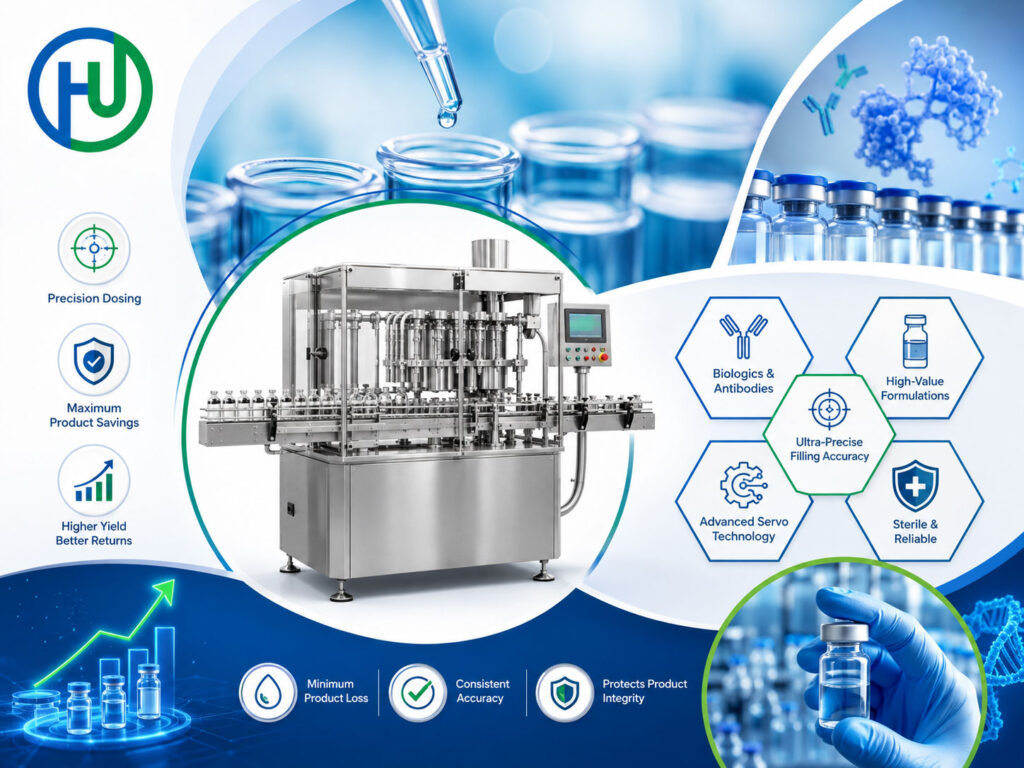
Biologics, such as monoclonal antibodies, vaccines, peptides, enzymes and cell- and gene-based therapies, are among the most valuable materials handled in pharmaceutical manufacturing. A single batch may represent months of upstream and downstream processing and a very high cost per gram. By the time the drug reaches the fill-finish stage, every drop has significant value.
Yet filling is where a surprising amount of product can be lost: in tubing and manifolds, during priming and set-up, through overfill, in rejected containers and in liquid left behind at the end of the batch. For small-batch and high-value products, these losses can be a meaningful share of the batch.
This article explains where biologic product is lost during filling, and presents practical precision dosing and process strategies to minimise those losses without compromising quality, sterility or patient safety.
Why Product Loss Matters So Much for Biologics
- High value per unit – each vial or syringe may represent a high manufacturing cost.
- Small batches – fixed losses, such as fluid path hold-up, are a larger percentage of small batches.
- Limited supply – for clinical trials, orphan drugs or new launches, every dose matters.
- Sensitive molecules – biologics can be damaged by shear, foaming, interfaces or temperature, so careless handling causes both loss and quality risk.
Where Product Is Lost During Filling
| Loss Source | What Happens |
|---|---|
| Fluid path hold-up | Liquid remains in tubing, filters, manifolds and needles |
| Priming and set-up | Product used to fill the fluid path and verify weights before production |
| Overfill | Containers filled above the target to stay safely above the minimum |
| Fill rejects | Containers outside fill weight limits are rejected |
| Process rejects | Containers rejected for stoppering, sealing or visual defects |
| Line stoppages | Product exposed or containers discarded after interventions |
| End-of-batch residue | Liquid left in the bulk container and fluid path when filling stops |
| Product damage | Aggregation or degradation caused by shear, foaming or interfaces |
Each source needs its own strategy.
Strategy 1: Minimise Fluid Path Hold-Up Volume
The fluid path between the bulk container and the filling needles holds liquid that may never reach a container. Reducing this volume directly reduces loss.
- Short tubing lengths – position the bulk container close to the filler
- Small internal diameters – appropriate to the flow rate needed
- Compact manifolds – minimal internal volume and few dead legs
- Filter selection – filters with appropriate size and low hold-up for the batch
- Gravity or pressure-assisted drainage at the end of the batch
Strategy 2: Use Single-Use Peristaltic Dosing
Peristaltic pumps move liquid by squeezing tubing, so product only contacts the tubing set. For biologics, this offers:
- Low hold-up in a dedicated, short fluid path
- No cleaning carry-over between batches or products
- Gentle handling that suits shear-sensitive molecules
- Pre-sterilised single-use assemblies that reduce set-up time and contamination risk
Servo-driven peristaltic systems deliver accurate small volumes. See the Automatic Peristaltic Based Liquid Filling Machine and the peristaltic based liquid filling machine. For a detailed comparison with piston systems, read peristaltic vs piston pumps: choosing the right filling system for your vial line.
Strategy 3: Reduce Overfill Through Precision
Overfill is often the largest controllable loss. Manufacturers fill above the target to ensure every container meets the minimum deliverable volume. The less variation in the filling process, the closer the target can be set to the minimum.
An illustrative example
Imagine a batch of 10,000 vials. If each vial is overfilled by 2% more than strictly necessary because of filling variation, the extra product used is equivalent to about 200 vials’ worth of drug. For a high-value biologic, reducing this excess through tighter process control can be very valuable. (This example is illustrative only; your actual figures depend on your product and process.)
How to reduce overfill
- Servo-controlled dosing with digital setting and per-head trimming
- Stable product supply – constant level and pressure at the pump inlet
- Consistent temperature, since viscosity affects dosing
- Frequent or continuous weight monitoring with feedback adjustment
- Statistical analysis to set targets based on demonstrated variation
Read how servo-driven vial filling systems outperform mechanical lines for the engineering behind precise dosing. See the Automatic Servo Based Vial Filling Machine.
Strategy 4: Smarter Start-Up and Priming
Every batch begins with priming the fluid path and confirming fill weights. Losses here can be reduced by:
- Priming with the minimum volume needed to fill the path and remove air
- Using check-weighing efficiently – confirming weights with the fewest containers necessary
- Recipe recall on servo machines, so settings start close to target
- Returning priming liquid to the bulk container where the process allows and is validated
- Training operators to perform set-up consistently
Strategy 5: Protect the Molecule
Product damaged during filling is lost product. Biologics are sensitive to:
- Shear – high flow rates and narrow passages
- Foaming and air-liquid interfaces – can cause protein aggregation
- Temperature excursions – during long holds or near heat sources
- Light – for some molecules
Gentle handling measures include:
- Controlled dosing speed profiles with slow start and finish
- Diving needles that fill from below the liquid surface, reducing splashing and foaming; read vial filling machine nozzle selection: how diving nozzles improve injectable filling performance
- Appropriate tubing and needle sizes
- Minimal hold times at room temperature
- Nitrogen protection for oxygen-sensitive products; read the role of nitrogen flushing in preserving injectable drug stability
Strategy 6: Reduce Rejects
Every rejected container contains product. Reducing rejects means:
- Accurate filling to keep weights within limits
- Reliable stoppering and sealing, such as on a vial cap sealing machine
- Gentle container handling to avoid breakage
- Clean, particle-free containers from validated washing and depyrogenation, for example a linear vial washer and a sterilizing tunnel for ampoules and vials
- Consistent inspection using equipment such as the visual ampoule and vial inspection machine, with clear defect criteria
Strategy 7: Minimise Interventions and Stoppages
In aseptic filling, interventions can lead to discarding containers that were exposed during the event. Reducing interventions protects both sterility and product:
- Reliable machines with fewer jams and breakdowns
- Automated functions such as stopper feeding and weight checks
- Barrier systems that allow interventions through glove ports
- Well-trained operators following clear procedures
Read a complete guide to aseptic packaging for liquid injectables.
Strategy 8: Recover Product at the End of the Batch
When the bulk container runs low, some product typically remains in the container, tubing and manifold. Strategies include:
- Bulk containers designed to drain completely, such as bags or vessels with low-point outlets
- Gentle pressure or gas push to move the last liquid through the path, where validated
- Filling partial final runs within validated parameters
- Accurate batch reconciliation to understand and track residual losses
Strategy 9: Choose the Right Container and Format
Some formats inherently reduce loss:
- Pre-filled syringes deliver a precise dose to the patient and reduce overfill compared with vials in many cases. See the Automatic Pre-Filled Syringe (PFS) Filling and Stoppering Machine and the pre-filled syringe filling and stoppering machine.
- Right-sized vials that match the dose avoid unnecessary headspace and overfill.
Strategy 10: Measure and Improve
You cannot reduce losses you do not measure. Track:
- Theoretical yield vs actual yield per batch
- Losses by category: hold-up, priming, overfill, rejects, residue
- Fill weight distribution and trends
- Reject reasons and quantities
Review results after each batch and target the largest losses first.
Summary: Loss Sources and Strategies
| Loss Source | Main Strategies |
|---|---|
| Fluid path hold-up | Short, narrow, compact fluid paths; low hold-up filters; drainage at end of batch |
| Priming and set-up | Minimum priming volume, efficient weight checks, recipe recall |
| Overfill | Servo or peristaltic precision, stable supply, statistical target setting |
| Fill rejects | Accurate, repeatable dosing with frequent monitoring |
| Process rejects | Reliable stoppering, sealing, handling and inspection |
| Stoppages and interventions | Reliable machines, automation, barrier systems, training |
| End-of-batch residue | Fully draining bulk containers, validated push-out methods |
| Product damage | Gentle dosing profiles, diving needles, temperature and light control |
Special Considerations for Clinical and Small Batches
Clinical trial materials and orphan drugs are often produced in very small batches, sometimes only a few hundred units. In these cases:
- Fixed losses dominate – hold-up and priming volumes can represent a large share of the batch, so minimising them is the top priority
- Flexibility matters – frequent changes between products and formats favour single-use fluid paths and recipe-driven machines
- Smaller machines – single or two-head fillers with short fluid paths may be more efficient than large, high-speed lines
- Manual steps – some processes use semi-automatic equipment, which still benefits from accurate dosing and careful set-up
Validation and Compliance
Any change intended to reduce product loss must maintain product quality and sterility:
- Fill weight targets must still ensure the minimum deliverable volume for every container
- Returning priming or residual liquid to the bulk must be justified and validated
- Single-use assemblies must be qualified for sterility, integrity and compatibility, including extractables and leachables
- Changes to filling parameters should go through change control
Work closely with your quality team to balance yield improvements with compliance.
A Product Loss Reduction Checklist
- Losses measured by category for recent batches
- Fluid path hold-up volume calculated and minimised
- Priming procedure optimised
- Fill weight variation analysed and targets reviewed
- Gentle dosing profiles and diving needles in use
- Reject reasons tracked and addressed
- End-of-batch recovery method defined and validated
- Container format and size reviewed
Evaluating a Filling Machine for Biologics
When comparing machines for high-value products, ask suppliers:
- What is the total hold-up volume of the fluid path, from bulk container to needles?
- How much product is typically needed for priming and weight verification?
- What fill accuracy is demonstrated at our fill volumes, and across all heads?
- Are single-use fluid paths available, and how are they installed?
- Which dosing speed profiles and needle movements can be programmed?
- How is product recovered at the end of the batch?
- How does the machine integrate with barrier systems?
Trials with a placebo or surrogate solution of similar viscosity can confirm the answers before purchase.
Equipment for High-Value Biologics
Equipment for biologics fill-finish typically combines:
- Servo-driven or peristaltic dosing with high accuracy at small volumes
- Single-use or easily sterilised fluid paths
- Diving needles and gentle motion profiles
- Integration with barrier systems
- Accurate stoppering and sealing
Examples include the liquid vial filling machine with rubber stoppering and the automatic liquid vial filling line. Browse the vial filling machines for liquid vials.
For broader waste-reduction ideas across liquid filling, see green manufacturing: reducing waste in liquid filling processes.
Frequently Asked Questions
Where is most product lost during biologics filling? Commonly in fluid path hold-up, priming and set-up, overfill, rejects and end-of-batch residue. The largest source varies by process.
How does precision dosing reduce product loss? Lower filling variation allows the fill target to be set closer to the minimum required volume, reducing overfill across every container.
Why are peristaltic pumps popular for biologics? They offer single-use fluid paths, low hold-up, gentle handling and no cleaning carry-over.
How can foaming be reduced? By using diving needles, controlled dosing speeds and suitable tubing and needle sizes.
Should priming liquid be returned to the bulk? Only if your process allows it and it has been validated. Otherwise, minimise the priming volume.
Want to reduce product loss on your biologics filling line? Contact our team or send an inquiry with your product, fill volumes and batch sizes.