
In injectable manufacturing, the nozzle is the single point of contact between your formulation and the container it will be sold in — and yet it’s often the most overlooked component when specifying a vial filling machine. Pump technology, PLC controls, and stoppering systems get most of the attention during equipment evaluation, but the nozzle configuration is what actually determines whether a batch runs clean or generates rejects at inspection.
This guide explains how diving nozzles work, why they’ve become the standard for injectable vial filling, and how to select the right nozzle configuration for your specific product, container, and line speed.
Why Nozzle Selection Deserves Its Own Conversation
Every vial filling line performs the same basic function: measure a precise volume of liquid and deposit it inside a vial. But how that liquid reaches the vial — the nozzle geometry, its dive depth, its withdrawal speed, and its shut-off behavior — has a direct and measurable impact on:
- Foaming and aeration, which can trap air bubbles in the product and interfere with fill-level inspection.
- Splashing and residue on the vial neck, which causes stopper-seating failures and cosmetic rejects.
- Dripping and stringing, which contaminates the sterile zone and creates cleaning downtime.
- Cross-contamination risk, particularly in multi-product facilities running frequent changeovers.
- Dosing accuracy at the low end of the volume range, where nozzle design has an outsized effect on repeatability.
A pump can be perfectly calibrated and still produce inconsistent, contaminated, or cosmetically flawed vials if the nozzle isn’t matched to the product and container. That’s why serious equipment specification starts with the nozzle, not just the pump.
What Is a Diving Nozzle?
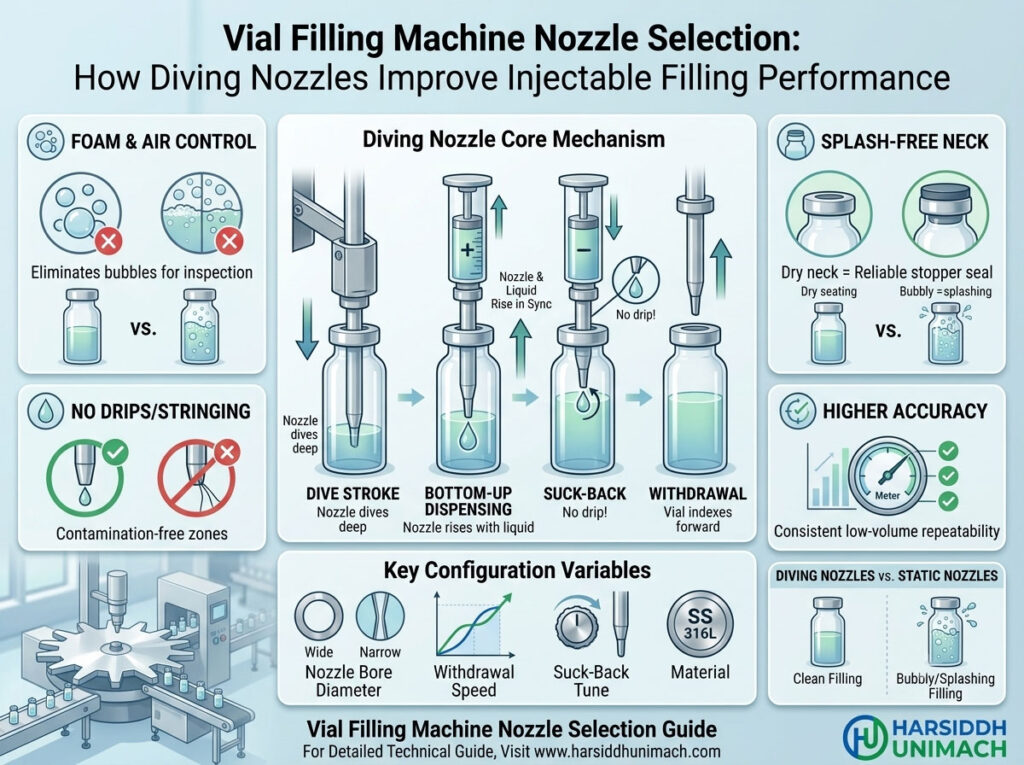
A diving nozzle is a filling nozzle that physically lowers into the neck of the vial before dispensing begins, rather than dispensing from a fixed position above the container. The name describes the motion: the nozzle “dives” down toward the base of the vial, dispenses the dose while gradually withdrawing, and then lifts clear before the next indexing cycle.
This is fundamentally different from a static or “spray-fill” nozzle, which stays in a fixed position above the vial opening and lets the liquid fall or spray into the container. For thin, non-foaming liquids at low speed, a static nozzle can be adequate. For injectable-grade liquids — many of which are viscous, foam-prone, or extremely high-value per milliliter — a diving nozzle is almost always the better engineering choice.
The Core Mechanism
A typical diving nozzle cycle on an automatic vial filling and stoppering machine follows this sequence:
- Indexing and centering — The vial arrives beneath the filling head and is held in position by a star wheel or timing screw.
- Dive stroke — The nozzle descends into the vial neck, stopping just above the base (or at a pre-calibrated depth for the fill volume).
- Bottom-up dispensing — The dosing pump strokes, delivering liquid while the nozzle rises in sync with the climbing fluid level.
- Suck-back — At the end of the stroke, the pump briefly reverses, drawing the last droplet back into the nozzle tip to prevent dripping.
- Withdrawal — The nozzle lifts clear of the vial neck, and the vial indexes forward toward stoppering.
This “bottom-up, rising nozzle” behavior is the defining feature of diving nozzle technology, and it’s the reason the design solves so many of the defects associated with static filling.
Why Diving Nozzles Improve Injectable Filling Performance
1. Foam and Air Entrapment Control
When liquid free-falls into a vial from above, it agitates the surface and traps air — a serious problem for protein-based biologics, surfactant-containing formulations, and any product where foam interferes with automated fill-level inspection on a visual inspection machine. By keeping the nozzle tip submerged just below the rising liquid surface throughout the dispense stroke, a diving nozzle eliminates the free-fall distance almost entirely, dramatically reducing foam generation.
2. Splash-Free, Contamination-Free Necks
A dry, residue-free vial neck is essential for a reliable stopper seal. Diving nozzles dispense at the base of the container rather than near the opening, so liquid never contacts the neck during filling. This matters as much for aseptic integrity as it does for cosmetic acceptance at inspection — a wet or contaminated neck is one of the most common causes of rejected vials downstream.
3. Elimination of Drips and Stringing
The suck-back feature built into most diving nozzle assemblies draws the final droplet back into the nozzle bore before withdrawal. Without it, a small bead of product remains at the tip and either drips into the vial after the machine has already indexed away, or strings down the outside of the vial — both of which compromise fill accuracy and cleanliness inside the machine.
4. Reduced Cross-Contamination Risk
Because the nozzle only ever contacts the interior of the vial and never the exterior surfaces, and because suck-back keeps the tip clean between cycles, diving nozzles reduce the buildup of residual product on machine surfaces — a meaningful advantage during changeovers on multi-product injectable lines.
5. Better Low-Volume Accuracy
At micro-dose volumes (well under 1 mL), even small amounts of splashing or surface tension disruption can represent a significant percentage error in the finished fill. Diving nozzles minimize turbulence at the point of dispensing, which is one of the reasons they pair so effectively with high-precision dosing systems such as peristaltic pump filling technology for small-volume injectables and diagnostic reagents.
Nozzle Configuration Variables That Actually Matter
Not all diving nozzles are built the same way, and the right configuration depends heavily on your specific product and container. Key variables to evaluate:
Nozzle Bore Diameter
A narrow bore increases exit velocity for a given flow rate, which can reintroduce turbulence and foaming — defeating the purpose of the diving design. A wider bore, low-velocity path is generally preferred for viscous or foam-prone injectables, while narrower bores may suit thin, low-viscosity liquids at higher speeds.
Dive Depth and Stroke Length
The nozzle needs to reach close enough to the vial base to prevent free-fall at the start of the dose, without touching the glass (which risks particulate generation from micro-contact) or fouling on vial-to-vial dimensional variance. Dive depth must be calibrated against your specific vial geometry — a 2 mL vial and a 50 mL vial require entirely different stroke profiles.
Withdrawal Speed Synchronization
The nozzle’s upward travel must track the rate at which the liquid level rises inside the vial. If withdrawal is too slow, the nozzle tip submerges too deep relative to the surface and can create back-pressure or dosing inconsistency. If it’s too fast, the tip breaks the surface early and reintroduces splash risk for the remainder of the dose.
Suck-Back Volume and Timing
Suck-back volume needs to be tuned to the product’s viscosity and surface tension. Too little suck-back leaves a drip; too much can actually pull a small amount of dosed product back out of the vial, undermining accuracy — an easy way to lose the very dosing precision the piston or peristaltic pump was designed to deliver.
Material of Construction
Nozzles in direct product contact should be manufactured in AISI 316L stainless steel (or, for certain highly reactive formulations, medical-grade alternatives), matched to the cGMP-compliant construction standard used across the rest of the fluid path — anything less introduces a validation and compatibility risk that undermines the rest of the line’s engineering.
Diving Nozzles vs. Other Nozzle Types: A Quick Comparison
| Nozzle Type | Best Suited For | Key Limitation |
|---|---|---|
| Diving Nozzle | Injectables, biologics, foam-prone or high-value liquids, low-volume precision filling | Requires precise synchronization with pump stroke |
| Static/Fixed Nozzle | Thin, non-foaming liquids, lower-speed lines | Higher splash and foam risk, poorer neck cleanliness |
| Spray/Fan Nozzle | Non-sterile industrial liquids, larger containers | Not suitable for aseptic injectable applications |
| Peristaltic Discharge Tip | Ultra-low-volume, high-purity, single-use fluid path applications | Limited to lower viscosity ranges and smaller doses |
For virtually any injectable liquid vial filling application, the diving nozzle remains the industry default — the comparison above exists mainly to clarify why it dominates rather than to suggest a genuine trade-off for sterile applications.
How Nozzle Selection Fits Into the Broader Filling Line
Nozzle selection doesn’t happen in isolation — it needs to be engineered alongside the rest of the filling and stoppering sequence. On an integrated Injectable Liquid Vial Filling Line, the nozzle assembly works in concert with:
- The dosing pump (piston, gear, or peristaltic), which determines flow rate and dosing accuracy.
- The “No Vial – No Fill” sensor system, which prevents the nozzle from firing into a missing or broken vial.
- Pre- and post-fill nitrogen purging, for oxygen-sensitive formulations, which must be sequenced correctly around the nozzle’s dive and withdrawal timing.
- The stoppering station, which depends entirely on a clean, dry vial neck — the direct output of correct nozzle behavior.
If you’re evaluating a full line rather than a standalone filler, it’s worth reviewing our related breakdown of every station in a vial filling line, including the diagram-level view of how these systems connect.
It’s also worth noting that diving nozzle technology isn’t unique to vials — the same bottom-up, foam-controlled dispensing principle is used in ampoule filling and sealing systems, where diving nozzles paired with pre- and post-gassing play the same anti-splash, anti-oxidation role for glass ampoules that they play for vials.
Common Nozzle-Related Defects and Their Root Causes
| Defect | Likely Cause | Fix |
|---|---|---|
| Foam or bubbles in fill | Nozzle rising too fast, or bore too narrow for viscosity | Slow withdrawal sync; widen bore diameter |
| Wet or contaminated vial neck | Dive depth too shallow, or missing suck-back | Recalibrate dive stroke and suck-back volume |
| Dripping after fill | Suck-back timing or volume insufficient | Increase suck-back stroke and verify timing against cycle speed |
| Inconsistent low-volume dosing | Turbulence at nozzle tip during dispense | Reduce exit velocity via wider bore or slower flow rate |
| Vial breakage or particulate generation | Nozzle contacting glass during dive | Recalibrate dive depth against actual vial tolerance range |
Choosing the Right Nozzle Configuration for Your Facility
A few practical questions should guide nozzle specification when evaluating or upgrading a vial filling line:
- What is your product’s viscosity and foaming tendency? Higher-foam-risk products need wider bores and slower withdrawal profiles.
- What is your fill volume range? Micro-dosing applications demand tighter turbulence control than standard 5–50 mL fills.
- Is your product oxygen-sensitive? If so, nozzle timing must be engineered around pre- and post-gassing cycles, not just the dose itself.
- What vial sizes and tolerances are you running? Dive depth and stroke length must be validated against your actual container specifications, not assumed from a generic setting.
- How frequently do you change over between products? Facilities running frequent changeovers benefit from tool-free nozzle and dosing cylinder replacement to minimize downtime.
Why Partner With Harsiddh Unimach Pvt. Ltd.
At Harsiddh Unimach Pvt. Ltd., we’ve engineered filling, stoppering, capping, and inspection systems for pharmaceutical and biotech manufacturers since 1988, serving clients across more than 50 countries. Our injectable vial filling equipment is built around precision diving nozzle technology, positive displacement dosing accurate to ±1%, and full cGMP-compliant construction using SS 316L contact parts.
Every line we build is backed by complete FAT/DQ/IQ/OQ validation documentation, so nozzle performance — foam control, neck cleanliness, dosing repeatability — isn’t just engineered correctly, it’s documented and verifiable for your regulatory audits.
Explore Related Equipment and Resources
- Automatic Vial Filling Machines
- Automatic Injectable Liquid Vial Filling & Stoppering Machine
- Injectable Liquid Vial Filling Line
- Automatic Peristaltic Based Liquid Filling Machine
- Visual Inspection Machines
- Vial Filling Machine Diagram: Understanding Every Station in the Filling Line
- Understanding the Ampoule Filling Machine Diagram and Working Process
- Optimizing Your Pharmaceutical Packaging Line: The Essential Guide to Filling Machines
Ready to specify the right nozzle configuration for your injectable line? Visit www.harsiddhunimach.com or contact our engineering team directly at info@harsiddhunimach.com for a tailored technical proposal.