
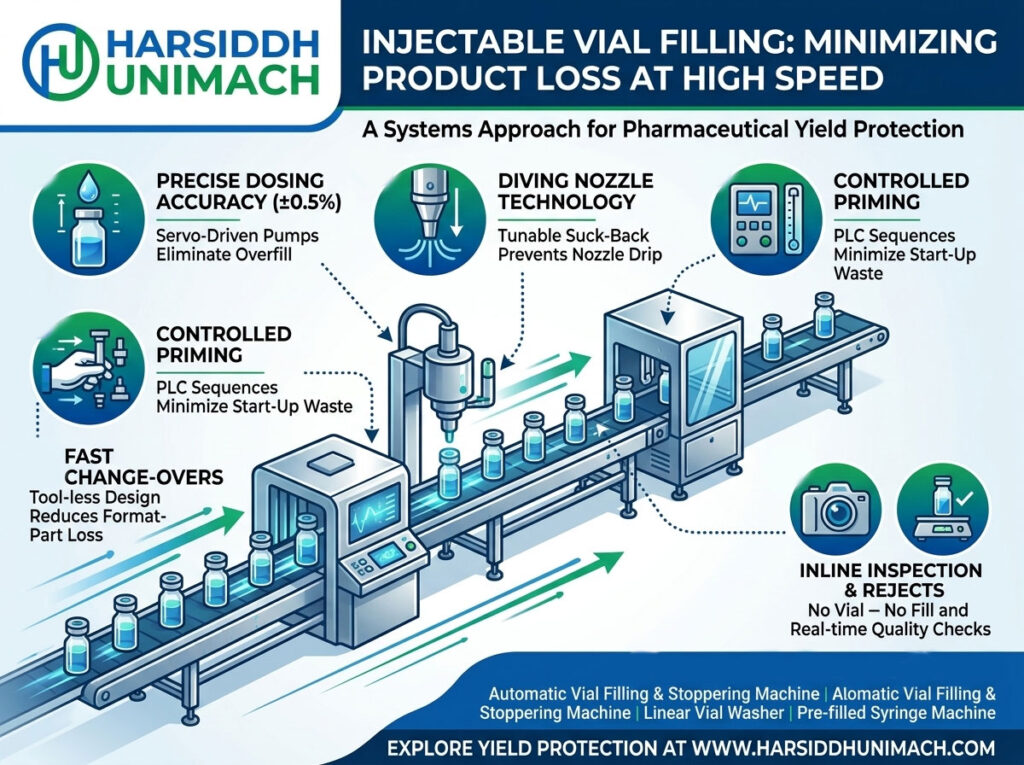
High-speed vial filling lines can fill large batches of injectable product quickly. But speed brings its own risk: when something goes wrong at high speed, more vials are affected before the problem is noticed. Small losses at each stage, such as priming, overfill, rejects, breakage and line purges, add up across a large batch. For expensive injectables, the value of lost product can be significant.
Minimising product loss is not only about saving money. Higher yield means more doses reach patients from each batch, fewer deviations need investigating and planning becomes more reliable.
This article explains where product is lost on a high-speed injectable vial filling line and how to reduce those losses. It covers each type of loss, practical engineering and operational measures, and how to map and track losses using yield reconciliation.
For dosing strategies specific to very high-value products, see our companion article on minimising product loss with precision dosing strategies for high-value biologics. This article takes a broader, line-wide view focused on high-speed production.
Where Product Is Lost: A Line-Wide Map
| Loss Category | Where It Happens | Typical Causes |
|---|---|---|
| Start-up and priming | Filler | Filling product lines and pumps; setup vials |
| Hold-up | Tanks, lines, pumps, manifolds | Product remaining in the system at batch end |
| Overfill | Filler | Target set above minimum to allow for variation |
| Fill rejects | Filler, checkweighing | Vials outside fill limits |
| Stoppering rejects | Stopperer | Missing, raised or tilted stoppers |
| Breakage and spills | Throughout the line | Glass breakage, jams, tipped vials |
| Capping rejects | Cap sealer | Missing or poor crimps |
| Inspection rejects | Visual inspection | Particles, cosmetic defects, fill level |
| Intervention losses | Filling zone | Vials removed after interventions or excursions |
| Changeover losses | Whole line | Setup vials, purging |
| Sampling | Throughout | In-process and QC samples |
Understanding which categories cause the most loss on your line is the first step to reducing them.
Loss 1: Start-Up and Priming
Before filling begins, product must fill the supply lines, pumps and needles, and the first vials are used to confirm fill weights.
How to reduce it:
- Minimise line length and volume between the product tank and the pumps.
- Use small-bore tubing where suitable, without restricting flow.
- Prime efficiently, with a defined procedure rather than trial and error.
- Use recipes so the correct fill volume is set immediately, reducing setup vials.
- Return or recover priming product only where your procedures and validation permit.
Servo-driven fillers, such as an automatic servo based vial filling machine, allow fill settings to be recalled precisely, shortening the setup phase.
Loss 2: Hold-Up and End-of-Batch Losses
At the end of a batch, product remains in the tank, lines, pumps and manifolds. Some systems allow this to be filled out; others leave it as waste.
How to reduce it:
- Design for low hold-up: compact manifolds, short lines and tanks with conical or sloped bottoms.
- Fill out remaining product where the system and validation allow, for example with controlled tank pressure or by reducing the number of active heads near the end.
- Choose the right pump technology. Peristaltic systems typically have low hold-up in the product path. Compare options such as a peristaltic based liquid filling machine and a servo based piston filling machine.
Illustrative example (not data for any line): suppose a batch fills 100,000 vials at an average of 2.05 ml each, using 205 litres of product. If the bulk batch was 210 litres, around 5 litres remain unaccounted for, in priming, hold-up, rejects and samples. Mapping where that volume goes shows where to focus.
Loss 3: Overfill
To ensure no vial is below the minimum dose, the target fill is set above it. The more variable the filling, the larger the overfill must be.
Illustrative example: across 100,000 vials, reducing average overfill by 0.02 ml saves about 2 litres of product per batch.
How to reduce it:
- Improve precision through the right pump, servo dosing, stable product temperature and well-maintained wear parts.
- Check every head and correct individual heads that drift.
- Trend fill data so the target can be set with confidence.
- Reduce drips and splashes with suitable nozzles and fill profiles.
Our articles on vial filling machine fill accuracy and how diving nozzles improve injectable filling performance explain how to achieve tighter fills.
Loss 4: Fill Rejects
Vials outside fill limits are rejected. At high speed, a drifting head can produce many rejects before detection.
How to reduce it:
- Check fills frequently at start-up and after any adjustment or stop.
- Act early on trends approaching limits.
- Investigate causes, such as air in the supply line, worn seals or tubing, temperature changes.
- Maintain dosing components on schedule.
Loss 5: Stoppering Rejects
Missing, raised or tilted stoppers lead to rejected vials, each containing product.
How to reduce it:
- keep stopper feeding systems clean and well supplied
- use consistent stoppers and vials
- set placement height and force correctly for each format
- prevent wet necks through correct filling
Our article on how stopper placement affects container closure quality covers stoppering in depth. Machines such as an automatic injectable liquid vial filling and stoppering machine or a liquid vial filling machine with rubber stoppering place stoppers immediately after filling.
Loss 6: Glass Breakage and Spills
Broken vials lose their contents and can force the removal of surrounding vials because of glass particle risk. Jams and tipped vials can spill product.
How to reduce it:
- Gentle, well-adjusted handling at star wheels, guides and transfers
- Controlled accumulation pressure on conveyors
- Matched speeds between machines to avoid crowding
- Good vial quality from qualified suppliers
- Correct change parts for each vial size
Upstream equipment such as an automatic linear vial washer, a rotary vial washing machine and a sterilizing tunnel for ampoules and vials must handle vials gently too, since damage introduced early can cause breakage later. Our article on the top 5 causes of vial breakage on high-speed filling lines explains how to prevent it.
Loss 7: Capping Rejects
Vials with missing caps or poor crimps are rejected after they have been filled and stoppered.
How to reduce it:
- consistent cap feeding and crimping
- correct stopper placement before capping
- regular checks of crimp quality
A vial cap sealing machine with 1, 4, 6 or 8 heads should be matched to the filler’s speed so vials do not back up.
Loss 8: Inspection Rejects
Visual inspection removes vials with particles, cosmetic defects or incorrect fill levels. Reject rates reflect problems upstream.
How to reduce it:
- trend rejects by defect type
- trace particle sources (glass, rubber, fibres, product)
- improve washing, handling and filling based on findings
- clean vial exteriors with an automatic external vial washing machine so residue is not mistaken for defects
Inspection equipment such as a visual ampoule and vial inspection machine supports consistent inspection.
Loss 9: Interventions and Environmental Excursions
In aseptic filling, operator interventions in the critical zone, or environmental excursions, may require nearby vials to be removed as a precaution.
How to reduce it:
- minimise interventions through reliable machine design
- clear jams quickly and in a controlled way
- maintain stable environmental conditions
- define clear procedures for which vials must be removed
Loss 10: Downtime and Stop–Start Operation
Frequent stops cause more than lost time. Each stop and restart can affect fill weights, require additional checks and lead to more rejects.
How to reduce it:
- address the root causes of minor stops
- balance line speeds with buffers
- maintain equipment proactively
Our article on understanding common causes of downtime in pharmaceutical filling lines covers this in more detail.
Loss 11: Changeovers and Sampling
- Changeovers: setup vials and purging consume product. Standardised changeovers and recipes reduce this.
- Sampling: in-process and QC samples are necessary, but sampling plans should be appropriate, not excessive.
Balancing Speed and Yield
Running faster increases output, but only if yield holds. At very high speeds, foaming, splashing, breakage and rejects may increase. The best operating speed is often the one that maximises good vials per hour, not the highest mechanical speed.
| Running Too Fast | Running at the Right Speed |
|---|---|
| More foaming and splashing | Clean, consistent fills |
| More stoppering and capping rejects | Reliable closures |
| More breakage and jams | Smooth handling |
| More stops and restarts | Steady operation |
| Lower yield | Higher yield |
Mapping and Tracking Losses: Yield Reconciliation
To manage product loss, measure it. At the end of each batch:
- Record bulk product quantity at the start.
- Record vials filled, accepted and rejected by category.
- Calculate product in accepted vials (count × average fill).
- Account for losses: priming, hold-up, rejects, samples, breakage.
- Compare with expected yield and investigate significant differences.
Trend yield across batches and focus improvement on the largest loss categories.
Machine Features That Help Reduce Loss
When buying or upgrading a vial filling line, look for features that directly limit product loss:
| Feature | How It Reduces Loss |
|---|---|
| Servo dosing with recipes | Accurate fills from the start; fewer setup vials |
| Low hold-up product path | Less product left in the system at batch end |
| No-vial, no-fill function | No product dispensed into empty positions |
| Missing stopper detection with targeted rejection | Only affected vials removed |
| Gentle, well-designed vial handling | Less breakage and fewer jams |
| Anti-drip nozzles or suck-back | Less product on the machine and vial necks |
| Linked line controls | Fewer stop–start events and pile-ups |
| Clear alarm diagnostics | Faster recovery from stops |
Building a Loss-Reduction Culture
Technology helps, but people make the biggest difference day to day. Share yield results with operators, celebrate improvements and involve the team in finding the causes of losses. Operators who understand the value of each vial, and see how their actions affect yield, are more likely to spot drift early, handle stops carefully and suggest improvements. Regular short reviews of loss data at shift handover keep the topic visible.
Integrated Lines and Product Loss
An integrated automatic liquid vial filling line reduces transfers between machines, which helps limit breakage and jams. Matched speeds and coordinated controls reduce stop–start losses.
Practical Checklist for Reducing Product Loss
- Map losses by category for recent batches.
- Minimise product line length and hold-up.
- Use recipes to cut setup vials.
- Improve fill precision to reduce overfill.
- Check every head and act on trends.
- Keep stoppering and capping consistent.
- Handle vials gently and balance line speeds.
- Reduce minor stops and interventions.
- Standardise changeovers.
- Track yield and review it regularly.
Frequently Asked Questions
What is the biggest source of product loss on vial lines? It varies by line and product. Overfill, rejects and hold-up are common major contributors. Loss mapping shows which matters most for you.
Does running faster always increase output? Not if yield drops. The goal is the maximum number of good vials per hour.
How can hold-up volume be reduced? Shorter product lines, compact manifolds, low hold-up pumps and tanks designed to drain fully.
Is recovering priming product allowed? Only where your procedures, validation and regulatory requirements permit. Your QA team should define this.
How do I know if my losses are improving? Track yield reconciliation and loss categories batch by batch.
Improve Yield With Harsiddh
Harsiddh Unimach manufactures injectable vial filling and stoppering machines, servo-based fillers, washers, sterilising tunnels, cap sealers, external washers, inspection machines and complete vial lines designed for consistent, low-loss operation. Our team can help you identify and reduce product losses on your line.
Contact us through our contact page or send your requirements through our inquiry form.