
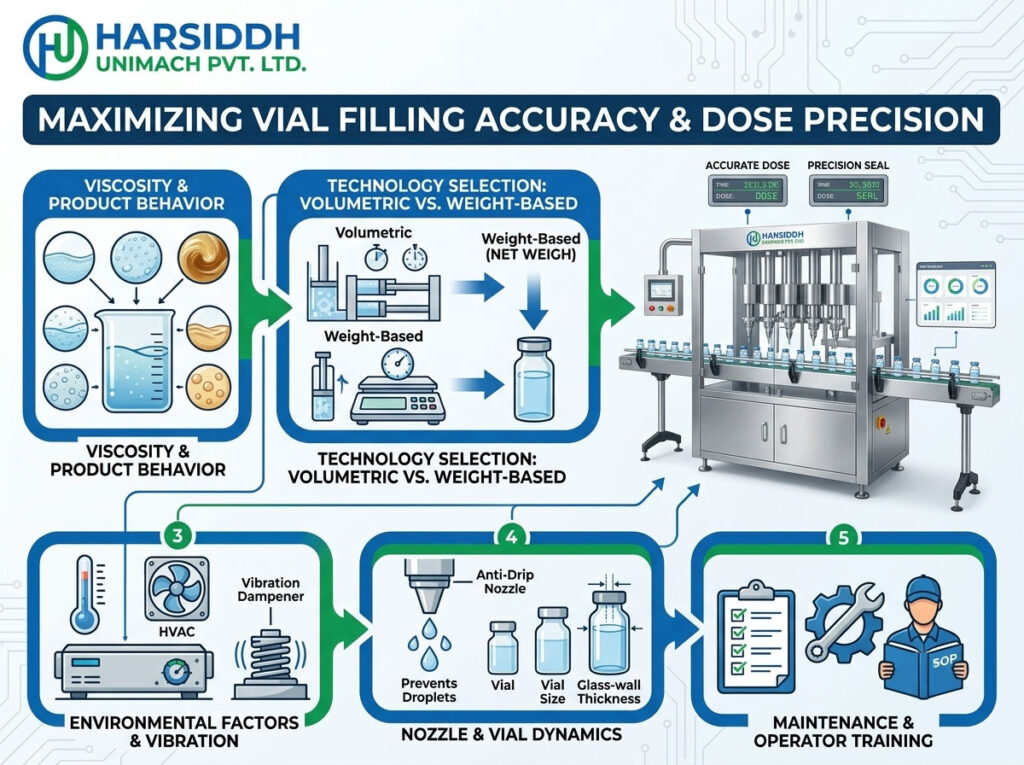
Every vial of an injectable product must deliver the dose stated on the label. Too little, and the patient may be underdosed. Too much, and valuable product is given away, and in some cases dose limits may be exceeded. That is why fill accuracy is one of the most closely watched parameters on any vial filling line.
Fill accuracy is not determined by the machine alone. It is the result of many factors working together: the dosing system, its condition and calibration, the product’s properties, the fill settings, the vials, the way fills are measured and the people running the line. When accuracy drifts, the cause can lie in any of these areas.
This article explains what factors affect dose precision on a vial filling machine, how accuracy is measured and what practical steps improve it. It is intended for production, engineering and quality teams who want to understand and control fill variation.
Numerical examples in this article are illustrative only. Your acceptance limits and methods should be defined by your quality system and product specifications.
Accuracy vs Precision: Two Different Things
The terms are often used interchangeably, but they mean different things:
- Accuracy is how close the average fill is to the target.
- Precision is how close individual fills are to each other, in other words, how much they vary.
A machine can be precise but inaccurate (all fills close together, but off target) or accurate on average but imprecise (average on target, but wide variation). The goal is both: an average on target with minimal variation.
Accuracy problems are usually corrected by adjustment. Precision problems usually point to a deeper cause in the machine, product or process.
Why Fill Accuracy Matters
- Patient safety: each vial must contain at least the labelled dose and, where applicable, enough extra to allow the dose to be withdrawn.
- Compliance: fill volume or weight is a critical quality attribute, checked during production and release.
- Cost: variation forces higher overfill targets to ensure no vial falls below the minimum. For high-value products, this overfill can be costly.
- Yield: out-of-limit vials are rejected, reducing batch yield.
Eleven Factors Behind Fill Accuracy
Factor 1: The Dosing System
The type of pump sets the baseline for achievable accuracy.
Piston Pumps
Piston pumps displace a fixed volume set by stroke length. They are highly accurate and handle a wide range of viscosities. Accuracy depends on:
- precise piston and cylinder fit
- valve timing and sealing
- consistent stroke length
Peristaltic Pumps
Peristaltic pumps move product by squeezing tubing. They offer a clean product path and fast changeover. Accuracy depends on:
- tubing material, diameter and wall thickness
- tubing condition, as tubing changes with use
- roller pressure and pump calibration
Our comparison of peristaltic vs piston pumps for vial lines explains the trade-offs. Examples of each include a servo based piston filling machine and a peristaltic based liquid filling machine.
Servo vs Mechanical Drive
Servo-driven dosing sets volume electronically and repeats it consistently, with fill profiles stored in recipes. Mechanical drives rely on cams and manual adjustment, which can drift and depend on operator skill. Our article on how servo-driven vial filling systems outperform mechanical lines explains the difference. An automatic servo based vial filling machine is one example, while an automatic injectable liquid vial filling and stoppering machine combines accurate dosing with immediate stoppering.
Factor 2: Wear, Maintenance and Calibration
Even the best pump drifts if it is not maintained.
- Piston seals and valves wear, allowing small leaks that reduce delivered volume.
- Peristaltic tubing changes shape and elasticity over time, altering the volume per rotation.
- Needles can become partially blocked or bent.
- Mechanical linkages loosen or wear.
Regular inspection, scheduled replacement of wear parts and calibration of dosing systems keep accuracy stable. Our article on vial filling machine maintenance best practices covers maintenance in detail.
Factor 3: Product Properties
The product itself has a major influence on accuracy.
| Property | Effect on Accuracy | Typical Controls |
|---|---|---|
| Viscosity | Thicker products fill slowly and may not drain fully from needles | Suitable pump, adequate fill time, drip control |
| Density | Affects conversion between weight and volume | Use correct density for weight checks |
| Surface tension | Affects droplet formation and dripping | Needle design, suck-back |
| Foaming | Foam takes up space and can overflow | Bottom-up filling, slower fill profile |
| Entrained air or gas | Bubbles reduce delivered volume | De-aeration, avoiding air ingress in supply lines |
| Particles (suspensions) | Settling causes concentration and flow changes | Agitation or recirculation, particle-tolerant pumps |
| Shear sensitivity | High-shear dosing may damage product | Gentle dosing, appropriate pump choice |
Factor 4: Temperature
Temperature changes viscosity and density. A product filled colder becomes thicker, flows more slowly and may deliver a different volume. Temperature variation between the start and end of a shift, or between batches, can therefore cause drift.
Controls include:
- keeping product, room and equipment temperature stable
- allowing product to reach a stable temperature before filling
- checking fills more often when temperature conditions change
Factor 5: Product Supply Conditions
How the product reaches the pump affects how consistently it is drawn in.
- Tank level: large changes in level change the pressure at the pump inlet.
- Supply line design: long or narrow lines, bends and restrictions affect flow.
- Air ingress: loose connections or empty lines introduce air.
- Pressure: where the product is supplied under pressure, the pressure must be stable.
Level control in the supply tank and good line design reduce these effects.
Factor 6: Fill Speed and Fill Profile
Filling faster is not always better. High fill speeds can cause:
- splashing onto the vial neck
- foaming
- turbulence that affects volume delivered
- droplets forming at the needle tip after filling
Servo-controlled fill profiles help by starting gently, filling quickly through the middle of the dose and slowing near the end. Suck-back, a small reverse movement at the end of the fill, pulls product back into the needle to prevent drips.
Factor 7: Needle Design and Position
- Needle diameter affects flow rate and droplet behaviour.
- Needle position in the vial matters: filling from the bottom, with the needle rising as the vial fills, reduces foaming and splashing.
- Centring of the needle in the vial neck prevents contact with the glass and wetting of the neck.
A wet neck can affect stoppering and, for ampoules, sealing quality.
Factor 8: Vial Variation
Vials are manufactured to tolerances. Variation in vial dimensions does not change the volume dispensed, but it can affect:
- how the vial is positioned under the needle
- the fill height, which matters for visual inspection and headspace
- weight checks, because tare weights vary from vial to vial
Clean, depyrogenated vials delivered consistently by a linear vial washer and a sterilizing tunnel for ampoules and vials help maintain stable handling.
Factor 9: Measurement Method
You cannot control what you cannot measure accurately. Fill accuracy is usually checked by weighing.
Gravimetric Checks
- Weigh the empty vial (tare), or use an average tare where justified.
- Fill the vial and weigh it again.
- Subtract the tare to get the fill weight.
- Convert weight to volume using the product’s density, if limits are set by volume.
Illustrative example: a fill weight of 2.04 g of a product with a density of 1.02 g/ml corresponds to 2.04 ÷ 1.02 = 2.00 ml.
Measurement Factors to Control
- Balance accuracy and calibration
- Correct density value for the product and temperature
- Tare method: individual tares are more accurate than average tares
- Sampling plan: how many vials, from which heads, how often
- Environmental conditions: air currents and vibration affect sensitive balances
Our article on vial filling machine inspection points to monitor during production explains in-process checks in more detail.
Factor 10: Multi-Head Consistency
On a multi-head machine, each head is a separate dosing unit. Heads can drift independently because of different wear, tubing or calibration. Fill checks should therefore sample from every head, and results should be reviewed by head so that a single drifting head can be identified and corrected.
Factor 11: People and Procedures
Operators influence accuracy through setup, adjustment and checking. Consistent results depend on:
- clear SOPs for setup, priming, adjustment and fill checks
- training on how the dosing system works and how to adjust it
- recorded settings for each product and vial size
- defined actions when checks are out of limits
How Variation Drives Overfill
Variation directly affects how much product must be given away. To make sure virtually no vial falls below the minimum, the average fill is usually set above the minimum by a margin related to the variation.
Illustrative example: suppose the minimum fill is 2.00 ml and the target is set three standard deviations above it.
- With a standard deviation of 0.02 ml, the target is 2.00 + 3 × 0.02 = 2.06 ml.
- With a standard deviation of 0.01 ml, the target is 2.00 + 3 × 0.01 = 2.03 ml.
Halving the variation in this example halves the overfill margin. The actual method for setting targets should follow your product specifications and quality system, but the principle holds: better precision means less product given away. Our article on minimising product loss in high-value biologics explores this further.
Accuracy for Powder Filling
Sterile powder filling has its own accuracy factors:
- powder bulk density and flowability
- humidity, which affects powder flow
- cavity size and vacuum settings on volumetric wheel fillers
- powder level in the hopper
Machines such as an automatic servo based injectable vial dry powder filling and stoppering machine or a double wheel injectable dry powder filling machine with vial rubber stoppering are designed to control these factors, but powder properties must still be consistent.
Practical Steps to Improve Fill Accuracy
- Choose the right dosing system for your product’s viscosity, value and sensitivity.
- Calibrate dosing units at setup and at defined intervals.
- Replace wear parts such as seals and tubing on schedule.
- Stabilise product temperature and supply conditions.
- Optimise the fill profile with appropriate speed, bottom-up filling and suck-back.
- Check every head and review results by head.
- Use calibrated balances, the correct density and a sound sampling plan.
- Trend fill data over time to spot drift early.
- Train operators and standardise setup with recipes and SOPs.
- Investigate root causes when precision worsens, rather than simply adjusting the average.
Accuracy During Qualification
Fill accuracy is a key parameter in operational and performance qualification. Testing typically covers the range of fill volumes, all heads and realistic run lengths. Our article on vial filling machine validation: key parameters to check before production covers this in detail.
Accuracy Across the Line
Fill accuracy is set at the filler, but other machines matter too:
- a liquid vial filling machine with rubber stoppering must stopper promptly after filling to prevent evaporation or contamination
- a vial cap sealing machine with 1, 4, 6 or 8 heads secures the closure
- a visual ampoule and vial inspection machine helps detect visibly low or high fills
- an automatic liquid vial filling line coordinates these steps
Frequently Asked Questions
What is a typical fill accuracy for vial filling machines? It depends on the dosing system, product, fill volume and conditions. Ask suppliers for accuracy data with your product at your fill volumes, and define your acceptance limits in your specifications.
Why do small fill volumes show more variation? The same absolute variation represents a larger percentage of a small dose, and effects such as droplets have a bigger relative impact.
How often should fill weights be checked? At defined intervals set by your quality system, typically at start-up, after adjustments or changeovers, and regularly during the run.
Does a servo machine guarantee accuracy? Servo control improves repeatability, but accuracy still depends on the pump, product, maintenance and measurement.
Why does accuracy drift during a shift? Common causes include temperature changes, tank level changes, tubing or seal wear and air in the supply line.
Improve Dose Precision With Harsiddh
Harsiddh Unimach manufactures liquid and powder vial filling machines with piston, peristaltic and servo-based dosing, along with complete vial lines. Our team can help you choose the right dosing system for your injectable product and advise on setup, calibration and maintenance for consistent fill accuracy.
Contact us through our contact page or send your requirements through our inquiry form.