
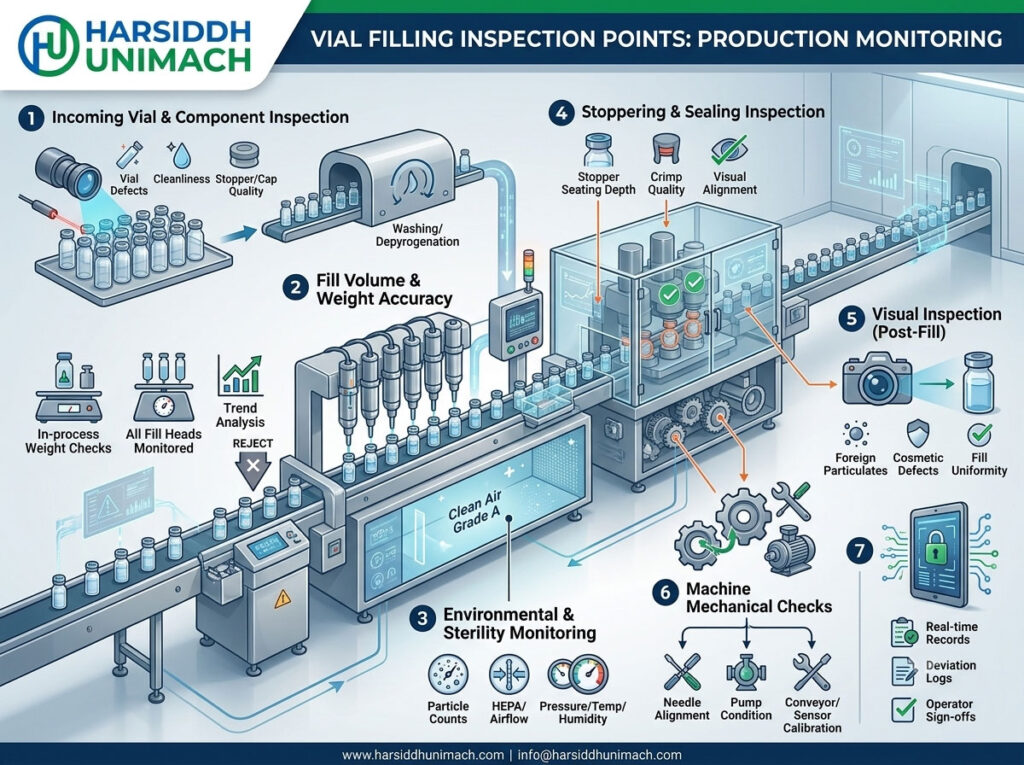
Pharmaceutical vial filling is one of the most sensitive stages in sterile and non-sterile drug manufacturing. A single missed inspection point can result in underfilled vials, contamination, stopper misalignment, or batch rejection — all of which carry regulatory, financial, and patient-safety consequences. For manufacturers running high-speed vial filling lines, building a disciplined inspection routine isn’t optional; it’s the backbone of consistent, compliant production.
At Harsiddh Unimach Pvt. Ltd., we design and manufacture vial filling and processing equipment with built-in monitoring capabilities that help pharmaceutical companies catch deviations before they become costly failures. In this article, we break down the critical inspection points every quality and production team should monitor throughout a vial filling run — from incoming vials to the final sealed, labeled output.
Why Inspection Points Matter in Vial Filling Operations
Vial filling machines operate at high speed, often processing hundreds to thousands of vials per hour. At this pace, even minor mechanical drift, environmental fluctuation, or component wear can compound quickly across a batch. Regulatory bodies such as the USFDA, EU-GMP, and WHO-GMP all expect manufacturers to demonstrate in-process control — not just end-of-line testing.
A structured inspection framework achieves three things simultaneously:
- Reduces rejection rates by catching fill weight or seal defects early.
- Protects sterility assurance by flagging contamination risks in real time.
- Supports audit readiness by generating documented, traceable inspection records.
Let’s walk through the inspection points that matter most, organized by the stage of the filling process.
1. Incoming Vial and Component Inspection
Before a single vial enters the filling line, it must be inspected for physical integrity. This stage prevents defective containers from ever reaching the filling nozzles.
What to monitor:
- Glass or plastic defects — chips, cracks, or hairline fractures at the vial neck or base
- Dimensional consistency — neck diameter, height, and wall thickness within tolerance
- Cleanliness — presence of glass particles, dust, or fiber contamination
- Stopper and cap quality — rubber stopper dimensions, cap crimp readiness, and material integrity
Automated vial washing and depyrogenation tunnels typically precede filling, and inspection at this stage should confirm that washing and drying cycles have been completed effectively before vials proceed to the filling zone.
2. Fill Volume and Weight Accuracy
Fill accuracy is arguably the single most scrutinized inspection point in the entire process, since it directly affects dosage accuracy and patient safety.
What to monitor:
- In-process weight checks at defined intervals (commonly every 15–30 minutes, or per SOP)
- Volumetric consistency across all filling heads/nozzles, not just a sample head
- Deviation trends — is fill weight drifting gradually upward or downward over the run?
- Viscosity-related variance for filling liquids with varying density or temperature sensitivity
Modern vial filling machines equipped with servo-driven pumps and load-cell-based checkweighers can flag out-of-range vials automatically and reject them before they reach the stoppering station. This real-time feedback loop is especially valuable for high-value biologics and injectables, where product loss must be minimized alongside accuracy — and it ties directly into the key validation parameters manufacturers should check before production.
3. Environmental and Sterility Monitoring
For sterile injectable production, the filling zone typically operates under Grade A/ISO 5 conditions within a Grade B background, often using RABS (Restricted Access Barrier Systems) or isolators.
What to monitor:
- Particle counts (viable and non-viable) within the filling zone
- HEPA filter integrity and airflow velocity (unidirectional airflow patterns)
- Differential pressure between cleanroom zones
- Temperature and humidity stability during the fill cycle
- Personnel and equipment gowning compliance, where applicable
Environmental monitoring isn’t a one-time check — it should be continuous and logged throughout the entire filling campaign, since even brief excursions can compromise sterility assurance for an entire batch.
4. Stoppering and Sealing Inspection
Once a vial is filled, proper stoppering and sealing determine whether the product remains sterile and stable through its shelf life.
What to monitor:
- Stopper seating depth — partially seated stoppers can compromise the container closure integrity
- Crimp quality on aluminum overseals, applied by the capping machine — too loose risks leakage, too tight risks glass damage
- Vacuum or headspace verification, where applicable to the product
- Visual alignment — stoppers or caps sitting off-center or tilted
Container closure integrity (CCI) is a growing regulatory focus area, and many manufacturers now integrate automated seal inspection systems directly into the filling line to catch these defects inline rather than relying solely on downstream sampling.
5. Visual Inspection for Particulates and Cosmetic Defects
After filling and sealing, vials typically move to a visual inspection stage — either manual, semi-automatic, or fully automated — to detect particulate contamination and cosmetic defects, following best practices for ampoule and vial inspection.
What to monitor:
- Foreign particulate matter suspended in the liquid (glass, fiber, rubber particles)
- Cracks or chips introduced during handling after filling
- Fill level uniformity across the batch, visible against calibrated backlighting
- Cosmetic defects on caps, labels, or vial surfaces
Automated inspection machines using high-resolution cameras and rotation mechanisms can inspect vials at far higher throughput and consistency than manual inspection alone, and they generate digital records that support traceability requirements.
6. Machine Mechanical and Component Checks
Beyond product-focused inspection, the filling machine itself requires scheduled mechanical monitoring — much like the components that require regular inspection on a high-speed labeling line — to prevent drift or failure mid-batch.
What to monitor:
- Filling needle/nozzle wear and alignment
- Peristaltic tubing or piston pump seal condition, depending on filling mechanism
- Conveyor and starwheel timing to prevent vial jams or misfeeds
- Sensor calibration for vial detection, fill level, and rejection systems
- Lubrication and wear on moving parts that operate in or near the sterile zone
A well-maintained machine reduces unplanned downtime and, more importantly, prevents mechanical inconsistency from silently affecting fill accuracy or vial handling over the course of a shift.
7. Batch Documentation and Traceability Checks
Every inspection point above needs to be captured in documentation that satisfies GMP recordkeeping requirements.
What to monitor:
- Batch records reflecting real-time inspection data, not retrospective entries
- Deviation logs for any out-of-specification readings
- Calibration certificates for checkweighers, sensors, and inspection cameras
- Operator sign-offs at each critical control point
Manufacturers increasingly rely on machines with integrated data logging and 21 CFR Part 11–compliant electronic records, reducing manual transcription errors and making audits significantly smoother.
Building an Inspection Checklist Into Your Filling Line
Rather than treating inspection as a separate quality function bolted onto production, the most efficient pharmaceutical manufacturers build inspection checkpoints directly into the machine architecture. This includes:
- In-line checkweighers integrated with automatic rejection
- Vision-based inspection stations positioned immediately after capping
- Environmental sensors feeding into a centralized SCADA or batch monitoring system
- Scheduled mechanical inspection intervals tied to preventive maintenance schedules
This integrated approach shifts inspection from a reactive, end-of-line activity to a proactive, real-time control strategy — which is exactly what regulatory frameworks like ICH Q10 and PIC/S guidelines encourage.
How Harsiddh Unimach Supports Inspection-Ready Vial Filling
At Harsiddh Unimach Pvt. Ltd., our vial filling machines are engineered with these inspection priorities in mind — from precision servo-driven filling heads that maintain consistent volumetric accuracy, to machine designs that support easy integration with checkweighing and vision inspection systems. Our goal is to help pharmaceutical manufacturers reduce rejection rates, maintain sterility assurance, and stay audit-ready without adding unnecessary complexity to their production floor.
Whether you’re setting up a new filling line or upgrading an existing one to meet tighter inspection standards, our team can help you select the right filling machine for injectable manufacturing and evaluate the right configuration for your product and throughput requirements.
Get in touch with us: 🌐 Website: www.harsiddhunimach.com 📧 Email: info@harsiddhunimach.com
Conclusion
Consistent vial filling isn’t just about speed — it’s about building layered, reliable inspection points across every stage of the process: incoming components, fill accuracy, environmental conditions, sealing integrity, visual inspection, machine mechanics, and documentation. Manufacturers who treat these checkpoints as an integrated part of their filling line design, rather than an afterthought, consistently see fewer rejections, smoother audits, and stronger product quality outcomes.
If you’re evaluating vial filling equipment or looking to strengthen your in-process inspection strategy, Harsiddh Unimach Pvt. Ltd. is here to help you build a line that’s accurate, compliant, and built for scale.
Related machines & categories:
- Vial Filling Machines
- Injectable Liquid Vial Filling Line
- Inspection Machines
- Capping Machines
- Washing Machine
- Labeling Machines
Related blog posts: