
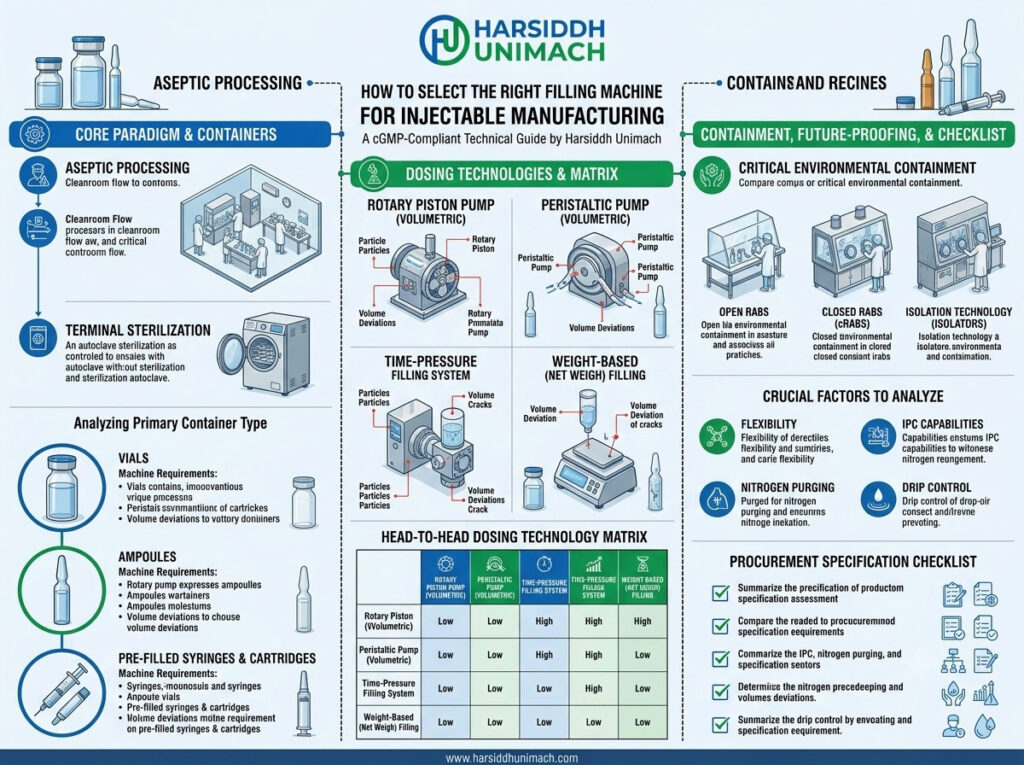
Choosing a filling machine for injectable products is one of the most consequential decisions a pharmaceutical manufacturer makes. The machine will handle sterile product worth far more than the equipment itself, it will be scrutinised in every regulatory audit, and it will shape your plant’s capacity, flexibility and costs for ten years or more.
A good choice delivers accurate doses, reliable sterility, smooth changeovers and easy validation. A poor choice brings product loss, frequent deviations, slow changeovers and a line that cannot grow with your business.
This guide walks you through a structured, step-by-step selection process — from understanding your product and container to evaluating suppliers — so you can invest with confidence.
Step 1: Understand Your Product
Every selection begins with the product. Document its key characteristics:
- Physical form: solution, suspension, emulsion, sterile powder or product for lyophilisation.
- Viscosity: water-like solutions behave very differently from oily or viscous formulations.
- Sensitivity to oxygen: oxygen-sensitive products need nitrogen purging before and after filling.
- Sensitivity to shear or foaming: proteins and biologics can be damaged by aggressive pumping or turbulence.
- Potency and toxicity: highly potent products may need closed product paths and containment.
- Value: expensive products demand minimal hold-up volume and low product loss.
- Temperature requirements: some products must be filled cold or within a narrow temperature range.
These factors determine the dosing technology, the materials of construction and the level of protection the machine must provide.
Step 2: Select the Container Format
Injectables are filled into several container types, and each needs different equipment:
- Vials – suitable for liquids, powders and lyophilised products; single- or multi-dose.
- Ampoules – all-glass, flame-sealed, single-dose containers for liquids.
- Pre-filled syringes (PFS) – ready-to-administer formats with growing demand.
- Cartridges – used in pens and auto-injectors.
If you are deciding between the two most common formats, read our article on ampoule vs vial filling: key differences explained.
Once the format is set, look at the matching equipment ranges:
- Vials: vial filling machines for liquid vials.
- Ampoules: ampoule filling machines for open ampoules or for closed ampoules.
- Pre-filled syringes: the Automatic Pre-Filled Syringe (PFS) Filling and Stoppering Machine and our PFS filling and stoppering machine.
- Sterile powders: injectable powder filling machines.
Step 3: Define Fill Volumes and Accuracy
List every fill volume you will run now and in the foreseeable future, along with the required accuracy. Small volumes (under 1 ml) demand very precise dosing systems, while larger volumes can tolerate slightly different technologies. Remember that accuracy requirements affect both regulatory compliance and product economics — every overfilled vial gives away valuable product.
Ask suppliers for documented fill accuracy data at your specific volumes, ideally from trials with your product or a similar placebo.
Step 4: Choose the Right Dosing Technology
The dosing system is the heart of the filling machine. The main options for injectable liquids are:
Piston (rotary or valveless) pumps
Piston pumps offer excellent accuracy across a wide range of volumes and viscosities. They are well proven for standard solutions and are robust in high-volume production. Servo-driven pistons allow volume adjustment from the HMI. See our servo based piston filling machine.
Peristaltic pumps
Peristaltic pumps move liquid through a flexible tube, so the product never touches the pump mechanism. Single-use tubing sets eliminate cleaning validation between batches, reduce cross-contamination risk and make them ideal for high-value, potent or biological products. See our peristaltic based liquid filling machine.
Time-pressure systems
Product flows from a pressurised vessel through a valve opened for a precise time. These systems are gentle and suit certain sensitive products, but require tight control of pressure, temperature and viscosity.
Powder dosing
For sterile powders, vacuum-pressure powder wheels or auger systems are used, depending on the powder and dose.
Servo control is now standard on most modern injectable fillers. It improves accuracy, speeds up changeovers and stores recipes for each product. The Automatic Servo Based Vial Filling Machine is an example of this approach.
Step 5: Determine the Required Capacity
Capacity is often overestimated or underestimated. Calculate it carefully:
- Annual demand: how many units do you need per year, now and in five years?
- Operating hours: how many shifts and days per year will the line run?
- Realistic efficiency (OEE): account for changeovers, cleaning, interventions and maintenance — real output is always lower than rated speed.
- Batch sizes: small batches with frequent changeovers favour flexible machines; large batches favour high-speed lines.
From these figures, calculate the required machine speed in containers per minute. Our article on small vial machines vs high-speed vial lines explains how to match capacity to demand.
For low volumes, R&D and clinical batches, a compact machine such as the Small Vial Filling Machine offers flexibility at lower cost. For commercial production, multi-head machines like the Six Head Liquid Vial Filling & Stoppering Machine deliver higher output.
Step 6: Decide on the Level of Automation
- Semi-automatic machines suit small batches and development work, with manual loading or unloading.
- Automatic standalone machines fill and stopper or seal containers automatically but are fed and discharged separately.
- Integrated lines connect washing, depyrogenation, filling, closing, capping and inspection in one synchronised system with minimal manual handling.
For sterile products, higher automation reduces human interventions in the critical zone — the main source of contamination risk. Integrated lines also reduce floor space and transfer points. An example is the automatic ampoule filling line (compact line), while vial users can explore our injectable liquid vial filling line category.
Step 7: Plan for Sterility Assurance
Injectable filling must take place in a Grade A environment. Consider:
- Unidirectional airflow (LAF): the minimum protection over the filling zone.
- RABS (Restricted Access Barrier Systems): physical barriers with glove ports that separate operators from open product.
- Isolators: fully enclosed systems with decontamination, offering the highest level of protection.
- Machine design: smooth surfaces, minimal horizontal ledges, sealed drives and designs that keep the operator’s hands away from open containers.
- Intervention design: how jams, broken containers and stopper issues are cleared without compromising sterility.
Current GMP expectations, including EU GMP Annex 1, emphasise a documented contamination control strategy, minimal interventions and appropriate barrier technology. Discuss barrier compatibility with your supplier early, since it affects machine design.
Step 8: Think About the Whole Line
The filler must work in harmony with upstream and downstream equipment:
- Washing machines must deliver clean containers at the right rate.
- Sterilising tunnels must match the filler’s speed and container size range — see our sterilizing tunnel for ampoules and vials.
- Capping or sealing machines must keep pace with filling.
- Inspection and labelling must handle the line output without bottlenecks.
Matching speeds, container handling and controls across all machines is essential for reliable operation.
Step 9: Evaluate Flexibility and Changeover
Many plants run multiple products, fill volumes and container sizes on the same line. Evaluate:
- How many container sizes the machine can handle
- How long changeover takes, and how many change parts are needed
- Whether change parts are tool-less and clearly identified
- Whether recipes store all settings for each product
- How easily product-contact parts can be removed for cleaning or sterilisation
Fast, repeatable changeovers increase productive time and reduce the risk of errors.
Step 10: Consider Cleaning and Sterilisation
Product-contact parts must be cleaned and sterilised between batches. Look for:
- SS 316L product-contact parts with smooth, polished surfaces
- Quick-release components that can be autoclaved
- Options for single-use product paths (especially with peristaltic dosing)
- Designs compatible with clean-in-place (CIP) and sterilise-in-place (SIP) where required
- Easy access for cleaning the machine surfaces
Step 11: Ensure Compliance and Documentation
A filling machine for injectables must be supported by comprehensive documentation:
- Design qualification (DQ) and user requirement specification (URS) review
- Factory acceptance testing (FAT) and site acceptance testing (SAT)
- Installation and operational qualification (IQ/OQ) documentation
- Material certificates for product-contact parts
- Calibration certificates for critical instruments
- Electronic records, audit trails and user access control where data integrity requirements apply
Good documentation shortens validation and makes regulatory audits smoother.
Step 12: Evaluate Total Cost and Supplier Capability
The purchase price is only part of the cost. Consider total cost of ownership:
- Product loss and fill accuracy
- Changeover and cleaning time
- Spare parts cost and availability
- Energy, compressed air and nitrogen consumption
- Maintenance and service support
- Validation effort
Our guide to aseptic vial filling line cost and key cost drivers explains where costs come from.
When evaluating suppliers, look at their experience with similar products, references from existing customers, engineering support, installation and training capabilities, and after-sales service. Visiting a supplier’s factory or a reference installation is often the best way to judge quality. Before you finalise, work through our vial filling line checklist: 7 things to evaluate before buying.
Three Example Scenarios
A start-up injectable unit filling generic solutions in ampoules. Volumes are modest, budget is limited and products are standard aqueous solutions. A four-head or six-head ampoule filling and sealing machine with piston dosing and nitrogen purging, paired with a rotary ampoule washer and a sterilising tunnel, offers a reliable, affordable start — with room to add a higher-speed machine later.
A growing contract manufacturer filling many products in vials. Frequent changeovers between products and vial sizes are the main challenge. A servo-driven vial filling and stoppering machine with stored recipes, tool-less change parts and quick-release product-contact parts maximises productive time. Peristaltic dosing can simplify cleaning between customers.
A biologics producer with high-value product. Product loss and sterility assurance dominate the decision. Peristaltic dosing with single-use tubing, minimal hold-up volume, gentle container handling, nitrogen protection and barrier technology such as RABS are the priorities, even if the machine costs more.
Build a Simple Selection Scorecard
To compare suppliers objectively, list your requirements and give each a weighting based on its importance — for example, fill accuracy, sterility assurance, changeover time, capacity, documentation, service and total cost. Score each supplier’s proposal against every requirement and multiply by the weighting. The scorecard turns a complex decision into a transparent comparison that the whole project team — production, quality, engineering and purchasing — can agree on. Share the scorecard with shortlisted suppliers so they understand exactly what matters most to you, and revisit it after product trials and reference visits.
Common Selection Mistakes to Avoid
- Buying on price alone: low initial cost often brings higher product loss and service costs.
- Underestimating future capacity: a line at full capacity from day one leaves no room for growth.
- Ignoring changeover requirements: frequent product changes can halve effective output on an inflexible machine.
- Overlooking barrier compatibility: adding RABS later can be difficult if the machine was not designed for it.
- Skipping product trials: testing with your actual product reveals foaming, dripping or accuracy problems before purchase.
- Neglecting documentation: incomplete documents can delay validation by months.
Frequently Asked Questions
What is the most important factor when selecting an injectable filling machine? Understanding your product — its form, viscosity, sensitivity and value — is the starting point, because it determines the container, dosing technology and sterility protection required.
Which dosing system is best for biologics? Peristaltic dosing with single-use tubing is often preferred for biologics because it is gentle, avoids cross-contamination and simplifies cleaning validation.
How do I calculate the filling speed I need? Divide your annual demand by available operating hours and adjust for realistic line efficiency, accounting for changeovers, cleaning and maintenance.
Do I need RABS or an isolator? It depends on your product, markets and contamination control strategy. Current GMP expectations favour barrier technologies for aseptic filling, so this should be considered at the selection stage.
What documentation should a filling machine supplier provide? At minimum: FAT/SAT protocols, IQ/OQ documentation, material and calibration certificates, manuals and drawings, plus data integrity features where required.
Need help selecting the right injectable filling machine? Contact our team or send an inquiry to discuss your product and requirements.