
In pharmaceutical, cosmetic, and FMCG production lines, the labeling machine is often the most underestimated piece of equipment on the floor — right up until it stops. A high-speed labeler running at hundreds or even thousands of containers per minute has dozens of moving parts working in constant, precise coordination. When even one of those parts drifts out of tolerance, the result isn’t a gentle slowdown — it’s crooked labels, missing barcodes, rejected batches, or a full line stoppage during a production run you can’t afford to delay.
Unlike catastrophic failures, most labeling machine breakdowns don’t happen suddenly. They build up quietly through worn rollers, misaligned sensors, and neglected drive components until the machine finally can’t compensate anymore. This is why a structured, component-level preventive maintenance program is not optional for any facility running high-speed labeling — it’s the difference between predictable uptime and unplanned production losses.
This guide breaks down the critical components of a high-speed labeling machine that demand regular inspection, the failure symptoms to watch for, and the maintenance cadence that keeps your line running at full speed without compromising label accuracy or regulatory compliance.
Why Labeling Machine Maintenance Deserves Priority Attention
Labeling is typically the last step before a product leaves the production line, which means any defect here is highly visible — to regulators, retailers, and end customers. A skewed label, a wrinkled application, or a missing lot number isn’t just cosmetic; in pharmaceutical and medical packaging, it can trigger a full batch rejection, a compliance audit finding, or in the worst case, a market recall.
At the same time, high-speed labelers are mechanically complex. They combine web handling (label reels and backing paper), precision servo motors, vacuum and pressure systems, sensing technology, and often integration with vision inspection machines and coding systems. Each subsystem has its own wear pattern and its own failure signature. A maintenance program that only reacts to breakdowns — rather than anticipating wear — will always cost more in downtime, scrap, and emergency repairs than a scheduled inspection routine would have cost in labor hours.
If you’re still finalizing your line’s labeling setup rather than maintaining an existing one, it’s worth reviewing our related post on Top 10 Labeling Mistakes Manufacturers Should Avoid — many of the defects covered there trace back to the same components discussed in this maintenance guide.
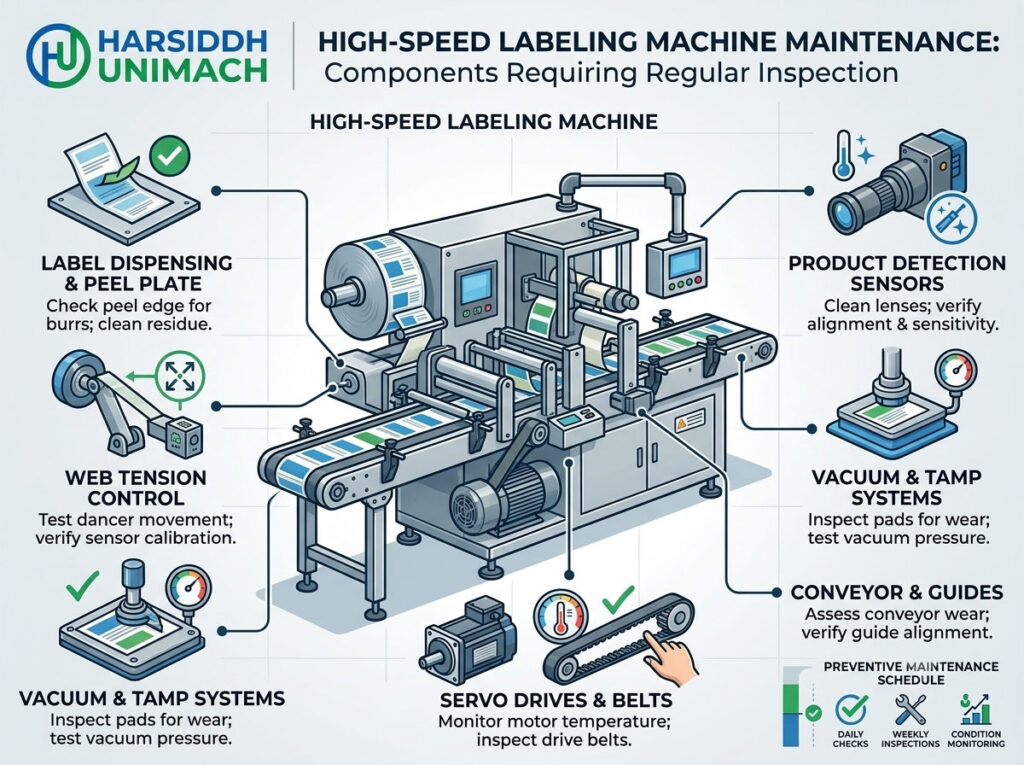
1. Label Dispensing and Peel Plate Assembly
The peel plate (or peel bar) is where the label separates from its backing liner as it’s applied to the container. This is one of the highest-wear components on the entire machine because it experiences continuous friction every single cycle.
What to inspect:
- Check the peel edge for nicks, burrs, or uneven wear that can cause labels to peel inconsistently or tear.
- Verify the peel angle is still within the machine’s original specification — even a slight shift changes label application timing.
- Inspect for adhesive residue buildup, which changes the friction coefficient and can cause labels to double-feed or skip.
Failure symptoms: Labels applied at an angle, torn labels, labels that fail to release cleanly from the backing web, or inconsistent placement from container to container.
Recommended frequency: Visual inspection every shift; deep clean and edge inspection weekly; replacement based on manufacturer wear-life or visible degradation.
2. Label Web Tension Control System
Consistent web tension is what keeps the label roll feeding smoothly through the dispensing mechanism without stretching, wrinkling, or snapping. High-speed machines use dancer arms, tension sensors, or braking systems (often magnetic particle brakes) to regulate this automatically.
What to inspect:
- Test the dancer arm’s free movement — any stiffness or drag indicates bearing wear.
- Verify tension sensor calibration against the machine’s target value.
- Inspect brake components for wear on friction surfaces, especially on machines using magnetic particle or hysteresis brakes.
Failure symptoms: Label stretching (causing barcode distortion), web breaks mid-run, inconsistent label registration, or unexplained speed-dependent defects that only appear at higher line speeds.
Recommended frequency: Daily visual check during changeover; full calibration monthly or per manufacturer schedule.
3. Registration and Product Detection Sensors
Photoelectric sensors, registration eyes, and product-presence sensors are the “eyes” of the labeling machine. They tell the system exactly when to dispense a label and where the label boundary is on the backing web. Even microscopic drift in sensor alignment or sensitivity can cascade into label placement errors across an entire run.
What to inspect:
- Clean sensor lenses regularly — dust, adhesive residue, and static-attracted debris are the most common causes of false triggering.
- Check sensor mounting brackets for vibration-induced loosening, which shifts the detection point over time.
- Verify sensitivity settings against label stock changes — clear labels, metallic labels, and dark backgrounds each require different sensor calibration.
Failure symptoms: Missed labels, double-dispensed labels, labels applied to the wrong position on the container, or erratic behavior that seems to correlate with specific label batches.
Recommended frequency: Daily cleaning; sensitivity verification with every label stock changeover; full alignment check monthly.
4. Applicator Pads, Rollers, and Vacuum/Tamp Systems
Depending on the machine configuration — wrap-around, tamp-blow, or roller applicator — this is the mechanism that transfers the label from the dispensing edge onto the moving product. These components experience constant mechanical cycling and are highly sensitive to wear.
What to inspect:
- Inspect vacuum pads for cracking, porosity loss, or clogged vacuum holes that weaken label hold during transfer.
- Check applicator roller surfaces for flattening, glazing, or uneven pressure distribution.
- Verify vacuum pump output pressure against baseline specifications — a slow decline in vacuum strength is a common early warning sign.
Failure symptoms: Labels dropping before full application, wrinkled or bubbled label application, inconsistent pressure marks, or labels applied with visible air gaps.
Recommended frequency: Weekly visual and functional inspection; vacuum pressure testing monthly; pad replacement per manufacturer wear guidelines.
5. Drive Motors and Servo Systems
Modern high-speed labelers rely on servo motors to synchronize label dispensing speed precisely with line speed and product spacing. Any drift in servo performance directly affects label placement accuracy, especially as production speeds increase.
What to inspect:
- Monitor servo motor temperature during extended runs — abnormal heat buildup often precedes bearing or winding failure.
- Check drive belts (if used) for tension, cracking, or glazing.
- Review servo error logs and diagnostic codes through the machine’s HMI for recurring fault patterns that indicate developing issues before they cause a hard stop.
Failure symptoms: Label placement drift that worsens over a production run, unusual motor noise, speed-dependent registration errors, or intermittent fault codes on the control panel.
Recommended frequency: Daily temperature and noise check during operation; quarterly detailed servo diagnostics; belt inspection at every changeover.
6. Conveyor and Product Handling Components
The conveyor system, star wheels, and product guides ensure containers move through the labeling zone at a consistent speed and orientation. Any inconsistency here directly transfers into label placement variability, even if every other subsystem is functioning perfectly.
What to inspect:
- Check conveyor belt tension and surface wear, particularly at high-friction zones near guide rails.
- Inspect star wheel pockets for wear that allows container rotation or slippage during labeling.
- Verify guide rail alignment hasn’t shifted from vibration or accidental impact.
Failure symptoms: Containers rotating slightly during label application, inconsistent gaps between products causing missed labels, or containers jamming at transition points.
Recommended frequency: Daily visual check; alignment verification weekly; belt and star wheel wear assessment monthly.
7. Coding and Vision Inspection Integration Points
Many high-speed labeling lines integrate printing (thermal transfer, inkjet, or laser coding) and vision inspection systems directly into the labeling module to verify lot numbers, expiry dates, and barcode readability in real time. These integration points are frequently overlooked during mechanical maintenance because they’re treated as separate systems.
What to inspect:
- Clean print heads and verify ribbon tension on thermal transfer coders.
- Check vision camera lenses and lighting rings for dust accumulation that reduces read accuracy.
- Confirm software-side calibration between the labeling module and the vision system hasn’t drifted after a firmware update or product changeover.
Failure symptoms: Illegible or smeared codes, false rejects from the vision system, or codes printed in the wrong position relative to the label.
Recommended frequency: Daily print head cleaning; camera and lighting inspection weekly; full integration calibration check at every SKU changeover.
For lines running vials or ampoules, this integration point often overlaps directly with upstream quality checks — see our guide on Best Practices for Ampoule and Vial Inspection for how vision inspection standards apply earlier in the process.
8. Pneumatic and Electrical Control Systems
Behind every mechanical action on a labeling machine is a pneumatic or electrical control signal. Air leaks, worn solenoid valves, and loose electrical connections are common root causes of intermittent faults that are difficult to diagnose without a systematic inspection routine.
What to inspect:
- Listen for air leaks at fittings, solenoid valves, and cylinder seals during operation.
- Check air filter and regulator condition — contaminated air supply accelerates wear across every pneumatic component.
- Inspect electrical terminals and connectors for corrosion or looseness, especially in facilities with high humidity or washdown environments.
Failure symptoms: Inconsistent cylinder actuation speed, intermittent electrical faults that clear themselves, or gradual performance degradation that maintenance teams struggle to pin to a single cause.
Recommended frequency: Weekly pneumatic leak check; air filter replacement per manufacturer schedule; electrical connection inspection quarterly or during planned shutdowns.
Building a Preventive Maintenance Schedule That Actually Works
A component checklist is only useful if it’s built into a disciplined maintenance cadence. The most effective programs combine three layers:
- Daily operator checks — quick visual and functional inspections performed by line operators at shift start (sensors, peel plate, conveyor alignment, air leaks).
- Scheduled technical maintenance — weekly and monthly inspections performed by trained maintenance technicians covering calibration, wear measurement, and component replacement based on manufacturer life-cycle data.
- Condition-based monitoring — where possible, use the machine’s own diagnostic data (servo fault logs, vacuum pressure trends, sensor sensitivity drift) to catch developing issues before they cause a stoppage, rather than waiting for a fixed calendar interval.
Documenting every inspection — even when no issue is found — also builds the historical data needed to predict component life more accurately over time, which is especially valuable for regulated industries where maintenance records are part of your audit trail.
How Harsiddh Unimach Supports Long-Term Machine Reliability
At Harsiddh Unimach Pvt. Ltd., we design our labeling machines with long-term maintainability built into the engineering from day one — not as an afterthought. Our high-speed labeling lines feature accessible component layouts for faster inspection and part replacement, robust sensor and servo systems engineered for demanding production environments, and detailed maintenance documentation to help your technical teams build an effective preventive maintenance schedule from the moment the machine is commissioned.
We also work directly with our clients’ maintenance teams to establish inspection intervals tailored to their specific production speed, label stock, and operating environment — because a generic maintenance schedule rarely matches the real wear patterns of a specific line. If your labeling line runs downstream of a filling or inspection process, our related guides on selecting the right filling machine for injectable manufacturing and our full range of inspection machines may also be useful for a complete line reliability strategy.
Conclusion
High-speed labeling machines are precision systems, and their reliability depends entirely on how consistently their individual components are inspected, calibrated, and maintained. From the peel plate and web tension system to servo motors, sensors, and pneumatic controls, every subsystem has its own wear signature and its own failure symptoms. A structured, component-level maintenance program — combining daily operator checks, scheduled technical inspections, and condition-based monitoring — is the most reliable way to protect label quality, avoid unplanned downtime, and keep your production line running at full speed.
If your facility is looking to build a stronger maintenance program for your labeling line, or evaluating a new high-speed labeling machine engineered for long-term reliability, reach out to the engineering team at Harsiddh Unimach Pvt. Ltd. We’re happy to walk through your specific production requirements and help you design a maintenance approach that fits your line.
Contact us: www.harsiddhunimach.com | info@harsiddhunimach.com
Related machines:
- Labeling Machines
- Inspection Machines
- Vial Filling Machines
- Ampoule Filling Machine
- Bottle Unscramblers
Related blog posts: