
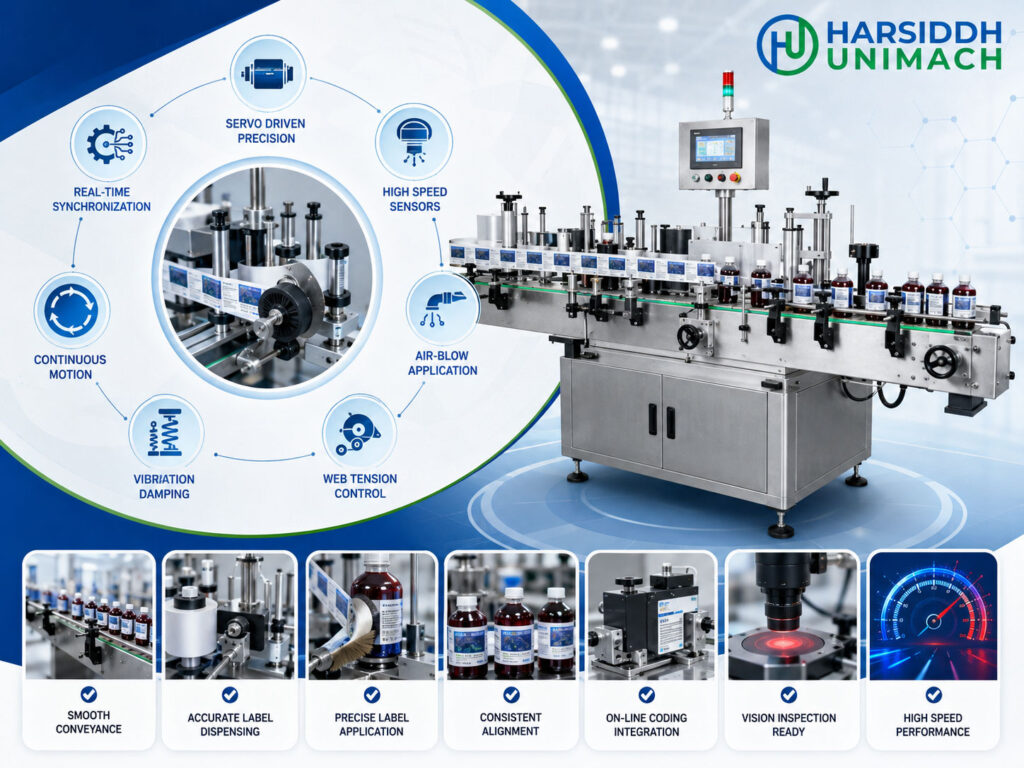
On a modern pharmaceutical or consumer goods line, the filler and capper may produce containers at a rapid rate, and the labeller must keep up without missing a beat. Every label must still land in exactly the same place, perfectly straight, free of wrinkles and bubbles, with a legible batch code. At high speeds, small timing errors become large placement errors, and small disturbances become lots of rejects.
A high-speed labeling machine is designed to apply self-adhesive labels quickly and accurately. It uses the same basic principle as any sticker labeller, peeling a label from its liner and pressing it onto a moving product, but adds technologies that control timing, speed and product handling far more precisely.
In this article, we explain what makes high-speed labelling possible: the drives, sensors, product handling, web control and inspection systems that work together, plus the settings and maintenance habits that keep performance high. For the fundamentals of self-adhesive labelling, read our sticker labeling machine working principle.
What Changes at High Speed?
At low speeds, a labeller can tolerate small variations. At high speeds, everything happens faster and within shorter time windows:
| Factor | At Low Speed | At High Speed |
|---|---|---|
| Time to apply each label | Generous | Very short |
| Effect of a small timing error | Small placement shift | Large placement shift |
| Label web acceleration | Gentle | Rapid start and stop |
| Product stability | Easy to control | Products may tip, slide or bounce |
| Reel changes | Infrequent | Frequent unless reels are large |
| Defect detection | Manual checks possible | Automatic inspection essential |
High-speed labellers are designed to manage each of these challenges.
Core Technology 1: Servo Label Drives
The label drive advances the web to dispense each label. At high speeds, it must accelerate the web from standstill to product speed, hold that speed precisely while the label is applied, then stop exactly at the next label gap, all in a fraction of a second.
Servo drives make this possible:
- Closed-loop control – the servo constantly measures its own position and corrects any error.
- High acceleration – the web reaches label speed quickly and smoothly.
- Precise stopping – each label stops in the same position, ready for the next product.
- Programmable motion profiles – acceleration and deceleration can be tuned to the label material.
Stepper drives work well for lower speeds, but servo drives are generally preferred for high-speed and high-precision labelling.
Core Technology 2: Encoder Speed Tracking
For a label to go on smoothly, its speed must match the speed of the product surface. On a high-speed line, conveyor speed may vary slightly as the line speeds up, slows down or responds to upstream and downstream conditions.
An encoder on the conveyor measures its actual speed continuously. The labeller uses this signal to:
- Match label dispense speed to product speed automatically
- Adjust the dispense timing so labels land in the same position at any speed
- Keep labels accurate during line acceleration and deceleration
Without speed tracking, labels would drift in position whenever the line speed changed.
Core Technology 3: Precise Product Spacing and Handling
High speeds require products to arrive at the label head evenly spaced and stable.
Infeed screws (feed worms)
A feed screw grips each product and sets an exact gap between products. This gives the label head a consistent time window for each label and prevents labels from bridging two products.
Stabilising belts
Side gripping belts and top hold-down belts keep products upright and moving at the same speed as the conveyor, preventing tipping and sliding, especially for light plastic bottles.
Wrap and pressing systems
Wrap belts, rollers and brushes must rotate and press products firmly but smoothly at speed, without causing products to bounce or slip.
Core Technology 4: Label Web Control
At high speed, the label web is accelerated and stopped very rapidly. Without good control, it can stretch, wander or break.
- Unwind dancer arm or brake – maintains steady tension as the reel unwinds and its diameter changes.
- Web guiding – keeps the web centred so labels go on straight.
- Low-inertia rollers – reduce resistance to rapid acceleration.
- Fast, accurate gap sensors – detect each label edge reliably at high web speeds, including for transparent labels where special sensors may be needed.
Core Technology 5: Large Reels and Reel Change Strategy
At high speeds, a label reel empties quickly. Each stop to change reels costs production time. High-speed labellers address this with:
- Large diameter unwinds that hold more labels per reel
- Low-label warning sensors so operators can prepare the next reel
- Quick-threading web paths to speed up reel changes
- Dual-head arrangements, where two label heads alternate so one can be reloaded while the other works
Core Technology 6: Rotary and Multi-Head Designs
Two main design approaches are used for high speeds:
Linear high-speed labellers
Products move in a straight line past one or more label heads. With servo drives, encoder tracking and good product handling, linear machines can reach high speeds while remaining compact and quick to change over. See the Automatic Round Bottle Sticker Labeling Machine, the bottle sticker labeling machine and the vertical bottle sticker labeling machine.
Rotary high-speed labellers
Products are transferred onto a rotating carousel, held on individual plates and rotated under precise control while labels are applied. Rotary designs are well suited to the highest speeds and to applications needing exact orientation or multiple labels per product. See the Automatic Rotary Sticker Labeling Machine and read our rotary sticker labeling machine working principle. For ampoules, see the rotary ampoule sticker labeling machine.
Multiple label heads
Front-and-back labellers, or machines applying body and neck labels, use two or more heads synchronised by the controller. See the Automatic Front and Back Sticker Labeling Machine and the double side flat bottle sticker labeling machine. Read more in front and back sticker labeling machine: how to achieve precise dual-side label placement.
High-Speed Labelling for Different Containers
The same technologies apply across container types, but each brings its own priorities at speed:
- Round bottles – stable wrap belts and accurate speed matching prevent spiralling labels. Read our bottle labeling machine working principle for bottle-specific detail.
- Flat and oval bottles – firm side and top belts keep the labelled face aligned with the label head.
- Vials – small diameters and glass require gentle but precise handling and strong edge pressing. See the vial sticker labeling machine.
- Ampoules and small cylinders – often labelled horizontally or on rotary machines for stable, controlled rolling.
Core Technology 7: Coding at Speed
Batch numbers and expiry dates must be printed on every label. High-speed lines use coders that can keep up with the label web, such as thermal transfer printers synchronised with the label drive or high-speed inkjet systems. The coder must print clearly at the web speed and be positioned so the ink or print is dry before the label is applied.
Core Technology 8: Inspection and Automatic Rejection
At high speeds, operators cannot check every product by eye. High-speed labellers typically include:
- Label presence sensors to detect missing labels
- Code verification using vision systems or code readers
- Position checks to detect skewed or misplaced labels
- Automatic reject systems that remove faulty products without stopping the line
- Consecutive-fault alarms that stop the line if several rejects occur in a row, signalling a problem to fix
Step-by-Step: High-Speed Labelling in Action
- Products arrive from the capper or sealer on a conveyor.
- The feed screw sets a precise, even gap between products.
- Stabilising belts hold products upright and at conveyor speed.
- The encoder continuously reports conveyor speed to the controller.
- The product sensor detects each product; the controller calculates exact dispense timing for the current speed.
- The servo label drive accelerates the web and dispenses the label at matched speed.
- The label is applied and wrapped or pressed onto the product.
- Brushes or rollers smooth the label.
- Inspection systems check label presence, position and code.
- The reject system removes any faulty products.
- Accepted products move on to cartoning and packing.
Where High-Speed Labelling Fits
High-speed labellers usually follow high-speed filling and capping equipment, such as a liquid bottle filling and capping machine (monoblock). The whole line must be balanced, with conveyor buffers between machines so that a short stoppage at one machine does not stop the entire line.
Browse all labeling machines, the labeling machines on Harsiddh Engineering, the labeling machines for round bottles and the labeling machines for flat bottles.
Key Settings for High-Speed Labelling
| Setting | What It Controls | Effect If Wrong |
|---|---|---|
| Feed screw pitch and timing | Product spacing | Labels bridging products, jams |
| Stabilising belt speed and pressure | Product stability | Tipping, sliding, skewed labels |
| Encoder calibration | Speed matching | Labels drifting with speed changes |
| Servo acceleration profile | Web behaviour | Web stretch, label misplacement |
| Dispense position offset | Label placement | Labels off-position |
| Unwind tension | Web stability | Web breaks, skew |
| Gap sensor setting | Label detection | Missed or double labels |
| Inspection thresholds | Reject decisions | False rejects or missed defects |
Troubleshooting High-Speed Labelling Problems
| Problem | Likely Cause | Corrective Action |
|---|---|---|
| Label position drifts as speed changes | Encoder not connected or calibrated | Check encoder and speed-tracking settings |
| Wrinkles at high speed only | Label speed not matched, web acceleration too harsh | Adjust speed matching and acceleration profile |
| Web breaks | Excessive tension, sharp acceleration | Adjust unwind tension and motion profile |
| Missed labels | Gap sensor too slow or wrongly set | Re-teach sensor, consider sensor suited to label type |
| Products tipping | Poor spacing, weak stabilising belts | Adjust feed screw and belts |
| High false reject rate | Inspection thresholds too tight, dirty camera | Review thresholds, clean optics |
| Frequent stops for reel changes | Small reels | Use larger reels or dual-head system |
| Labels bridging products | Feed screw timing | Re-time feed screw |
Maintenance at High Speed
High-speed machines experience more wear per hour than slower machines. Keep them running with:
- Regular inspection of belts, rollers, brushes and feed screws
- Cleaning of adhesive build-up from peel plates and rollers
- Checking sensors, encoders and cameras for dirt and alignment
- Lubrication of drives and bearings to schedule
- Planned replacement of wear parts before they fail
For a detailed list, read high-speed labeling machine maintenance: components that require regular inspection.
How to Choose a High-Speed Labeling Machine
- Required speed – including future growth
- Products – shapes, sizes, materials and stability
- Label positions – wrap, front, back, multiple labels
- Design – linear or rotary
- Drive technology – servo with encoder tracking
- Reel capacity and reel change strategy
- Coding and inspection capabilities
- Changeover time and complexity
- Integration with upstream and downstream machines
Frequently Asked Questions
What is the working principle of a high-speed labeling machine? It applies self-adhesive labels using servo-driven label dispensing synchronised with conveyor speed through an encoder. Products are precisely spaced and stabilised, labels are dispensed at matched speed, and inspection systems check every product.
Why are servo drives used in high-speed labellers? They provide closed-loop control, fast acceleration and precise stopping, keeping label placement accurate at high speeds.
What is encoder speed tracking? An encoder measures conveyor speed so the labeller can match label speed and timing automatically, even when line speed changes.
Is a rotary or linear labeller better for high speed? Both can run at high speeds. Rotary designs suit the highest speeds and applications needing orientation or multiple labels; linear designs offer compactness and quicker changeovers.
How can I reduce downtime on a high-speed labeller? Use large reels or dual heads, maintain wear parts proactively, keep sensors clean and balance the line with buffers.
Need a labeller that keeps up with your line? Contact our team or send an inquiry with your product, label and speed requirements.