
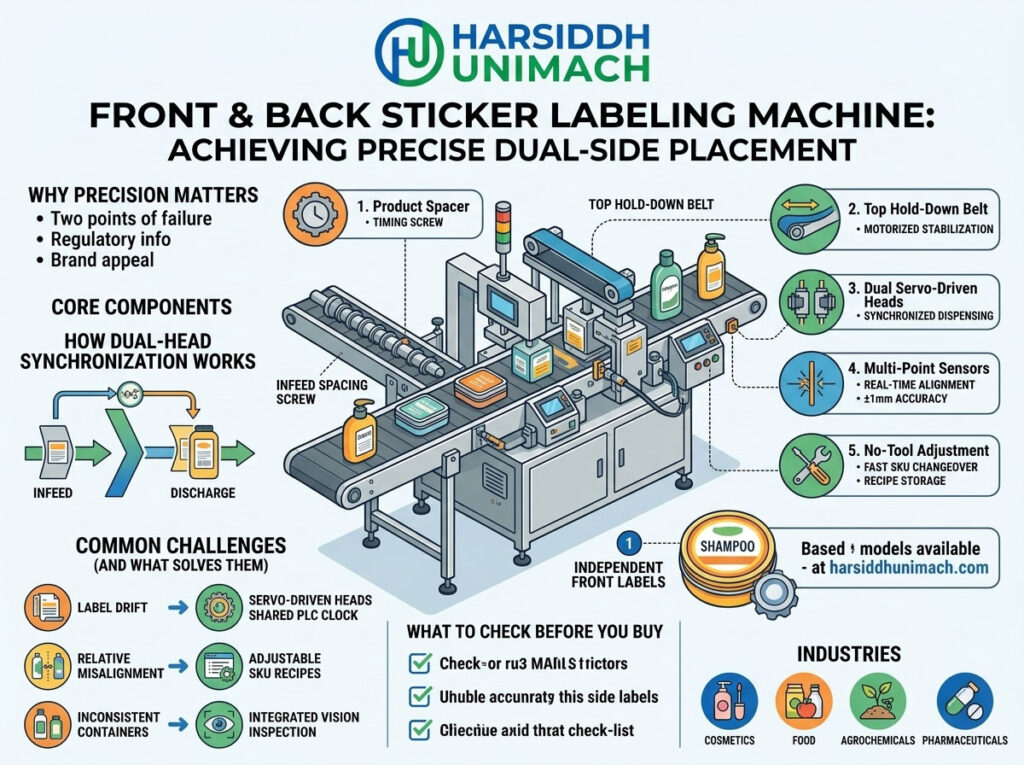
Many pharmaceutical, nutraceutical and personal care products are packed in flat, oval or square bottles that carry two labels: a front label with the brand and product name, and a back label with dosage instructions, ingredients, warnings and regulatory information. A front and back sticker labeling machine applies both labels in one pass.
On these containers, label position is very visible. A front label that sits a few millimetres higher than the back label, a label that is slightly skewed or one with a lifting edge is immediately noticeable, and in pharmaceutical products can be grounds for rejection. Precise dual-side placement depends on many factors working together: how the container is held, how the labels are dispensed, how sensors trigger and how the machine is set up.
This article explains how to achieve precise front and back label placement, from container handling and labelling head setup to sensors, label quality, setup procedures and troubleshooting. It is intended for production and engineering teams running or commissioning dual-side labellers.
If you are still selecting a machine, see our automatic front and back sticker labeling machine buying guide for pharmaceutical manufacturers.
How a Front and Back Labeller Works
A typical front and back sticker labeling machine works as follows:
- Containers enter on a conveyor, usually spaced by a separating wheel or screw.
- Side guides or belts centre and orient the container.
- A top hold-down belt keeps the container stable and upright.
- A product sensor detects the container’s leading edge.
- Two labelling heads, one on each side, dispense labels onto the front and back faces as the container passes.
- Pressing rollers, brushes or sponges smooth the labels onto the surfaces.
- A coder prints batch and expiry information on one or both labels.
An automatic front and back sticker labeling machine or an automatic double side flat bottle sticker labeling machine follows this principle. Our article on the sticker labeling machine working principle covers the basics of label dispensing.
What “Precise Placement” Means
Before improving placement, define what you are aiming for:
| Placement Aspect | Description |
|---|---|
| Vertical position | Height of the label on the container, relative to base or shoulder |
| Horizontal position | Position along the container face, relative to edges |
| Skew | Angle of the label relative to the container base |
| Front–back alignment | Matching height and position of front and back labels |
| Surface quality | No wrinkles, bubbles or lifting edges |
| Coding position | Batch and expiry code in the correct area and legible |
Set tolerances for each aspect in your specifications, and use them as the basis for setup and inspection.
Factor 1: Container Quality and Consistency
The machine can only place labels as accurately as the container allows.
- Dimensional consistency: variations in container width, height or wall shape cause position changes.
- Flat label panels: the label area should be flat or gently curved as intended, without bulges or sink marks.
- Clean, dry surfaces: residue, moisture or dust reduces adhesion and causes lifting.
- Stability: tall, narrow or light containers can tip or twist.
Agree container tolerances with your supplier, and inspect incoming batches, especially when changing container suppliers or moulds.
Factor 2: Container Spacing and Infeed
Containers must arrive at the labelling heads evenly spaced so each receives labels at the same point.
- Separating wheel or screw: creates consistent gaps between containers.
- Conveyor speed: must be stable and matched to the labelling speed.
- Infeed supply: a steady flow from upstream equipment, such as a bottle unscrambler or a liquid bottle filling and capping monoblock, prevents bunching and gaps.
Factor 3: Centring and Orientation
Flat and oval containers must be presented with their label faces parallel to the labelling heads.
- Side belts or guides centre the container on the conveyor and keep both faces correctly aligned.
- Orientation devices turn containers that arrive rotated, where required.
- Correct width settings for each container size are essential.
If the container enters at a slight angle, one label will be skewed or both will be misaligned.
Factor 4: Top Hold-Down Belt
The hold-down belt presses gently on the container’s top or cap to keep it stable as it passes the labelling heads.
- Set the height so the belt holds the container firmly without pressing so hard that it deforms plastic bottles.
- Match the belt speed to the conveyor speed, so the container does not twist.
- Check belt wear and tension regularly.
A poorly set hold-down belt is one of the most common causes of skewed or wrinkled labels on dual-side machines.
Factor 5: Labelling Head Position and Angle
Each labelling head must be set precisely:
- Height: sets the vertical label position.
- Distance from the container: the peel plate should be close enough for clean transfer without touching the container.
- Angle: the head should be square to the container face to prevent skew.
- Front–back matching: both heads must be set to the same reference height for aligned labels.
Use scales, digital counters or recorded settings to set heads to known positions rather than adjusting by eye.
Factor 6: Label Dispensing Timing and Speed Synchronisation
- Product sensor position: determines when each label starts dispensing relative to the container’s edge.
- Dispense delay settings: fine-tune the horizontal position of each label.
- Label speed: must match the conveyor speed. If the label moves faster or slower than the container, it wrinkles or stretches.
- Encoder feedback: on many machines, an encoder measures conveyor speed so label speed is adjusted automatically.
Set timing separately for the front and back heads, since they may be positioned at different points along the conveyor.
Factor 7: Label Sensors
The label (gap) sensor detects the gap between labels on the roll so each label stops at the same point.
- Keep sensors clean and free of adhesive.
- Calibrate when changing label material, size or backing.
- Use the appropriate sensor type for transparent labels, where standard optical sensors may struggle.
Factor 8: Web Tension
Steady tension in the label web ensures consistent dispensing.
- Check the brake and dancer arm on the unwind.
- Make sure the backing paper rewind runs smoothly.
- Keep rollers clean of adhesive.
Factor 9: Pressing and Wiping
After dispensing, labels must be smoothed onto the container.
- Pressing rollers or sponges follow the container surface.
- Brushes work well on curved or uneven surfaces.
- Set pressure to remove air without distorting the label or container.
- Replace worn sponges and brushes.
Factor 10: Label Quality
Labels themselves strongly influence placement accuracy:
- Consistent gap and pitch between labels on the roll
- Accurate die-cutting so all labels are the same size
- Correct winding direction and core size for the machine
- Adhesive suited to the container material and surface
- Label material with suitable stiffness for clean dispensing
Poor-quality labels cause problems that no machine setting can fully correct.
A Step-by-Step Setup Procedure
- Confirm materials: correct containers, front and back labels and coding data for the batch.
- Set conveyor guides and side belts to the container width.
- Set the hold-down belt height and speed.
- Load label rolls on both heads, threading the web correctly.
- Calibrate label sensors for each roll.
- Set labelling head height, distance and angle to recorded values for the format.
- Set product sensor position and dispense delays for front and back.
- Set pressing components for the container.
- Run test containers at low speed and check position, skew, alignment and surface quality.
- Increase to production speed and check again.
- Verify coding for content, position and legibility.
- Record settings and obtain approval to start production.
Store settings for each format in recipes where the machine allows, or on a setup sheet kept at the machine.
Troubleshooting Common Placement Problems
| Problem | Likely Causes | What to Check |
|---|---|---|
| Front and back labels at different heights | Heads set to different heights | Head height settings, reference point |
| Labels skewed | Container not square, hold-down belt, head angle | Side belts, hold-down belt, head alignment |
| Horizontal position varies | Container spacing, sensor, timing | Separating device, product sensor, dispense delay |
| Wrinkles | Label speed mismatch, pressing problems | Speed synchronisation, encoder, pressing rollers |
| Air bubbles | Insufficient pressing, curved surface | Pressing pressure, sponge or brush condition |
| Lifting edges (flagging) | Adhesive, surface contamination, curvature | Label adhesive, container cleanliness, pressing |
| Missing labels | Label sensor, product sensor, roll end | Sensor calibration and cleanliness |
| Double labels | Label sensor calibration | Sensor sensitivity and gap detection |
| Containers twisting | Hold-down belt speed or pressure | Belt speed matching and height |
For a component-level maintenance guide, see our article on high-speed labeling machine maintenance and components that require regular inspection.
Labelling as Part of the Line
Placement accuracy also depends on what happens before the labeller. Containers that arrive wet, tilted or crowded are harder to label precisely. Make sure upstream machines deliver containers clean, dry and correctly closed. If bottles pass through an induction sealing machine before labelling, check that caps are seated squarely, because a tilted cap can push against the hold-down belt and twist the container. Matching the labeller’s speed to the rest of the line, with short buffers where needed, prevents containers from bunching at the infeed.
Verifying Placement During Production
- Check label position, skew and alignment at start-up and at defined intervals.
- Use a simple template or gauge to measure label height consistently.
- Check coding legibility and content after every roll change.
- Monitor reject rates and investigate increases.
- Record checks in the batch record.
Labelling Other Container Types
Front and back labelling is most common on flat and oval containers. For round bottles, wrap-around labellers are typically used, such as a vertical bottle sticker labeling machine or a bottle sticker labeller. Our article on the bottle labeling machine working principle explains the differences. For single-face labelling of flat containers, an automatic flat bottle sticker labeling machine may be sufficient, and for labels on container tops, an automatic top side sticker labeling machine is available.
Explore our ranges of labeling machines for flat bottles, labeling machines for round bottles and all labeling machines, including the double side flat bottle sticker labeling machine.
Common Mistakes to Avoid
- Adjusting by eye instead of using recorded settings.
- Setting the hold-down belt too tight or at the wrong speed.
- Not recalibrating sensors after changing label rolls or materials.
- Ignoring container variation from different suppliers or moulds.
- Running at full speed before confirming placement at low speed.
- Allowing adhesive build-up on peel plates and rollers.
Our article on the top 10 labeling mistakes manufacturers should avoid covers more pitfalls.
Frequently Asked Questions
Why are my front and back labels at different heights? The two labelling heads are probably set to different reference heights, or the container is tilting. Check head settings and the hold-down belt.
Can one machine label both flat and oval containers? Often yes, with appropriate adjustments and change parts. Confirm with the supplier for your container shapes.
How do I stop flat plastic bottles from deforming during labelling? Reduce hold-down belt pressure and check side belt settings so the container is supported without being squeezed.
Do transparent labels need special sensors? Standard optical sensors may not detect clear labels reliably. Capacitive or ultrasonic sensors are often used.
How often should placement be checked? At start-up, after roll changes or adjustments, and at defined intervals during production.
Achieve Precise Labelling With Harsiddh
Harsiddh Unimach manufactures front and back, double side flat bottle, round bottle, vial, ampoule and top labelling machines for pharmaceutical and other industries. Our team can help you set up your labeller for precise dual-side placement and recommend the right machine for your containers.
Contact us through our contact page or send your requirements through our inquiry form.