
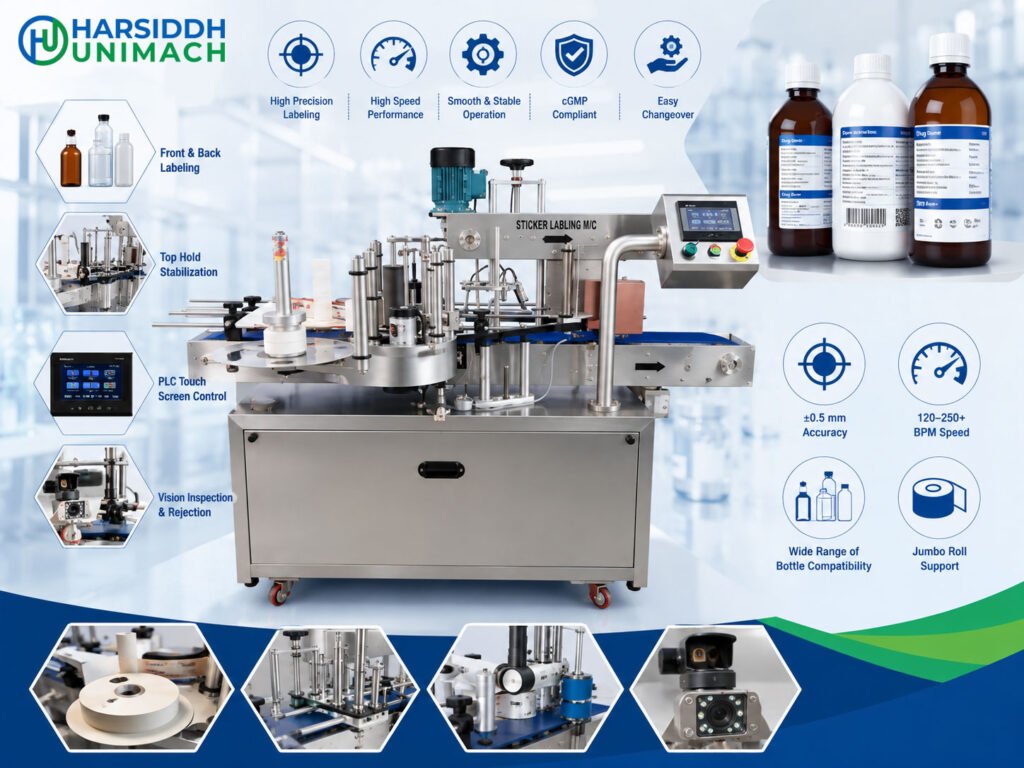
Many pharmaceutical products are packed in flat, oval or square bottles: oral liquids, antiseptic solutions, hand sanitisers, lotions, ointment jars and some syrups. These containers usually carry two labels — a front label with the product name and branding, and a back label with composition, dosage, warnings, batch number and expiry date. Applying both labels accurately, straight and wrinkle-free, at production speed, is the job of an automatic front and back sticker labeling machine.
Buying the right machine is not as simple as matching a speed figure. Container shapes vary, label stocks behave differently, regulatory information must be printed and verified, and the labeller must integrate with filling, capping and packing equipment. A poor choice leads to skewed labels, rejected bottles, stoppages and compliance risks.
This buying guide explains what a front and back labeller does, which features matter most for pharmaceutical use, how to evaluate suppliers and how to avoid common mistakes. For the technical details of achieving precise two-sided placement, see our companion article on how to achieve precise dual-side label placement.
What Is a Front and Back Sticker Labeling Machine?
It is an automatic machine that applies self-adhesive labels to two opposite sides of a container in a single pass. Bottles travel along a conveyor, are centred and stabilised by guides and belts, and pass two labelling heads — one on each side — that dispense and apply labels as the bottle moves. Pressure rollers or brushes then smooth the labels onto the surface.
See the Automatic Front and Back Sticker Labeling Machine and our double side flat bottle sticker labeling machine. For the basics of how sticker labellers work, read the sticker labeling machine working principle.
Typical Pharmaceutical Applications
- Flat and oval bottles for oral liquids and syrups
- Antiseptic and disinfectant bottles
- Hand sanitisers and personal care products
- Lotions, gels and topical solutions
- Square or rectangular containers
- Some veterinary and nutraceutical products
Many machines can also apply a single wrap-around label to round bottles with an optional attachment, increasing flexibility.
Step 1: Define Your Containers
Container characteristics are the single biggest factor in machine selection. List every container you plan to label:
- Shape — flat, oval, square, round or irregular
- Material — glass, PET, HDPE or other plastics
- Dimensions — height, width, depth and label panel size
- Surface — flat, slightly curved, tapered, ribbed or textured
- Stability — tall, narrow or light bottles may tip easily
- Cap type — affects top hold-down belt contact
Flat and oval bottles need careful centring so both labels are applied evenly. Lightweight plastic bottles may flex when pressed, so the machine must support them without deformation. Browse our labeling machines for flat bottles.
Step 2: Define Your Labels
- Label sizes for front and back
- Label material — paper, PP, PE or transparent film
- Adhesive type — suited to container material and storage conditions
- Roll specifications — core diameter, outer diameter, unwind direction and label gap
- Transparent labels — need special sensors to detect the label gap
Agree a clear label roll specification with your label supplier and your machine supplier at the same time.
Step 3: Determine Output Requirements
Match labeller speed to your filling line, with a margin for recovery after stoppages. Consider:
- Current and future output
- The slowest container size you will run
- Whether the labeller must keep pace with a high-speed filler and capper
Key Features to Look For
1. Servo-driven labelling heads
Servo motors synchronise label dispensing precisely with conveyor speed, ensuring accurate placement without stretching or wrinkling labels. They also allow quick adjustment of label position from the HMI.
2. Bottle centring and orientation
Flat and oval bottles must be aligned so the label panel faces each labelling head squarely. Look for:
- Side guide belts that centre and hold bottles
- Top hold-down belt to stabilise bottles during labelling
- Orientation devices for containers that must be presented in a specific direction
3. Accurate label detection
- Label gap sensors that detect each label reliably
- Transparent label sensors if you use clear labels
- Product sensors that trigger labelling at the right moment
4. Smooth application
- Pressure rollers, brushes or sponge pads suited to container shape
- Wipe-down systems that press labels firmly onto flat and slightly curved surfaces without bubbles
5. Coding and printing integration
Pharmaceutical labels must carry batch number, manufacturing date, expiry date and sometimes price or serialized codes. Look for integration with:
- Hot stamp, thermal transfer or inkjet coders
- Online printing synchronised with the labelling heads
- Vision verification of printed data
As serialization requirements grow, verification becomes increasingly important — see how serialization is transforming pharmaceutical packaging.
6. Detection and rejection
- Missing label detection on both sides
- Code verification with automatic rejection
- Confirmed reject systems that prove defective bottles have left the line
7. Changeover features
- Tool-less height and position adjustments with scales or digital indicators
- Recipe storage for each product
- Quick-change label reels
8. GMP-friendly construction
- Stainless steel frame and covers
- Smooth, easy-to-clean surfaces
- Guarding for operator safety
- Documentation for qualification
9. Optional wrap-around station
A wrap-around attachment allows the same machine to label round bottles — useful for plants with mixed container types. Compare with dedicated labeling machines for round bottles, such as our bottle sticker labeling machine.
How a Front and Back Labeller Places Two Labels in One Pass
Front and Back vs Other Labeller Types
| Machine Type | Best For | Notes |
|---|---|---|
| Front and back labeller | Flat, oval, square containers with two labels | Two heads, centring and hold-down systems |
| Wrap-around labeller | Round bottles and vials | Single head, rolling application |
| Top labeller | Jar lids, cartons, pouches | Labels flat top surfaces |
| Single-side flat labeller | Flat containers with one label | Simpler, lower cost |
For single-label flat containers, the Automatic Flat Bottle Sticker Labeling Machine may be enough; for two labels, the Automatic Double Side Flat Bottle Sticker Labeling Machine is designed for front and back application.
Integration With the Filling Line
A front and back labeller usually sits near the end of the line:
- Filling — using machines from our range of bottle filling machines for oral liquids
- Capping — for example, a bottle screw and ROPP capping machine
- Induction sealing — on an induction sealing machine
- Inspection — such as at a bottle visual inspection table
- Front and back labelling
- Cartoning and packing
Integration points to check:
- Conveyor height and speed matching
- Bottle stability after capping — loose or tilted caps affect top belt contact
- Clean, dry bottles — residue or moisture prevents proper adhesion
- Accumulation before and after the labeller to absorb short stoppages
Evaluating Accuracy and Quality
Ask suppliers to demonstrate with your actual containers and labels:
- Placement accuracy — label position relative to bottle edges
- Front-to-back alignment — both labels at the same height
- Skew — labels straight, not angled
- Bubbles and wrinkles — smooth application
- Code quality — clear, complete printing
A factory trial with your own materials is the most reliable way to confirm performance before purchase.
Compliance Considerations for Pharmaceutical Labelling
Labelling is a GMP-critical step, because a wrong or missing label can lead to a product mix-up or recall. When choosing a front and back labeller, think about how it supports compliance:
- Line clearance: the machine should be easy to clear of all labels from the previous batch, with no hidden areas where labels can be trapped.
- Label verification: barcode or code readers can confirm that the correct label roll is loaded before production starts.
- Variable data verification: cameras or OCR systems check batch, manufacturing and expiry details on every label.
- Reconciliation: label counters help reconcile labels issued, used, rejected and returned.
- Access control: password-protected settings prevent unauthorised changes to label position or coder data.
- Documentation: drawings, manuals and qualification documents support installation and operational qualification.
Installation and Qualification
Plan for the machine’s arrival and qualification well before delivery:
- Prepare the site — floor space, conveyor connections, power and compressed air.
- Factory acceptance test (FAT) — confirm performance with your containers, labels and coding requirements at the supplier’s site.
- Installation — align the labeller with upstream and downstream conveyors.
- Site acceptance test (SAT) — repeat key tests after installation.
- Qualification — complete IQ and OQ, including tests of placement accuracy, detection and rejection functions.
- Training — operators learn setup, changeover, coding and troubleshooting.
A well-planned qualification avoids delays and ensures the machine is ready for routine production quickly. Keeping the FAT results as a performance baseline also makes it easier to spot gradual drift in placement accuracy later in the machine’s life.
Total Cost of Ownership
Consider beyond purchase price:
- Label waste from setup and misapplication
- Rejects caused by poor placement or coding
- Changeover time between products
- Wear parts — rollers, belts, brushes, peel plates
- Maintenance effort — see our guide to high-speed labeling machine maintenance
- Support and spare parts availability
Common Buying Mistakes
- Not testing with real containers and labels — especially lightweight or tapered bottles
- Ignoring label roll specifications, leading to misfeeds
- Underestimating coding requirements, then adding printers awkwardly later
- Choosing a speed that only matches today’s line, leaving no headroom
- Overlooking bottle stability, causing tipping and misplacement
- Forgetting changeover needs for multiple products
For more pitfalls to avoid, read top 10 labeling mistakes manufacturers should avoid.
Questions to Ask Suppliers
- What range of container shapes and sizes can the machine handle?
- How are flat and oval bottles centred and stabilised?
- What placement accuracy can you demonstrate with my containers?
- Are labelling heads servo-driven?
- Can the machine detect transparent labels?
- Which coders can be integrated, and is vision verification available?
- How does the machine detect and reject missing labels or bad codes?
- How long does a changeover take, and are settings stored as recipes?
- Is a wrap-around attachment available?
- What documentation, training and spare parts are included?
Example Scenario
A manufacturer of antiseptic solutions and oral liquids fills 100 ml, 200 ml and 500 ml flat PET bottles, each with front and back labels, and needs batch and expiry coding. The ideal machine has servo labelling heads, side and top belts to stabilise lightweight PET bottles, a thermal transfer coder with vision verification, missing-label rejection and recipe storage for the three bottle sizes. A trial with the actual bottles and label stock confirms placement accuracy before the order is placed.
Maintenance Basics
- Clean adhesive build-up from rollers, peel plates and guides daily
- Inspect belts, brushes and pressure rollers for wear
- Calibrate label and product sensors at each changeover
- Check coder consumables and print quality regularly
- Keep critical spare parts in stock, especially belts and rollers
Frequently Asked Questions
What is a front and back sticker labeling machine? An automatic machine that applies self-adhesive labels to two opposite sides of a container in a single pass, typically for flat, oval or square bottles.
Can a front and back labeller handle round bottles? Many models can, with an optional wrap-around attachment; otherwise a dedicated round bottle labeller is used.
What affects labelling accuracy? Container consistency, centring and stabilisation, label roll quality, sensor calibration and speed synchronisation.
Can batch and expiry details be printed during labelling? Yes. Coders can be integrated to print variable data on labels, often with vision verification.
How do I choose the right machine? Define your containers, labels, output and coding needs, then test candidate machines with your actual materials.
Looking for the right front and back labeling machine? Explore our labeling machines and the full range of labeling machines on Harsiddh Engineering, contact our team or send an inquiry.