
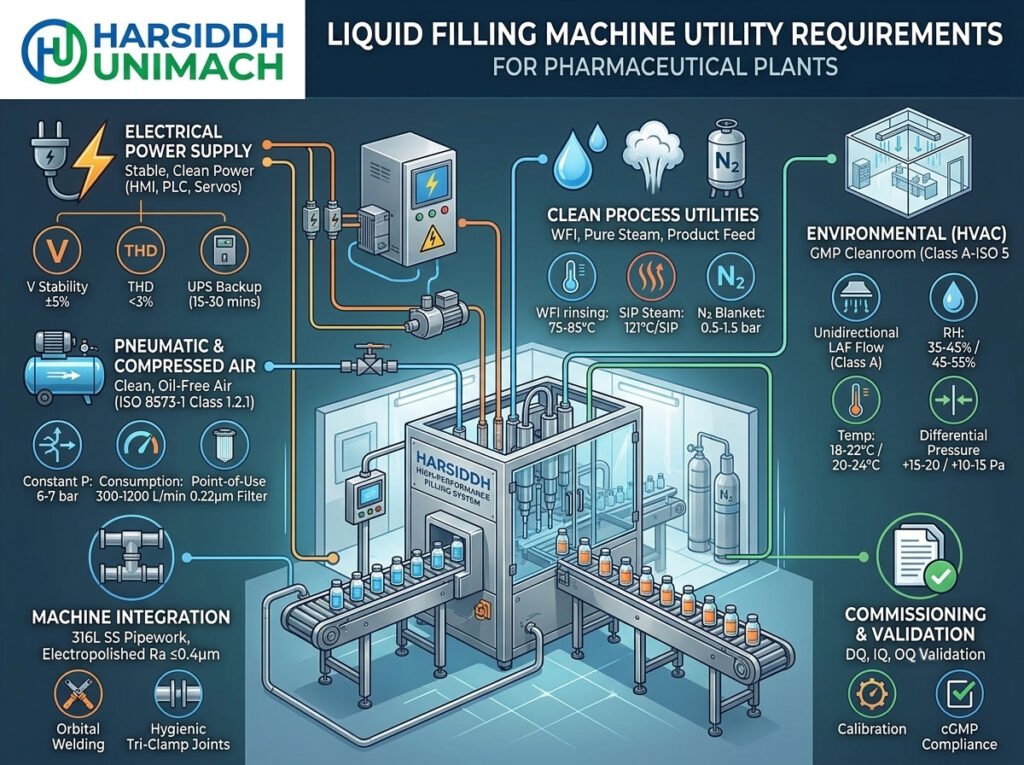
A liquid filling machine can be perfectly engineered and still perform poorly if the utilities feeding it are not right. Unstable power trips servo drives, wet or oily compressed air damages pneumatic valves and contaminates product areas, insufficient nitrogen leaves oxygen-sensitive products unprotected, and an undersized water supply starves the bottle washer. In practice, many commissioning delays and early production problems are utility problems, not machine problems.
Planning utilities correctly — before the machine arrives — saves time, protects product quality and supports smooth qualification. This guide explains the utilities a typical pharmaceutical liquid filling line needs, what quality and capacity to plan for, which machines use which utilities and how to prepare the site with a practical checklist.
Exact requirements vary by machine model, configuration and output. Always confirm values against each supplier’s utility specification and your site’s engineering standards.
Why Utility Planning Matters
- Performance: accurate filling depends on stable power, air pressure and environmental conditions.
- Product quality: air, gas and water that contact products or containers must meet defined quality standards.
- GMP compliance: utilities that affect product quality must be specified, qualified and monitored.
- Uptime: undersized or unreliable utilities cause stoppages and alarms.
- Cost: utility consumption is a significant part of operating cost — and a factor in filling machine ROI.
Ten Utilities a Liquid Filling Line Needs
1. Electrical Power
What uses it
Every machine on the line: servo and motor drives, PLCs and HMIs, pumps, heaters, sensors, conveyors, induction sealers and lighting.
What to plan
- Supply voltage, phase and frequency matching the machine specification
- Connected load and running load for each machine, plus a margin for future additions
- Stable supply — voltage fluctuations and spikes can trip drives and damage electronics
- Proper earthing — essential for safety and for reliable operation of servo drives and sensors
- Dedicated feeders and isolators for each machine
- Protection — circuit breakers, residual current protection and surge protection as required
- Backup power for controls where data loss or uncontrolled stops would be a problem
Practical tips
Servo-driven machines, such as the Automatic Servo Based Liquid Filling Machine and our servo based piston filling machine, are particularly sensitive to poor earthing and unstable supply. Voltage stabilisers or power conditioning may be needed where the grid is unreliable.
2. Compressed Air
What uses it
Pneumatic cylinders and valves, nozzle shut-off valves, stopper gates, pick-and-place heads, bottle air-jet cleaning, drying air in washers and some capping functions.
Quality requirements
Compressed air quality is commonly specified using ISO 8573-1, which classifies air by particle content, moisture (pressure dew point) and oil content. Typical expectations:
- Oil-free air for any air that may contact product, containers or product-contact surfaces
- Dry air to prevent moisture in valves and lines
- Filtered air — with appropriate filtration at the point of use; sterile-grade filtration where air contacts sterile product or containers
Capacity requirements
- Flow rate at the required pressure for every machine operating together
- Pressure — supply pressure must stay above the minimum required at the machine, even at peak demand
- Receiver capacity to smooth out demand peaks
Practical tips
- Install pressure regulators and filter-regulator units at each machine
- Plan for air consumption of bottle cleaners — an automatic bottle airjet and vacuum cleaning machine can be one of the largest air users on a line
- Fix leaks promptly — compressed air is expensive to produce
3. Nitrogen
What uses it
Nitrogen purging for oxygen-sensitive products — before, during and after filling — and blanketing of product holding tanks.
What to plan
- Purity appropriate for pharmaceutical use
- Supply source — cylinders, bulk liquid nitrogen or an on-site generator
- Flow and pressure to all gassing points
- Sterile-grade filtration at the point of use where gas contacts product
- Monitoring of pressure and flow
4. Water
What uses it
- Bottle and container washing — such as on a linear bottle washing machine
- Cleaning of product-contact parts and the machine
- Product manufacture (outside the filler, but often on the same utility system)
Water quality
- Potable water for general cleaning where permitted
- Purified water for cleaning product-contact parts and for washing containers for many oral products
- Water for Injection (WFI) for final rinsing of containers for parenteral products
What to plan
- Flow rate and pressure at the point of use
- Temperature if heated water is required
- Distribution loops designed to maintain water quality
- Sampling points for quality monitoring
5. Steam
What uses it
- Autoclaves for sterilising product-contact parts
- Sterilise-in-place (SIP) systems on some sterile filling equipment
- Heating of jacketed tanks or hoppers for viscous products
What to plan
- Clean steam where steam contacts product-contact surfaces
- Plant steam for indirect heating
- Pressure, flow, condensate return and safety valves
6. Vacuum
What uses it
Some filling and handling functions use vacuum — for example, vacuum heads for picking caps, measuring cups or stoppers, vacuum cleaning of bottles and vacuum-assisted filling in specific applications. The automatic measuring cup placement machine, for instance, may use vacuum or pneumatic pick-up.
What to plan
- Whether vacuum is generated by on-machine pumps or a central system
- Exhaust routing for vacuum pumps
- Filtration to protect pumps from product or dust
7. HVAC and Environmental Conditions
Why it matters
Temperature and humidity affect product viscosity, fill accuracy, label adhesion, electronic reliability and operator comfort. Cleanroom classification determines particle and microbial limits.
What to plan
- Room classification appropriate to the product — sterile, ophthalmic or oral
- Temperature and relative humidity within the ranges required for product and equipment
- Pressure differentials between rooms
- Heat load from machines — servo drives, heaters, induction sealers and lights add heat to the room
- Local extraction where needed — for example, for solvent-based products
8. Drainage
What uses it
Washers, cleaning stations and condensate from compressed air and steam systems.
What to plan
- Drain points near washers and cleaning areas
- Adequate capacity for peak discharge
- Hygienic design — trapped, cleanable drains suitable for classified areas
- Segregation of process and domestic drains where required
9. Space, Floor and Access
- Floor area for machines, operators, maintenance and changeover parts
- Floor loading capacity for heavier equipment
- Level floors for accurate conveyor alignment
- Access routes for installing machines
- Service space around machines for maintenance and cleaning
10. Data and Communication
Modern lines increasingly connect machines to each other and to plant systems:
- Network connections for line synchronisation
- Connections for batch reporting or data collection
- Remote support access, where allowed by site IT policy
Utility Matrix by Machine Type
| Machine | Power | Compressed Air | Nitrogen | Water | Vacuum |
|---|---|---|---|---|---|
| Bottle unscrambler | ✔ | Often | — | — | — |
| Bottle washer | ✔ | ✔ | — | ✔ | — |
| Air-jet / vacuum cleaner | ✔ | ✔ | — | — | ✔ |
| Servo piston filler | ✔ | ✔ (valves, gates) | Optional | Cleaning | — |
| Peristaltic filler | ✔ | Often | Optional | Cleaning | — |
| Load cell filler | ✔ | ✔ | Optional | Cleaning | — |
| Monoblock filler-capper | ✔ | ✔ | Optional | Cleaning | — |
| Capping machine | ✔ | Often | — | — | — |
| Measuring cup placer | ✔ | ✔ | — | — | Often |
| Induction sealer | ✔ | — | — | Cooling (some models) | — |
| Labeller | ✔ | Sometimes | — | — | — |
Examples include our peristaltic based liquid filling machine, load cell based liquid filling machine, liquid bottle filling and capping machine (monoblock) and induction sealing machine.
Utility Considerations for Specific Products
Oral liquids and syrups
Typically need purified water for cleaning, compressed air for pneumatics and bottle cleaning, and controlled temperature for consistent viscosity. A common setup includes the Automatic Liquid Bottle Filling Machine with upstream bottle cleaning and downstream capping.
Eye and ear drops
Require high-quality environments, sterile-filtered air and gases, and careful cleaning or single-use product paths. See the Automatic Eye/Ear Drop Filling Machine.
Oxygen-sensitive products
Need reliable nitrogen supply with sterile filtration, plus nitrogen blanketing of holding tanks.
Viscous products
May need heated hoppers or jacketed tanks, adding steam or electrical heating requirements.
Pre-Installation Checklist
Before the filling line arrives, confirm:
- Utility specifications received from every machine supplier
- Electrical supply installed with correct voltage, phase, earthing and protection
- Compressed air available at required pressure, flow and quality at each machine
- Nitrogen supply installed and filtered, if required
- Water supply at required quality, pressure and flow for washers and cleaning
- Steam available for autoclaves, SIP or heating, if required
- Vacuum arranged, if needed
- Drainage points in place
- HVAC commissioned, with room conditions meeting requirements
- Floor level and able to bear machine loads
- Access routes clear for delivery
- Network connections available, if required
- Utility qualification planned for systems that affect product quality
Common Utility Problems and Their Effects
| Problem | Effect on the Line |
|---|---|
| Voltage fluctuations | Servo drive trips, PLC resets, damaged electronics |
| Poor earthing | Sensor errors, communication faults, safety risk |
| Wet compressed air | Valve sticking, corrosion, contamination risk |
| Oily compressed air | Contamination of containers and product areas |
| Low air pressure at peak demand | Gates and valves fail to operate, jams |
| Insufficient nitrogen flow | Higher residual oxygen, reduced product stability |
| Low water pressure | Poor washing results, alarms |
| High room temperature | Viscosity changes, electronic overheating, label adhesion problems |
| Inadequate drainage | Flooding, hygiene risk |
Many of these problems show up as unplanned downtime. Our guide to common causes of downtime in pharmaceutical filling lines explains how to identify and prevent them.
Reducing Utility Consumption
Utilities are a recurring cost, so efficiency pays back year after year:
- Fix compressed air leaks and switch off air to idle machines
- Right-size pressure — avoid running air systems higher than needed
- Recirculate washing water where the process allows
- Use air-jet cleaning instead of water washing where appropriate
- Choose servo drives, which use energy more efficiently than many pneumatic alternatives
- Reduce changeover time, so utilities aren’t consumed during long setups — see engineering methods to improve changeover time
Read more in our article on green manufacturing and reducing waste in liquid filling processes.
Working With Your Machine Supplier
A good supplier provides a clear utility specification for each machine, including power, air, gas and water requirements, consumption figures and connection details. Share your site’s utility capabilities early, so the supplier can recommend equipment that fits — and highlight any upgrades needed. Our guide on how to choose the right filling machine for your production line covers the wider selection process.
Frequently Asked Questions
What utilities does a liquid filling machine need? Typically electrical power and compressed air, plus nitrogen for oxygen-sensitive products, water for washing and cleaning, and sometimes steam and vacuum.
What quality of compressed air is required? Clean, dry, oil-free air, often specified using ISO 8573-1 classes, with sterile-grade filtration where air contacts sterile products or containers.
Why is earthing important for servo filling machines? Poor earthing can cause electrical noise, sensor errors and drive faults, and creates safety risks.
Do all filling lines need nitrogen? No. Nitrogen is needed mainly for oxygen-sensitive products or for blanketing holding tanks.
When should utilities be planned? Before ordering equipment and well before installation, so supply capacity, quality and connections are ready when the machines arrive.
Planning a new liquid filling line? Explore our liquid filling machines and the full range of liquid filling machines on Harsiddh Engineering, contact our team or send an inquiry for a utility specification for your line.