
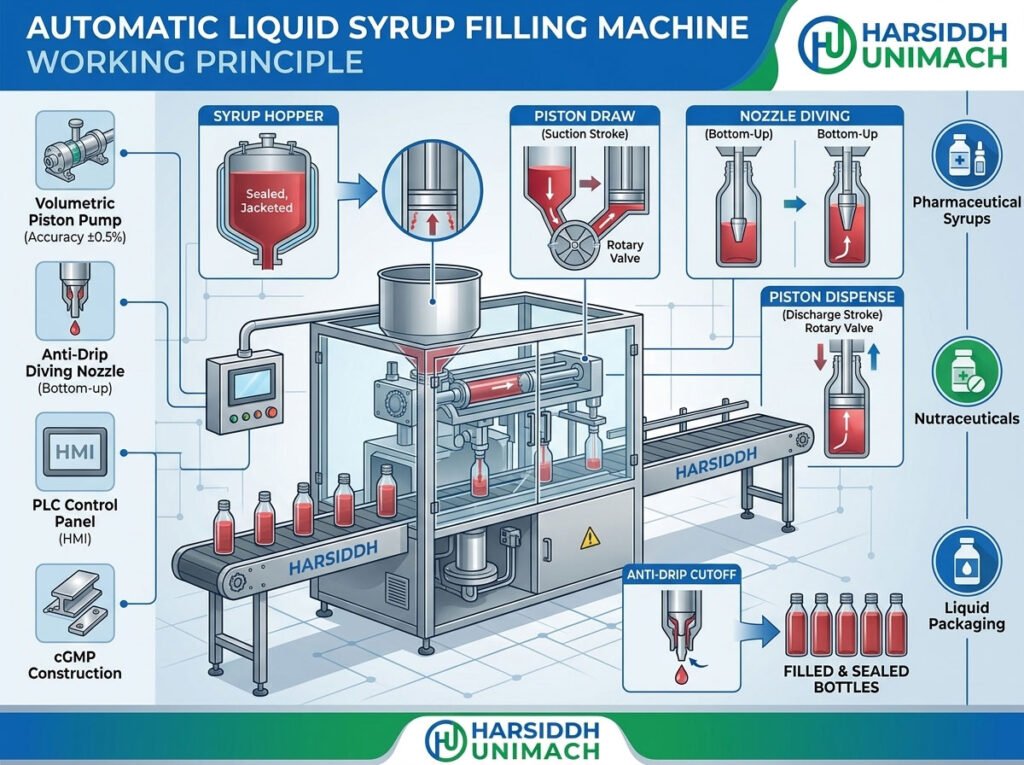
In the modern pharmaceutical, nutraceutical, and beverage industries, maintaining absolute precision in liquid packaging isn’t just an operational goal—it is a strict regulatory requirement. Viscous formulations, sticky oral drops, and high-sugar pharmaceutical syrups present unique material handling challenges. Manual or semi-automatic filling methods simply cannot keep pace with high-volume production demands or match the razor-thin margin of error allowed for exact dosage delivery.
This is where the Automatic Liquid Syrup Filling Machine becomes indispensable.
As a leading manufacturer of high-performance industrial packaging machinery, Harsiddh Unimach Pvt. Ltd. engineers state-of-the-art liquid packaging solutions designed to deliver uncompromising accuracy, speed, and hygienic operations. In this technical guide, we break down the inner workings, mechanism variants, core components, and step-by-step working principles that drive an industrial-grade syrup filling system.
What is an Automatic Liquid Syrup Filling Machine?
An automatic liquid syrup filling machine is an advanced electromechanical system engineered to dispense precise volumes of low-to-high viscosity liquids into containers (such as glass or PET bottles, vials, and jars) without human intervention.
Unlike free-flowing liquids like water, medicinal syrups possess higher density and viscosity, and are often prone to foaming, stringing, or dripping. Industrial filling machinery must handle these physical properties carefully to prevent product waste, bottle contamination, and volumetric inconsistencies.
Core Components of an Automatic Syrup Filling Machine
To understand the working principle, we must first look at the mechanical anatomy of the machine. An automated system from Harsiddh Unimach Pvt. Ltd. integrates several synchronized sub-systems:
- Feeding & Conveyor Assembly: A motorized stainless steel (SS 304/316) conveyor belt that transports empty bottles from the washing or turn-table station to the filling zone, and carries filled bottles to the capping machine.
- Pneumatic Bottle Stoppering & Gating System: Utilizes pneumatic indexing gates (star wheels or stopper pins) to accurately hold a predetermined number of bottles directly beneath the filling heads.
- Product Storage Tank (Hopper): A sanitized, pressure-balanced or gravity-fed vessel that holds the bulk syrup formulation before dispensing.
- Volumetric Dosing Syringes / Piston Pumps: Precision-machined mechanical cylinders that draw a calculated volume of liquid from the hopper and displace it into the bottles.
- Diving Nozzles with Anti-Drip Mechanism: Specialized filling nozzles that lower themselves into the bottle neck during dispensing to prevent foaming, splashing, and accidental dripping.
- PLC Control Panel & HMI Screen: The computerized brain of the machine where operators configure filling volumes, conveyor speeds, and monitor real-time diagnostics.
The Step-by-Step Working Principle of Syrup Filling Machines
The fundamental mechanical sequence of an automatic syrup filling machine operates on a highly synchronized, cyclic process driven by a Programmable Logic Controller (PLC). Let’s trace the journey of a bottle through the production line.
1.Bottle Feeding and Infeed Indexing:Phase 1.
Empty containers move along the continuous stainless steel conveyor belt. As they approach the filling station, an optical sensor counts the incoming bottles. Once the programmed number of bottles (e.g., 4, 6, or 8 heads) enters the zone, a pneumatic stopper gate engages to halt the line, aligning each bottle perfectly beneath a corresponding filling nozzle.
2.The Volumetric Suction Stroke:Phase 2.
While the bottles are being indexed, the filling pumps prepare the dose. A rotary or 3-way valve switches its position to open the passage between the product storage hopper and the dosing syringe cylinder. The piston moves downward or backward, creating a vacuum that pulls an exact volume of syrup from the hopper into the cylinder chamber.
3.Nozzle Diving and Positioning:Phase 3.
To eliminate foaming—a common issue with high-viscosity sugar syrups—the machine utilizes a pneumatic or servo-driven diving nozzle assembly. The filling nozzles descend into the necks of the stabilized bottles. For highly prone-to-foam liquids, the nozzles sink near the bottom of the bottle and slowly retreat upward as the liquid level rises (bottom-up filling).
4.The Displacement & Discharge Stroke:Phase 4.
The 3-way valve shifts position again, closing the path to the hopper and opening the channel to the discharge nozzle. The piston drives forward or upward, displacing the exact volume of syrup contained within the cylinder out through the nozzle tips and cleanly into the awaiting bottles.
5.Anti-Drip Cutoff and Outfeed:Phase 5.
Once the stroke concludes, a pneumatic suck-back or positive shut-off valve within the nozzle tip activates instantly. This cuts off the liquid stream cleanly, preventing any residual drops from trailing onto the bottle threads. The diving nozzles lift completely, the exit gating system retracts, and the conveyor moves the filled bottles toward the capping section while letting a fresh batch of empty containers in.
Different Types of Syrup Filling Mechanisms
Depending on production scale, syrup thickness, and accuracy requirements, different filling mechanisms are utilized across industrial lines:
1. Piston Filling Mechanism (Volumetric Displacement)
This is the gold standard for dense, sticky medicinal syrups. It relies on a mechanical piston driving inside a calibrated chamber. Because volume is governed strictly by the physical stroke length of the piston, it delivers exceptional volumetric accuracy (typically within ±0.5%), regardless of fluctuations in product temperature or viscosity.
2. Servo-Driven Flow Meter Filling
For ultra-modern lines demanding fast changeovers between different bottle sizes, servo-driven flow meters are used. Each filling head features an electromagnetic or mass flow meter that measures the precise volume passing through it in real time. Operators can alter filling sizes from 50ml to 500ml directly via the HMI touchscreen without swapping out mechanical syringes.
3. Vacuum-Gravity Overflow Filling
Mainly used when containers must be filled to an exact visual height rather than a specific volume. The nozzle seals against the bottle rim, pumping liquid until it reaches an overflow port, where excess syrup is pulled back into a reservoir via vacuum.
Key Technical Specifications of Industrial Syrup Fillers
When sourcing an automated line, evaluating operational limits is critical to matching your facility’s output targets. Below is a standard baseline layout of performance characteristics:
| Feature/Specification | Linear Automatic Filling System | Rotary High-Speed System |
| Output Speed | 30 to 120 Bottles / Minute | 120 to 300+ Bottles / Minute |
| Number of Heads | 2, 4, 6, or 8 Heads | 12 to 36+ Rotational Stations |
| Filling Range Volume | 10 ml to 1000 ml (With appropriate syringes) | 30 ml to 500 ml |
| Accuracy Tolerance | ±0.5% to ±1% of filling volume | ±0.5% |
| MOC (Material of Construction) | SS 316 for contact parts, SS 304 frame | Full SS 316 Contact, GMP Compliant |
| Air Consumption | 4 to 6 Bar Pressure | 6 Bar Constant Pressure |
Critical Factors That Ensure Flawless Syrup Filling Operations
To achieve peak operational efficiency (OEE) and maintain compliance with international GMP (Good Manufacturing Practice) norms, your filling line must solve several real-world material challenges:
- Viscosity Management: Syrups change flow characteristics depending on ambient cleanroom temperatures. Advanced fillers can be integrated with jacketed pre-heating hoppers to maintain uniform fluid density, ensuring uniform flow rates.
- Foam Mitigation: High-speed filling can introduce air pocket turbulence into sugary fluids. Utilizing programmable Bottom-Up Servo Diving Nozzles minimizes agitation by keeping the nozzle tip just millimeters above the rising fluid surface.
- No Bottle – No Fill Safety System: Integrated photoelectric proximity sensors constantly monitor the line. If a bottle falls over or a gap occurs in the incoming queue, the PLC commands that specific filling head to skip its stroke, entirely eliminating machine downtime and messy cleanups.
- Sanitization and CIP (Clean-In-Place): Pharmaceutical production requires intense cleaning between batches to prevent cross-contamination. Elite syrup fillers feature sanitary tri-clamped fittings and specialized CIP bypass modes that allow sanitizing agents to flush through the pumps and nozzles thoroughly without dismantling the hardware.
Why Choose Harsiddh Unimach Pvt. Ltd. for Your Liquid Packaging Lines?
Selecting the right packaging machinery partner transforms your production throughput and safeguards product quality. At Harsiddh Unimach Pvt. Ltd., we combine decades of mechanical engineering experience with cutting-edge automation to manufacture elite-tier industrial liquid filling systems.
Our Machinery Competitive Advantages:
- cGMP-Compliant Designs: Every machine features full stainless steel construction with smooth, crevice-free contact points designed for strict sanitary verification.
- High Volumetric Consistency: Advanced engineering minimizes component wear, maintaining exceptional accuracy across extended multi-shift manufacturing cycles.
- User-Centric Automation: Tailored PLC integrations featuring intuitive touchscreen HMIs provide operators complete control over diagnostic tracking, batch settings, and speed synchronization.
- Scalable Customization: From standalone linear multi-head fillers to fully integrated turnkey lines featuring washing, filling, capping, and labeling automation—we construct custom production workflows suited to your factory floor space and budget.
Maximize Your Production Efficiency Today
Whether you are expanding an existing pharmaceutical formulation facility, scaling up a nutraceutical bottling line, or upgrading your syrup packaging speed, understanding the technical physics of your machinery ensures long-term operational success.
Optimize your industrial liquid manufacturing floor with precision-engineered automation. For detailed product catalogs, technical customization consultations, or price quotes, connect with our engineering department directly:
- Corporate Website: www.harsiddhunimach.com
- Official Inquiry Mail: info@harsiddhunimach.com
- Manufacturing Unit: Harsiddh Unimach Pvt. Ltd., Gujarat, India.