
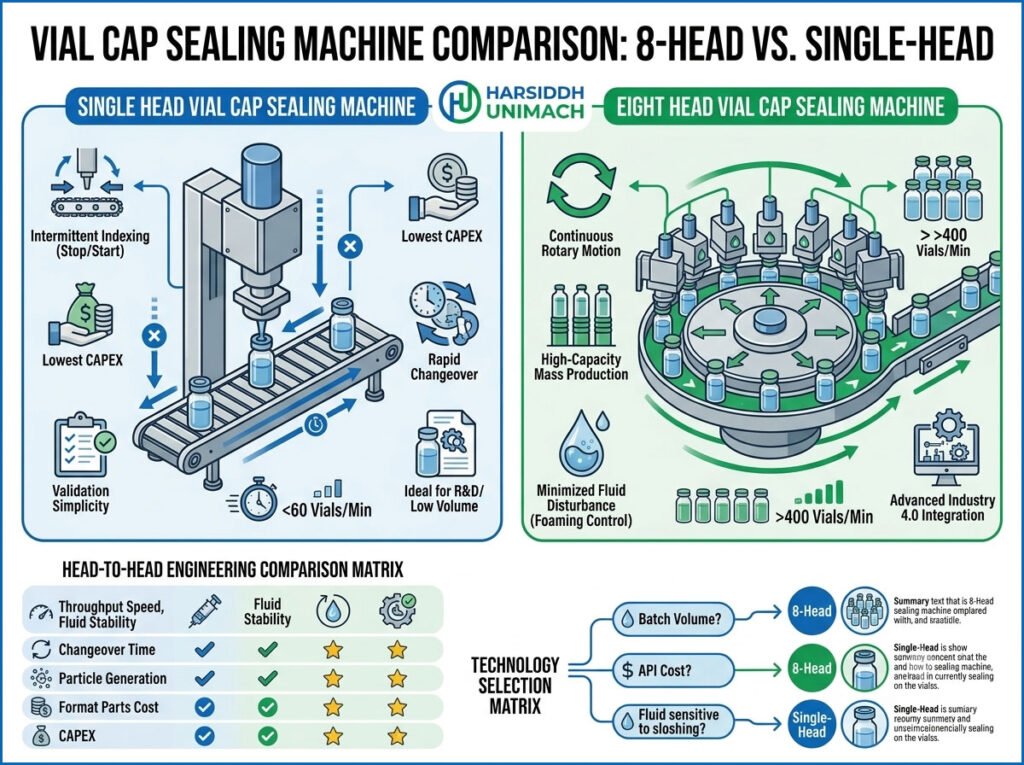
In small-volume parenteral (SVP) packaging, selecting the correct liquid dosage container closure system is only half the battle. Maintaining the sterile integrity of the product until it reaches the patient requires a statistically verifiable, hermetic seal between the rubber stopper, the vial crown, and the aluminum cap. Choosing between an Eight Head Vial Cap Sealing Machine and a Single Head Vial Cap Sealing Machine is a strategic engineering decision that directly impacts operational uptime, batch repeatability, regulatory compliance, and total cost of ownership.
Engineering these advanced sealing systems, which manage synchronized mechanics, precise torque control, and container transport, requires a fundamental understanding of fluid dynamics and cGMP-compliant design principles. At Harsiddh Unimach Pvt. Ltd., we have spent over three decades engineering precise pharmaceutical machinery, including cGMP-compliant ampoule processing and vial filling lines capable of handling up to 18,000 containers per hour.
This comprehensive technical guide breaks down the structural mechanics, operational dynamics, advantages, and limitation profiles of eight-head vs. single-head mechanisms to help process engineers and facility managers optimize their sterile processing lines.
1. Defining the Core Mechanical Functions
Before analyzing the differences, it is crucial to establish the common mechanical function both machines must perform perfectly, in line with international standards like FDA 21 CFR Part 211 and ISO 13485.
Vial sealing (often called crimping) is not simply about applying a cap. It is a four-step process that must occur in a validated sequence:
[ Top-Load Compression of Stopper ] ──► [ Axial Formation of the Crimp ] ──► [ Radial Pressure and Tuck ] ──► [ Measurement of Residual Seal Force (RSF) ]
- Vial Platform & Centering: The stoppered vial is positioned and centered directly beneath the sealing head.
- Top-Load Application: The sealing head descends, applying a calibrated, spring-loaded, or pneumatically assisted vertical force (top load). This force compresses the elastomeric stopper face against the glass crown, establishing the initial microbial barrier.
- Crimping Mechanic: The machine uses either dynamic spinning rollers or a radial collet to deform the aluminum cap skirt inward, underneath the glass crown ridge.
- Resilience & Restoration: Once the head retracts, the compressed stopper “breathes,” pushing upward against the newly formed aluminum crimp, maintaining a constant seal pressure (Residual Seal Force).
2. Understanding the Single Head Vial Cap Sealing Machine
Mechanics of Intermittent Motion
The Single Head Vial Cap Sealing Machine operates on an intermittent motion principle. This means the transport conveyor must physically stop, indexing the single container precisely beneath the single sealing head.
[ Slat Conveyor ] ──► [ Indexing Star Wheel (PAUSE) ] ──► [ Single Sealing Stroke ] ──► [ Star Wheel indexes NEXT Vial (START) ]
Once the star wheel pauses, the single sealing spindle descends, performs the top-load compression and radial crimp, and then retracts. Only then does the star wheel advance to the next position.
When to Select Single-Head Systems: Key Advantages
- Ultimate Validation Precision: With only one variable to track (one sealing spindle), calibrating, validating (IQ/OQ/PQ), and documenting consistent Residual Seal Force is geometrically simpler. Every batch has a validated process signature tied to a single set of mechanical tolerances.
- Rapid Format Changeovers: Lines that switch frequently between 2 ml and 100 ml vials benefit from the minimalist design. Single changeover parts (one star wheel, one feed worm) mean minimal downtime—often under 30 minutes.
- Ideal for Low-Volume / High-Value R&D: For expensive active pharmaceutical ingredients (APIs), biological proteins, or clinical trial batches, high speed is secondary to zero-defect processing. Single-head machines offer excellent stability with zero risk of vial breakage from synchronized turret speeds.
- Lowest Capital Expenditure: The simplified architecture, lack of complex turret synchronization, and fewer moving parts make it an attractive entry-level cGMP system for pilot plants or small compounding pharmacies.
Limitations of Single-Head Systems
- Strict Throughput Ceiling: The unavoidable intermittency of stopping and starting the conveyor severely restricts output, typically capping speeds between 40 and 60 vials per minute. Any attempt to run faster compromises seal quality as dwell time decreases.
- Higher Labor Requirement Per Unit Output: Operating a line at 3,000 vials per hour requires the same regulatory operator and QC oversight as a line running at 15,000 vials per hour, increasing the overall cost of goods manufactured (COGM).
3. Understanding the Eight Head Vial Cap Sealing Machine
Mechanics of Continuous Motion Rotary Turrets
The Eight Head Vial Cap Sealing Machine is a highly engineered continuous-motion rotary unit. The key to its performance is synchronization: the transport conveyor, infeed scroll, star wheels, and central rotating turret all move without stopping.
[ Continuous Infeed Scroll ] ──► [ Infeed Star Wheel ] ──► [ CENTRAL 8-HEAD ROTARY TURRET (360° Synchronized Rotation) ] ──► [ CCIT Rejection (Optional) ] ──► [ Outfeed Discharge ]
As the turret rotates, the eight independent, spring-loaded sealing spindles descend over the vials “on the fly.” Crucially, each spindle performs the complete sealing cycle during its arc of rotation, completing a full 360° rotation to seal eight containers in one single index. This continuous flow avoids sudden velocity changes and liquid splashing.
When to Select Eight-Head Systems: Key Advantages
- High-Capacity Mass Production: This machinery is an industrial workhorse, capable of output speeds from 240 to over 400 vials per minute, essential for high-volume vaccine production, large-batch antibiotics, or high-throughput filling lines.
- Minimized Fluid Dynamics Disturbances: Intermittent motion (single-head) creates sloshing within filled vials. Continuous rotary motion provides a smooth velocity curve, preventing cosmetic splash defects, reducing foaming in biologics, and maintaining batch homogeneity.
- Advanced Automation Integration (Industry 4.0): Harsiddh Unimach eight-head cappers easily integrate servo-motor drives, PLC controls, and human-machine interface (HMI) screens for real-time statistical process control.
- Reduced Particle Generation: Many eight-head systems utilize highly polished tungston carbide sealing rollers or collets, minimizing aluminum flaking and keeping dark-room particle counts low.
Limitations of Eight-Head Systems
- Higher Technical and Maintenance Requirements: Managing eight separate spindles requires synchronized timing, turret bearing maintenance, and more extensive utility setups. Validation documentation also increases eight-fold.
- Expensive and Lengthy Changeovers: Swapping between format sizes requires replacing eight sealing heads, multiple star wheels, and guide rails. The changeover time is longer (1.5 to 2 hours) and the required format parts carry a higher cost.
4. Head-to-Head Engineering Comparison Matrix
This matrix provides process engineers with a quantitative evaluation of both filling technologies.
| Engineering Parameter | Single Head Vial Cap Sealing Machine | Eight Head Vial Cap Sealing Machine |
| Motion Principle | Intermittent (Index / Stop / Start) | Continuous (Synchronized Rotary Flow) |
| Throughput Speed Range | 40–60 Vials/Min (Max ~3,600 vials/hour) | 240–400+ Vials/Min (Up to ~24,000 vials/hour) |
| Volumetric Fluid Stability | Poor (Prone to sloshing, foaming) | Superior (Smooth velocity, low disturbances) |
| Residual Seal Force Repeatability | Geometrically simpler to validate (one source) | High, but requires validating eight independent sources |
| Particle Generation (cGMP) | Moderate | Low to Extremely Low (depending on head tech) |
| Changeover Time (Downtime) | Excellent (~20–30 mins) | Moderate (~1.5–2.0 hours) |
| Format Parts Cost | Low | High |
| Capital Expenditure (CAPEX) | Low (Entry-Level / Pilot Plant) | High (Industrial Scale) |
5. Technology Selection Matrix: Which Machine Does Your Facility Need?
The optimal choice depends on balancing multiple constraints: batch volume, API cost, liquid formulation stability, and facility technical depth.
                    ┌──────────────────────────────┐
                    │  What is your desired output?│
                    └───────────────┬──────────────┘
                                    │
            ┌───────────────────────┴───────────────────────┐
            ▼                                               ▼
  [ Low Volume (< 10,000/Day) ]               [ High Volume (> 50,000/Day) ]
            │                                               │
            ▼                                               ▼
  Are you processing expensive             Does your liquid formulation foam
  biologics or handling multiple           easily when agitated?
  format changes daily?                     ├─ YES ──► 8-HEAD (CONTINUOUS)
      ├─ YES ──► SINGLE HEAD                └─ NO  ──► BOTH APPLICABLE
      └─ NO  ──► SINGLE HEAD                    (Select based on budget)
Choose the SINGLE HEAD Vial Cap Sealing Machine If:
- Batch sizes are small and frequent: For clinical trials, compounding pharmacies, or veterinary biologics with multiple size variations, rapid changeover is the single most valuable metric.
- You process expensive APIs: The zero-defect philosophy of intermittent motion minimizes the risk of synchronized jams or breaking rare, expensive glass vials.
- Validating microbial integrity is the #1 priority: With only one spindle to calibrate, providing high statistically verified Residual Seal Force consistency is guaranteed with minimalist documentation.
Choose the EIGHT HEAD Vial Cap Sealing Machine If:
- Line efficiency and throughput are critical: Facilities running large-scale campaigns of vaccines, antibiotics, or standard injectables need rotary speeds to optimize asset utilization.
- Liquid products are sensitive to sloshing: Continuous motion prevents liquid splashing defects, which is vital for sterile parenteral products, especially biological serums and proteins prone to foaming.
- Advanced automation is already in place: Facilities equipped with automated rejection systems, online camera inspection, and servo control will maximize the ROI of an eight-head rotary turret.
6. Engineering Innovations from Harsiddh Unimach Pvt. Ltd.
At Harsiddh Unimach Pvt. Ltd., we engineering solutions for sterile processing, extending from high-speed vial washing and sterilization tunnels to precision liquid filling and stopper insertion machinery. Our vial cap sealing technology—whether single-head lab units or high-speed industrial eight-head processing lines—integrates the latest mechanical and electronic advancements.
Key Technical Advantages of Harsiddh Sealing Machinery
- Servo-Controlled Spindles: We utilize independent servo drives to control spindle rotation speeds and torque dynamically, offering digital dosing calibration via an HMI touchscreen.
- cGMP Stainless Steel Architecture: All product contact parts utilize SS 316L, and main frames are SS 304, featuring smooth, angled surfaces for quick Clean-in-Place (CIP) or Sterilize-in-Place (SIP) access.
- “No Vial – No Cap” and “No Cap – No Seal” Safety Interlocks: Integrated optical proximity sensors prevent wasting expensive flip-off or tear-off seals and eliminate batch contamination risks.
- Particle Minimization Technology: Optional tungsten carbide or micro-polished stainless steel sealing rollers and collet mechanisms minimize particle generation near the open vial neck.
- Comprehensive Turnkey Solutions: Harsiddh provides fully synchronized lines from infeed rotary tables to CCIT rejection stations and automated labeling, minimizing engineering integration risks for end-users.
Frequently Asked Questions (FAQ)
What output speed can a Single Head Vial Cap Sealing Machine achieve?
An intermittent-motion single-head capper typically reaches speeds between 40 and 60 vials per minute, depending on the vial size, liquid formulation, and operator skill during changeovers.
Is the “No Vial – No Cap” safety system standard on Harsiddh machines?
Yes. To ensure efficient production and minimize waste in both liquid injectables and dry powder filling, all Harsiddh automated capper models include standard “No Vial – No Cap” sensors.
Can an eight-head sealer handle both flip-off and tear-off aluminum caps?
Yes. The engineering flexibility of our vibratory cap elevators and chute mechanisms allows for the precise sorting and delivery of both aluminum flip-off and tear-off seal designs.
Upgrade Your Sterile Packaging Line with Harsiddh Unimach
Selecting the proper vial container closure technology—whether a single-head intermittently indexed unit or an eight-head continuous-motion rotary turret—requires balancing complex constraints, from initial CAPEX and viscosity limitations to strict cGMP compliance requirements. Harsiddh Unimach Pvt. Ltd. specializes in engineered tailored machinery for sterile parenteral production, prioritizing repeatability, high output, and zero neck contamination.
Explore our full range of ampoule processing, vial washing, and sealing solutions at www.harsiddhunimach.com.
- Website: www.harsiddhunimach.com
- Direct Email Inquiry: info@harsiddhunimach.com
- Specialization: Automatic Ampoule Filling & Sealing Lines, Vial Filling Machinery, Injectable Dry Powder Equipment, and cGMP Sterile Processing Technology.