
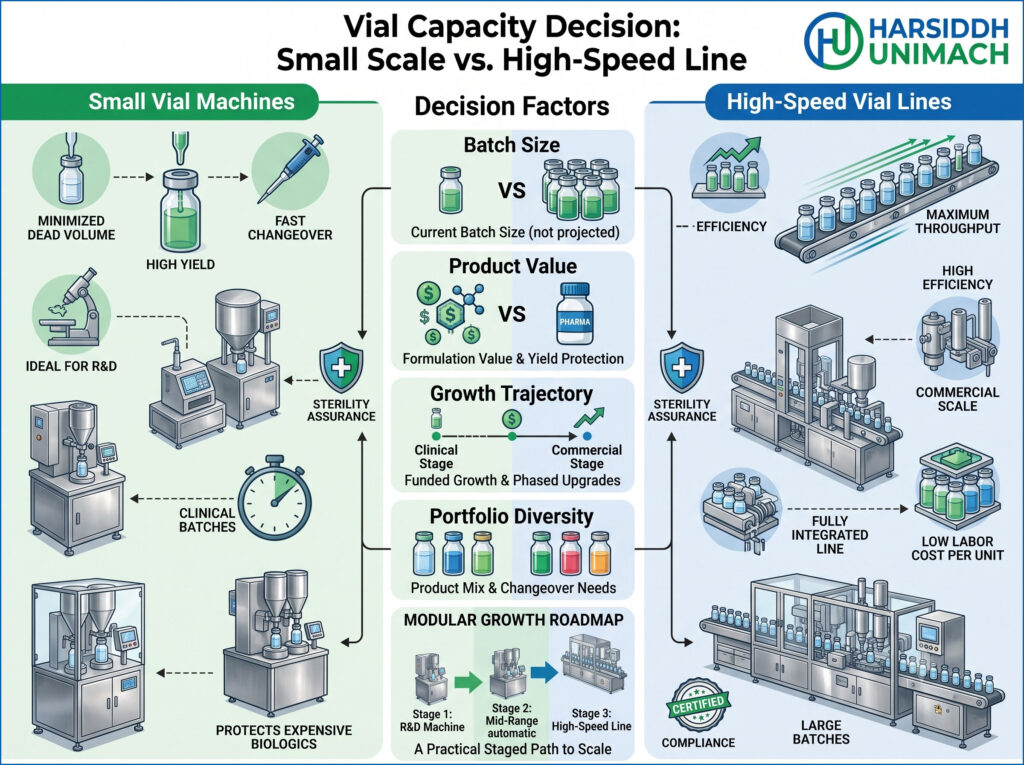
One of the most important decisions when investing in injectable production is capacity. Should you buy a compact vial filling machine with a few heads, or a high-speed line capable of filling many vials per minute? Choose too small, and you will face bottlenecks, overtime and early replacement. Choose too large, and you will tie up capital in capacity that sits idle, pay for more change parts and lose more product at every start-up.
The right answer depends on your demand, batch sizes, product mix, changeover needs, facility and growth plans. This article explains how small vial machines and high-speed lines differ, shows how to calculate the capacity you actually need with a worked example, and offers a practical framework for making the decision.
Small Vial Machines vs High-Speed Lines
| Factor | Small Vial Machine | High-Speed Vial Line |
|---|---|---|
| Typical configuration | One to four heads, compact frame, sometimes monoblock | Multiple heads, integrated washer, tunnel, filler, capper, inspection |
| Output | Low to medium | High |
| Batch sizes | Small to medium | Large |
| Changeover | Quick, few change parts | Longer, more change parts across machines |
| Flexibility | Very high | Lower, optimised for fewer products |
| Footprint | Small | Large |
| Investment | Lower | Higher |
| Product loss per batch (hold-up, start-up) | Lower | Higher |
| Labour per vial | Higher | Lower |
| Best for | Clinical supply, small batches, multi-product plants | High-volume, dedicated products |
Examples of smaller machines include the Two Head Liquid Vial Filling Stoppering Machine; higher-output machines include the Six Head Liquid Vial Filling Stoppering Machine and the Automatic Servo Based Vial Filling Machine.
Step 1: Calculate the Capacity You Actually Need
The basic formula
Required rated speed = Annual demand ÷ (Production days × Hours per day × 60 × Overall efficiency)
Overall efficiency accounts for everything that stops or slows production: changeovers, cleaning, line clearance, breaks, maintenance, minor stops and rejects. It is always well below 100%.
A worked illustrative example
The following figures are illustrative only:
| Assumption | Value |
|---|---|
| Annual demand | 2,000,000 vials |
| Production days per year | 250 |
| Shift length | 8 hours |
| Overall efficiency | 60% |
One shift per day:
- Available minutes per year = 250 × 8 × 60 = 120,000 minutes
- Speed needed at 100% efficiency = 2,000,000 ÷ 120,000 ≈ 16.7 vials per minute
- Speed needed at 60% efficiency = 16.7 ÷ 0.6 ≈ 28 vials per minute
Two shifts per day:
- Available minutes double to 240,000
- Required rated speed at 60% efficiency ≈ 14 vials per minute
This example shows how strongly the number of shifts and realistic efficiency affect the machine size you need. If the same demand were met at a lower efficiency, for example because of frequent changeovers, the required rated speed would rise further. It also shows why simply comparing rated speeds without considering efficiency leads to undersized lines.
Add growth headroom
Add capacity for expected growth over the next few years, but avoid planning for highly uncertain future volumes with a line that will run mostly idle today. A practical approach is to size the line for confirmed demand plus a realistic growth margin, and to plan the room, utilities and layout so that additional capacity can be added later.
Step 2: Consider Batch Sizes
Batch size often matters as much as annual volume.
- Small batches (clinical supplies, orphan drugs, contract manufacturing) favour small machines. A high-speed line might fill the batch in minutes but take far longer to set up, clean and qualify, and lose more product in its longer fluid path.
- Large batches of a single product favour high-speed lines, where set-up time is spread over many vials.
Step 3: Analyse Your Product Mix and Changeovers
| Situation | Better Fit |
|---|---|
| Many products, frequent changeovers | Small machine or flexible servo machine |
| Few products, long runs | High-speed line |
| Many vial sizes | Small machine with simple change parts |
| One or two vial sizes | High-speed line |
| High-value products where every vial counts | Small machine with low hold-up |
On a multi-product line, changeover time can consume a large share of available time. A small, flexible machine may deliver more real output than a faster line that spends hours changing over.
Step 4: Consider Facility and Footprint
High-speed lines need more space in classified cleanrooms, larger HVAC systems and more utility capacity. Small machines, especially compact monoblocks, can fit into smaller rooms and are often easier to place inside barrier systems. Read monoblock vial filling, stoppering and capping explained.
Step 5: Compare Investment and Operating Costs
Investment
High-speed lines require more investment in machines, change parts, facility, utilities and qualification. Read aseptic vial filling line cost: key cost drivers explained.
Operating costs
- Labour per vial is usually lower on high-speed lines
- Product loss per batch is usually lower on small machines
- Utilities scale with line size and cleanroom area
- Maintenance is more complex on larger lines
If you are moving from manual or semi-automatic filling, see automatic vs semi-automatic vial fillers: ROI analysis for growing pharma labs.
Step 6: Assess Risk
Risks of undersizing
- Bottlenecks and missed orders
- Overtime, extra shifts and staff fatigue
- Early replacement or costly additional lines
Risks of oversizing
- Capital tied up in idle capacity
- Higher product loss per batch
- More complex qualification and maintenance
- Reduced flexibility
Single line vs multiple smaller lines
Two smaller lines can sometimes be better than one large line:
- Redundancy – if one line stops, the other can keep running
- Parallel products – two products can be filled at the same time
- Phased investment – the second line can be added when demand grows
Contract Manufacturers: A Special Case
Contract manufacturers face particular capacity challenges. They often handle many clients, each with different products, vial sizes, batch sizes and timelines. For them, the ability to change over quickly, run small and medium batches efficiently and document each batch clearly is often more valuable than maximum speed. A combination of flexible, smaller machines for development and small commercial batches, and one higher-capacity line for the largest contracts, is a common and effective approach.
Step 7: Plan for Growth
- Choose upgradeable machines – fillers that accept extra heads or servo upgrades
- Design the room for a larger line – leave space and utility capacity
- Start with a smaller line for clinical and early commercial supply, then add a high-speed line for established products
- Keep the smaller machine for small batches, new products and contract work once the larger line is running
High-Speed Lines: Special Considerations
High-speed lines bring their own technical challenges, such as vial handling at speed, breakage, foaming during fast dosing and synchronising multiple machines. Read challenges in high-speed vial processing and their solutions and top 5 causes of vial breakage on high-speed filling lines.
A high-speed line typically includes:
- A high-capacity washer, such as the linear vial washer or the rotary vial washing machine
- A sterilizing tunnel for ampoules and vials matched to the filler’s output
- A multi-head filler, such as the liquid vial filling machine with rubber stoppering
- A vial cap sealing machine with enough heads to keep pace
- Inspection on a visual ampoule and vial inspection machine and labelling on a vial sticker labeling machine
Integrated solutions such as the automatic liquid vial filling line offer a balanced, compact alternative for medium outputs. Browse the vial filling machines for liquid vials.
What Affects Overall Efficiency?
Overall efficiency is the most uncertain number in the capacity calculation, so it helps to understand what drives it:
| Factor | Effect on Efficiency |
|---|---|
| Number of changeovers | More changeovers reduce available filling time |
| Changeover duration | Longer changeovers reduce efficiency further |
| Cleaning and line clearance | Required between batches and products |
| Batch size | Small batches spend proportionally more time on set-up |
| Machine reliability | Breakdowns and minor stops reduce running time |
| Interventions | In aseptic filling, interventions interrupt production |
| Reject rate | Rejected vials reduce good output |
| Staffing and breaks | Lines may stop during breaks unless staffed for continuous running |
| Line balance | A slow machine anywhere limits the whole line |
When estimating efficiency, use data from your existing lines where possible. If no data exists, take a conservative view and remember that new lines usually take time to reach their best performance.
Data You Need Before Sizing a Line
- Annual and monthly demand for each product, now and forecast
- Typical and minimum batch sizes
- Number of products and vial sizes
- Expected changeovers per week or month
- Working pattern – days per year, shifts per day, hours per shift
- Fill volumes for each product
- Special requirements – nitrogen, lyophilisation, high potency
- Facility constraints – room size, cleanroom grade, utilities
Collecting this data before talking to suppliers leads to better proposals and a more accurate sizing.
Common Sizing Mistakes
- Using rated speed without an efficiency factor, which leads to undersized lines
- Planning for best-case demand that may never materialise
- Ignoring changeover time on multi-product lines
- Focusing on the filler alone while washers, tunnels or cappers limit output
- Forgetting about product loss at start-up and line clearance on larger lines
- Not leaving space for future expansion
Reviewing Capacity Over Time
Capacity needs change. Review your line performance and demand forecasts at least once a year. Track actual output, efficiency and changeover times, and compare them with demand. Early warning signs, such as regular overtime, growing backlogs or rising changeover counts, indicate when it is time to add capacity, while consistently idle time may suggest that a planned expansion can be postponed.
Decision Framework
| If You… | Consider |
|---|---|
| Produce clinical batches or small commercial batches | Small vial machine |
| Run many products with frequent changeovers | Small or flexible servo machine |
| Fill high-value products where every vial counts | Small machine with low hold-up |
| Have one or two high-volume products | High-speed line |
| Have limited cleanroom space | Compact machine or monoblock |
| Expect strong but uncertain growth | Start smaller, plan space for expansion |
| Need redundancy | Two smaller lines |
Our vial filling line checklist: 7 things to evaluate before buying can help structure your evaluation.
Frequently Asked Questions
How do I calculate the vial filling capacity I need? Divide annual demand by available production minutes, then divide by a realistic overall efficiency to find the required rated speed. Add headroom for growth.
Is a high-speed line always more cost-effective? No. For small batches, many products or uncertain demand, a small machine often delivers better value because of lower investment, faster changeovers and less product loss.
What efficiency should I assume? It depends on your products, changeover frequency and operations. Use data from existing lines where possible; new lines usually take time to reach their best efficiency.
Should I buy one large line or two smaller ones? Two smaller lines offer redundancy, parallel production and phased investment; one large line offers lower labour per vial for high-volume products.
Can I start small and grow later? Yes. Many manufacturers start with a smaller machine and add higher-capacity lines as demand grows, keeping the small machine for small batches and new products.
Not sure which capacity is right for you? Contact our team or send an inquiry with your demand forecast, batch sizes and product mix, and we will help you size your vial line.