
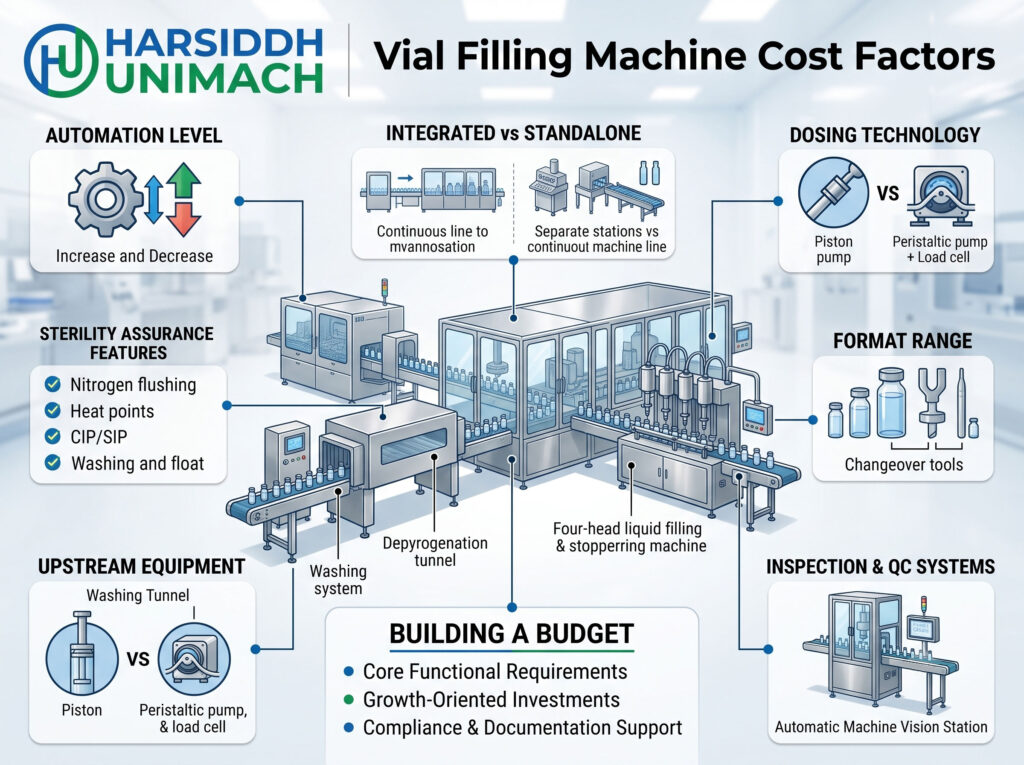
“How much does an aseptic vial filling line cost?” is one of the first questions any injectable manufacturer asks, and one of the hardest to answer with a single number. Two lines that both “fill vials” can differ enormously in price, because the cost depends on the products, output, level of automation, contamination control approach, documentation, facility and much more.
Instead of quoting figures that would not apply to your project, this article explains the key cost drivers behind an aseptic vial filling line. Understanding them helps you set a realistic budget, compare proposals fairly and decide where to invest and where to save. It also highlights hidden costs that are often missed, how to compare quotations on equal terms, and how to balance cost savings against quality and compliance risks.
The Two Sides of Cost: Investment and Operation
| Cost Type | What It Includes |
|---|---|
| Capital investment | Machines, barrier systems, options, change parts, documentation, installation, qualification, facility and utilities |
| Operating costs | Labour, consumables, utilities, maintenance, spare parts, environmental monitoring, process simulations, downtime |
A line with a lower purchase price can cost more over its life if it is less efficient, harder to clean or less reliable. Both sides need to be considered.
Cost Driver 1: Equipment Scope
The most obvious driver is which machines are included. A complete aseptic vial line typically comprises:
- Vial washing machine – such as the linear vial washer
- Depyrogenation tunnel – such as the sterilizing tunnel for ampoules and vials; see also our range of sterilizers
- Filling and stoppering machine – such as the Automatic Servo Based Vial Filling Machine or the liquid vial filling machine with rubber stoppering
- Cap sealing machine – such as the vial cap sealing machine or the Automatic Eight Head Vial Cap Sealing Machine
- External vial washing – such as the automatic external vial washing machine
- Inspection – such as the visual ampoule and vial inspection machine
- Labelling – such as the vial sticker labeling machine
Some projects buy only part of the line, adding the rest later. Integrated solutions, such as the automatic liquid vial filling line, combine several steps, which can reduce footprint and integration effort. Browse our injectable liquid vial filling lines.
Cost Driver 2: Output and Number of Heads
Higher output generally means:
- More filling and stoppering heads
- Larger washers and tunnels
- More robust handling and transfer systems
- Faster, more capable inspection and labelling
Output is one of the biggest cost multipliers. Sizing the line to realistic demand, with sensible headroom, avoids paying for capacity you will not use. Read small vial machine vs high-speed vial lines: how to choose the right capacity.
Cost Driver 3: Level of Automation
| Automation Level | Investment | Labour | Typical Use |
|---|---|---|---|
| Semi-automatic machines | Lower | Higher | Small batches, R&D, early clinical supply |
| Automatic standalone machines | Medium | Medium | Growing commercial production |
| Fully integrated line | Higher | Lower | Commercial and high-volume production |
Automation affects not only purchase price but also labour, consistency and contamination risk. For a detailed comparison, read automatic vs semi-automatic vial fillers: ROI analysis for growing pharma labs.
Cost Driver 4: Contamination Control and Barrier Technology
How the critical zone is protected has a major impact on cost:
| Approach | Equipment Cost | Facility Requirements | Operating Considerations |
|---|---|---|---|
| Open line under unidirectional airflow | Lowest equipment cost | Highest cleanroom demands around the line | More gowning, more environmental control |
| Restricted Access Barrier System (RABS) | Higher | Still requires a high-grade surrounding room | Fewer direct interventions |
| Isolator | Highest equipment cost | Surrounding room can be of a lower grade | Decontamination cycles, glove management |
Barrier choice also affects cleanroom size and grade, HVAC capacity, gowning costs and validation scope. Increasingly, regulatory expectations favour barrier technologies for aseptic processing. Read the rise of RABS and isolators in modern pharmaceutical vial filling machines.
Cost Driver 5: Options and Special Features
Each option adds capability and cost:
- Servo-driven dosing for accuracy and flexibility
- Peristaltic or single-use fluid paths for multi-product or high-value products
- Nitrogen purging for oxygen-sensitive products
- Automatic weight control and checkweighing
- Clean-in-place or sterilise-in-place systems
- Additional change parts for extra vial sizes
- Partial stoppering for lyophilised products
- Integration with serialization or inspection systems
Choose options based on your actual product needs, now and in the foreseeable future.
Cost Driver 6: Controls, Data Integrity and Software
Modern aseptic lines require control systems that support GMP:
- User access levels and unique log-ins
- Audit trails and secure data storage
- Recipe management
- Communication between machines and with plant systems
More sophisticated controls cost more but reduce compliance risk and support efficient operation.
Cost Driver 7: Documentation and Qualification
In aseptic manufacturing, documentation and qualification are a significant part of the total cost:
- Design documentation – specifications, drawings, certificates
- FAT and SAT – testing at the supplier and on site
- IQ, OQ and PQ – documented qualification
- Computerised system validation for control software
- Process simulations (media fills) for the aseptic process
Supplier-provided protocols and well-organised documentation can reduce internal effort considerably. Read automatic vial filling equipment validation: IQ, OQ and PQ explained and our cGMP compliance guide: essential features for sterile vial filling machinery.
Cost Driver 8: Facility and Utilities
For many projects, the facility costs as much as, or more than, the equipment:
- Cleanroom construction – walls, ceilings, floors, doors and pass boxes
- HVAC – air handling, filtration, pressure cascades
- Utilities – purified water, water for injection, clean steam, compressed air, nitrogen and vacuum
- Space – classified areas are expensive per square metre to build and run
- Gowning and changing areas
Compact, integrated lines and barrier technologies can reduce the size or grade of the cleanroom needed.
Cost Driver 9: Installation, Commissioning and Training
- Transport and rigging into the building
- Mechanical and electrical installation
- Commissioning and start-up support from the supplier
- Operator and maintenance training
These are often underestimated in early budgets.
Cost Driver 10: Operating Costs Over the Line’s Life
| Operating Cost | Influenced By |
|---|---|
| Labour | Automation level, number of interventions, gowning |
| Consumables | Single-use fluid paths, filters, gloves, stoppers and seals wasted |
| Utilities | HVAC, water, steam, compressed air, nitrogen, electricity |
| Environmental monitoring | Cleanroom size and grade, barrier type |
| Process simulations | Frequency and line complexity |
| Maintenance and spares | Machine design, reliability, supplier support |
| Product loss | Dosing accuracy, hold-up volume, rejects |
| Downtime | Reliability, changeover time, service response |
Over the life of the line, these costs can exceed the original investment, so efficiency and reliability matter. Small improvements, such as shorter changeovers, fewer interventions or lower overfill, repeat with every batch and therefore add up to significant savings over the years.
Hidden Costs That Are Often Missed
Early budgets frequently overlook items that only become visible later in the project:
- Additional change parts for vial sizes added after the initial order
- Spare parts stock – an initial set of critical spares
- Utility upgrades – larger compressors, extra water for injection capacity, nitrogen supply
- Facility modifications – openings for equipment entry, structural changes, floor levelling
- Extended qualification time – the line cannot produce saleable product until qualification is complete
- Consultants or validation resources for protocol writing and execution
- Staff time for training, FAT attendance and project management
- Environmental monitoring equipment for the new cleanroom areas
- Initial consumables – single-use sets, filters, gloves, cleaning agents
Listing these early prevents surprises and keeps the project on budget.
Comparing Quotations for Aseptic Lines
Quotations for aseptic lines can be difficult to compare because scope varies widely. To compare fairly:
- Send the same URS to every supplier
- List the scope of each quotation – which machines, options, change parts and services are included
- Check documentation and qualification support – what is included and what costs extra
- Compare installation, commissioning and training – days, people and travel
- Review warranty and service terms
- Estimate operating costs – labour, consumables, utilities, maintenance
- Adjust quotations to the same scope before comparing prices
A quotation that looks expensive may include services that another supplier charges separately.
Balancing Cost and Risk
In aseptic manufacturing, some savings carry risks that outweigh the benefit:
| Possible Saving | Potential Risk |
|---|---|
| Choosing an open line instead of a barrier system | Higher contamination risk, more demanding cleanroom, regulatory expectations |
| Reducing documentation scope | Longer, harder qualification and audit findings |
| Undersizing the line | Bottlenecks and early replacement |
| Skipping trials | Accuracy or handling problems discovered after installation |
| Minimal spare parts | Longer downtime when parts fail |
The aim is not the lowest possible price, but the best balance of cost, quality, compliance and reliability for your products and markets.
A Phased Budgeting Approach
Many manufacturers spread aseptic investment over phases:
- Phase 1 – core filling and stoppering with cap sealing, using existing or manual washing and sterilisation where acceptable
- Phase 2 – automated washing and depyrogenation for continuous feeding
- Phase 3 – external washing, automated inspection and labelling
- Phase 4 – barrier upgrades, serialization and higher-capacity machines
Planning the layout and utilities for the final line from the start makes later phases easier and cheaper to add.
How Product Type Affects Cost
Different injectable products place different demands on the line:
- Simple aqueous solutions – standard dosing and stoppering; the most economical configuration
- Oxygen-sensitive products – nitrogen purging systems and gas monitoring add cost
- Biologics and high-value products – single-use fluid paths, precise dosing and low hold-up designs add cost but reduce product loss
- High-potency or cytotoxic products – containment requirements, often with isolators, increase equipment and facility costs
- Lyophilised products – partial stoppering, loading and unloading systems and integration with freeze dryers
- Dry powder injectables – powder dosing systems and dust control in place of liquid pumps
Defining your product portfolio, including likely future products, early in the project keeps the design and the budget aligned.
Ways to Optimise Your Investment
- Define requirements clearly – a precise URS avoids paying for unnecessary features
- Size capacity realistically – with planned headroom rather than maximum speed
- Consider phased investment – start with core machines and add others as volumes grow; our vial filling line checklist helps plan this
- Evaluate barrier options on total cost, including facility and operating costs
- Choose flexible machines – servo drives and recipes reduce changeover costs
- Reduce product loss – accurate dosing and low hold-up volumes
- Leverage supplier documentation – to reduce qualification effort
- Compare total cost of ownership, not just purchase price
Frequently Asked Questions
Why do aseptic vial filling line prices vary so much? Because cost depends on equipment scope, output, automation, barrier technology, options, controls, documentation and facility requirements, which differ widely between projects.
Is the facility a major part of the cost? Yes. Cleanrooms, HVAC and utilities can represent a large share of the total investment.
Do isolators cost more than RABS? Isolators usually have higher equipment costs but can reduce cleanroom grade and operating costs. Total cost should be compared over the line’s life.
How can I reduce the cost of an aseptic line? Define requirements precisely, size capacity realistically, consider phased investment, choose flexible machines and compare total cost of ownership.
Should qualification be included in the budget? Yes. Documentation, FAT, SAT, IQ, OQ, PQ and process simulations are significant cost elements in aseptic projects.
Planning the budget for an aseptic vial line? Contact our team or send an inquiry with your products, output targets and contamination control approach, and we will prepare a detailed proposal.