
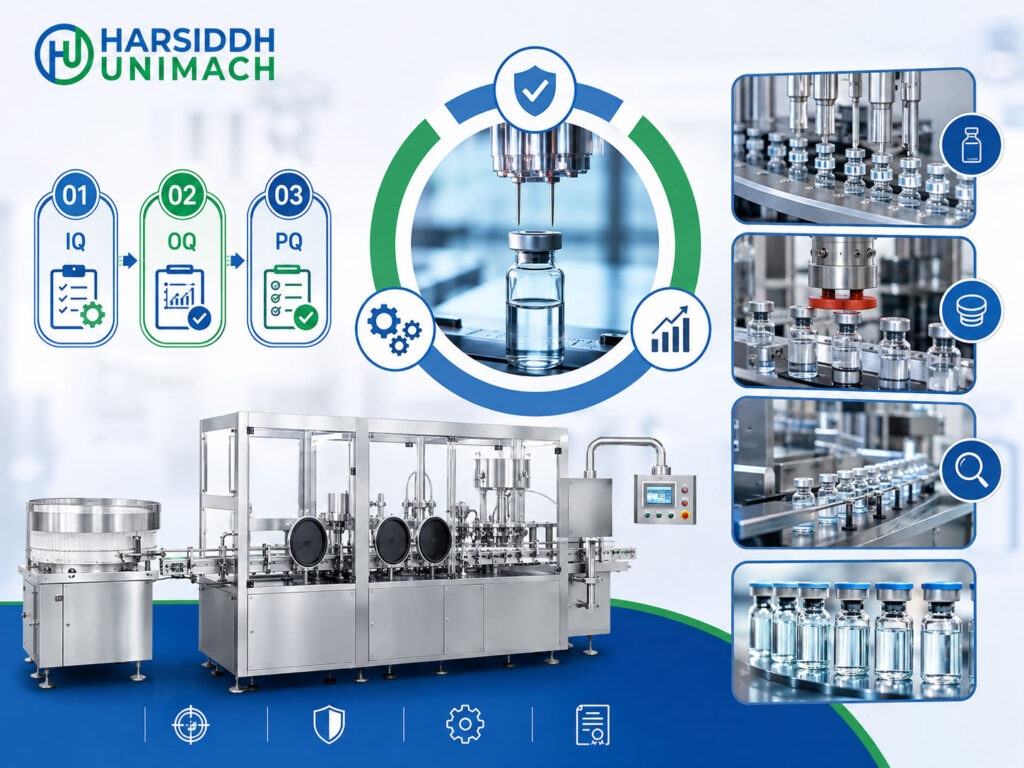
Before an automatic vial filling machine can be used to produce injectable products for patients, the manufacturer must prove that it has been installed correctly, operates as intended and consistently produces product that meets requirements. This proof is provided through equipment qualification, usually structured as Installation Qualification (IQ), Operational Qualification (OQ) and Performance Qualification (PQ).
Qualification can seem complex and time-consuming, but it follows a clear, logical structure. Done well, it not only satisfies regulatory expectations but also gives the manufacturer confidence that the machine will perform reliably for years.
This guide walks through the full qualification lifecycle for automatic vial filling equipment, from the user requirement specification to maintaining the validated state, with practical examples of what is typically checked at each stage. Specific approaches vary between companies and markets, so always align your programme with your own quality system and current regulatory guidance. For an overview of the design features that make compliance easier, read our cGMP compliance guide: essential features for sterile vial filling machinery.
The Qualification Lifecycle
| Stage | Purpose | Typical Location |
|---|---|---|
| User Requirement Specification (URS) | Define what the equipment must do | Manufacturer |
| Risk assessment | Identify functions critical to product quality | Manufacturer, with supplier input |
| Design Qualification (DQ) | Confirm the design meets the URS | Manufacturer and supplier |
| Factory Acceptance Test (FAT) | Test the machine before shipment | Supplier’s site |
| Site Acceptance Test (SAT) | Confirm performance after installation | Manufacturer’s site |
| Installation Qualification (IQ) | Verify correct installation | Manufacturer’s site |
| Operational Qualification (OQ) | Verify functions across operating ranges | Manufacturer’s site |
| Performance Qualification (PQ) | Demonstrate consistent performance in routine conditions | Manufacturer’s site |
FAT and SAT results can often be leveraged in IQ and OQ, reducing duplication, if they are performed and documented to the required standard.
Step 1: User Requirement Specification (URS)
The URS describes what you need the machine to do. For a vial filler, it typically covers:
- Products – properties, fill volumes and tolerances
- Containers and closures – vial sizes, stoppers, seals
- Output – required speed and efficiency
- Process requirements – aseptic filling, nitrogen, temperature, barrier compatibility
- Materials – product contact materials and finishes
- Controls and data – user levels, recipes, audit trails, data storage
- Safety – interlocks, guards, emergency stops
- Utilities – available supplies and their quality
- Documentation – drawings, manuals, certificates
- Testing – FAT, SAT and qualification expectations
A clear URS is the foundation for every later stage. A buyer’s perspective on these requirements is given in our vial filling line checklist: 7 things to evaluate before buying.
Step 2: Risk Assessment
A risk assessment identifies which machine functions could affect product quality and patient safety, so qualification effort can focus where it matters most. For a vial filler, critical functions usually include:
- Fill volume accuracy
- Stopper placement
- Sterility assurance of product contact parts and the critical zone
- Container handling without breakage
- Alarms and safeguards (no vial, no fill; no stopper detection)
- Data integrity of recipes and records
Tools such as failure mode and effects analysis (FMEA) are commonly used.
Step 3: Design Qualification (DQ)
DQ is documented confirmation that the proposed design meets the URS and GMP expectations. It typically involves reviewing:
- Functional and design specifications from the supplier
- General arrangement and P&ID drawings
- Materials and surface finishes
- Control system architecture and software functions
- Hygienic and aseptic design features
- Compliance of each URS requirement, often in a traceability matrix
Step 4: Factory Acceptance Test (FAT)
The FAT tests the machine at the supplier’s site before shipment. Typical FAT activities include:
- Visual and dimensional checks against drawings
- Verification of materials and documentation
- Functional tests of all motions and stations
- Fill accuracy tests with water or a placebo
- Changeover demonstration
- Alarm and interlock tests
- Control system and recipe tests
Issues found at FAT are much cheaper and faster to correct than after shipment.
Step 5: Installation and Site Acceptance Test (SAT)
After delivery and installation, the SAT confirms that the machine works correctly in your facility, connected to your utilities. It often repeats key FAT tests under site conditions.
Step 6: Installation Qualification (IQ)
IQ verifies that the equipment has been delivered and installed correctly according to specifications. Typical IQ checks include:
| IQ Check | Examples |
|---|---|
| Equipment identification | Model, serial number, major components |
| Documentation | Manuals, drawings, certificates, software records |
| Materials of construction | Certificates for product contact parts |
| Installation | Correct location, levelling, anchoring |
| Utilities | Electrical supply, compressed air, vacuum, nitrogen connections and quality |
| Instruments | Identification and calibration status of critical instruments |
| Software | Installed version, backup and configuration records |
| Spare parts | List of spares received |
| Safety | Guards, emergency stops and labelling in place |
Step 7: Operational Qualification (OQ)
OQ verifies that the equipment operates as intended across its specified operating ranges. Typical OQ tests for a vial filler include:
| OQ Test | What It Demonstrates |
|---|---|
| Speed range | Machine runs correctly at minimum, normal and maximum speeds |
| Fill volume range | Accurate fills at the lowest and highest specified volumes |
| Fill accuracy per head | Each head delivers within limits |
| Stoppering | Stoppers placed correctly; missing stoppers detected |
| Vial handling | Correct transfer without breakage for each vial size |
| Changeover | Each format can be set up correctly |
| Alarms and interlocks | No vial, no fill; door interlocks; low level alarms; utility alarms |
| Emergency stop | Machine stops safely |
| Power failure recovery | Machine and data behave correctly after power loss |
| Recipe management | Recipes created, approved, selected and protected as specified |
| Access control | Users can only perform functions allowed for their level |
| Audit trail | Changes are recorded correctly with user, time and details |
| Nitrogen purging (if used) | Gas flows and timing operate as specified |
Computerised system checks
Because modern vial fillers are controlled by PLCs and HMIs, OQ also covers computerised system aspects such as data integrity, audit trails, backup and restore, and electronic records, in line with applicable regulations and your computerised system validation procedures. Servo-driven machines, discussed in how servo-driven vial filling systems outperform mechanical lines, rely heavily on software, so these checks are particularly important.
Step 8: Performance Qualification (PQ)
PQ demonstrates that the equipment consistently performs as required under routine production conditions. Typical PQ activities include:
- Consecutive runs – often three or more, as defined by your protocol – at normal operating conditions
- Fill weight data collected across the run from all heads, with statistical analysis
- Stopper placement and container closure verification
- Breakage and reject rates monitored
- Environmental monitoring in the critical zone during runs, for aseptic lines
- Product or placebo representative of routine production
Process simulation for aseptic filling
For aseptic processes, media fills (aseptic process simulations) are used to demonstrate that the whole process, including equipment, environment, personnel and procedures, can produce sterile product. Media fills are typically repeated periodically and after significant changes, according to your procedures and regulatory guidance.
Qualifying the Whole Line
A vial filler operates within a complete line, and each machine needs qualification:
- Washing – such as the rotary vial washing machine or linear vial washer: cleaning efficiency, water quality and particle removal
- Depyrogenation – such as the sterilizing tunnel for ampoules and vials: temperature distribution, heat penetration and endotoxin reduction
- Filling and stoppering – such as the Automatic Servo Based Vial Filling Machine, the Four Head Liquid Vial Filling Stoppering Machine or the liquid vial filling machine with rubber stoppering
- Cap sealing – such as the vial cap sealing machine: crimp quality and closure integrity; read vial capping machine: how crimping force affects container closure integrity
- External washing – such as the automatic external vial washing machine
- Inspection – such as the visual ampoule and vial inspection machine: detection capability
Integrated solutions such as the automatic liquid vial filling line can simplify qualification with coordinated documentation and testing. Browse our vial filling machines and the vial filling machines for liquid vials.
Barrier Systems and Qualification
Where RABS or isolators are used, qualification also covers barrier integrity, airflow, glove integrity and, for isolators, decontamination cycles. The filling machine’s design must be compatible with these tests. Read the rise of RABS and isolators in modern pharmaceutical vial filling machines.
Common Qualification Pitfalls
- Vague acceptance criteria – protocols must state clearly what result counts as a pass
- Testing only at normal settings – OQ should challenge the full specified operating ranges
- Ignoring the control system – recipes, audit trails, access control and backups need testing too
- Uncalibrated instruments – test results are only as reliable as the instruments used
- Poor deviation handling – every failed test must be investigated, resolved and documented
- Late involvement of quality – protocols written without quality input often need rework
- No link to the URS – without traceability it is hard to show that every requirement was tested
Typical Qualification Documents
| Document | Content |
|---|---|
| Validation plan | Scope, responsibilities, approach and acceptance strategy |
| URS | User requirements |
| Risk assessment | Critical functions and controls |
| DQ report | Confirmation that design meets the URS |
| FAT and SAT protocols and reports | Tests and results at supplier and site |
| IQ, OQ and PQ protocols | Planned tests and acceptance criteria |
| IQ, OQ and PQ reports | Results, deviations and conclusions |
| Traceability matrix | Links between requirements and tests |
| Validation summary report | Overall conclusion and release for use |
Maintaining the Validated State
Qualification is not a one-time event. To keep equipment in a validated state:
- Change control – evaluate and document any changes to hardware, software, settings or procedures; requalify where needed
- Preventive maintenance – keep the machine in the condition in which it was qualified
- Calibration – maintain critical instruments within their calibration intervals
- Periodic review – regularly review performance data, deviations and changes to confirm the qualified state
- Requalification – after significant changes, relocation or as defined by your procedures
- Training – keep operator and maintenance training current and documented
Practical Tips for Efficient Qualification
- Start with a clear URS – ambiguous requirements cause rework later
- Involve quality early – agree the qualification strategy before ordering
- Use the supplier’s documentation – a good supplier provides protocols and supporting documents
- Leverage FAT and SAT – avoid repeating tests unnecessarily
- Focus on critical functions – guided by the risk assessment
- Plan time realistically – qualification often takes longer than expected
- Keep traceability – link every URS requirement to a test and result
Understanding the full cost and effort of a sterile line, including qualification, is covered in aseptic vial filling line cost: key cost drivers explained.
Frequently Asked Questions
What is the difference between IQ, OQ and PQ? IQ verifies correct installation, OQ verifies correct operation across specified ranges, and PQ demonstrates consistent performance under routine production conditions.
Can FAT and SAT replace IQ and OQ? They can often be leveraged to reduce duplication, provided they are planned, executed and documented to the required standard and approved by quality.
What is a traceability matrix? A document linking each user requirement to the design, test and result that demonstrates it has been met.
Are media fills part of equipment qualification? Media fills demonstrate that the whole aseptic process, including the equipment, can produce sterile product. They complement equipment PQ.
When is requalification needed? After significant changes, relocation, or at intervals defined by your quality procedures.
Need support with qualifying your vial filling line? Contact our team or send an inquiry to discuss documentation, FAT and qualification support for your project.