
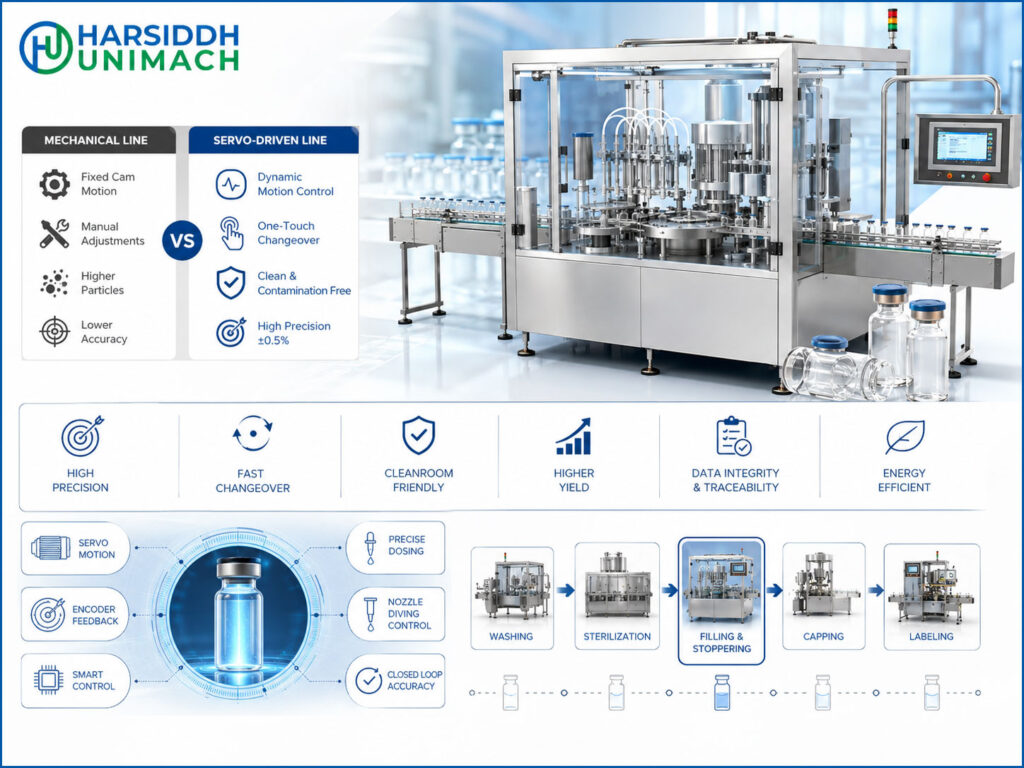
For decades, vial filling machines were built around a single main motor driving a system of gearboxes, shafts, cams and linkages. Every motion, from the star wheel indexing vials to the pistons dosing product and the head placing stoppers, was mechanically tied to that one drive. These machines were robust and many still run well today.
Modern vial fillers increasingly use servo motors for some or all of their motions. Instead of a mechanical cam defining each movement, software defines it, and each servo axis follows its programmed motion precisely. This change in architecture brings significant engineering advantages in accuracy, flexibility, changeover speed and diagnostics.
This guide explains how mechanical and servo-driven vial filling systems work, compares them function by function, and helps you decide which approach suits your products and plant. For a general introduction to servo filling, see servo based liquid filling machines explained and the working principle of servo based liquid filling machines.
Architecture: Mechanical vs Servo
Mechanical (cam-driven) machines
- One main motor drives a main shaft through a gearbox.
- Mechanical cams on the shaft convert rotation into specific motions: vertical needle movement, piston strokes, stopper head movement.
- Linkages and gears transmit motion to star wheels, pumps and other mechanisms.
- All motions are locked together by the mechanical design; changing one motion profile means changing hardware.
Servo-driven machines
- Several servo motors, each controlling one axis: for example vial transport, needle lift, dosing pistons and stoppering head.
- A motion controller coordinates all axes using electronic cams: software profiles that define position versus time or versus a master axis.
- Feedback from encoders on each servo tells the controller the exact position, allowing closed-loop correction.
- Motions can be changed in software without changing mechanical parts.
| Feature | Mechanical | Servo-Driven |
|---|---|---|
| Drive source | One main motor | Multiple servo motors |
| Motion definition | Physical cams and linkages | Electronic cams in software |
| Changing motion profiles | Hardware change | Parameter or recipe change |
| Feedback | Usually none on individual motions | Encoder feedback on every axis |
| Synchronisation | Fixed mechanically | Coordinated electronically |
1. Dosing Accuracy
Mechanical dosing
In mechanical piston fillers, the stroke length of each piston is set by adjusting a crank, screw or linkage. Setting all heads equally takes time and skill, and wear in linkages can gradually change the stroke.
Servo dosing
With servo-driven pistons, the stroke is set digitally:
- Exact stroke length entered on the HMI
- Individual head trimming to correct small differences between pumps
- Repeatability maintained by closed-loop position control
- No mechanical drift from linkage wear
The result is tighter fill-weight distribution and less overfill. For the trade-offs between dosing technologies, read peristaltic vs piston pumps: choosing the right filling system for your vial line.
2. Motion Profiles and Product Handling
A mechanical cam has one fixed profile. A servo axis can follow almost any profile:
- Dosing speed profiles – slow at the start to avoid splashing, faster in the middle, slow at the end for a clean cut-off
- Needle movement – diving into the vial, rising with the liquid level at a matched speed to prevent foaming
- Vial transport – smooth acceleration and deceleration that reduce vial tipping and glass-to-glass contact
These profiles can be tuned for each product: thin solutions, viscous liquids, foaming products or shear-sensitive biologics. Read about how diving nozzles improve injectable filling performance.
3. Synchronisation and Stoppering
On a vial filler, dosing, needle movement, vial transport and stoppering must stay perfectly synchronised.
- Mechanical machines achieve this through the fixed relationship of cams on one shaft. Synchronisation is reliable but rigid.
- Servo machines synchronise axes electronically to a virtual master. The controller can adjust timing relationships, for example giving a viscous product more dosing time, without changing hardware.
Servo stoppering heads can also control placement speed and depth precisely, which supports consistent stopper seating. For more on the process, read understanding the complete vial filling and stoppering process.
4. Changeovers
| Changeover Task | Mechanical Machine | Servo Machine |
|---|---|---|
| Fill volume | Adjust each pump mechanically | Enter value or recall recipe |
| Dosing speed | Often fixed | Adjustable in recipe |
| Needle stroke | Mechanical adjustment | Recipe parameter |
| Timing | Fixed by cams | Adjustable in software |
| Vial format | Change parts plus adjustments | Change parts plus recipe recall |
Servo machines still need format change parts such as star wheels and guides for different vial sizes, but many adjustments become recipe selections. This shortens changeovers and makes them more repeatable. See vial filling machine changeover: best practices for faster product and format changes.
5. Diagnostics and Data
Servo drives continuously monitor position, speed, current and errors. This provides:
- Clear fault messages – for example, an axis overload or position error, rather than a general stop
- Early warning signs – rising motor current can indicate increasing friction or wear
- Data for batch records – recipe used, parameters and alarms, supporting data integrity
- Remote support – suppliers can review data to help troubleshoot
Mechanical machines generally provide much less information about what is happening inside the drive train.
6. Mechanical Simplicity and Maintenance
Servo-driven machines remove many mechanical components: long drive shafts, multiple cams, complex linkages and some gearboxes. This can mean:
- Fewer wearing parts to inspect and replace
- Less lubrication of cams and linkages
- Less noise and vibration
- Easier cleaning, because drive components can be kept away from the product zone
Servo systems do introduce electronic components such as drives, motors, cables and controllers, which require appropriate skills for maintenance and fault-finding.
7. Speed and Throughput
Servo machines can often run faster for a given product because motion profiles are optimised: rapid moves where possible and gentle moves where needed. They can also maintain accuracy at higher speeds through closed-loop control. However, the real limit is often the product and container, such as foaming, viscosity or glass handling, rather than the drive technology.
8. Recipe Control and Data Integrity
Because servo machines store settings as recipes, control over those recipes becomes part of good manufacturing practice:
- User access levels restrict who can create or change recipes
- Audit trails, where configured, record who changed which parameter and when
- Recipe verification at batch start confirms that the correct settings are loaded
- Electronic records of parameters and alarms support batch documentation
These features help meet data integrity expectations, but they must be configured and managed correctly. Involve your quality team when defining recipe management procedures.
9. Validation Considerations
Servo machines introduce software into the motion and dosing system, so validation needs to cover both mechanical performance and control functions:
- Installation qualification checks hardware, wiring, software versions and documentation
- Operational qualification tests each axis, recipe functions, alarms, interlocks and access controls
- Performance qualification confirms fill accuracy, stoppering quality and throughput with the actual product
- Change control governs future software updates or recipe changes
A supplier that provides clear documentation of the control system makes validation faster and simpler.
10. Retrofitting Mechanical Machines
Some existing mechanical vial fillers can be upgraded with servo technology, for example by replacing mechanical dosing drives with servo-driven pistons while keeping the existing frame and transport. Retrofits can bring part of the benefit, such as digital fill setting and head trimming, at lower cost than a new machine. Whether a retrofit is worthwhile depends on the machine’s condition, design and remaining life, and on the effort needed to requalify it.
How to Evaluate a Servo Vial Filler
- Which axes are servo-driven? Dosing only, or also needle lift, transport and stoppering?
- How are recipes managed? Storage, access control and audit trail
- What accuracy is demonstrated with your product and fill volumes?
- How are heads trimmed and verified?
- What diagnostics are available on the HMI?
- What documentation is provided for the control system?
- What support is available for servo drives and software?
Machines and Line Integration
Servo vial fillers fit into complete injectable lines with washing, depyrogenation, sealing and inspection:
- Washing on a linear vial washer
- Depyrogenation in a sterilizing tunnel for ampoules and vials
- Filling and stoppering on machines such as the Automatic Servo Based Vial Filling Machine, the Automatic Injectable Liquid Vial Filling and Stoppering Machine, the Four Head Liquid Vial Filling Stoppering Machine or the liquid vial filling machine with rubber stoppering
- Cap sealing on a vial cap sealing machine
- Inspection on a visual ampoule and vial inspection machine
Compact integrated solutions such as the automatic liquid vial filling line combine these steps. Browse the vial filling machines for liquid vials. Servo technology is also available on other filler types, for example the servo based piston filling machine and the servo based gear pump filling machine.
When Mechanical Machines Still Make Sense
Servo technology is not always the right answer. Mechanical machines can still be a good choice when:
- A plant runs one product and one vial size for long periods
- Budget is very limited and changeover speed is not critical
- Maintenance teams are experienced with mechanical systems and less familiar with servo electronics
- A proven existing design is already qualified and performing well
Many plants operate both: servo machines for flexible, multi-product lines and mechanical machines for dedicated high-volume products.
Skills and Training for Servo Machines
Moving from mechanical to servo machines changes the skills a plant needs. Operators spend less time making mechanical adjustments and more time selecting recipes, monitoring the HMI and responding to alarms. Maintenance teams need to understand servo drives, encoders, motion controllers and network communication, alongside traditional mechanical skills. Good suppliers provide training, clear electrical documentation and remote support. Planning this training before the machine arrives helps the plant gain the full benefit of servo technology from the start.
Summary: Servo vs Mechanical at a Glance
| Criterion | Advantage |
|---|---|
| Fill accuracy and repeatability | Servo |
| Changeover speed | Servo |
| Flexibility for new products | Servo |
| Diagnostics and data | Servo |
| Purchase price | Mechanical |
| Simplicity for mechanical-only teams | Mechanical |
| Dedicated single-product operation | Either, depending on volume and budget |
Cost Considerations
| Cost Factor | Mechanical | Servo |
|---|---|---|
| Purchase price | Usually lower | Usually higher |
| Changeover time | Longer | Shorter |
| Product loss from overfill | Higher, due to wider variation | Lower, due to tighter control |
| Mechanical wear parts | More | Fewer |
| Electronic components | Fewer | More |
| Data and diagnostics | Limited | Extensive |
| Flexibility for new products | Limited | High |
For multi-product plants or high-value products, savings in product, changeover time and downtime often justify the higher initial investment.
Frequently Asked Questions
What is a servo-driven vial filling machine? A vial filler in which key motions, such as dosing, needle movement, vial transport and stoppering, are driven by individual servo motors coordinated by a motion controller, instead of by mechanical cams on one main shaft.
Why are servo vial fillers more accurate? Servo pistons use digital stroke settings, individual head trimming and closed-loop position control, which reduce variation and drift.
Do servo machines change over faster? Yes. Many adjustments become recipe selections, although format parts such as star wheels may still need changing.
Are mechanical vial fillers obsolete? No. They remain suitable for dedicated, single-product lines and plants with strong mechanical maintenance skills.
Is a servo vial filler worth the extra cost? For multi-product lines, high-value products and plants needing data and flexibility, the savings in product, changeover time and downtime often justify the investment.
Considering a servo-driven vial filling line? Contact our team or send an inquiry with your products, vial sizes and output targets.