
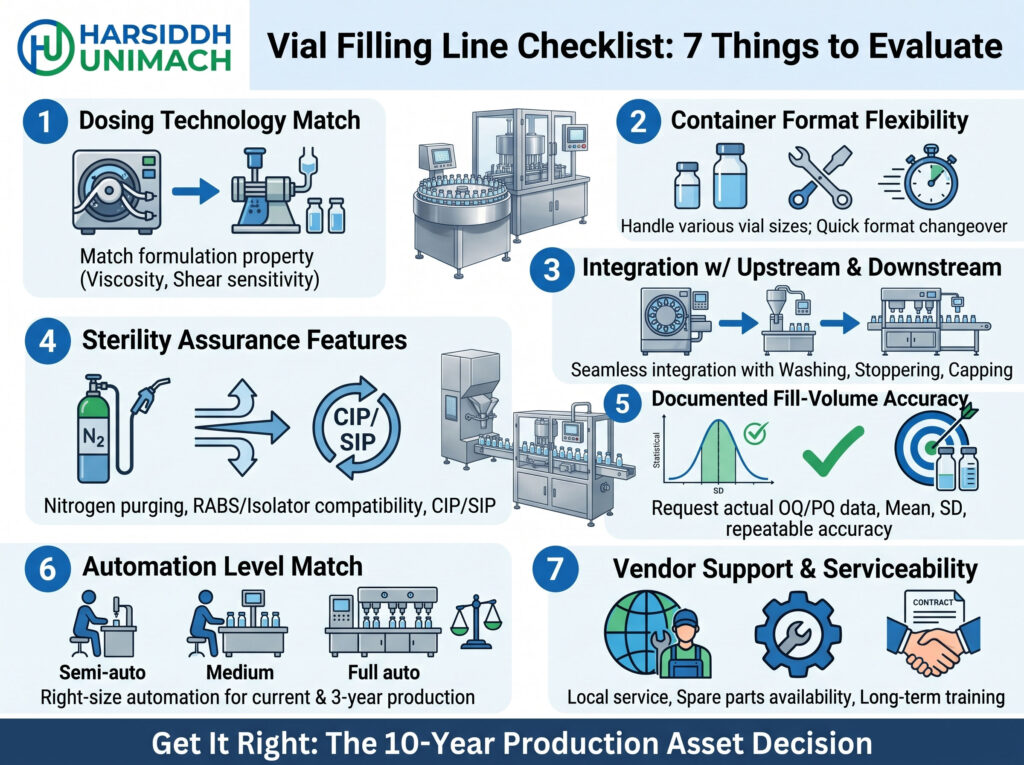
Buying a vial filling line is a major decision for any injectable manufacturer. A complete line, from vial washing and depyrogenation through filling, stoppering, capping, inspection and labelling, represents a significant investment and will shape your production capability, quality and compliance for many years.
With so many machines, options and suppliers to compare, it is easy to focus on one or two headline numbers such as speed or price and miss factors that matter just as much in daily operation. This checklist sets out seven key areas to evaluate before you buy, with practical questions for each. Use it to structure your discussions with suppliers and your internal decision-making.
1. Product and Process Requirements
Every line decision starts with your products.
What to evaluate
- Product types – aqueous solutions, suspensions, oily injectables, biologics, dry powders
- Fill volume range – smallest and largest fills
- Vial sizes – the full range you need now and in the future
- Sterility approach – aseptic filling or terminal sterilisation
- Special needs – nitrogen purging, temperature control, light protection, high potency containment
- Stopper types – full insertion for liquids, partial insertion for lyophilisation if relevant
Questions to ask
- Can the line handle all our products and vial sizes, including future ones?
- Which options are needed for oxygen-sensitive or shear-sensitive products?
- Can trials be run with our product or a representative placebo?
2. Capacity and Line Balance
What to evaluate
- Required output – based on realistic demand, efficiency and growth
- Bottleneck machine – usually the filler, with other machines sized slightly faster
- Line balance – washer, tunnel, filler, capper, inspection and labeller matched in speed
- Buffers between machines to absorb short stoppages
- Footprint – space required in classified and unclassified areas
Questions to ask
- What output can the whole line achieve with our products, not just the filler?
- How are machines synchronised, and what happens when one stops?
- Is there room to add capacity later?
Choosing the right capacity is discussed in small vial machine vs high-speed vial lines: how to choose the right capacity. If you are moving up from semi-automatic equipment, read automatic vs semi-automatic vial fillers: ROI analysis for growing pharma labs.
3. Dosing Accuracy and Technology
What to evaluate
- Pump type – piston, servo piston or peristaltic
- Accuracy and repeatability at your fill volumes, across all heads
- Head adjustment – individual trimming of each head
- Filling motion – diving needles and speed profiles to prevent foaming and splashing
- Weight control – manual sampling or automatic checkweighing
- Product loss – hold-up volume, priming and end-of-batch losses
Questions to ask
- What accuracy has been demonstrated for products and volumes similar to ours?
- How is fill weight verified during production?
- How much product is needed for priming and set-up?
For the pump choice, read peristaltic vs piston pumps: choosing the right filling system for your vial line.
4. Aseptic Design and Contamination Control
What to evaluate
- Hygienic design – smooth surfaces, drives below the table, sealed penetrations
- Critical zone protection – unidirectional airflow over open vials and stoppers
- Barrier compatibility – RABS or isolator integration
- Sterilisable product paths – or single-use fluid paths
- Interventions – how often they are needed and how they are performed
- Washing and depyrogenation – effective particle and endotoxin removal
Questions to ask
- How is the machine designed to minimise interventions?
- Which parts are removed for sterilisation, and how?
- How does the line integrate with barrier systems?
For the design features that support compliance, read our cGMP compliance guide: essential features for sterile vial filling machinery.
5. Changeover and Flexibility
What to evaluate
- Changeover time for vial size and product changes
- Change parts – number, ease of fitting, tool-less design, colour coding
- Recipe management – stored settings on servo-driven machines
- Cleaning time between products
- Format range – ability to add new vial sizes later
Questions to ask
- How long does a full changeover take on each machine in the line?
- Can you demonstrate a changeover during the factory acceptance test?
- What does each additional vial format cost in change parts?
6. Controls, Data Integrity and Documentation
What to evaluate
- Control system – PLC and HMI, user-friendliness and language options
- Access control – user levels and unique log-ins
- Audit trails – recording parameter and recipe changes
- Data storage and backup
- Line integration – communication between machines
- Documentation – specifications, drawings, certificates, manuals, software records
- Qualification support – FAT, SAT and IQ/OQ protocols
Questions to ask
- How does the control system support our data integrity requirements?
- What documentation is included, and in what format?
- What support is provided for qualification?
Our guide to automatic vial filling equipment validation: IQ, OQ and PQ explained explains what qualification involves.
7. Supplier Support and Total Cost of Ownership
What to evaluate
- Supplier experience with injectable lines and similar products
- Installation and commissioning support
- Training for operators and maintenance staff
- Spare parts availability and lead times
- Service response – on-site and remote
- Total cost of ownership – purchase price, change parts, qualification, utilities, product loss, maintenance, downtime
Questions to ask
- Can you provide references from similar installations?
- What spare parts should we keep on site?
- What is the typical service response time?
For a closer look at where costs come from, read aseptic vial filling line cost: key cost drivers explained.
Machine-by-Machine Line Checklist
| Machine | Key Points to Evaluate |
|---|---|
| Vial washer | Cleaning effectiveness, water and air consumption, gentle handling, changeover |
| Sterilizing tunnel | Temperature uniformity, cooling performance, airflow, integration with washer and filler |
| Filling and stoppering | Dosing accuracy, aseptic design, stoppering reliability, interventions |
| Cap sealing | Crimp quality, force control, particle management |
| External washing | Residue removal, drying, gentle handling |
| Inspection | Detection capability, consistency, reject handling |
| Labelling | Placement accuracy, code verification, small-diameter handling |
Typical machines include:
- Washers – the Automatic Linear Vial Washer, the linear vial washer or the rotary vial washing machine
- Depyrogenation – the sterilizing tunnel for ampoules and vials
- Filling and stoppering – the Automatic Servo Based Vial Filling Machine, the Six Head Liquid Vial Filling Stoppering Machine or the liquid vial filling machine with rubber stoppering
- Cap sealing – the vial cap sealing machine
- External washing – the automatic external vial washing machine
- Inspection – the visual ampoule and vial inspection machine
- Labelling – the vial sticker labeling machine
Integrated options such as the automatic liquid vial filling line combine these steps in a compact layout. A single-supplier line simplifies integration, documentation and responsibility, while combining machines from several suppliers gives more choice for each step but places the integration effort on you. Either approach can work well if interfaces, speeds and controls are clearly defined from the start.
A Simple Weighted Scoring Matrix
To compare proposals objectively, assign a weight to each of the seven areas according to its importance for your plant, then score each supplier. The weights below are an illustrative example only; adjust them to your priorities.
| Evaluation Area | Example Weight | Supplier A Score (1–5) | Supplier B Score (1–5) |
|---|---|---|---|
| Product and process fit | 20% | ||
| Capacity and line balance | 15% | ||
| Dosing accuracy and technology | 15% | ||
| Aseptic design and contamination control | 20% | ||
| Changeover and flexibility | 10% | ||
| Controls, data and documentation | 10% | ||
| Supplier support and total cost | 10% | ||
| Weighted total | 100% |
Multiply each score by its weight and add the results. A structured matrix makes discussions within your team clearer and helps document why a supplier was chosen.
Is Your Site Ready?
Before the line arrives, check that your facility is prepared:
- Space and layout – room dimensions, access for installation, service clearances
- Cleanroom classification – appropriate grades for each part of the line
- Utilities – electrical supply, compressed air, purified water and water for injection, steam, nitrogen and vacuum where required
- HVAC – airflow and pressure cascades designed for the line
- Floor loading and levelling
- Material and personnel flows – routes for vials, stoppers, seals, product and people
- Waste handling – broken glass, rejected vials and consumables
Site preparation often takes longer than expected, so start early.
Questions for Reference Site Visits
If possible, visit a plant running similar equipment. Useful questions include:
- How reliable has the line been since installation?
- How long do changeovers actually take?
- How responsive is the supplier’s service team?
- How easy was qualification with the supplier’s documentation?
- What would you do differently if you were buying again?
Planning the Project Timeline
A vial filling line project usually involves several stages, each needing time and coordination:
- Requirements and URS – defining what you need
- Supplier selection – proposals, evaluation, trials and negotiation
- Design review – confirming layouts, specifications and interfaces
- Manufacturing – building the machines
- Factory acceptance test – testing before shipment
- Site preparation – running in parallel with manufacturing
- Installation and commissioning
- Site acceptance test and qualification – IQ, OQ, PQ and process simulation where required
- Training and handover
- Ramp-up to full production
Building realistic time for each stage, especially site preparation and qualification, avoids pressure to cut corners later. Agree milestones and responsibilities with your supplier in writing.
Thinking About the Future
A vial line often runs for many years. When evaluating options, consider how your needs may change: new products, different vial sizes, higher volumes, stricter contamination control expectations or new data requirements. Lines with servo-driven machines, recipe management, wide format ranges and barrier-ready designs are easier to adapt than rigid, single-purpose equipment.
Common Buying Mistakes
- Focusing only on filler speed while other machines limit the line
- Underestimating changeover time on multi-product lines
- Skipping product trials
- Leaving documentation requirements vague in the purchase order
- Ignoring utility and facility needs until installation
- Choosing on price alone without considering total cost of ownership
Using the Checklist
- Write a user requirement specification (URS) covering all seven areas
- Share the URS with shortlisted suppliers so proposals are comparable
- Score each proposal against the seven areas
- Run trials or visit reference sites
- Agree the FAT protocol before ordering
- Confirm documentation, training and support in the contract
Quick Checklist Summary
- Products, vial sizes and special needs defined
- Capacity calculated and line balanced
- Dosing technology and accuracy confirmed
- Aseptic design and barrier compatibility evaluated
- Changeover time and flexibility assessed
- Controls, data integrity and documentation reviewed
- Supplier support and total cost of ownership compared
Frequently Asked Questions
What is the most important factor when buying a vial filling line? Matching the line to your products, vial sizes and realistic output, then ensuring aseptic design, accuracy and compliance support.
Should I evaluate the filler alone or the whole line? The whole line. The slowest or least reliable machine determines real output and quality.
How important are product trials? Very. Trials confirm accuracy, handling and suitability with your actual product and vials.
What documentation should I expect? Specifications, drawings, material certificates, software records, manuals, spare parts lists and FAT, SAT and qualification support.
How do I compare suppliers fairly? Send all suppliers the same URS, score proposals against the same criteria and compare total cost of ownership, not just price.
Planning a vial filling line? Contact our team or send an inquiry with your products, vial sizes and output targets.