
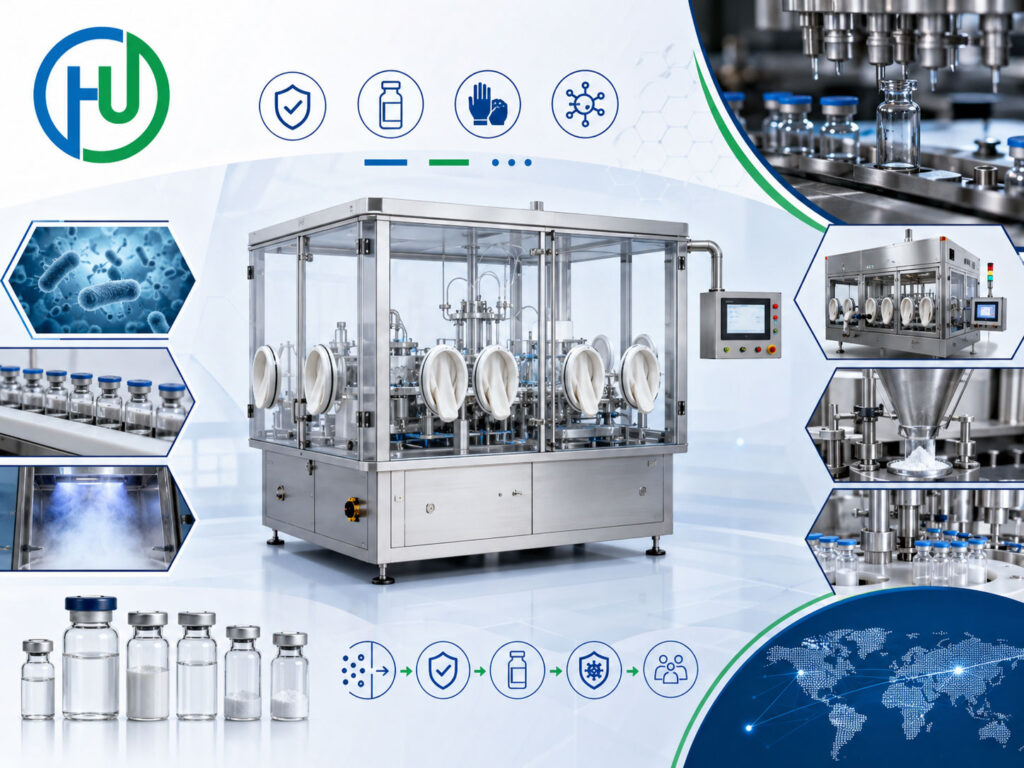
For many years, sterile vial filling took place in open cleanrooms: the filling machine stood under unidirectional airflow, and gowned operators worked directly around it. Strict gowning, aseptic technique and environmental monitoring were the main defences against contamination. But people are the largest source of microbial and particle contamination in a cleanroom, and every time an operator reaches into the critical zone, risk increases.
Barrier technologies, namely Restricted Access Barrier Systems (RABS) and isolators, reduce this risk by physically separating operators from the critical zone where vials are open. Over the past decades, and especially with updated regulatory guidance for sterile products emphasising contamination control and barrier technologies, RABS and isolators have moved from specialised solutions to the expected standard for many new aseptic filling lines.
This article explains why barrier technologies are rising, how RABS and isolators work, how they differ, what they mean for the design of vial filling machines and how to choose the right approach for your facility.
Why Barrier Technologies Are Rising
- Reduced contamination risk – separating people from open product is one of the most effective contamination controls
- Regulatory expectations – current guidance for sterile products places strong emphasis on contamination control strategies, minimising interventions and the use of appropriate barrier technologies
- Product value – biologics and other high-value injectables justify stronger protection
- Operator protection – barriers also protect staff from potent or hazardous products
- Consistency – barriers reduce variability caused by human behaviour in the cleanroom
What Is a RABS?
A Restricted Access Barrier System is a rigid enclosure around the critical zone of the filling machine, with:
- Rigid walls, usually with transparent panels
- Glove ports that allow operators to perform interventions without opening the barrier
- Unidirectional airflow of filtered air over the critical zone
- Doors that can be opened only under defined, controlled conditions
Open RABS
In an open RABS, filtered air flows over the critical zone and exits at the bottom of the enclosure into the surrounding cleanroom. The surrounding room must itself be maintained at a high cleanroom grade.
Closed RABS
In a closed RABS, air is recirculated within the enclosure through its own filters and ductwork, providing greater separation from the surrounding room.
Active and passive RABS
- Active RABS have their own fan and filter units on the barrier.
- Passive RABS rely on the room’s ceiling-mounted filtered air supply.
What Is an Isolator?
An isolator is a fully sealed enclosure that separates the internal environment completely from the surrounding room. Key features include:
- Sealed walls with glove ports or half-suits for interventions
- Controlled internal pressure, usually positive for sterile products (or negative for containment of potent products)
- Automated bio-decontamination, typically using vaporised hydrogen peroxide (VHP), before production
- Transfer systems, such as rapid transfer ports and decontamination airlocks, for introducing materials
- Leak testing to confirm enclosure integrity
Because the isolator creates its own controlled environment, the surrounding room can often be maintained at a lower cleanroom grade than for open filling or RABS, subject to your contamination control strategy and applicable guidance.
RABS vs Isolator: Key Differences
| Feature | Open RABS | Closed RABS | Isolator |
|---|---|---|---|
| Separation from room | Partial | Greater | Complete |
| Air handling | Exits into room | Recirculated within | Fully controlled internally |
| Surrounding room grade | High | High | Can be lower |
| Decontamination | Manual cleaning and disinfection | Manual cleaning and disinfection | Automated bio-decontamination |
| Door opening during production | Restricted, controlled | Restricted, controlled | Not opened |
| Equipment cost | Moderate | Higher | Highest |
| Facility cost | Higher (room grade) | Higher (room grade) | Can be lower (room grade) |
| Changeover and set-up | Faster | Moderate | Longer (decontamination cycle) |
| Flexibility | High | Moderate | Lower |
| Contamination assurance | Good | Better | Highest |
What Barriers Mean for Vial Filling Machine Design
A vial filler designed for a barrier is different from one designed for open operation. Key design features include:
Clean, compact critical zone
- Drives below the table, separated from the critical zone
- Minimal components above open vials
- Smooth, easily cleaned surfaces compatible with disinfectants and, for isolators, hydrogen peroxide
Ergonomic glove access
- Machine stations positioned so all necessary interventions can be reached through glove ports
- Change parts designed to be handled through gloves where needed
Reduced interventions
- Reliable vial handling with correct change parts
- Automatic stopper feeding with adequate bowl capacity
- Automatic weight control to reduce manual sampling
- Clear alarms to diagnose problems without opening the barrier
Material transfer
- Interfaces for introducing stoppers, sterile parts and tools through transfer ports
- Single-use fluid paths that can be introduced aseptically
Integration with upstream and downstream equipment
- Interfaces with the depyrogenation tunnel, such as the sterilizing tunnel for ampoules and vials
- Exit interfaces to cap sealing, for example a vial cap sealing machine
Machines such as the Automatic Servo Based Vial Filling Machine, the Automatic Injectable Liquid Vial Filling and Stoppering Machine and the liquid vial filling machine with rubber stoppering can be integrated with barrier systems according to project requirements. For the full set of compliance-related design features, read our cGMP compliance guide: essential features for sterile vial filling machinery.
Interventions: The Key Design Driver
Interventions are any actions where operators interact with the critical zone, such as clearing a fallen vial, replenishing stoppers or adjusting a part. Barrier systems are designed around them:
- Inherent interventions – planned, routine actions such as assembling sterile parts or loading stoppers
- Corrective interventions – unplanned actions to fix problems such as jams
Good machine design minimises corrective interventions; good barrier design ensures that necessary interventions can be performed safely through gloves. All interventions should be defined, trained, and included in process simulations (media fills).
Decontamination and Cleaning
RABS
RABS are cleaned and disinfected manually, using validated procedures and disinfectants, before production. Doors may be opened for set-up under defined conditions.
Isolators
Isolators use an automated bio-decontamination cycle, commonly vaporised hydrogen peroxide, which must be validated to achieve the required reduction of biological indicators. Machine materials and components inside the isolator must tolerate repeated exposure to the decontaminant, and the cycle time must be included in production planning.
Barriers for Other Sterile Formats
Barrier technologies are not limited to liquid vials:
- Dry powder filling – barriers help contain powder and protect product, for example around the single wheel injectable dry powder vial filling with rubber stoppering machine
- Pre-filled syringes – often filled from nested tubs inside isolators or RABS; see the pre-filled syringe filling and stoppering machine
- Potent and cytotoxic products – isolators with negative pressure protect operators
Retrofitting Barriers to Existing Lines
Many manufacturers operate open filling lines that were designed before barrier technologies became common. Retrofitting a RABS can be possible if:
- The machine’s critical zone is compact and accessible through glove ports
- Drives and mechanical parts are already separated from the product zone
- There is enough space around the machine for the barrier structure
- Airflow can be arranged to sweep over open vials as required
Retrofitting an isolator is usually more complex, because the machine must withstand decontamination and the enclosure must be sealed. In many cases, a new barrier-ready machine offers a better long-term solution. Any retrofit requires careful engineering assessment and requalification.
People and Training in Barrier Operations
Barriers change how operators work. Instead of moving freely around the machine, they perform tasks through gloves, which requires practice, good ergonomics and clear procedures. Training should cover:
- Correct glove-port technique and posture
- Defined interventions and their sequences
- Glove inspection and integrity testing
- Material transfer procedures
- Responses to alarms and breaches
Including all routine and corrective interventions in process simulations demonstrates that operators can perform them aseptically.
Nitrogen and Other Process Gases Inside Barriers
Many barrier-protected lines also use nitrogen to protect oxygen-sensitive products during filling. Gas supply lines, filters and needles must be integrated into the barrier design without disturbing unidirectional airflow, and for isolators, without compromising the sealed environment or decontamination. Read the role of nitrogen flushing in preserving injectable drug stability.
Looking Ahead
Barrier technologies continue to evolve. Trends include more compact, flexible isolators for small batches, wider use of single-use fluid paths and pre-sterilised components that simplify aseptic set-up, faster decontamination cycles, and greater automation inside barriers to reduce the number of glove interventions. Vial filling machines are increasingly designed from the outset to work inside barriers, rather than having barriers added afterwards.
Cost Considerations
Barrier technologies change the cost structure of an aseptic facility:
- Equipment cost increases from open lines to RABS to isolators
- Facility costs may decrease with isolators, because the surrounding room grade can often be lower
- Operating costs change: less intensive gowning and environmental monitoring around isolators, but decontamination cycles, glove testing and replacement add new tasks
- Qualification includes barrier integrity, airflow, glove integrity and, for isolators, decontamination validation
Comparing options on total cost over the life of the line gives a fairer picture than comparing equipment prices alone. Read aseptic vial filling line cost: key cost drivers explained.
Choosing Between RABS and Isolators
| Situation | Often Favoured |
|---|---|
| Multi-product facility with frequent changeovers | RABS |
| Existing cleanroom of high grade | RABS |
| Highest contamination assurance required | Isolator |
| Potent or hazardous products | Isolator (often negative pressure) |
| New facility where room grade can be reduced | Isolator |
| Long campaigns of a single product | Isolator |
| Limited budget for equipment | Open RABS |
The decision should be part of your overall contamination control strategy, developed with quality, engineering and regulatory input. Trials, discussions with regulators where appropriate and visits to similar facilities can all help confirm which approach best suits your products and operations.
Qualification of Barrier Systems
Barrier systems add specific qualification activities:
- Airflow visualisation (smoke studies) to confirm unidirectional airflow over open vials
- Pressure and leak testing for isolators
- Glove integrity testing at defined intervals
- Decontamination cycle validation for isolators
- Process simulations (media fills) that include representative interventions
Read automatic vial filling equipment validation: IQ, OQ and PQ explained.
The Complete Barrier-Protected Line
A modern aseptic line may include a linear vial washer, a depyrogenation tunnel, barrier-protected filling and stoppering, cap sealing, external washing and a visual ampoule and vial inspection machine. Integrated solutions such as the automatic liquid vial filling line can be planned with barrier integration in mind. Browse our vial filling machines and the vial filling machines for liquid vials.
For related reading, see a complete guide to aseptic packaging for liquid injectables and monoblock vial filling, stoppering and capping explained.
Frequently Asked Questions
What is the difference between RABS and an isolator? A RABS is a rigid barrier with glove ports and filtered airflow, located in a high-grade cleanroom; an isolator is a fully sealed enclosure with its own controlled environment and automated bio-decontamination.
Why are barrier systems becoming standard? They reduce contamination risk by separating operators from open product, and current regulatory guidance emphasises contamination control and barrier technologies.
Do isolators reduce cleanroom requirements? Often, yes. The surrounding room can typically be of a lower grade than for open filling or RABS, depending on your contamination control strategy and applicable guidance.
Can existing filling machines be fitted with RABS? Sometimes. It depends on the machine’s design, layout and access for glove-port interventions.
How are interventions performed in barrier systems? Through glove ports or half-suits, following defined and trained procedures, without opening the barrier.
Planning a barrier-protected vial filling line? Contact our team or send an inquiry with your product, facility and contamination control requirements.