
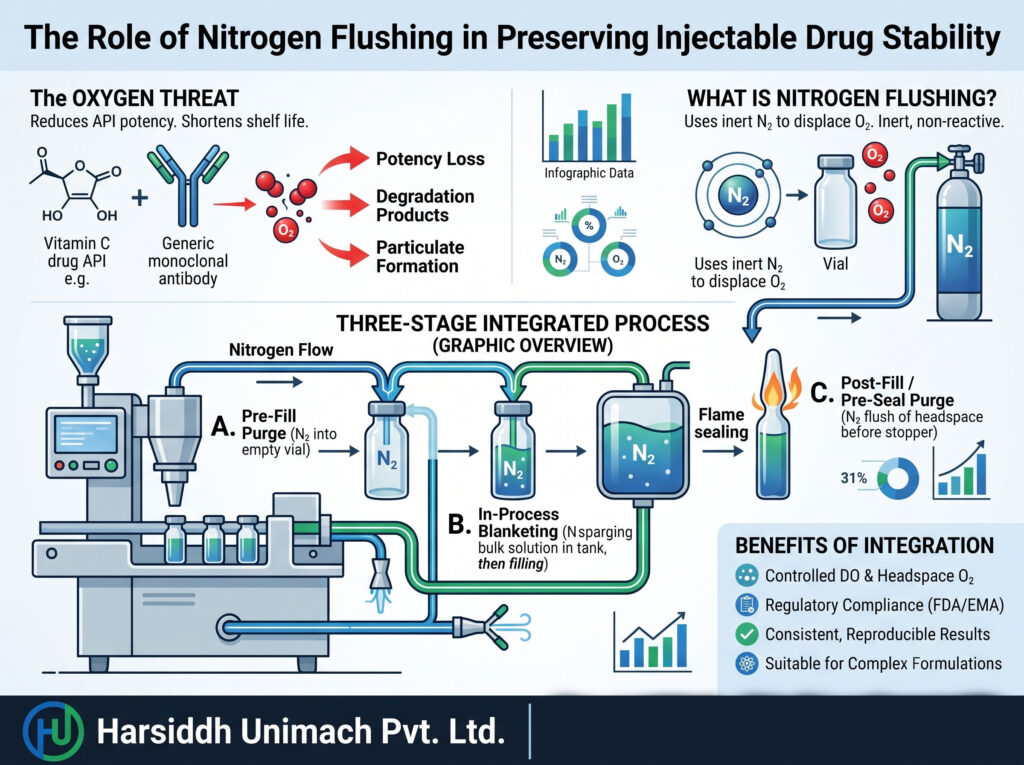
Many injectable drugs are sensitive to oxygen. Exposure to even small amounts of oxygen during manufacturing or in the sealed container can trigger chemical reactions that reduce potency, change colour, form degradation products or shorten shelf life. For these products, controlling oxygen is not optional; it is part of the product’s quality design.
Nitrogen flushing, also called nitrogen purging or inert gas overlay, is one of the most widely used methods to protect oxygen-sensitive injectables. By replacing air with nitrogen in solutions, process equipment and container headspace, manufacturers can significantly reduce oxygen exposure from the mixing tank to the sealed vial or ampoule.
This article explains why oxygen is a problem for injectables, how nitrogen protects them at each stage of manufacturing, how nitrogen is applied in vials, ampoules, syringes and powder filling, what quality the nitrogen itself must meet, and how manufacturers verify that nitrogen protection is working. For the machine-level details of nitrogen in ampoule filling specifically, see our article on how nitrogen flushing improves sterility and stability in ampoule filling machines.
Why Oxygen Is a Problem for Injectable Drugs
Oxidation
Oxidation is a chemical reaction in which a drug molecule reacts with oxygen. Certain chemical groups are particularly susceptible. Oxidation can:
- Reduce potency, so the patient receives less active drug than intended
- Create degradation products, some of which may be undesirable or require control
- Cause discolouration, such as yellowing or browning of solutions
- Change pH or other properties, affecting stability and compatibility
- Shorten shelf life, increasing waste and supply challenges
Where oxygen comes from
Oxygen can enter an injectable product from several sources:
| Source | How Oxygen Enters |
|---|---|
| Dissolved oxygen in the solution | Water and solutions absorb oxygen from the air during preparation |
| Process equipment | Air in tanks, pipes, filters and filling lines |
| Container headspace | Air trapped above the liquid when the container is sealed |
| Container and closure permeation | Slow ingress through some closure materials over shelf life |
| Exposure during filling | Open containers in contact with air before sealing |
An effective oxygen control strategy addresses all of these sources, not just the headspace.
How Nitrogen Protects the Product
Nitrogen is an inert gas: it does not react with most drug substances. When nitrogen replaces air, oxygen concentration falls. This protection can be applied at several stages:
1. Solution preparation
- Sparging – bubbling nitrogen through the solution to drive out dissolved oxygen
- Nitrogen blanketing – maintaining a nitrogen layer above the solution in mixing and holding tanks
2. Transfer and filtration
- Pushing solutions through filters and pipework with nitrogen pressure rather than air
- Keeping transfer lines filled with nitrogen between batches where appropriate
3. Filling
- Pre-purging the empty container with nitrogen before filling
- Filling under a nitrogen atmosphere at the filling station
- Post-purging the headspace after filling and immediately before closing
4. Closing
- Stoppering vials or sealing ampoules quickly after post-purging, so air cannot re-enter
- Using closures with suitable barrier properties
The combination of these steps, rather than any single one, determines the final oxygen level in the product.
Nitrogen Flushing in Different Container Types
Vials
On vial filling machines, nitrogen can be introduced:
- Through a pre-purge needle that flushes the empty vial
- Through the filling needle or an adjacent gas needle during filling
- Through a post-purge station that flushes the headspace just before the stopper is placed
Some designs use nitrogen tunnels or covers over the vial path between filling and stoppering to reduce air contact. See the Automatic Servo Based Vial Filling Machine, the Automatic Injectable Liquid Vial Filling and Stoppering Machine and the liquid vial filling machine with rubber stoppering. For the full process, read understanding the complete vial filling and stoppering process.
After stoppering, vials are sealed with aluminium caps on a vial cap sealing machine.
Ampoules
Ampoules are flame-sealed, so all nitrogen must be applied before sealing. Machines typically pre-purge the empty ampoule, fill, and post-purge the headspace immediately before the neck reaches the burners. Gas flow is set so it protects the product without disturbing the flame. See the Automatic Servo Based Ampoule Filling and Sealing Machine, the eight head ampoule filling and sealing machine and the four head closed ampoule filling and sealing machine.
Pre-filled syringes
In syringes, the headspace is typically minimised by placing the plunger stopper close to the liquid surface, often using vacuum or vent-tube stoppering. Nitrogen may also be used during filling to reduce oxygen exposure. See the Automatic Pre-Filled Syringe (PFS) Filling and Stoppering Machine and the pre-filled syringe filling and stoppering machine.
Dry powder injectables
Some sterile powders are also oxygen- or moisture-sensitive. In vacuum powder filling, nitrogen can be used instead of air for blowing the powder dose from the dosing wheel into the vial, and the vial headspace may be flushed before stoppering. See the single wheel injectable dry powder vial filling with rubber stoppering machine.
Other Oxygen Control Measures
Nitrogen flushing works best as part of a wider strategy. Formulation and packaging choices also help protect oxygen-sensitive drugs:
- Antioxidants – some formulations include antioxidants to react with oxygen before it attacks the drug
- Chelating agents – can reduce metal-catalysed oxidation in some formulations
- Closure selection – stoppers and seals with suitable barrier properties limit oxygen ingress over shelf life
- Container choice – glass offers excellent barrier properties; some plastics allow more oxygen permeation
- Light protection – amber glass or secondary packaging protects products where light accelerates oxidation
- Storage conditions – controlled temperature slows many degradation reactions
These measures are decided during product development, and the filling process must support them consistently.
Designing a Nitrogen Strategy Step by Step
- Understand the product – how sensitive is it to oxygen, and what headspace or dissolved oxygen level is acceptable?
- Map oxygen sources – solution preparation, equipment, filling, headspace and closure
- Select controls – sparging, blanketing, nitrogen transfers, pre-purge, post-purge, nitrogen tunnels
- Specify the nitrogen supply – source, purity, filtration, pressure and flow
- Define process parameters – flow rates, purge times, needle positions and maximum time to closing
- Validate – demonstrate headspace oxygen and product stability under routine conditions
- Monitor – in-process checks of nitrogen supply and periodic headspace testing
Nitrogen Quality Requirements
The nitrogen itself must not introduce contamination. Key requirements typically include:
- Purity – appropriate for the application, as defined in your specifications
- Low oxygen and moisture content
- Sterile filtration at the point of use, through validated filters, for gas contacting sterile product or containers
- Oil-free supply – no oil contamination from compressors
- Particle control consistent with the cleanroom classification
- Regular testing of gas quality
Nitrogen may come from cylinders, liquid nitrogen storage or on-site generators. Each source must be qualified and monitored. For broader utility planning, read liquid filling machine utility requirements for pharmaceutical plants.
Process Parameters That Matter
| Parameter | Why It Matters |
|---|---|
| Nitrogen flow rate | Too low leaves oxygen behind; too high can cause splashing, foaming or turbulence |
| Purge time | Must be long enough to displace air from the container |
| Needle position | Determines how effectively the headspace is flushed |
| Time between post-purge and closing | Longer delays allow air to re-enter |
| Line speed | Faster lines leave less time for purging |
| Air movement around the line | Strong airflows can disturb the nitrogen blanket |
Optimising these parameters is often done during process development and confirmed during validation.
Verifying Nitrogen Effectiveness
Manufacturers confirm that nitrogen protection is working through:
- Headspace oxygen measurement – testing sealed containers to confirm oxygen is below the specified limit, using suitable analytical methods
- Dissolved oxygen measurement – in the bulk solution before filling
- Stability studies – showing that the product remains within specification throughout its shelf life
- In-process monitoring – checking nitrogen pressure and flow during production
- Alarms – stopping or flagging production if nitrogen supply falls outside limits
Specific limits and methods should be defined in your product specifications and quality procedures. Headspace oxygen results are most useful when trended over time: a gradual rise can reveal a worn needle, a partly blocked filter or a change in line speed long before results exceed the limit.
Common Challenges and Solutions
| Challenge | Likely Cause | Solution |
|---|---|---|
| Headspace oxygen above limit | Insufficient purge time or flow, delay before closing | Optimise purge parameters, shorten time to stoppering or sealing |
| Splashing or foaming during purging | Nitrogen flow too high, needle too close to liquid | Reduce flow, adjust needle position |
| Variable results between heads | Uneven gas distribution | Balance gas flow to each needle |
| Disturbed flame on ampoule machines | Excess nitrogen near burners | Adjust flow and needle position |
| Results worsen at higher speed | Less purge time per container | Adjust speed or add purge stations |
| Nitrogen consumption too high | Continuous flow when containers absent | Use container-present control where available |
Personnel Safety
Nitrogen is not toxic, but it can displace oxygen in enclosed or poorly ventilated spaces, creating an asphyxiation risk without warning. Filling rooms, nitrogen storage areas and enclosures where nitrogen is used should have adequate ventilation, and oxygen monitoring is often installed where significant volumes are present. Staff should be trained on the hazards and on safe handling of cylinders and liquid nitrogen.
Nitrogen Flushing and Aseptic Processing
For sterile injectables, nitrogen systems must also support aseptic processing:
- Gas lines and needles must be sterilisable or supplied sterile
- Gas must be sterile-filtered at the point of use
- Nitrogen flow must not disrupt unidirectional airflow in the critical zone
- Systems must integrate with barrier technologies where used
Read a complete guide to aseptic packaging for liquid injectables and the rise of RABS and isolators in modern pharmaceutical vial filling machines.
Choosing a Filling Machine with Nitrogen Capability
When selecting a filling machine for oxygen-sensitive injectables, check:
- Purge positions – pre-purge, during filling and post-purge, and whether each can be adjusted independently
- Flow control – flow meters or regulators for each head or group of heads
- Gas filtration – sterile filters at the point of use, with provisions for integrity testing
- Container-present control – nitrogen supplied only when a container is in position
- Monitoring and alarms – low pressure or flow alarms that stop or flag production
- Time to closing – how quickly containers move from post-purge to stoppering or sealing
- Compatibility with barriers – integration with RABS or isolators where used
Trials with your product, combined with headspace oxygen testing, are the best way to confirm that a machine meets your requirements.
The Complete Line
Nitrogen protection is one part of a complete injectable line, which also includes container washing, depyrogenation in a sterilizing tunnel for ampoules and vials, filling and closing, and inspection on a visual ampoule and vial inspection machine. Integrated solutions such as the automatic liquid vial filling line can incorporate nitrogen systems at the filling stage.
Frequently Asked Questions
Why is nitrogen used in injectable manufacturing? Nitrogen is inert and replaces oxygen in solutions, equipment and container headspace, protecting oxygen-sensitive drugs from oxidation.
What is pre-purging and post-purging? Pre-purging flushes the empty container with nitrogen before filling; post-purging flushes the headspace after filling, just before closing.
Does nitrogen flushing alone guarantee stability? No. It is one part of an oxygen control strategy that also includes solution preparation, equipment design, closure selection and validation.
How is the effectiveness of nitrogen flushing checked? Through headspace and dissolved oxygen measurements, stability studies and in-process monitoring of nitrogen supply.
What quality must the nitrogen meet? It must be of suitable purity, oil-free, low in moisture and oxygen, and sterile-filtered at the point of use when it contacts sterile product or containers.
Need nitrogen protection on your injectable filling line? Contact our team or send an inquiry with your product, containers and oxygen requirements.