
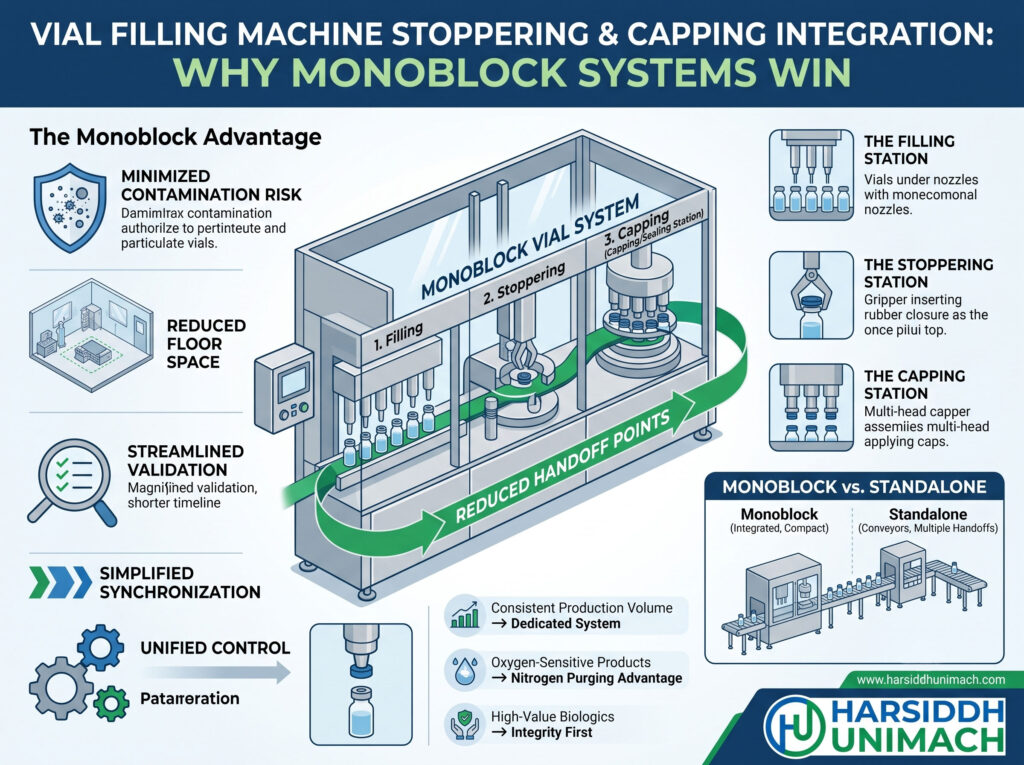
In a traditional injectable line, vials pass through a series of separate machines: a filling machine, a stoppering machine (often combined with the filler) and a separate cap sealing machine, connected by conveyors. Each machine has its own frame, drive, controls and change parts.
A monoblock machine combines several of these functions, typically filling, stoppering and capping (cap sealing), on a single frame with coordinated drives and one control system. Vials enter at one end and leave filled, stoppered and sealed at the other.
Monoblock machines are popular with small and medium injectable manufacturers, contract manufacturers and clinical supply units, because they save space, reduce transfers and simplify operation. They are also a practical way for companies entering injectable production to install a complete, coordinated solution without the complexity of linking several separate machines. In this article, we explain how a vial monoblock works, its advantages and limitations, how it compares with separate machines and how to decide whether it suits your production.
What Is a Monoblock Machine?
“Monoblock” simply means one block: several processing stations built into one machine. In vial filling, the most common combinations are:
| Monoblock Type | Functions Combined |
|---|---|
| Filling and stoppering | Liquid dosing and rubber stopper insertion |
| Filling, stoppering and capping | Dosing, stopper insertion and aluminium seal crimping |
| Filling and capping (bottles) | Liquid dosing and screw or ROPP capping |
This article focuses on filling, stoppering and capping for vials. The same principle is used for bottles, for example in the Automatic Liquid Bottle Filling and Capping Machine (Monoblock) and the liquid bottle filling and capping machine (monoblock).
How a Vial Monoblock Works
Station 1: Vial infeed
Sterile, depyrogenated vials arrive from the tunnel, such as a sterilizing tunnel for ampoules and vials, onto an infeed turntable or conveyor. A worm screw or star wheel spaces the vials and transfers them into the machine’s main transport, which may be a star wheel system, a walking beam or an indexing conveyor.
Station 2: Filling
At the filling station, needles descend into the vials and dose the product using piston, servo piston or peristaltic pumps. Diving needles rise with the liquid level to reduce foaming. Sensors ensure “no vial, no fill”. Nitrogen purging can be included for oxygen-sensitive products.
Station 3: Stoppering
Rubber stoppers are fed from a vibratory bowl, oriented and delivered along a track to the stoppering station. The stoppering head picks up each stopper and inserts it into the vial neck, fully for liquid products or partially for products going to lyophilisation (where applicable). A sensor detects missing stoppers so faulty vials can be rejected.
For more on this step, read vial filling machine stoppering: how stopper placement affects container closure quality and understanding the complete vial filling and stoppering process.
Station 4: Cap feeding and placement
Aluminium caps, often with flip-off tops, are fed from a separate bowl, oriented and placed over the stoppered vials.
Station 5: Crimping (cap sealing)
A crimping head, using rollers or a crimping die, rolls the aluminium skirt under the vial’s neck flange, securing the stopper and forming the seal. Crimping force is set to give a secure seal without damaging the glass. Read vial capping machine: how crimping force affects container closure integrity and our vial cap sealing machine working principle.
Station 6: Discharge and rejection
Sealed vials leave the machine onto an outfeed turntable or conveyor. Vials with detected faults, such as missing stoppers or caps, are rejected automatically.
Advantages of a Monoblock Machine
1. Smaller footprint
One machine replaces two or three, plus the conveyors between them. In classified cleanrooms, where every square metre is expensive to build and operate, this is a significant benefit.
2. Fewer transfers
Each transfer between machines is a potential source of jams, breakage and delays. A monoblock keeps vials in one transport system from infeed to discharge, reducing these risks.
3. Simpler operation
One control panel, one set of recipes and coordinated stations make the machine easier to operate and supervise.
4. Easier synchronisation
All stations are synchronised within the machine, so there is no need to balance speeds between separate machines.
5. Faster changeovers
With fewer machines to adjust and a single recipe system, changeovers between vial sizes can be quicker, especially on servo-driven designs.
6. Simplified qualification
One machine means one set of documentation, one FAT and a coordinated IQ/OQ, which can reduce validation effort.
7. Lower investment for small and medium output
For many applications, a monoblock costs less than separate machines with conveyors and controls.
Limitations and Considerations
Particle generation from crimping
Crimping aluminium caps can generate particles. In aseptic processing, it is important that these particles do not reach open vials or the critical filling zone. Monoblock designs address this through physical separation of the capping section, local extraction and airflow design. The arrangement must be consistent with your contamination control strategy and current regulatory guidance for sterile products. Some manufacturers prefer to keep capping in a separate machine and area for this reason.
Throughput
Monoblocks are typically designed for small to medium outputs. Very high-volume production may be better served by separate, dedicated high-speed machines.
Downtime affects all functions
If one station stops, the whole machine stops. With separate machines, buffers can sometimes keep other machines running.
Barrier integration
Monoblocks can be integrated with RABS or isolators, but the barrier design must consider both the filling/stoppering zone and the capping zone. Read the rise of RABS and isolators in modern pharmaceutical vial filling machines.
Monoblock vs Separate Machines
| Factor | Monoblock | Separate Filler and Capper |
|---|---|---|
| Footprint | Compact | Larger |
| Vial transfers | Fewer | More |
| Controls | Single system | Separate systems to coordinate |
| Investment (small/medium output) | Often lower | Often higher |
| Maximum output | Small to medium | Small to very high |
| Particle separation of capping | Requires careful design | Easier to separate physically |
| Flexibility to upgrade individual functions | Lower | Higher |
| Qualification | One machine | Several machines |
Who Should Consider a Monoblock?
A monoblock is well suited to:
- Small and medium-scale injectable manufacturers
- Contract manufacturers with many products and moderate batch sizes
- Clinical supply and pilot production
- New facilities where cleanroom space is limited
- Companies starting injectable production who want a complete, compact solution
Separate machines may be preferable for:
- High-volume, dedicated products
- Plants requiring strict physical separation between filling and capping areas
- Lines where individual machines may be upgraded or replaced independently
For help deciding on capacity, read small vial machine vs high-speed vial lines: how to choose the right capacity.
Integrating a Monoblock into a Complete Line
A monoblock is usually part of a larger line:
- Washing – for example, on a linear vial washer
- Depyrogenation – in a sterilizing tunnel
- Filling, stoppering and capping – in the monoblock
- External washing – on an automatic external vial washing machine
- Inspection – on a visual ampoule and vial inspection machine
- Labelling and packing
Compact solutions such as the automatic liquid vial filling line bring these steps together in a small footprint.
Operating a Monoblock: A Typical Batch
- Line clearance – remove all materials from the previous batch and confirm the area is clear
- Assembly of sterile parts – fit sterilised product contact parts, or install a single-use fluid path, using aseptic technique
- Load components – stoppers into the stopper bowl and caps into the cap bowl
- Select the recipe – fill volume, speeds and station settings for the product and vial size
- Prime and verify – prime the fluid path and confirm fill weights on all heads
- Production – run with in-process checks of fill weight, stopper placement and crimp quality
- Monitor alarms and rejects – investigate and record any recurring issues
- End of batch – reconcile components, empty bowls, remove product contact parts for cleaning or disposal
- Cleaning and documentation – clean the machine and complete batch records
Common Problems and Solutions
| Problem | Likely Cause | Solution |
|---|---|---|
| Fill weight variation | Air in fluid path, worn pump parts, supply level changes | Re-prime, service pumps, stabilise supply |
| Missing stoppers | Stopper bowl or track jam, stopper quality | Clear track, adjust bowl, check stopper lots |
| Stoppers not fully seated | Wrong head height, vial or stopper dimensions | Adjust head, verify component dimensions |
| Caps not placed squarely | Cap track misalignment, cap quality | Align track, check cap lots |
| Loose crimps | Low crimping force, worn rollers | Adjust force, replace rollers |
| Cracked vials at crimping | Excessive force, misalignment | Reduce force, centre vials correctly |
| Vial jams at transfers | Wrong or worn change parts, timing | Fit correct parts, adjust timing |
Maintenance Tips
- Inspect pumps, seals and needles regularly
- Clean and check stopper and cap bowls and tracks
- Inspect crimping rollers or dies for wear
- Check star wheels, guides and transfer parts for wear and alignment
- Verify sensors for vial, stopper and cap presence
- Calibrate fill weight and crimping force checks according to schedule
Servo-Driven Monoblocks
Many modern monoblocks use servo motors for key motions such as vial transport, needle movement, dosing and stoppering. Servo control brings digital fill setting, individual head trimming, programmable motion profiles for gentle handling and stored recipes for each product and vial size. For a multi-function machine like a monoblock, this coordination is particularly valuable, because all stations can be adjusted together from one control panel and synchronised precisely. The result is faster changeovers, more consistent quality and better diagnostic information when something goes wrong.
Monoblocks and Product Loss
Because a monoblock keeps vials in one transport system and minimises transfers, it can also help reduce product loss: fewer jams and broken vials mean fewer discarded containers. Combined with accurate dosing and short fluid paths, this makes monoblocks attractive for high-value products and small batches where every vial counts.
Machines to Consider
- Automatic Injectable Liquid Vial Filling and Stoppering Machine
- Liquid vial filling machine with rubber stoppering
- Vial cap sealing machine (1, 4, 6, 8 head) where capping is performed separately
- Vial cappers and glass vial capping machines
Browse our vial filling machines.
How to Choose a Vial Monoblock
- Products and fill volumes – including oxygen-sensitive or high-value products
- Vial sizes – range and change parts
- Output – matched to realistic demand
- Dosing technology – piston, servo piston or peristaltic
- Stoppering – full or partial insertion
- Capping design – separation, extraction and airflow
- Barrier compatibility – RABS or isolator integration
- Controls and data – recipes, access control, audit trails
- Documentation and qualification support
Frequently Asked Questions
What is a monoblock vial filling, stoppering and capping machine? A single machine that doses liquid into vials, inserts rubber stoppers and crimps aluminium caps, all on one frame with coordinated drives and controls.
What are the main advantages of a monoblock? Compact footprint, fewer vial transfers, simpler operation, easier synchronisation, faster changeovers and simplified qualification.
Are there concerns about crimping inside a monoblock? Crimping can generate particles, so the capping section must be designed with separation, extraction and airflow that protect open vials, in line with your contamination control strategy.
Is a monoblock suitable for high-volume production? Monoblocks are usually designed for small to medium output. Very high volumes are often better served by separate high-speed machines.
Can a monoblock be used with RABS or isolators? Yes, if the barrier design accounts for both the filling and stoppering zone and the capping zone.
Considering a monoblock for your injectable line? Contact our team or send an inquiry with your products, vial sizes and output targets.