
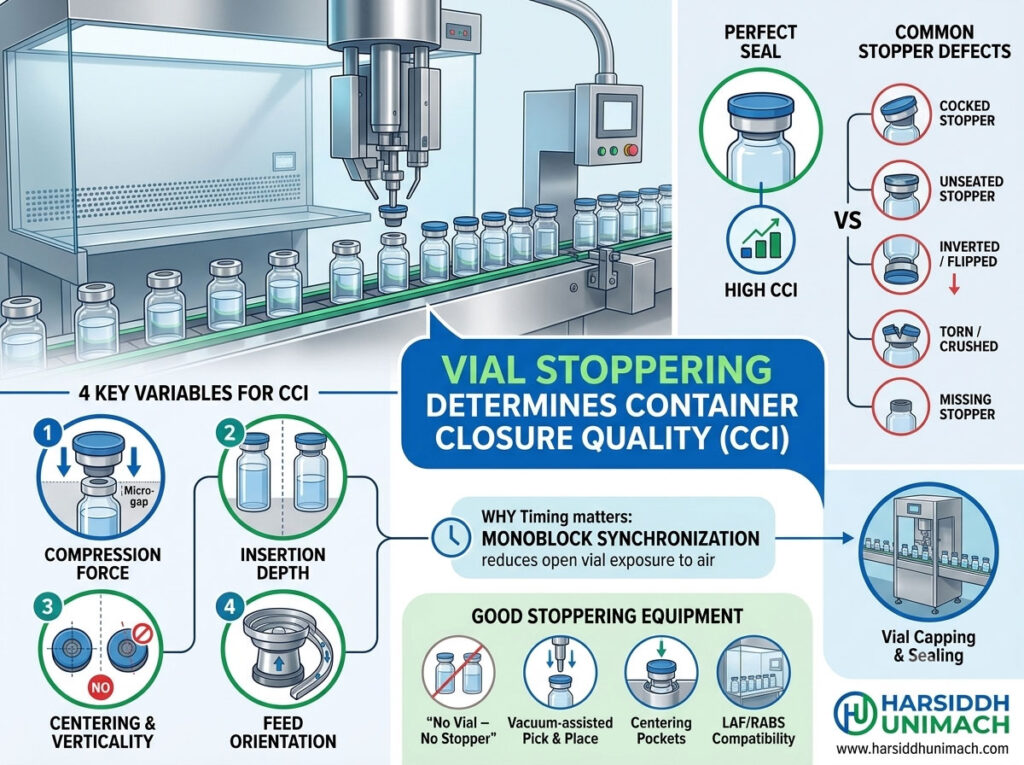
Every injectable vial that leaves a production line is only as sterile as its weakest seal point — and that seal point is almost never the glass. It’s the rubber stopper. Long before an aluminum cap is crimped into place, the stopper has already done the actual work of sealing the vial. If it wasn’t seated correctly at that moment, no amount of downstream capping pressure can fix it.
This is why stopper placement — not just fill accuracy — deserves serious engineering attention on any injectable vial line. A batch can pass every fill-weight check and still fail container closure integrity (CCI) testing because of a stoppering issue that no one caught visually. This article walks through exactly how stopper placement determines closure quality, the defects that result when it goes wrong, and what separates dependable stoppering equipment from equipment that quietly creates rejects.
The Stopper Is the Seal — The Cap Just Holds It There
It’s a common misconception that the aluminum cap is what seals a vial. In reality, the cap’s only job is to compress the rubber stopper permanently against the vial’s neck and keep it from working loose over time. The actual barrier between the sterile product and the outside world is formed entirely by the stopper itself, through elastic compression against the glass.
That means the single most important moment in the entire closure process is the instant the stopper is pressed into the vial neck — not the moment the cap is crimped afterward. Get that moment wrong, and you’ve built a defect into the vial that capping cannot undo.
Four Variables That Determine Whether a Stopper Seals Correctly
Compression Force
The stopper’s flange is manufactured slightly oversized relative to the vial opening, so inserting it always involves compressing the rubber. That compression is what generates sealing pressure. Insert it too gently, and the compression is incomplete, leaving microscopic gaps along the seal. Insert it with inconsistent force from cycle to cycle, and some vials in a batch will seal properly while others quietly don’t — which is exactly the kind of intermittent defect that’s hardest to catch without dedicated CCI testing.
Insertion Depth
Not every product wants the same seating depth. Standard liquid injectables need full seating — stopper flange flush with the vial’s neck finish, ready for immediate capping. Freeze-dried (lyophilized) products need the opposite at the filling stage: partial or half-seating, where the stopper rests in the vial’s neck groove without fully sealing it, allowing moisture vapor to escape during the lyophilization cycle. Only after freeze-drying is complete does the stopper get pressed fully home — typically inside the lyophilizer chamber itself, under vacuum, so the product is never exposed to ambient air.
Running the wrong seating depth for the product type isn’t a minor tuning issue — it’s a direct route to batch failure, either through incomplete seals or through trapped moisture in a lyophilized product.
Centering and Verticality
A stopper that isn’t inserted dead-center over the vial mouth goes in at a slight angle — a “cocked” stopper. Even a small tilt compresses one side of the seal too much and the other side too little, and a cocked stopper is also far more likely to be damaged during the capping stage, since crimping rollers are calibrated for a level, evenly seated stopper. Centering accuracy comes down almost entirely to how precisely the vial is held in place during insertion — which is a machine design question, not an operator skill question.
Feed Orientation
Before a stopper can be placed correctly, it needs to arrive at the insertion head correctly oriented — flange up, skirt down, one at a time. Automated lines handle this with a vibratory bowl feeder that sorts loose stoppers by orientation and channels them down a guide chute. When that feed system misbehaves — jamming, feeding stoppers sideways, or occasionally feeding two at once — every downstream mechanical precision advantage the machine has is wasted, because the defect was introduced before insertion even happened.
The Defects That Result When Placement Goes Wrong
| Defect | Visible Sign | Root Cause |
|---|---|---|
| Cocked stopper | Sits at a visible angle | Vial not centered, or insertion head misaligned |
| Unseated stopper | Flange sits proud of the vial finish | Insufficient insertion force or wrong depth setting |
| Inverted / flipped stopper | Stopper sits upside-down or sideways | Vibratory bowl orientation failure |
| Torn or crushed stopper | Visible tearing on the flange | Excessive force, or crimping over a cocked stopper |
| Missing stopper | Vial reaches capping unstoppered | Feed jam not caught by machine sensors |
Every one of these defects traces back to a specific, identifiable point in the stoppering sequence — which is exactly why they’re preventable through machine design rather than something to catch only at final inspection.
Why Exposure Time Between Filling and Stoppering Matters Too
Placement precision isn’t the only variable — timing matters just as much. Every second a filled vial sits open before its stopper goes on is a second of exposure to the surrounding cleanroom air. This is why the physical distance between the filling nozzle and the stoppering head on a production line is itself a quality variable, not just a throughput one.
Monoblock machines — where filling and stoppering happen on the same compact platform rather than across a longer conveyor run between two separate stations — minimize this exposure window by design. Harsiddh Unimach’s Automatic Injectable Liquid Vial Filling & Stoppering Machine (HLVF Series) uses exactly this synchronized, close-proximity architecture for that reason.
What Good Stoppering Equipment Does Differently
The best way to prevent the defects above isn’t tighter manual inspection — it’s equipment that removes the opportunity for the defect to occur in the first place. Specifically, look for:
- “No Vial – No Stopper” interlocks, which stop the insertion head from actuating when a vial is missing or misaligned, avoiding wasted stoppers and downstream jams.
- Vacuum-assisted or pick-and-place insertion, which applies consistent force cycle after cycle instead of relying on gravity or purely mechanical pressure that can drift over a production run.
- Precisely sized vial-holding pockets, which keep every vial centered and vertical through the insertion stroke.
- Adjustable seating depth, so the same machine can run full seating for liquid injectables and partial seating for lyophilized products without a major changeover.
- LAF/RABS-compatible design, since stoppering happens on an open vial and needs continuous Class 100 laminar airflow protection throughout the process.
Harsiddh Unimach’s Vial Filling Machines and Injectable Liquid Vial Filling Line are built around this exact set of principles — SS 316L contact parts, “No Vial – No Fill / No Stopper” sensor logic, and monoblock filling-to-stoppering synchronization engineered to cGMP standards.
Verifying That It Worked: How CCI Gets Tested
Because stoppering defects aren’t always visible, manufacturers typically confirm closure integrity using one or more of these methods:
- Automated or manual visual inspection, catching obvious cocked, flipped, or missing stoppers before cap crimping — a role served on Harsiddh Unimach lines by the Semi-Automatic Visual Vial Inspection Machine and Visual Vial & Bottle Inspection Machine.
- Vacuum decay testing, a non-destructive method measuring pressure change in a vial placed under vacuum to detect micro-leaks.
- Dye ingression testing, a destructive method where sealed vials are submerged in dye under vacuum and checked for penetration through a compromised seal.
- Headspace gas analysis, used for oxygen-sensitive products, confirming the sealed headspace atmosphere has held over time.
Stoppering Sets Up the Capping Stage — Not the Other Way Around
It’s worth stating plainly: capping quality is downstream of stoppering quality, not independent of it. A correctly seated, evenly compressed stopper gives crimping rollers — whether on Harsiddh Unimach’s Automatic Single Head Vial Cap Sealing Machine or the bench-scale Semi-Automatic Vial Cap Sealing Machine — a predictable, level surface to work with. A cocked or unseated stopper going into the crimping stage almost guarantees an uneven or damaged final seal, regardless of how well-calibrated the capping machine itself is.
Line qualification should therefore treat stoppering and capping as one connected sequence, not two separately validated steps.
Questions Worth Asking Before You Buy Stoppering Equipment
- Does the insertion head apply consistent, adjustable force across every vial size we run?
- Can it switch cleanly between full seating and partial/half-seating for lyophilized products?
- What sensors catch a missing, misfed, or misaligned stopper before it reaches capping?
- How much open-air exposure does a vial experience between the filling nozzle and the stoppering head?
- Is the machine validated for integration under LAF or RABS systems, with supporting IQ/OQ documentation?
Final Thoughts
Container closure integrity is decided the instant a stopper meets a vial neck — not at the capping station, and not at final inspection. Compression consistency, correct seating depth, centering accuracy, and feed reliability all compound into a single binary outcome: a sterile seal that holds for the product’s full shelf life, or a defect that surfaces later, often far from the production floor.
Manufacturers who apply the same engineering scrutiny to stoppering that they already apply to fill accuracy consistently see fewer CCI failures and fewer rejected batches downstream.
Related Reading
- The Ultimate Guide to Ampoule Filling and Sealing Machine Working Principle
- The Importance of GMP Compliance in Pharmaceutical Machinery
- How to Calculate Filling Machine ROI for Manufacturing Plants
Explore Related Machines
- Automatic Injectable Liquid Vial Filling & Stoppering Machine (HLVF Series)
- Vial Filling Machines
- Injectable Liquid Vial Filling Line
- Vial Capping / Sealing Machines
- Inspection Machines
- Pharma Machinery (Blog Category)
Get in touch: For technical datasheets, machine specifications, or a customized consultation on vial filling and stoppering solutions, visit www.harsiddhunimach.com or contact our engineering team at info@harsiddhunimach.com.