


Visual Vial/Bottle Inspection Machine
High-Precision Quality Control for Liquid Packaging Lines
In the modern pharmaceutical, biotechnology, and veterinary manufacturing sectors, product purity and packaging integrity are paramount. Even the smallest microscopic oversight can compromise consumer safety and jeopardize a manufacturer’s brand reputation. The Harsiddh Visual Vial & Bottle Inspection Machine serves as an indispensable secondary packaging and quality assurance solution designed to eliminate these risks entirely.
Engineered to operate as a critical quality checkpoint, this advanced inspection table empowers packaging lines to maintain 100% safety compliance. It provides human operators with the ideal ergonomic environment and optical conditions needed to identify foreign contaminants in liquid formulas, examine seal structural integrity, and detect micro-cracks or full fractures in glass containers. Built with heavy-duty, vibration-free materials and available in highly customizable track configurations, the Harsiddh visual inspection system serves as a reliable, long-term asset tailored for both boutique small-batch clinical trials and rapid, high-volume commercial production lines.
Why Visual Inspection Matters in Sterile & Liquid Packaging
While upstream automation handles rapid filling and capping, mechanical errors or environmental particulates can still occur. This is where a specialized visual inspection conveyor becomes critical. The primary role of the Harsiddh inspection system is to establish a flawless bridge between your capping and final labeling departments, catching structural and aesthetic anomalies that sensors might miss.
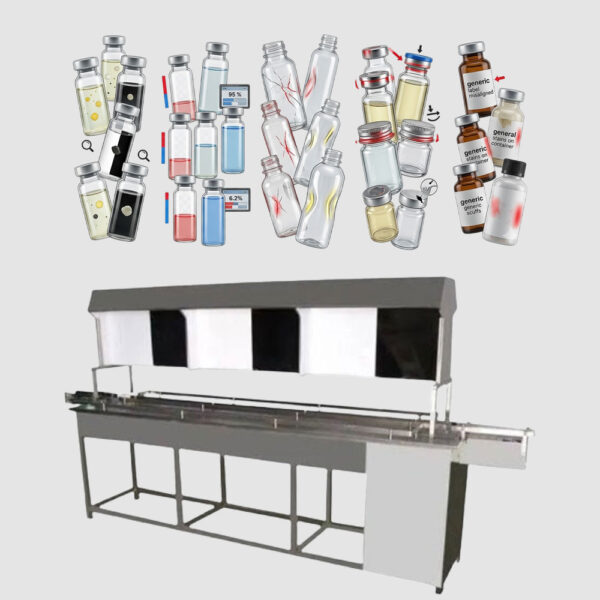
Our machine is strategically engineered to assist operators in pinpointing multiple critical defects, including:
- Particulate Matter Contamination: Instantly flags floating dark fibers, glass shards, chemical precipitants, or dust particles floating inside liquid suspensions, syrups, or injectables.
- Structural Glass Imperfections: Detects fine cracks, hairline fractures, chips, or cosmetic defects in the glass or plastic structure before they leave the facility.
- Cap and Closure Integrity Flaws: Allows operators to review the exact sealing depth, detecting skewed aluminum caps, loose flip-off seals, or misplaced rubber stoppers that could breach container sterility.
- Fill Level Uniformity deviations: Helps identify sub-optimal or overfilled containers at a glance, protecting dosage accuracy.
The Systematic 5-Stage Operational Workflow
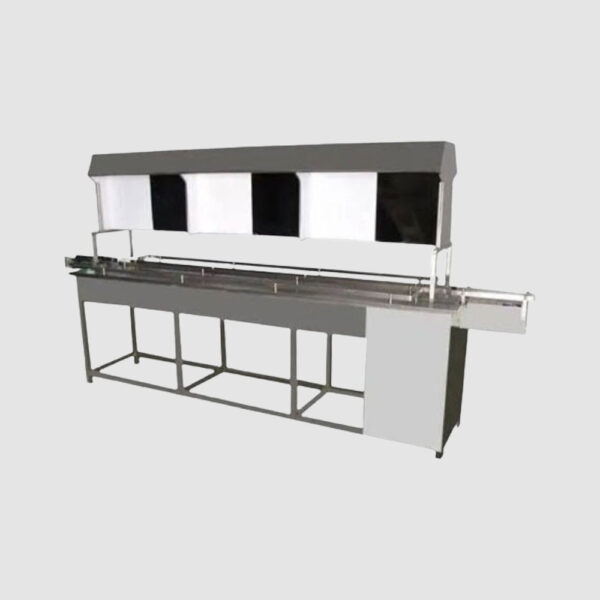
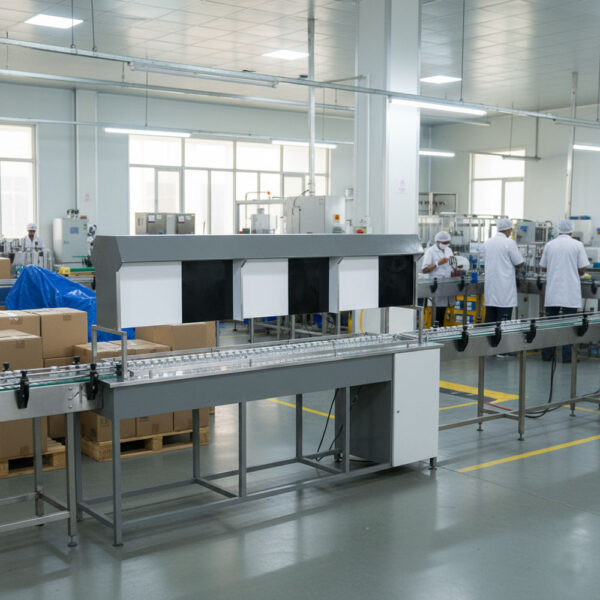
The Harsiddh Visual Inspection Table utilizes a highly structured, three-track conveyor design that guarantees zero mix-ups between uninspected, passed, and rejected vials or bottles.
Step 1: Automated Infeed Stage
The cycle initiates as filled and sealed containers are transferred directly onto the central conveyor track from preceding upstream machinery, such as an automatic capping or crimping machine. The moving stainless steel slat chain ensures a smooth, non-turbulent movement, preventing containers from toppling or colliding.
Step 2: Mechanical Bifurcation
To divide the workload evenly among operators without halting line momentum, incoming vials and bottles hit an integrated, gentle diversion gate. The containers are smoothly split and routed outward away from the central channel onto two parallel, adjoining side-tracks. This brings the containers directly into the designated operator workspaces.
Step 3: Ergonomic Manual Scrutiny
Once the containers arrive on the side inspection tables, operators conduct a direct, focused visual audit. The table features an overhead illuminated canopy hood fitted with high-intensity, flicker-free LED lighting panels. Positioned directly behind the bottles is a dual-contrast background panel featuring alternating, high-contrast black and white zones.
- The Science behind the Optics: Light-colored or transparent particulates (such as glass fibers or dust) become brightly illuminated and visible against the black background. Conversely, dark or opaque foreign matter (such as rubber fragments or carbon specks) stands out immediately against the white background.
Step 4: Strict Quality Sorting & Separation
Operators evaluate each container as it moves across their station.
- If a vial or bottle passes all quality checks, the operator moves it back onto the central conveyor track.
- If any defect is observed—such as a hairline crack or a floating filament—the operator instantly pulls it off the line and deposits it into a dedicated rejection area, preventing compromised batches from advancing.
Step 5: Secure Discharge & Labeling Integration
The approved, 100% validated “good” containers travel forward down the primary central track. This central lane acts as a secure transit corridor that guides the verified products directly to downstream equipment, like a high-speed labeling machine or secondary cartooning system, finishing the packaging process.
Key Salient Features and Advantages
1. Robust, Vibration-Free Engineering
The entire foundation of the machine is constructed out of heavy-walled stainless steel square pipes supported by adjustable leveling bolts. This rigid structure completely isolates the inspection table from external plant floor vibrations, preventing optical distortions for operators and ensuring flawless product stability during high-speed runs.
2. Variable AC Frequency Drive (VFD)
To seamlessly match your plant’s dynamic production schedules, our machine features an electronic variable speed AC drive. Production managers can fine-tune the conveyor’s linear travel speed to align perfectly with the specific dexterity, comfort levels, and capabilities of the human inspectors on shift.
3. Low-Friction, Maintenance-Free Components
To eliminate grease contamination risks in sterile rooms, the conveyor mechanism features self-lubricating UHMW (Ultra-High-Molecular-Weight) wear-strip guides beneath the stainless steel slat chains. Coupled with high-grade self-aligning bearings, the system provides exceptionally smooth operation with minimal mechanical maintenance required.
4. Customizable Modular Lengths
Every manufacturing floor layout presents unique space constraints. Harsiddh offers customizable machine lengths and flexible track modules. Whether you need a shorter dual-operator configuration for limited laboratory spaces or an extended multi-operator system for maximum throughput, the table length can be adapted to your exact operational space.
5. Smooth Line Synchronization
Thanks to its highly adjustable conveyor height bolts, this inspection machine easily integrates into pre-existing automatic bottling lines. It can be physically leveled and configured to match the discharge heights of third-party liquid fillers, cappers, and labelers, minimizing manual handling and eliminating product tipping risks.
Technical Specification
| Feature | Details |
|---|---|
| Production Output | Up to 100 Containers / Minute |
| Container Diameter | 22 mm to 100 mm |
| Container Height | 58 mm to 240 mm |
| Number of Operators | Four (2 x 2 Configuration) |
| Power Drive | 0.5 H.P. |
| Electrical Supply | 220 Volts, Single Phase, 50 Hz |
| Conveyor Height | 850 mm to 900 mm (Adjustable) |
| Overall Dimensions | Approx. 1850 mm (L) x 700 mm (W) x 1550 mm (H) |
Frequently Asked Questions
How does the machine assist the operator in identifying small particles?
The Harsiddh inspection machine uses a mechanical rotation and agitation system. As containers move along the conveyor, they are spun at high speeds and then slowed down. This motion causes any heavy particles in the liquid to move and swirl, making them much easier to detect against the illuminated background compared to a stationary container.
What kind of lighting and visual aids are integrated into the machine?
To maximize visibility and reduce operator eye strain, the machine is equipped with:
High-Contrast Backgrounds: A combination of Black and White backgrounds to help detect both light-colored and dark-colored impurities.
Flicker-Free LED Illumination: Provides consistent, high-intensity light that highlights cracks and particles without causing a "strobe" effect.
Magnifying Lens: A large, adjustable magnifying glass is positioned at eye level to provide a detailed view of the container's contents and seal.
Can the machine handle different container sizes and materials?
Yes. This machine is highly versatile and designed to accommodate a wide range of glass vials, plastic bottles, and glass bottles. It typically supports container sizes ranging from 2ml to 250ml (or larger depending on the specific model). Switching between different sizes is simple, requiring only minor adjustments to the conveyor guides and the rotation rollers.
What are the key cGMP and safety features of this inspection unit?
As a cGMP-compliant unit built for sterile and regulated environments:
Material Integrity: The main frame and all non-contact parts are fabricated from polished SS 304 stainless steel for easy sanitization.
Ergonomic Design: The machine is height-adjustable to ensure the inspection zone remains at the operator's natural eye level, preventing physical fatigue during long shifts.
Low Maintenance: The system uses a simple mechanical drive with few wearing parts, ensuring high uptime and long-term reliability in a production line.