
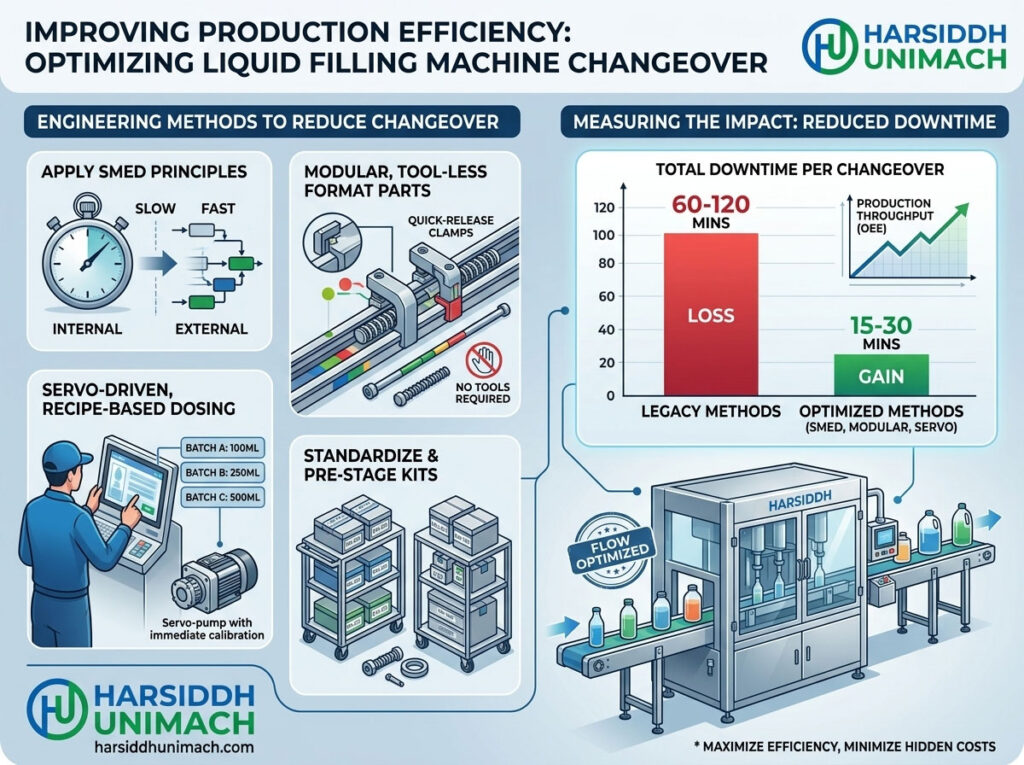
Liquid filling lines for syrups, suspensions, oral solutions, eye drops and similar products often run many products and bottle sizes. Each change means stopping the line, draining and cleaning the product path, swapping change parts, adjusting nozzles, guides and cappers, and then verifying the new setup. On busy multi-product lines, these changeovers can consume more production time than any other loss.
Procedures and training help, but there is a limit to what better organisation can achieve if the machine itself is slow to change over. The biggest, most lasting gains often come from engineering: designing or modifying machines and lines so changeovers need fewer steps, fewer tools and fewer adjustments.
This article explains engineering methods to reduce liquid filling machine changeover time. It covers how to analyse a changeover, product path design, change part design, adjustment elimination, standardisation and changeover-friendly capping and labelling equipment.
For the organisational side of changeovers, such as preparation, sequencing and line clearance, see our article on vial filling machine changeover best practices, many of which apply equally to bottle filling lines.
Why Changeover Time Matters
Illustrative example (not data for any line): a liquid filling line runs 16 hours a day with two changeovers. If each changeover takes 90 minutes, only 13 hours remain for production. Reducing each changeover to 45 minutes leaves 14.5 hours, about 11% more production time from the same line and shift pattern.
Shorter changeovers also allow:
- smaller batch sizes without losing capacity
- lower inventory, because products can be made closer to demand
- faster response to customer orders
- less risk of setup errors, because simpler changeovers are more repeatable
Step 1: Analyse the Current Changeover
Engineering improvements should target the biggest losses. Start by understanding the current changeover in detail.
- Record a changeover, ideally on video where permitted, from the last good bottle of one batch to the first good bottle of the next.
- List every activity with its duration.
- Classify activities as internal (only possible with the line stopped) or external (possible while running).
- Group activities by type: cleaning, disassembly, assembly, adjustment, verification, waiting and searching.
- Identify the longest and most variable activities.
This is the core of the SMED (Single-Minute Exchange of Die) approach. Once organisational fixes have moved external work outside the stop, the remaining internal work is the target for engineering.
| Activity Type | Typical Engineering Solutions |
|---|---|
| Cleaning the product path | Disposable tubing, quick-release pumps, CIP, spare product path sets |
| Removing and fitting parts | Tool-less fastenings, locating features, fewer parts |
| Adjustment | Servo recipes, scales, fixed stops, motorised height adjustment |
| Verification | Recipe-based settings, automatic checks |
| Searching and waiting | Changeover trolleys, marked parts, shadow boards |
Step 2: Engineer the Product Path for Fast Cleaning
On product changeovers, cleaning the product path is often the longest step. Engineering options include:
Disposable or Dedicated Peristaltic Tubing
With peristaltic dosing, product contacts only the tubing. Changing products can be as simple as replacing the tubing set, with no pump to dismantle or clean. An automatic peristaltic based liquid filling machine or a peristaltic based liquid filling machine uses this principle. Dedicated tubing sets per product further reduce cross-contamination risk.
Quick-Release Piston Pumps
Where piston pumps are needed for viscous products, designs with quick-release clamps and minimal parts allow pumps to be removed, cleaned and refitted quickly. Servo-driven versions, such as an automatic servo based piston filling machine or a servo based piston filling machine, add recipe-based volume setting.
Sanitary Clamp Fittings
Replacing threaded connections with sanitary clamp fittings on hoses, manifolds and tanks speeds disassembly and reassembly and improves cleanability.
Spare Product Path Sets
Holding a second set of pumps, manifolds, hoses and nozzles allows one set to be cleaned offline while the other is in use, converting internal cleaning time into external work.
Clean-in-Place (CIP)
For some liquid products and larger systems, CIP allows tanks and product lines to be cleaned without dismantling. CIP must be designed and validated for the specific system.
Minimised Hold-Up Volume
Shorter product lines and smaller manifolds reduce the product left in the system, speeding draining and cleaning and reducing product loss.
Step 3: Design Change Parts for Speed and Accuracy
Format changeovers involve swapping parts that handle bottles: star wheels, guides, timing screws, nozzle holders and capper chucks.
- Tool-less fastenings: hand knobs, quick-release pins and clamps replace bolts.
- Locating dowels and keyed fittings: parts can only be fitted in the correct position.
- Colour coding or engraving: each part is marked with its format.
- Lightweight materials: easier, faster and safer handling.
- Fewer parts: design parts that serve multiple formats where possible.
- Changeover trolleys and shadow boards: every part and tool has a visible place.
Step 4: Eliminate Adjustment
Adjustment is often the most time-consuming and variable part of a format changeover. Engineering methods include:
Servo Recipes
On servo-driven fillers, fill volume, speed, nozzle stroke and timing are stored for each product and format. Selecting a recipe sets the machine automatically.
Motorised or Indexed Height Adjustment
Nozzle and capping head heights can be set with motorised drives linked to recipes, or with indexed positions and digital readouts.
Centralised Guide Adjustment
Instead of adjusting each guide rail individually, centralised mechanisms move several guides together with a single handwheel and scale.
Scales, Counters and Fixed Stops
Where manual adjustment remains, scales and counters allow operators to set recorded values quickly and repeatably.
Step 5: Use Quick-Change Nozzles
Different products and bottle necks may need different nozzle sizes. Quick-change nozzle holders allow nozzles to be swapped without tools, and drip-free or anti-drip nozzle designs reduce cleaning and setup time.
Step 6: Standardise Containers and Closures
Every additional bottle size, neck finish or closure adds change parts and adjustments. Working with packaging development and suppliers to standardise can reduce changeover burden significantly:
- fewer bottle sizes and shapes
- common neck finishes across bottle sizes
- common cap types and sizes
- standard label sizes where possible
Standardisation may require agreement from marketing and regulatory teams, but it often delivers the largest long-term reduction in changeover time.
Step 7: Make Capping Changeovers Quick
Cappers often have more change parts than fillers. Engineering methods include:
- quick-change chucks or capping heads
- tool-less star wheel and guide changes
- adjustable cap chutes with scales
- recipe-based torque settings on servo cappers
- universal parts that suit several cap sizes
Inline cappers, such as a linear capping machine, typically change over faster than rotary cappers because adjustments are simpler. A bottle screw and ROPP capping machine should be specified with change parts for every cap in your range. Our article on optimising production efficiency with advanced capping machines covers capper features in more detail.
Step 8: Make Labelling Changeovers Quick
Labellers need label roll changes, guide settings and coder updates.
- quick-load label reels
- labelling head height and angle scales
- recipe storage for label length and dispense settings
- pre-loaded coding data linked to the batch
A bottle sticker labeller with these features changes over much faster than one requiring trial-and-error adjustment.
Step 9: Consider Integrated Machines
A monoblock that combines filling and capping in one frame has fewer separate machines to change over and fewer conveyor transfers to adjust. An automatic liquid bottle filling and capping monoblock can reduce both changeover time and footprint.
Upstream, a linear bottle washing machine with quick-change parts helps keep the whole line’s changeover short.
Step 10: Choose the Right Filling Technology
Some filling technologies are inherently faster to change over than others.
| Technology | Changeover Characteristics |
|---|---|
| Peristaltic | Very fast product changes with tubing replacement |
| Gravity | Simple design, but tank and valve cleaning needed |
| Piston | Quick with quick-release design; more parts to clean |
| Gear pump | Moderate; pump housing must be cleaned |
An automatic gravity based liquid filling machine suits thin liquids with simple cleaning, while a servo based gear pump filling machine suits more viscous products. Our comparison of liquid filling machine technologies explains each in more detail. Browse our full range of liquid filling machines and bottle filling machines for oral liquids.
Step 11: Measure Results and Keep Improving
After each engineering change, measure changeover time again and compare with the baseline. Track:
- total changeover time
- time per activity
- start-up rejects
- problems encountered
Continue to target the longest remaining activities. Changeover reduction is an ongoing process, not a single project.
Applying These Methods to Other Lines
The same engineering principles apply to ampoule and vial lines, with additional considerations for sterile product paths and format parts. See our article on ampoule filling machine changeover and reducing downtime between different ampoule sizes.
Designing a New Line for Fast Changeover
If you are buying a new line, changeover performance should be part of the specification from the start, rather than something to fix later. Include in your User Requirement Specification:
- the full list of products, bottle sizes, neck finishes, caps and labels the line must run
- a target changeover time for product changes and for format changes
- requirements for tool-less change parts, marking and changeover trolleys
- recipe storage for fill volumes, speeds, heights and torque where available
- a demonstration of a full changeover during the Factory Acceptance Test
Ask suppliers to show how many parts change between your formats and how long each step takes. The same thinking applies to injectable lines; our article on vial filling machine flexibility and running multiple vial sizes on a single line explains how to plan a format range at the design stage.
People Still Matter
Even the best-engineered machine needs a trained team. Involve operators in changeover improvement, because they see where time is lost every day. Train everyone on the standard sequence, and cross-train several people so changeovers do not depend on one expert.
Compliance Considerations
Engineering changes to a qualified line must go through change control. Consider:
- impact on cleaning validation, especially for changes to product-contact parts
- requalification of affected functions
- updated SOPs, setup sheets and training
- documentation of new change parts and recipes
Designing changeover features into new machines from the start avoids many of these steps.
Engineering Checklist for Fast Changeovers
| Area | Question |
|---|---|
| Product path | Can product-contact parts be removed without tools or replaced as disposables? |
| Spare sets | Would a second product path set allow offline cleaning? |
| Change parts | Are parts tool-less, keyed and clearly marked? |
| Adjustment | Are settings stored in recipes or set with scales and stops? |
| Nozzles | Can nozzles be changed quickly? |
| Standardisation | Can container, neck and cap variety be reduced? |
| Capper and labeller | Do they change over as quickly as the filler? |
| Integration | Would a monoblock reduce changeover steps? |
| Measurement | Is changeover time measured and reviewed? |
Frequently Asked Questions
What is the fastest way to reduce changeover time? Usually, moving preparation outside the stop and eliminating adjustment through recipes and marked parts.
Is peristaltic filling always fastest to change over? For product changes, it is often very fast because only tubing is replaced. For very viscous products, other technologies may be necessary.
Do engineering changes need revalidation? Changes to a qualified line should go through change control, and some may require requalification or cleaning validation updates.
Should I buy spare product-contact parts? For lines with frequent product changes, spare sets often pay for themselves by allowing offline cleaning.
Can older machines be upgraded for faster changeover? Often yes, with quick-release fittings, marked parts, scales and, in some cases, servo upgrades.
Engineer Faster Changeovers With Harsiddh
Harsiddh Unimach designs liquid filling machines, cappers, labellers and monoblocks with changeover in mind: quick-release product paths, peristaltic and servo dosing, marked change parts and recipe-based settings on servo models. Our team can review your products and formats and recommend equipment or upgrades to cut changeover time.
Contact us through our contact page or send your requirements through our inquiry form.