
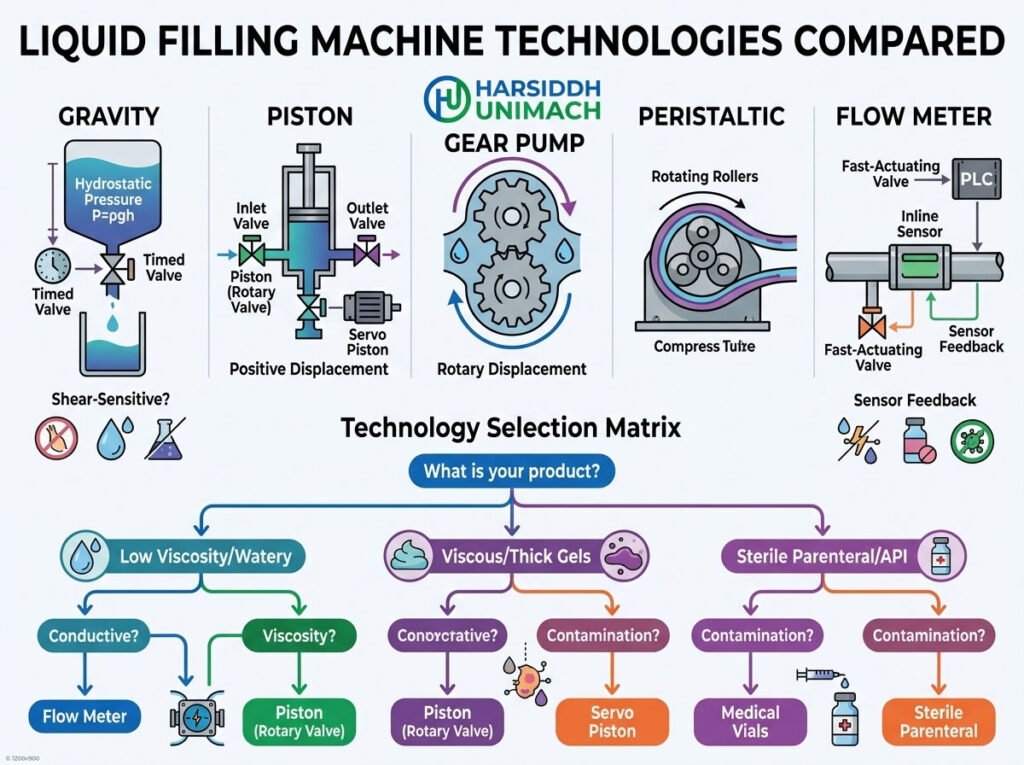
When you shop for a liquid filling machine, one of the first questions a supplier will ask is: which filling technology do you need? The answer has a bigger impact than almost any other choice. It decides how accurately your containers are filled, which products the machine can handle, how fast it runs, how easy it is to clean and what it costs to own over many years.
Five technologies cover the vast majority of liquid filling applications: gravity, piston, gear pump, peristaltic and flow meter. Each has clear strengths and limitations. This guide compares them side by side on the factors that matter most to buyers, shows which products suit each one and gives you a practical decision framework.
If you want a deeper explanation of the physics behind each method, see our companion article: liquid filling machine working principle explained.
The Five Technologies at a Glance
- Gravity filling – liquid flows from an overhead tank through a timed valve.
- Piston filling – a piston draws product into a cylinder and pushes out a fixed volume.
- Gear pump filling – a servo-driven gear pump delivers a measured volume per revolution.
- Peristaltic filling – rollers squeeze a flexible tube to push product forward.
- Flow meter filling – a meter measures liquid passing through and closes the valve at the target quantity.
Master Comparison Table
| Criterion | Gravity | Piston | Gear Pump | Peristaltic | Flow Meter |
|---|---|---|---|---|---|
| Accuracy | Moderate | High | High | High (small volumes) | High (clean liquids) |
| Viscosity range | Thin only | Thin to very thick | Medium to high | Thin to medium | Thin |
| Particles / suspensions | Limited | Good (with suitable valves) | Limited | Good | Poor |
| Foaming products | Moderate | Good (with diving nozzles) | Good | Good | Moderate |
| Small volumes (< 10 ml) | Poor | Good | Moderate | Excellent | Moderate |
| Large volumes (1 L+) | Good | Good | Excellent | Poor | Excellent |
| Speed | Moderate | Moderate to high | High | Moderate | High |
| Cleaning | Easy | Moderate (disassembly) | Moderate | Very easy (replace tube) | Easy (CIP-friendly) |
| Cross-contamination risk | Low–moderate | Moderate | Moderate | Very low | Low |
| Typical cost | Low | Moderate | Moderate | Moderate | Moderate to high |
| Main wear parts | Valves, seals | Piston seals, valves | Gears, seals | Tubing | Valves, seals |
Five Liquid Filling Technologies at a Glance
1. Gravity Filling
How it works in brief
An overhead tank feeds product to each nozzle through a valve. The valve opens for a set time; with a constant liquid level, that time delivers a consistent volume.
Best for
Thin, free-flowing liquids such as water, mouthwash, solvents, vinegar, alcohol-based sanitisers, juices and some chemicals.
Advantages
- Simple and economical
- Few parts in contact with the product
- Gentle on the product
Limitations
- Accuracy depends on stable tank level, temperature and viscosity
- Not suitable for viscous products
- Slower for larger volumes
See the Automatic Gravity Based Liquid Filling Machine and our gravity based liquid filling machine.
2. Piston Filling
How it works in brief
A piston moves back to draw product into a cylinder through an inlet valve, then forward to push the measured volume out through the nozzle. Volume is set by stroke length; servo versions set it electronically.
Best for
A very wide range of products: pharmaceutical syrups and suspensions, lotions, creams, gels, sauces, honey, pastes and viscous chemicals.
Advantages
- High accuracy and repeatability
- Handles thin to very thick products
- Suitable for products with small particles, using appropriate valves
- Servo models offer fast, recipe-based changeovers
Limitations
- More parts to disassemble and clean than peristaltic systems
- Piston seals and valves wear and need periodic replacement
- Very thin liquids need anti-drip nozzles
See the Automatic Servo Based Piston Filling Machine, our servo based piston filling machine and our lotion and gel filling machine.
3. Gear Pump Filling
How it works in brief
A servo motor turns a gear pump a precise number of revolutions. Each revolution moves a known volume of liquid trapped between the gear teeth and housing.
Best for
Medium to high viscosity liquids filled continuously at speed: edible oils, lubricants, engine oils, shampoos, liquid soaps and detergents.
Advantages
- Smooth, low-pulsation flow
- Fast filling, especially for medium and large volumes
- Accurate with servo control
- Compact design
Limitations
- Not ideal for products with abrasive or large particles
- Gears and seals wear over time
- Less suited to very small volumes
See the Automatic Servo Based Gear Pump Filling Machine, our servo based gear pump filling machine and our servo based oil and viscous filling machine.
4. Peristaltic Filling
How it works in brief
Rollers on a rotor compress a flexible tube, pushing pockets of liquid towards the nozzle. The product only touches the inside of the tube.
Best for
Small volumes, sterile and high-value liquids, and multi-product facilities: eye and ear drops, injectables, diagnostic reagents, essential oils and serums.
Advantages
- Excellent accuracy at small volumes
- Product contacts only the tubing — no cross-contamination
- Single-use tubing removes cleaning validation between products
- Fast product changeovers
Limitations
- Tubing wears and must be replaced regularly
- Slower for large volumes
- Accuracy can drift as tubing ages, so recalibration is needed
See the Automatic Peristaltic Based Liquid Filling Machine, our peristaltic based liquid filling machine and our automatic eye/ear drop filling line. For a closer comparison with piston dosing, read peristaltic vs piston pumps.
5. Flow Meter Filling
How it works in brief
Liquid flows through a magnetic or mass (Coriolis) flow meter, which measures the quantity passing through. When the target is reached, the controller closes the valve.
Best for
Clean, homogeneous, low-viscosity liquids filled at high speed: water, beverages, some chemicals and cleaning products.
Advantages
- Few moving parts in contact with the product
- Hygienic, CIP-friendly design
- Fast filling, well suited to large volumes
- Mass meters measure mass directly, compensating for density changes
Limitations
- Magnetic meters need conductive liquids
- Not suitable for products with particles or high viscosity
- Higher cost per nozzle than simpler systems
What About Weight-Based Filling?
Load cell (net weight) filling is a sixth option, measuring each container’s weight as it fills. It is ideal for large containers, high-value products and products sold by weight. See our load cell based liquid filling machine, and read our guide to weight-based vs volumetric filling.
Matching Technology to Product
| Product | Recommended Technology |
|---|---|
| Water, mouthwash, vinegar | Gravity or flow meter |
| Alcohol-based sanitiser | Gravity or piston (with anti-foam nozzles) |
| Pharmaceutical syrup / suspension | Piston (servo or volumetric syringe) |
| Eye and ear drops | Peristaltic |
| Injectables (small volumes) | Peristaltic or piston |
| Shampoo, liquid soap | Gear pump or piston |
| Lotion, cream, gel | Piston |
| Honey, sauces, pastes | Piston (large-bore nozzles) |
| Edible oil (bottles) | Gear pump or piston |
| Edible oil / lubricant (large containers) | Gear pump or weight-based |
| Beverages (high speed) | Flow meter or gravity |
| Essential oils, serums | Peristaltic |
Five Questions to Choose the Right Technology
1. How thick is the product?
- Thin → gravity, flow meter or peristaltic
- Medium → gear pump, piston or peristaltic
- Thick → piston
2. What fill volumes do you need?
- Very small → peristaltic or piston
- Medium → piston or gear pump
- Large → gear pump, flow meter or weight-based
3. Does the product contain particles or foam?
- Particles → piston (suitable valves) or peristaltic
- Foam → bottom-up filling with diving nozzles on piston, gear pump or peristaltic machines
4. How critical are hygiene and cross-contamination?
- Sterile, potent or many products → peristaltic with single-use tubing
- High-volume single products → piston, gear pump or flow meter with validated cleaning
5. What output and budget do you have?
- Low budget, simple product → gravity
- High speed, thin products → flow meter
- Flexible, accurate filling across many products → servo piston
Example Scenarios
A pharmaceutical company filling cough syrups and antacid suspensions in 60–200 ml bottles needs accuracy, GMP construction and the ability to handle suspended particles. A servo piston or volumetric syringe filler is usually the best fit.
An ophthalmic manufacturer filling 5 ml and 10 ml eye drop bottles needs very accurate small doses and minimal contamination risk. Peristaltic filling with single-use tubing is the natural choice.
A personal care brand filling shampoo, conditioner and body wash in several bottle sizes needs smooth, fast filling of medium-viscosity, foamy products. A servo gear pump or piston filler with diving nozzles works well.
An edible oil packer filling 1 L bottles and 5 L cans needs speed and accuracy across larger volumes. Gear pump filling suits the bottles, while weight-based filling is often preferred for the cans.
A beverage or water bottler filling thin, clean liquids at high speed may choose flow meter or gravity filling.
In every case, a trial with the actual product and containers is the best way to confirm the choice before buying.
Cost of Ownership Considerations
Purchase price is only part of the story. Compare:
- Product giveaway — more accurate technologies reduce overfill
- Wear parts — seals, gears, valves or tubing and how often they need replacing
- Cleaning time — and whether cleaning needs validation
- Changeover time — servo systems with recipes are fastest
- Energy and compressed air use
- Downtime risk — simpler systems may be more robust in some applications
Common Mistakes When Choosing a Technology
- Choosing gravity for a viscous product, resulting in slow, inaccurate fills
- Using a flow meter for products with particles, causing measurement errors and blockages
- Choosing peristaltic for large volumes, leading to slow output and frequent tube changes
- Ignoring foaming behaviour, causing overflow and wasted product
- Selecting on price alone, without considering giveaway and maintenance
- Not testing with real product before purchase
Maintenance by Technology
| Technology | Key Maintenance Tasks |
|---|---|
| Gravity | Clean valves and nozzles, check level sensors, inspect seals |
| Piston | Replace piston seals, inspect valves, lubricate drive components |
| Gear pump | Inspect gears and seals, check for wear and leakage |
| Peristaltic | Replace tubing on schedule, recalibrate, inspect rollers |
| Flow meter | Verify meter calibration, inspect valves and seals |
Frequently Asked Questions
Which liquid filling technology is the most accurate? Piston, peristaltic and flow meter systems all offer high accuracy in their ideal applications. Peristaltic excels at small volumes, piston across a wide viscosity range and flow meters for clean, thin liquids.
Which technology is best for viscous products? Piston filling is generally best for thick products, with gear pumps a good choice for medium to high viscosity liquids.
Is gravity filling still used? Yes. It remains a simple, economical choice for thin, free-flowing liquids where maximum accuracy is not critical.
When should I choose peristaltic filling? For small volumes, sterile or high-value products and multi-product facilities where avoiding cross-contamination is important.
Can one machine handle different technologies? Usually not. Each machine is built around one dosing principle, so choosing the right technology for your main products is essential.
Not sure which filling technology suits your product? Read how to choose the right filling machine for your production line, explore our liquid filling machines and the full range of liquid filling machines on Harsiddh Engineering, contact our team or send an inquiry.