
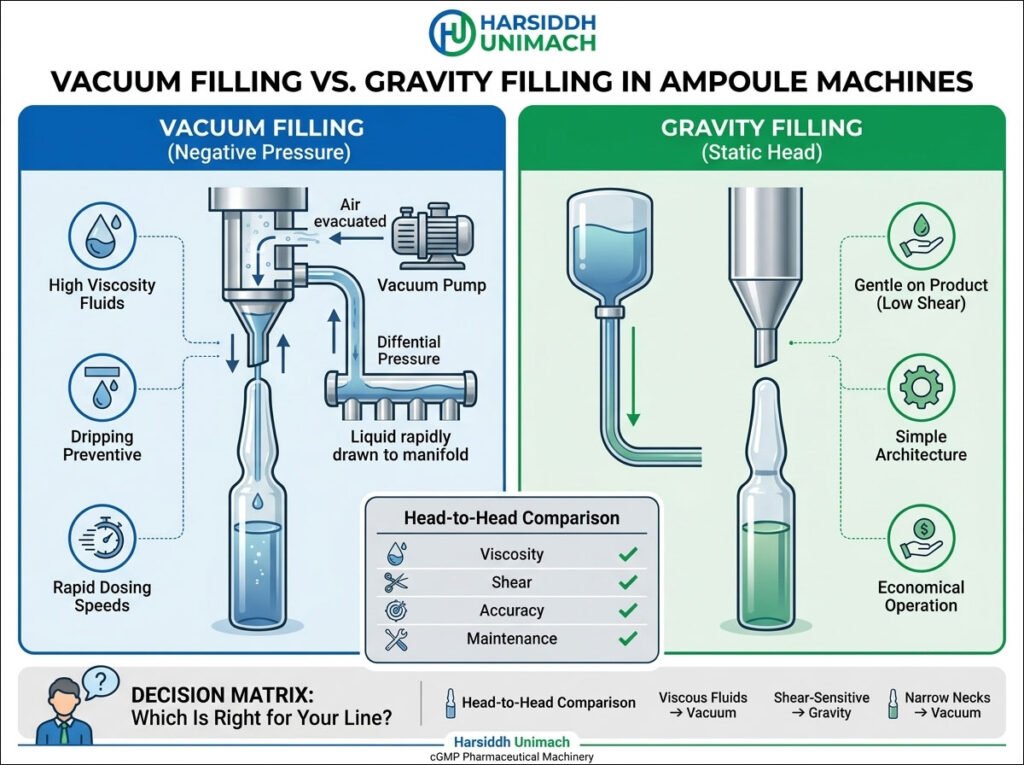
How liquid gets into an ampoule might seem like a small detail, but it shapes almost everything about the filling process: dose accuracy, speed, risk of contamination on the ampoule neck, seal quality, cleaning effort and which products can be filled at all.
Over the history of ampoule manufacturing, two filling approaches have been widely discussed — vacuum filling and gravity filling. Today, many modern machines use positive-displacement pumps instead, but understanding vacuum and gravity filling remains important: both are still used in specific applications, and both help explain why pump-based dosing became the standard for pharmaceutical ampoules.
In this engineering comparison, we explain how each method works, compare them on the factors that matter, look at where each is still used and show how modern piston and peristaltic dosing compare. For the full picture of how ampoule machines work, see our ultimate guide to the ampoule filling and sealing machine working principle.
The Basic Challenge of Filling Ampoules
Ampoules present specific filling challenges:
- Narrow necks that liquid must pass through without wetting the neck walls
- Small volumes, often 1–10 ml, where small errors are significant
- Flame sealing shortly after filling, which requires a clean, dry neck
- Fragile glass that must not be stressed during filling
- Oxygen-sensitive products that may need nitrogen protection
Any filling method must deliver an accurate dose while keeping the neck dry and the product protected.
How Gravity Filling Works in Ampoule Machines
Principle
In gravity filling, product is stored in a tank positioned above the filling needles. When a valve opens, liquid flows down through tubing and the needle into the ampoule under its own weight. The dose is controlled by how long the valve stays open, sometimes combined with a metering chamber.
The physics
The flow rate depends on:
- The head height — the vertical distance between the liquid level in the tank and the needle outlet
- The viscosity of the product
- The diameter and length of tubing and needle
- The valve opening
If these remain constant, a fixed opening time delivers a fixed volume. This is why gravity systems need tight control of tank level and product temperature.
Strengths
- Simple design with few moving parts in contact with the product
- Gentle flow, suitable for shear-sensitive liquids
- Low mechanical complexity and cost
Limitations
- Accuracy depends on stable head height, temperature and viscosity
- Not suitable for viscous products, which flow too slowly
- Fill time can be longer for larger volumes
- Less precise at small volumes than positive-displacement pumps
For a broader look at gravity filling across liquid products, see our gravity based liquid filling machine and our article on liquid filling machine working principles.
How Vacuum Filling Works in Ampoule Machines
“Vacuum filling” is used to describe two different techniques in the ampoule world. It is important to distinguish between them.
Method 1: Batch (chamber) vacuum filling
This is the classic vacuum filling method used historically for high-volume ampoule production:
- A batch of open ampoules is placed, neck-down, in a holder inside a vacuum chamber.
- The ampoule tips are immersed in a trough of product.
- Air is evacuated from the chamber, drawing air out of the ampoules.
- When the vacuum is released, atmospheric pressure pushes liquid up into the ampoules.
- The ampoules are removed, turned upright and taken for neck cleaning and sealing.
The fill volume depends on the degree of vacuum, the ampoule volume and the product properties.
Key drawback: because ampoule necks are dipped in the product, liquid coats the outside and inside of the neck. Before sealing, necks must be cleaned — for example by washing or steaming — otherwise product residue chars during sealing, causing weak seals and black tips. This extra handling step also increases contamination and product-loss risks.
Method 2: Vacuum-assisted nozzle filling
In this approach, a nozzle seals against the ampoule mouth and a vacuum draws liquid from the supply into the ampoule until it reaches a set level, with excess returning to the supply. This works like a level filler and is more common for perfumes and non-pharmaceutical products than for injectables.
Strengths of vacuum filling
- Batch vacuum filling can fill many ampoules at once
- Vacuum methods can be gentle on fragile glass
- Vacuum-assisted systems naturally reject cracked containers, which cannot hold vacuum
Limitations of vacuum filling
- Batch methods wet the ampoule necks, requiring an additional cleaning step
- Dose accuracy depends on vacuum control and is generally less precise than positive-displacement pumps
- Product contact with chamber troughs increases cleaning effort and potential waste
- Harder to integrate with continuous, automated, aseptic lines
- Nitrogen protection is more difficult to control
Vacuum vs Gravity: Side-by-Side Comparison
| Factor | Gravity Filling | Vacuum Filling (Batch) |
|---|---|---|
| Driving force | Gravity (head pressure) | Pressure difference (vacuum release) |
| Dose control | Valve time / metering | Vacuum level and ampoule volume |
| Typical accuracy | Moderate | Moderate to lower |
| Neck wetting | Low if needle is positioned well | High — necks dipped in product |
| Extra neck cleaning | Not normally required | Required before sealing |
| Viscosity range | Thin liquids only | Thin liquids |
| Speed | Moderate | High per batch, but extra handling |
| Integration with continuous lines | Good | Limited |
| Nitrogen protection | Possible with gassing needles | More difficult |
| Product loss | Low | Higher (trough residue, cleaning) |
| Cleaning effort | Moderate | Higher |
The Modern Standard: Positive-Displacement Dosing
Most modern pharmaceutical ampoule filling and sealing machines use positive-displacement pumps, which push a defined volume of product through the needle regardless of small changes in head height or vacuum.
Piston (syringe) pumps
A piston draws product into a cylinder and pushes it out through the needle. Volume equals piston area multiplied by stroke length. Piston pumps deliver excellent accuracy and repeatability across a wide range of volumes and viscosities. On servo machines, stroke and speed are set digitally. See our servo based piston filling machine and the Automatic Servo Based Ampoule Filling and Sealing Machine.
Peristaltic pumps
Rollers squeeze flexible tubing to push product forward in precise increments. The product only contacts the tubing, which can be single-use, making peristaltic dosing ideal for high-value or sensitive products and multi-product facilities. See the Automatic Peristaltic Based Ampoule Filling Machine and our peristaltic based liquid filling machine. For a detailed comparison of these two pump types, read peristaltic vs piston pumps.
Why positive displacement became the standard
- Higher accuracy — dose is defined mechanically, not by flow conditions
- Dry necks — diving needles fill from the bottom up, with suck-back to prevent drips
- No extra neck cleaning — ampoules go straight from filling to sealing
- Easy nitrogen integration — pre- and post-gassing needles work in sequence with filling
- Continuous, automated operation — suits integrated lines with washers and tunnels
- Wider product range — handles thin and moderately viscous products
Four Ways to Dose an Ampoule
Four-Way Comparison
| Factor | Gravity | Vacuum (Batch) | Piston Pump | Peristaltic Pump |
|---|---|---|---|---|
| Accuracy | Moderate | Moderate to lower | High | High |
| Neck wetting risk | Low–moderate | High | Low | Low |
| Viscosity range | Thin | Thin | Thin to viscous | Thin to medium |
| Product contact parts | Tank, tubing, valve, needle | Trough, chamber | Pump, valves, needle | Tubing only |
| Cleaning | Moderate | Higher | Moderate | Easy (replace tubing) |
| Line integration | Good | Limited | Excellent | Excellent |
| Typical use today | Simple, thin liquids | Limited legacy applications | Mainstream pharma ampoules | High-value, multi-product |
Engineering Factors That Affect Each Method
Head pressure stability (gravity)
Maintaining a constant liquid level in the supply tank — using level sensors and controlled refilling — is essential for repeatable gravity fills.
Vacuum control (vacuum)
Vacuum level, evacuation time and release rate all influence fill volume. Leaks or pump wear cause variation.
Temperature and viscosity
Both gravity and vacuum methods are sensitive to viscosity changes caused by temperature. Positive-displacement pumps are less affected.
Needle design and position
For gravity and pump-based methods, needle diameter, length and dive depth determine whether liquid wets the neck. Diving needles that rise with the liquid level are preferred.
Nitrogen protection
Pump-based machines integrate nitrogen gassing easily before and after filling. Learn more about how nitrogen flushing improves sterility and stability in ampoule filling machines.
Accuracy and Regulatory Expectations
Pharmaceutical ampoules must deliver at least the labelled volume, typically with a small, justified overfill, and fill weights must be consistent from ampoule to ampoule. Methods that depend on variable flow or vacuum conditions require tighter process controls to meet these expectations. Read more about filling machine accuracy standards in pharma manufacturing.
Which Method Should You Choose?
Gravity filling may suit: – Simple, thin, non-critical liquids – Applications where low cost and simplicity matter more than maximum accuracy
Vacuum filling may suit: – Specific legacy or non-pharmaceutical applications – Level filling of cosmetic or perfume ampoules
Piston pump filling suits: – Most pharmaceutical ampoule products – A wide range of volumes and viscosities – High accuracy and integrated, automated lines
Peristaltic pump filling suits: – High-value, potent or sensitive products – Multi-product facilities needing fast product changes – Applications where minimising cleaning validation is important
Pump-Based Dosing Across Machine Sizes
Modern dosing technology is available across the range:
- Medium production: our four head ampoule filling and sealing machine
- Higher production: our six head ampoule filling and sealing machine
- High-volume production: the Automatic Eight Head Ampoule Filling & Sealing Machine and our high-speed eight head vertical ampoule filling and sealing machine
Browse our ampoule filling machines for open ampoules and ampoule filling machines for closed ampoules.
Upgrading From Gravity or Vacuum to Pump-Based Filling
Plants still using gravity or batch vacuum filling often upgrade when they need better accuracy, want to remove the neck-cleaning step, plan to supply regulated export markets or want to integrate filling into a continuous line. When planning an upgrade:
- Confirm the fill volume range and accuracy required for each product
- Choose piston or peristaltic dosing based on product value, viscosity and cleaning needs
- Plan nitrogen gassing if products are oxygen-sensitive
- Review how the new machine will link to existing washing and sterilising equipment
- Allow time for qualification and operator training
Quality Checks Whatever the Method
Regardless of filling method, sealed ampoules must be inspected for fill level, particles, charred tips and seal defects — for example, on a visual ampoule and vial inspection machine. Trends in defects such as black tips often point straight back to filling: wet necks from splashing, dripping or, in vacuum methods, inadequate neck cleaning.
Frequently Asked Questions
What is the difference between vacuum filling and gravity filling for ampoules? Gravity filling lets liquid flow into the ampoule from an overhead tank, with dose controlled by valve time. Vacuum filling uses a pressure difference to draw or push liquid into ampoules, often in batches.
Why is batch vacuum filling less common today? Because ampoule necks are dipped in product, they must be cleaned before sealing, adding handling, contamination risk and product loss. Positive-displacement pumps avoid this.
Which filling method is most accurate for ampoules? Positive-displacement methods — piston and peristaltic pumps — generally provide the highest accuracy and repeatability.
Can gravity filling handle viscous products? Not well. Viscous products flow too slowly; piston pumps are better suited.
Do modern ampoule machines still use gravity filling? Some simple applications do, but most pharmaceutical ampoule machines use piston or peristaltic pumps for better accuracy and control.
Need help choosing the right filling method for your ampoules? Explore our ampoule filling machine range, contact our team or send an inquiry.