
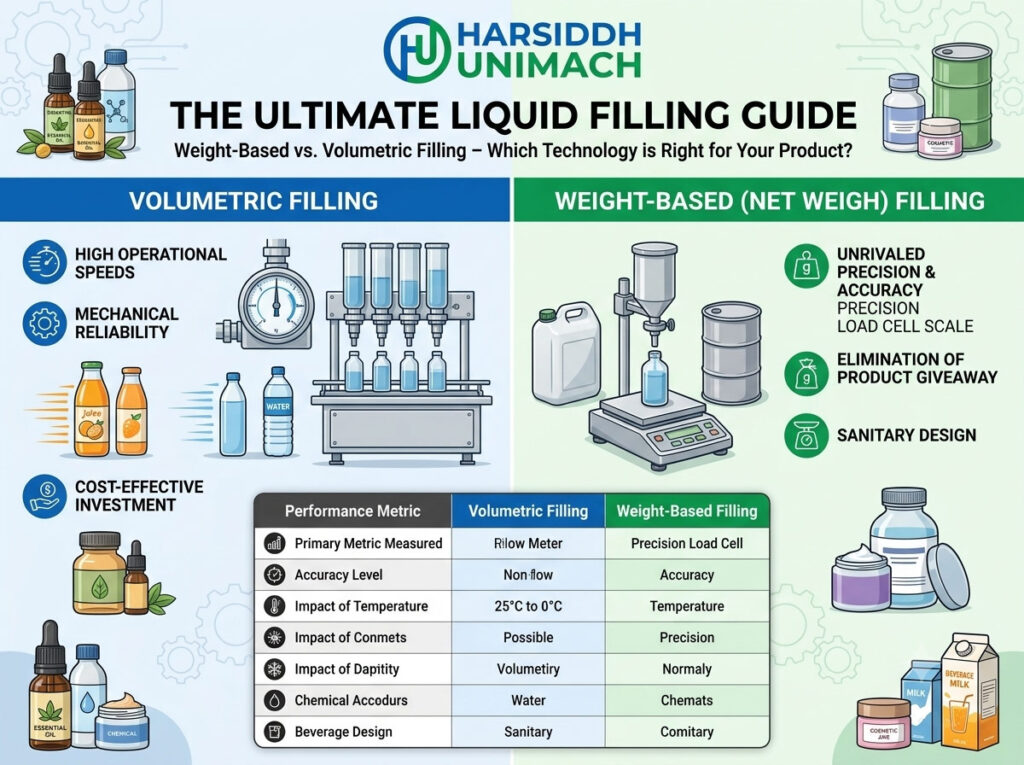
Every liquid filling machine has to answer one basic question: how much product goes into each container? There are two fundamentally different ways to answer it. A volumetric filler measures a set volume of liquid — for example, 100 ml. A weight-based filler measures a set mass — for example, 100 g — by weighing the container as it fills.
At first glance the difference seems small. In practice, it affects accuracy, speed, cost, cleaning, compliance and how much product you give away every day. Choosing the right approach for your product can save significant money over the life of a machine; choosing the wrong one can mean chronic overfilling, rejected batches and frustrated operators.
This guide explains how each method works, compares them side by side and gives you a practical framework for choosing. If you are new to filling equipment, our step-by-step guide to how a liquid filling machine works is a useful starting point.
What Is Volumetric Filling?
Volumetric filling dispenses a fixed, measured volume of liquid into each container. The machine does not know how much the dose weighs; it simply delivers the same volume every cycle. If the liquid’s density is constant, the same volume always weighs the same — so volumetric filling also delivers consistent weight.
Common volumetric technologies
Piston fillers. A piston draws liquid into a cylinder and pushes it out through the nozzle. The stroke length sets the volume. Servo-driven pistons, such as the Automatic Servo Based Piston Filling Machine, allow volume and speed to be set precisely from the HMI. See also our servo based piston filling machine.
Syringe-type volumetric fillers. Multiple syringe pumps deliver identical doses through several nozzles at once. This is the classic choice for pharmaceutical syrups and oral liquids — for example, the volumetric bottle liquid filler and the Automatic Liquid Syrup Filling Machine.
Gear pump fillers. A servo motor turns a gear pump a precise number of revolutions. Each revolution delivers a known volume, making these fillers ideal for oils and medium-viscosity liquids. See the servo based gear pump filling machine.
Peristaltic fillers. Rollers compress a flexible tube, pushing forward a precise volume with each rotation. The product touches only the tube, making this method ideal for small, sterile or high-value doses. See our peristaltic based liquid filling machine.
Time-gravity fillers. Liquid flows from an overhead tank through a valve opened for a set time. With a constant liquid head, time equals volume. Simple and economical for thin liquids — see the gravity based liquid filling machine.
Flow meter fillers. A magnetic or mass flow meter measures liquid as it passes and closes the valve at the target volume.
For a deeper comparison of these technologies, read liquid filling machine technologies compared.
A note on level filling
Some machines fill every container to the same visual level rather than the same volume. This is popular for clear bottles on retail shelves, where a uniform appearance matters. Because container volumes vary slightly, level filling does not guarantee identical volumes and is not the right choice when precise dosing is required.
What Is Weight-Based Filling?
Weight-based (gravimetric) filling dispenses product until a target weight is reached. The container sits on a precision load cell — an electronic weighing sensor — throughout the filling cycle.
How it works
- Tare: the empty container is weighed and its weight is set to zero.
- Bulk fill: the valve opens fully and product flows quickly into the container.
- Dribble fill: as the weight approaches the target, the valve partly closes to slow the flow.
- Cut-off: the valve closes exactly at the target weight, with compensation for product still “in flight”.
- Verification: the final weight is recorded and out-of-tolerance containers can be rejected automatically.
Because each container is weighed individually, weight-based filling automatically compensates for changes in density, temperature and container variation. It is the most direct way to guarantee that each pack contains the declared net weight.
Examples include the Automatic Load Cell Based Liquid Filling Machine and our load cell based liquid filling machine.
Net weight vs gross weight
- Net weight filling tares each container, so only the product is measured. This is the most accurate method.
- Gross weight filling weighs the container and product together against a fixed target. It is simpler but depends on containers having consistent weights.
Weight-Based vs Volumetric Filling: Side-by-Side
| Factor | Volumetric Filling | Weight-Based Filling |
|---|---|---|
| What is measured | Volume (ml, L) | Mass (g, kg) |
| Effect of density change | Fill weight changes | Automatically compensated |
| Typical accuracy | High with stable products | Very high, especially for larger fills |
| Speed | Generally faster, especially for small fills | Slower due to weighing and dribble phase |
| Small volumes (under ~10 ml) | Excellent (piston, peristaltic) | Difficult — load cells less practical |
| Large volumes (1 L and above) | Good | Excellent |
| Foamy products | Requires careful speed control | Handles well with bottom-up fill |
| Investment cost | Usually lower | Usually higher per head |
| Data and traceability | Needs separate check-weigher | Every fill weight recorded |
| Cleaning | Varies; peristaltic is easiest | Simple product path, but load cells must be protected |
Key Factors That Decide the Right Technology
1. Product density and its stability
If your product’s density is stable from batch to batch and through the shift, volumetric filling delivers consistent weights at lower cost. If density changes — due to temperature, aeration, natural variation in raw materials or product settling — weight-based filling is more reliable. Edible oils, for example, expand as they warm, so the same volume weighs less at higher temperatures.
2. Fill size
Small fills such as eye drops, injectables and small syrup bottles are best handled by volumetric technologies, which are fast and precise at low volumes. Large fills — such as 1 L, 5 L or 20 L containers — benefit from weight-based filling, where even small percentage errors represent significant amounts of product.
3. Viscosity
Thin liquids suit gravity, flow meter, peristaltic and volumetric fillers. Thick liquids and pastes are best handled by piston fillers, which push product positively regardless of viscosity. Weight-based filling works across a wide viscosity range but slows down with very thick products. Learn more in our article on high viscous liquid filling machine working principle.
4. How the product is sold
Check how the quantity is declared on your label. Products declared by weight (kg, g) — such as many edible oils, chemicals and lubricants — often benefit from weight-based filling. Products declared by volume (ml, L) — such as syrups, sanitisers and beverages — are naturally suited to volumetric filling. Either way, your process must comply with the legal metrology rules for declared quantity in your markets.
5. Value of the product
The more expensive the product, the more each millilitre of overfill costs. For high-value liquids, the higher accuracy of weight-based filling — or of precise servo volumetric filling — usually pays back quickly.
6. Speed requirements
Volumetric fillers are generally faster because they do not need to wait for weight readings to stabilise. For high-speed lines, volumetric filling combined with a downstream check-weigher often gives the best balance between speed and control.
7. Regulatory and quality requirements
Pharmaceutical manufacturers must demonstrate consistent fill accuracy and often document it batch by batch. Weight-based filling records every fill automatically, while volumetric systems typically rely on in-process sampling or check-weighing. See our article on filling machine accuracy standards in pharma manufacturing.
Which Technology Suits Your Industry?
- Pharmaceutical syrups and oral liquids: volumetric (syringe or servo piston) for speed and accuracy at typical bottle sizes.
- Eye drops, ear drops and injectables: volumetric, usually peristaltic or servo piston, for small sterile doses.
- Edible oils: weight-based for large containers; servo gear pump or piston for smaller bottles. See the Automatic Edible Oil Filling Machine and our servo based oil and viscous filling machine.
- Lubricants and chemicals: weight-based for drums and large cans; volumetric for small bottles.
- Cosmetics and personal care: volumetric piston or gear pump fillers for lotions, shampoos and creams.
- Pouches: volumetric dosing is common for spout pouches — see our spout pouch filling machine.
The Best of Both Worlds: Hybrid Approaches
Many modern lines combine both methods:
- Volumetric filling with check-weighing: the filler works volumetrically at high speed, while a check-weigher downstream verifies each container and rejects any out of tolerance.
- Closed-loop correction: the check-weigher feeds data back to the servo filler, which automatically adjusts the dose to correct for drift in density or temperature.
- Weight-based calibration: volumetric fillers are calibrated by weighing samples, ensuring the dose corresponds to the declared weight.
These approaches give the speed of volumetric filling with the confidence of weight control.
Looking Beyond the Purchase Price
When comparing quotations, it is tempting to focus only on the machine price. A more useful comparison looks at total cost of ownership over several years:
- Product giveaway: even a small average overfill multiplied across annual production often exceeds the price difference between two machines.
- Rejects and rework: a filler that drifts out of tolerance creates rejected containers, wasted packaging and extra handling.
- Changeover time: servo machines with stored recipes switch products in minutes, adding productive hours every week.
- Maintenance and spares: pistons and seals, pump tubing, gear sets and load cells each have different wear patterns and replacement costs.
- Calibration and documentation: weight-based systems record fill data automatically, while volumetric systems may need more frequent manual sampling.
Running these numbers for your own product and output usually makes the right choice clear.
Common Myths About Filling Technologies
“Weight-based filling is always more accurate.” Not necessarily. For small doses, a well-designed servo piston or peristaltic filler can be more accurate and much faster than a load cell system.
“Volumetric filling can’t handle variable products.” With closed-loop check-weigher feedback and temperature control, volumetric fillers can handle moderate variation effectively.
“Weight-based filling is too slow for production.” Multi-head weight fillers deliver strong output for medium and large containers, where they are most often used.
A Simple Decision Guide
Choose volumetric filling if: – Your fills are small to medium (up to around 1 L) – Product density is stable – High speed is a priority – The product is sold by volume – You need sterile or very small doses
Choose weight-based filling if: – Your fills are large (1 L and above) – Product density varies with temperature or batch – The product is sold by weight – The product is high-value and overfill must be minimised – You need a recorded weight for every container
Still unsure? Testing your actual product on both technologies is the most reliable way to decide. Explore our full range of liquid filling machines and our liquid filling machines on Harsiddh Engineering to compare options.
Frequently Asked Questions
What is the difference between volumetric and weight-based filling? Volumetric filling dispenses a fixed volume of liquid, while weight-based filling dispenses product until a target weight is reached on a load cell.
Which is more accurate: weight or volumetric filling? It depends on the application. Weight-based filling is very accurate for larger fills and variable-density products, while servo volumetric fillers are often more accurate and faster for small doses.
Is weight-based filling slower? Generally, yes, because the machine waits for stable weight readings and slows down near the target. For large containers, the difference matters less.
Can a volumetric filler fill products sold by weight? Yes. The volume is calibrated to the required weight, and check-weighing can be used to confirm that each container meets the declared quantity.
Which filling method is best for edible oil? Weight-based filling is often preferred for large oil containers, while servo gear pump or piston fillers suit smaller bottles at higher speeds.
Need help choosing between weight-based and volumetric filling? Contact our team or send an inquiry to discuss your product and requirements.