
Not long ago, a batch number and an expiry date were all the identification most medicine packs carried. If a problem was discovered, manufacturers could trace it to a batch — but not to an individual pack, a specific shipment or a particular pharmacy. That gap allowed counterfeit and diverted medicines to enter supply chains, and made recalls slow and imprecise.
Serialization has changed that. By giving every saleable pack its own unique identity, serialization allows medicines to be tracked from the production line to the patient. Today, it is a legal requirement in many major markets and is rapidly becoming a standard expectation everywhere.
For manufacturers, serialization is more than a compliance task. It reshapes packaging lines, labelling equipment, data systems and quality processes. In this guide, we explain what serialization is, why it matters, how regulations are evolving, how a serialized packaging line works and what to look for in machines that support it.
What Is Pharmaceutical Serialization?
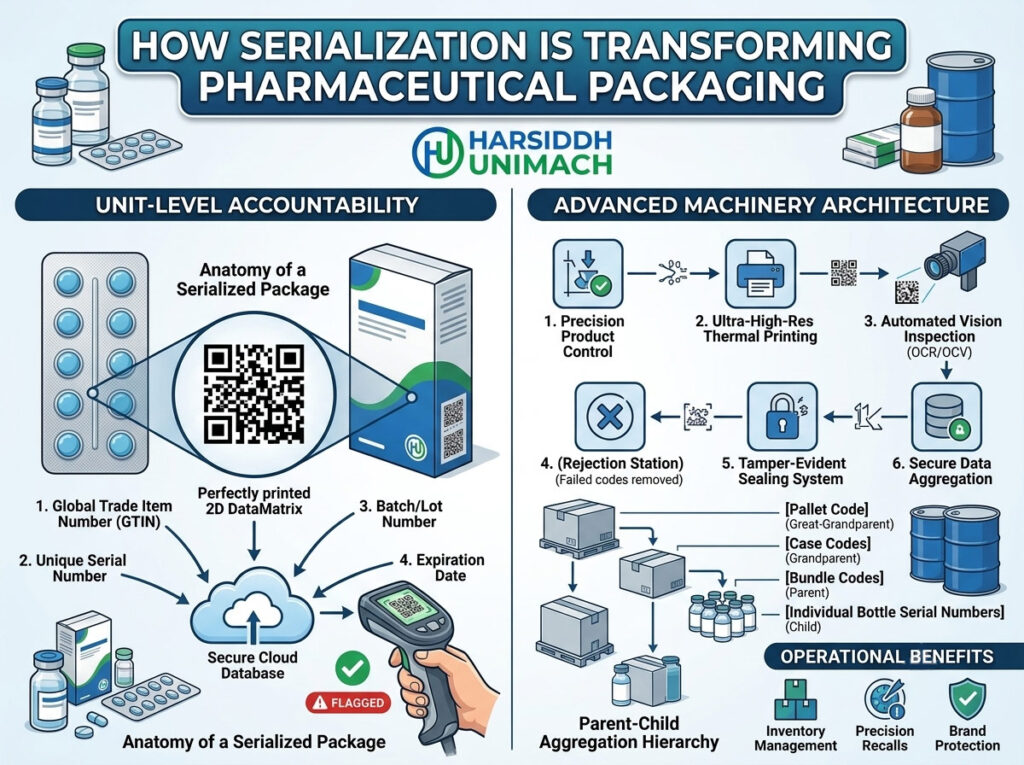
Serialization is the process of assigning a unique serial number to each individual saleable unit of a medicine — such as a carton, bottle or vial pack — and linking that number to key product data. The information is printed on the pack in both human-readable text and a machine-readable code, usually a 2D Data Matrix barcode.
A serialized code typically contains:
- Product code – often a GS1 Global Trade Item Number (GTIN) identifying the product and pack size
- Unique serial number – different for every pack
- Batch or lot number
- Expiry date
- In some markets, a national reimbursement or registration number
The serial number is recorded in the manufacturer’s database together with the batch, production line and packaging time. As the pack moves through the supply chain, it can be scanned and verified.
Serialization vs Track-and-Trace vs Aggregation
These terms are often used together but mean different things:
- Serialization gives each pack a unique identity.
- Aggregation builds parent–child relationships between packaging levels — for example, recording which serialized cartons were packed into a shipper case, and which cases were loaded onto a pallet. Cases and pallets are typically identified with a Serial Shipping Container Code (SSCC).
- Track-and-trace uses serialization and aggregation data to follow products through every movement in the supply chain, from manufacturer to wholesaler to pharmacy.
Aggregation makes distribution practical: scanning a single pallet label can confirm hundreds or thousands of serialized packs without opening any boxes.
Why Serialization Matters
Fighting counterfeit medicines
Falsified medicines are a serious global health threat. A unique, verifiable code on each pack makes it far harder for counterfeiters to introduce fake products, because each serial number can be checked against the manufacturer’s records — and a duplicated number is immediately flagged.
Faster, more precise recalls
When a quality issue arises, serialization and aggregation data allow manufacturers to identify exactly which packs were affected and where they went, enabling targeted recalls instead of withdrawing entire product lines.
Supply chain visibility
Serialization data shows how products move through distribution, helping companies detect diversion, manage inventory and protect brand integrity.
Regulatory access to markets
Above all, serialization is required to sell medicines in many of the world’s major markets. Without it, export opportunities are closed.
The Global Regulatory Landscape
Serialization rules differ from country to country, and they continue to evolve. Manufacturers should always confirm the current requirements for each destination market. Broadly:
- United States: the Drug Supply Chain Security Act (DSCSA) requires a product identifier on prescription drug packages and has moved the industry towards interoperable, electronic, package-level tracing.
- European Union: the Falsified Medicines Directive and its Delegated Regulation require safety features on most prescription medicines — a unique identifier in a 2D Data Matrix and an anti-tampering device — with packs verified and decommissioned at the point of dispensing.
- India: export track-and-trace requirements apply to pharmaceutical exports, including barcoding and serialization at different packaging levels. Domestically, rules have introduced QR codes on active pharmaceutical ingredients and barcodes or QR codes on the labels of specified high-selling formulation brands.
- Other markets: countries across the Middle East, Latin America, Asia and Eastern Europe have introduced or are implementing their own serialization and track-and-trace systems, often with unique data formats and reporting requirements.
Because each market has its own rules, a serialization solution must be flexible enough to handle different code formats, data fields and reporting interfaces.
Understanding the Serialization Architecture
Serialization systems are usually described in five levels:
- Level 1 – Devices: printers, cameras, scanners and sensors on the packaging line.
- Level 2 – Line controller: coordinates the devices, controls the reject system and manages serial numbers on the line.
- Level 3 – Site server: manages serial number pools, batches and data for all lines in a plant.
- Level 4 – Enterprise system: links serialization data with ERP and the company’s global product data.
- Level 5 – Regulatory and trading partner reporting: connects to government databases and supply chain partners.
The packaging machines themselves operate at Levels 1 and 2 — and that is where labelling and coding equipment plays a central role.
How a Serialized Packaging Line Works
A typical serialized line for bottles, vials or ampoules follows these steps:
- Product labelling: primary containers are labelled at speed. On many lines, variable data such as batch number and expiry date — and, where required, a Data Matrix code — is printed on the label.
- Code printing: thermal transfer, thermal inkjet or laser printers apply serialized codes to labels or cartons.
- Vision verification: a camera reads each code immediately after printing, checking readability, print quality and data accuracy.
- Rejection: any pack with a missing, unreadable or incorrect code is automatically rejected.
- Cartoning and carton serialization: primary containers are packed into cartons, which are labelled or printed with serialized codes. Tamper-evident labels may also be applied.
- Aggregation: cartons are packed into shipper cases, and the system links each carton serial number to the case’s SSCC label. Cases may then be aggregated to pallets.
- Data upload: all serialization and aggregation data is transferred to the site and enterprise systems for reporting.
The Role of Labelling Machines in Serialization
Accurate labelling is the foundation of serialization. If a label is skewed, wrinkled or misplaced, the printed code may be unreadable — and the pack will be rejected. Modern labelling machines support serialization by delivering:
- Precise label placement at consistent positions, so cameras can find and read codes reliably.
- Smooth, wrinkle-free application for clear, scannable print.
- Integration space and mounting points for printers, cameras and reject systems.
- Synchronised speed control so printing and verification keep pace with labelling.
- No-label and missing-label detection to prevent unlabelled containers from passing.
Learn how labelling machines achieve this precision in our article on sticker labeling machine working principle, and avoid common pitfalls with our list of top 10 labeling mistakes manufacturers should avoid.
Labelling solutions by container type
Vials. Small diameters and high speeds make vial labelling demanding. The Automatic Vial Sticker Labeling Machine and our vertical vial sticker labeller are designed for precise wrap-around labelling. Explore our labeling machines for vials, and read about handling different vial diameters during changeover.
Ampoules. Ampoules are small and fragile, so they need gentle, accurate handling. See the Automatic Rotary Ampoule Sticker Labeling Machine, our horizontal ampoule sticker labelling machine and the full range of labeling machines for ampoules.
Round bottles. Syrups, tablets and capsules in round bottles are labelled with wrap-around labels on machines like the Automatic Round Bottle Sticker Labeling Machine. See also our labeling machines for round bottles.
Flat and oval bottles. Front and back labelling on flat containers requires precise registration on both sides. The double side flat bottle sticker labeling machine and our labeling machines for flat bottles handle these formats. Our buying guide for automatic front and back sticker labeling machines explains what to look for.
Cartons. Carton-level serialization is a core requirement in many markets. The Automatic Carton Box Sticker Labeling Machine applies labels — including serialized labels and tamper-evident seals — to cartons accurately.
Inspection: The Quality Gate for Serialization
Serialization only works if every code is correct and readable. That makes inspection essential at several points:
- Print quality grading of Data Matrix codes to recognised standards.
- OCR/OCV (optical character recognition and verification) of human-readable text such as batch and expiry.
- Label presence and position checks.
- Container inspection before labelling to ensure only good product is serialized.
Integrating serialization with upstream product checks — supported by our inspection machines — helps ensure that only good, correctly identified packs reach the market.
Challenges of Implementing Serialization
Serialization projects bring real challenges:
- Line speed: printing, verification and rejection must keep pace without slowing production.
- Data management: serial numbers must be generated, allocated, tracked and reported without duplication or loss.
- Multiple market formats: different countries require different codes and data.
- Validation: serialization systems are GMP-critical and must be fully validated.
- Retrofitting older lines: existing labelling machines may lack the space, control or precision needed for reliable code printing and reading.
- Operator training: teams need to understand new procedures for batch setup, rejection handling and reconciliation.
Planning early, choosing scalable equipment and working with experienced suppliers make implementation far smoother.
Machine Innovation Driven by Serialization
Serialization has accelerated innovation in packaging equipment:
- Servo-driven labelling gives precise label positioning at high speed.
- Integrated print-and-verify modules combine printing and inspection in a compact footprint.
- Smart reject systems with confirmation sensors prove that rejected packs have actually left the line.
- Recipe management stores label positions, print layouts and camera settings for quick changeovers.
- Connectivity allows machines to exchange data with line controllers and plant systems.
- Audit trails and user access control support data integrity requirements.
These features improve not just compliance, but also overall labelling quality and line efficiency.
The Future of Serialization
Serialization is evolving from a compliance requirement into a foundation for digital supply chains. Trends include wider adoption of aggregation, real-time verification at dispensing points, patient-facing codes that provide product information, and the use of serialization data for analytics and supply chain planning. As more countries introduce requirements, manufacturers who build flexible, serialization-ready lines today will be best placed to enter new markets tomorrow.
Getting Started: A Simple Checklist
- List every market you supply and confirm its current serialization and reporting requirements.
- Audit your existing labelling and packaging lines for accuracy, speed and space for printers and cameras.
- Decide which packaging levels need serialization and aggregation.
- Select line equipment and software that can grow with new markets and formats.
- Plan validation, operator training and a pilot run before full rollout.
How Harsiddh Unimach Can Help
Harsiddh Unimach Pvt. Ltd. manufactures labelling machines for vials, ampoules, round bottles, flat bottles, cartons and more — designed for accurate label placement and ready for integration with printers, vision systems and serialization software. Explore our labeling machines and the full range of labeling machines on Harsiddh Engineering.
Frequently Asked Questions
What is serialization in pharmaceutical packaging? It is the assignment of a unique serial number to each saleable pack, printed with product data in a machine-readable code, so the pack can be identified and verified throughout the supply chain.
What is the difference between serialization and aggregation? Serialization identifies individual packs. Aggregation links those packs to the cases and pallets they are packed into, enabling efficient tracking during distribution.
What information is in a serialized code? Typically a product code (such as a GTIN), a unique serial number, a batch number and an expiry date, plus any additional data required by the destination market.
Do labelling machines need to be upgraded for serialization? Often, yes. Serialization requires precise label placement and space for printers, cameras and reject systems. Modern labelling machines are designed to integrate these components.
Is serialization required in India? India has track-and-trace requirements for pharmaceutical exports and has introduced QR code or barcode requirements for certain domestic products. Manufacturers should check the latest rules for their products and markets.
Planning a serialization-ready labelling line? Contact our team or send an inquiry to discuss your requirements.