
After an injectable vial is filled and stoppered, it passes to the capping machine, where an aluminium cap is crimped over the stopper and vial flange. This small step completes the container closure system and has a big influence on whether the product stays sterile and stable throughout its shelf life.
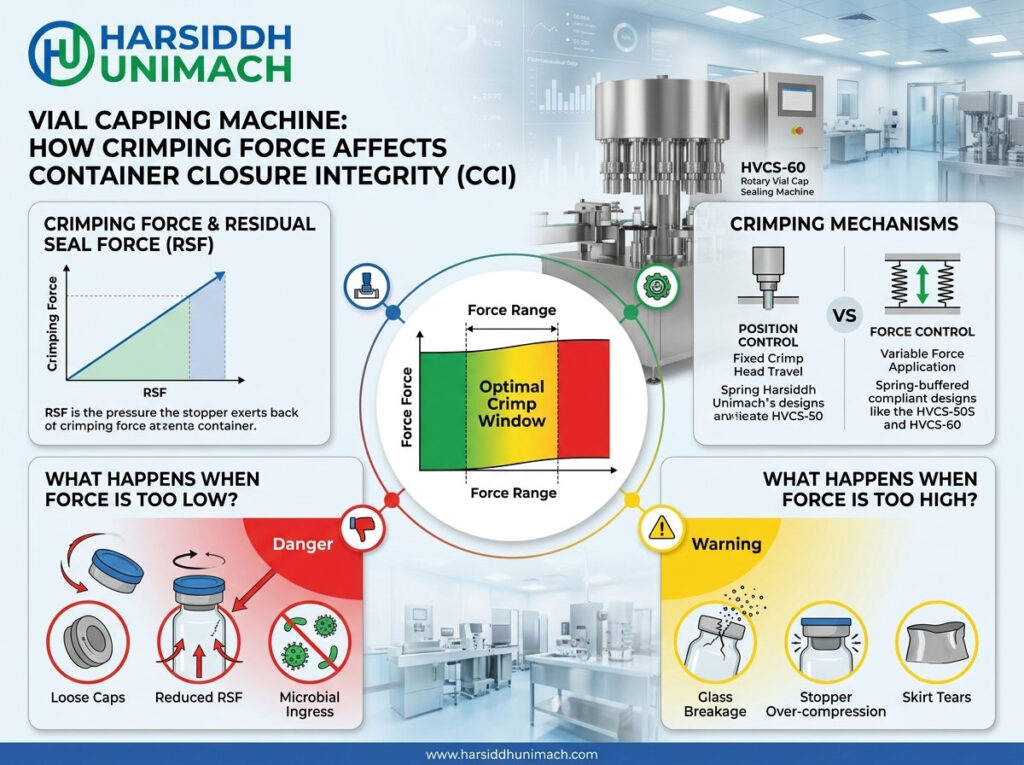
The key variable is crimping force: how firmly the cap is pressed and formed around the vial. Too little force, and the stopper may not be compressed enough to seal reliably. Too much, and the cap, stopper or glass may be damaged. Getting it right, and keeping it right batch after batch, is central to container closure integrity (CCI).
This article explains how crimping force affects container closure integrity on a vial capping machine. It covers how crimping works, the main force-related parameters, what happens when force is too low or too high, factors that influence crimp quality, how crimp quality is tested and how to set up, monitor, maintain and validate the process.
Crimp settings, test methods and acceptance criteria must be defined and validated by each manufacturer for its own vials, stoppers and caps. This article describes general principles; your QA and packaging development teams should define the specific requirements.
The Vial Container Closure System
A vial closure system has three main parts:
- Glass vial with a defined neck finish and flange
- Rubber stopper, with a plug inside the neck and a flange resting on the vial top
- Aluminium cap, often with a plastic flip-off button, crimped under the vial flange
The seal is created mainly by the compression of the stopper flange between the vial top and the aluminium cap. The cap holds the stopper in a compressed state. If compression is too low, the seal may be weak. If it is too high, the stopper may be over-stressed or the components damaged.
How Vial Crimping Works
Most vial cap sealing machines work as follows:
- Cap placement: a cap is placed over the stoppered vial from a cap chute or pick-off station.
- Top compression: a pressing head applies downward force to the cap, compressing the stopper flange against the vial.
- Crimping: while the cap is held down, a roller or crimping tool moves inwards and folds the cap skirt under the vial flange, usually as the vial or the head rotates.
- Release: the head lifts, and the capped vial moves on.
Machines may have one head or several heads working in parallel. Our article on the vial cap sealing machine working principle explains the mechanism in detail, and our comparison of eight head and single head vial cap sealing machines explains how head count affects output.
Key Crimping Parameters
| Parameter | What It Controls | Effect on Closure |
|---|---|---|
| Top compression force | How much the stopper flange is compressed before crimping | Main driver of seal compression |
| Roller pressure or crimp tool force | How tightly the cap skirt is folded under the flange | Holds compression; affects crimp appearance |
| Roller or tool position (height) | Where the crimp forms relative to the flange | Correct fold under flange |
| Rotation speed and duration | How evenly the crimp forms around the circumference | Even crimp all round |
| Head height setting | Matches vial and cap height | Correct contact and force |
Top compression and crimp roller settings work together. Strong roller pressure cannot compensate for insufficient top compression, because it is the compression held by the cap that creates the seal.
What Happens When Crimping Force Is Too Low
- Insufficient stopper compression, risking a weak seal and potential leak paths
- Loose caps that can be rotated easily by hand
- Incomplete crimp with the cap skirt not fully folded under the flange
- Risk to sterility and stability over the shelf life
What Happens When Crimping Force Is Too High
- Cracked or broken vial flanges, creating glass particles and potential leaks
- Damaged caps, with wrinkles, splits or deformed flip-off buttons
- Over-compressed stoppers, which may affect needle penetration, resealing or long-term seal performance
- Cosmetic defects that lead to rejects
| Condition | Typical Signs | Risk |
|---|---|---|
| Too low | Loose caps, incomplete crimp | Weak seal, possible leakage |
| Correct | Smooth, even crimp; cap secure | Reliable closure |
| Too high | Wrinkled or split caps, cracked flanges | Glass damage, over-compressed stopper |
The goal is a defined operating window: enough force to create and hold a reliable seal, but not so much that components are damaged.
Factors That Influence Crimp Quality
1. Stopper Placement
If the stopper is raised, tilted or damaged before capping, the cap cannot compress it evenly. Correct stopper placement is a prerequisite for a good crimp. Our article on how stopper placement affects container closure quality explains this in detail.
2. Component Dimensions and Variation
Vial flange thickness, stopper flange thickness and cap dimensions all vary within tolerances. The combined stack height affects how much compression a given setting produces. Tight component specifications and consistent suppliers reduce variation.
3. Component Materials
Stopper elastomer properties, cap aluminium temper and thickness, and glass type all influence how components respond to force.
4. Machine Setup
Head height, top compression and roller settings must be correct for each vial, stopper and cap combination.
5. Machine Condition
Worn rollers, pressing heads, springs or bearings change the force applied. Regular maintenance keeps settings stable.
6. Vial Handling
Vials must be held steady and centred under the capping head. Misalignment causes uneven crimps.
7. Upstream Cleanliness
Product residue on the vial flange or stopper can affect sealing. Clean filling and correct stoppering on machines such as a liquid vial filling machine with rubber stoppering or an injectable dry powder vial filling and rubber stoppering machine help.
How Crimp Quality and Closure Integrity Are Tested
Several types of check are used, often in combination.
Visual Crimp Inspection
Inspectors look for a smooth, even crimp, cap skirt fully folded under the flange, no wrinkles, splits or cracks, and intact flip-off buttons. Visual inspection equipment, such as a visual vial dry powder inspection machine, helps inspectors examine capped vials consistently.
Cap Rotation (Twist) Checks
A simple manual check of whether the cap can be turned by hand. It gives a quick indication of gross under-crimping but does not measure seal compression precisely.
Residual Seal Force (RSF) Testing
RSF testing measures the force the compressed stopper exerts against the cap after crimping. It is widely used to characterise and monitor crimping because it relates directly to stopper compression. It is typically used during setup, validation and periodic monitoring.
Container Closure Integrity Testing
CCI tests assess whether the closure system prevents leakage or ingress. Methods include dye ingress, microbial ingress and deterministic methods such as vacuum decay or headspace analysis. The choice of method is made by your quality and packaging teams based on product and regulatory requirements.
Setting Up the Capping Machine
- Confirm components: correct vial, stopper and cap for the batch.
- Fit format parts for the vial size.
- Set head height for the vial and cap.
- Set top compression and roller settings to recorded, validated values.
- Run test vials and inspect crimps visually.
- Perform defined checks, such as cap rotation and, where specified, RSF measurement.
- Record settings and results before releasing the machine.
Machines such as an automatic four head vial cap sealing machine or a vial cap sealing machine with 1, 4, 6 or 8 heads should be set to the values established during validation. For a practical walkthrough, see our article on the step-by-step operation of a four head vial cap sealing machine.
Recording and Controlling Crimp Settings
Validated crimp settings are only useful if they are applied the same way every time. Record, for each vial, stopper and cap combination:
- head height
- top compression setting (spring position, pneumatic pressure or servo value, depending on design)
- roller or crimp tool position and pressure
- rotation speed or crimping time
- reference photographs of an acceptable crimp
Keep these values on a controlled setup sheet at the machine or in machine recipes, and restrict changes through access levels and change control. For a detailed look at how a typical multi-head cap sealer is built and adjusted, see our complete guide to the automatic four head vial cap sealing machine working principle.
Multi-Head Machines: Head-to-Head Consistency
On multi-head cap sealers, each head applies its own force. Heads can drift independently because of wear or adjustment. Checks should sample from every head, and results should be reviewed by head so that a drifting head is identified quickly. An automatic eight head vial cap sealing machine, for example, needs each of its heads checked.
Monitoring Crimp Quality During Production
- visual checks of crimps at defined intervals
- cap rotation checks according to procedure
- periodic RSF or other measurements where specified
- monitoring rejects for cap defects and cracked vials
- checking cap supply and feeding
- recording all results in the batch record
Downstream, an automatic external vial washing machine removes residue so caps and labels are clean.
Maintenance for Consistent Crimping
- inspect crimping rollers or tools for wear and damage
- check pressing heads and springs or pneumatic pressure for consistent top compression
- check bearings and rotating parts
- clean aluminium dust and debris regularly
- verify alignment of heads with vial positions
- replace worn parts before crimp quality drifts
- record all maintenance
Validating the Crimping Process
During qualification and process validation, typical activities include:
- establishing the crimp setting window for each vial, stopper and cap combination
- testing at the edges of the window to understand its limits
- confirming consistent performance across all heads and at production speed
- correlating machine settings with RSF and CCI results where applicable
- documenting the validated settings and in-process checks
Our article on vial filling machine validation and key parameters to check before production covers the wider validation context.
Semi-Automatic and Automatic Cap Sealers
Smaller operations may use a semi-automatic vial cap sealing machine, where the operator places vials and the machine crimps. Automatic machines feed vials and caps continuously at higher output. In both cases, the same principles of controlled, consistent crimping apply. Explore our full range of glass vial capping machines and capping machines.
Crimping as Part of the Line
The cap sealer works with the filler, stopperer and upstream container preparation. Vials depyrogenated in a sterilizing tunnel for ampoules and vials, filled and stoppered correctly, and transferred smoothly arrive at the capper ready for a good crimp. An integrated automatic liquid vial filling line coordinates these steps.
Common Mistakes to Avoid
- Relying only on cap rotation checks to judge seal quality
- Increasing roller pressure to fix a loose cap without checking top compression
- Ignoring stopper placement problems upstream
- Not checking every head on multi-head machines
- Changing components without assessing their effect on crimping
- Allowing worn parts to remain in service
Frequently Asked Questions
What is the most important crimping parameter? Top compression, because it determines how much the stopper is compressed, which creates the seal. Roller settings hold that compression in place.
Is a cap that cannot be rotated always well sealed? Not necessarily. Cap rotation checks detect gross problems but do not measure stopper compression precisely.
What is residual seal force? The force the compressed stopper exerts against the cap after crimping. It is used to characterise and monitor crimp tightness.
Can over-crimping cause problems? Yes. It can crack vial flanges, damage caps and over-compress stoppers.
Do crimp settings need to change for different vials? Yes. Each vial, stopper and cap combination has its own validated settings.
Achieve Consistent Crimping With Harsiddh
Harsiddh Unimach manufactures semi-automatic and automatic vial cap sealing machines with single and multiple heads, along with vial filling and stoppering machines and complete vial lines. Our team can help you set up and maintain your cap sealer for consistent crimp quality.
Contact us through our contact page or send your requirements through our inquiry form.