
Introduction
In pharmaceutical and biotech manufacturing, a single vial filling error can compromise an entire production batch, delay regulatory approval, or worse — put patient safety at risk. That’s why vial filling machine validation isn’t just a regulatory checkbox; it’s the foundation of consistent, compliant, and safe drug manufacturing.
Validation ensures that a vial filling machine performs exactly as intended, every single time, under real production conditions. Regulatory bodies such as the US FDA, EU EMA, and WHO require manufacturers to demonstrate — through documented evidence — that their equipment consistently produces output meeting predetermined specifications and quality attributes.
For manufacturers investing in new vial filling lines or upgrading existing ones, understanding the validation process and its key parameters is essential. This guide breaks down what validation involves, why it matters, and the specific parameters your team must verify before starting commercial production.
What Is Vial Filling Machine Validation?
Vial filling machine validation is a documented process that confirms a piece of equipment consistently performs according to its design specifications and produces output that meets predefined quality criteria. It’s not a one-time event but a structured, phased approach typically broken into three stages:
- Installation Qualification (IQ) — Verifying the machine is installed correctly according to manufacturer specifications and facility requirements.
- Operational Qualification (OQ) — Confirming the machine operates as intended across its full operating range.
- Performance Qualification (PQ) — Demonstrating the machine performs consistently under actual production conditions, using the real product or a suitable simulant.
Together, IQ/OQ/PQ form the backbone of equipment validation and are non-negotiable requirements under Good Manufacturing Practice (GMP) guidelines. Skipping or rushing any of these stages increases the risk of non-conformance, product recalls, and regulatory citations.
Why Validation Matters Before Production Begins
Before a single commercial batch is filled, manufacturers must be confident that their vial filling machine will deliver:
- Consistent fill volumes across thousands of vials
- Sterility assurance in aseptic filling environments
- Minimal product loss and waste
- Compliance with regulatory frameworks (FDA 21 CFR Part 211, EU GMP Annex 1, WHO guidelines)
- Traceable documentation for audits and inspections
Without proper validation, manufacturers risk batch rejections, costly downtime, and — in the worst cases — patient harm from underfilled or contaminated vials. Investing time in a thorough validation protocol upfront saves far more time, money, and reputational risk down the line.
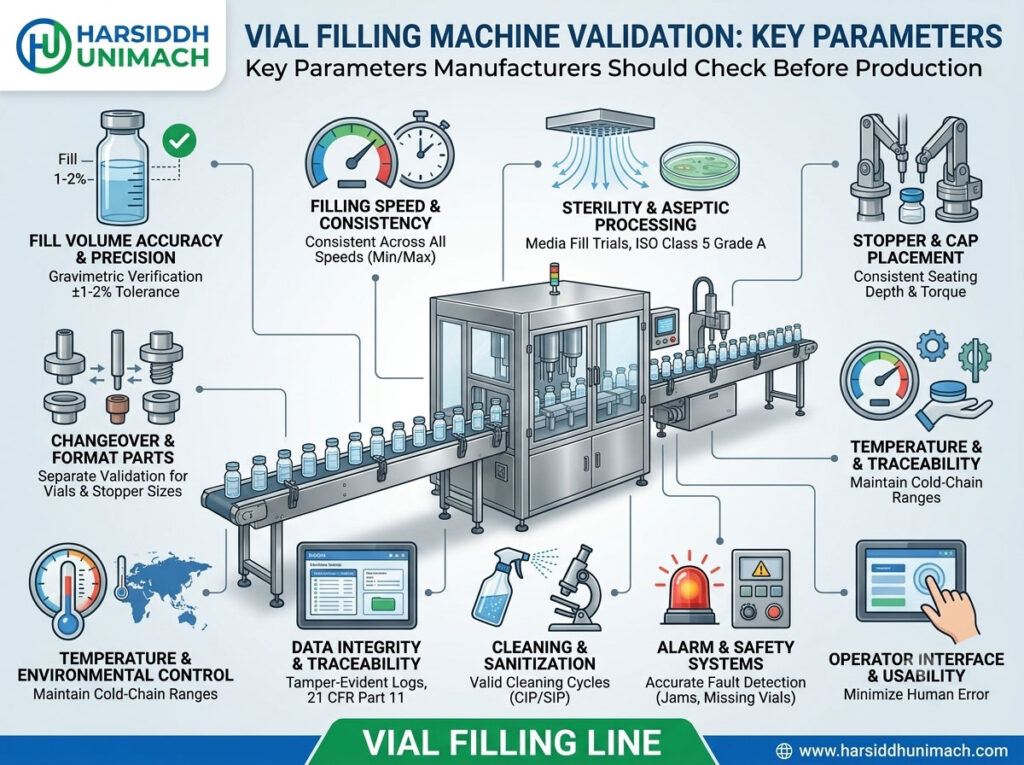
Key Parameters to Validate Before Production
1. Fill Volume Accuracy and Precision
Fill volume is perhaps the most scrutinized parameter in vial filling validation. Regulatory guidelines demand extremely tight tolerances, particularly for high-value biologics, vaccines, and injectables where even minor deviations can affect dosing accuracy.
During validation, manufacturers should:
- Test fill accuracy across the minimum, nominal, and maximum fill volumes the machine will handle
- Run multiple consecutive cycles to assess repeatability
- Use gravimetric (weight-based) verification methods for the highest accuracy, especially with viscous or high-value formulations
- Document acceptable variance limits (typically within ±1-2% depending on product and regulatory requirements)
Weight-based filling systems generally offer superior accuracy compared to volumetric systems, particularly for products with variable viscosity or density, making this a critical consideration during equipment selection and validation planning.
2. Filling Speed and Throughput Consistency
Manufacturers need to validate that the machine maintains accuracy and consistency across its full range of operating speeds — not just at a single test speed. A machine that performs well at low speeds but loses accuracy at production-line speeds creates a validation gap that will surface during actual manufacturing.
Key checks include:
- Testing at minimum, average, and maximum rated speeds
- Verifying that fill accuracy doesn’t degrade as speed increases
- Confirming synchronization between filling, stoppering, and capping stations at production speed
- Assessing mechanical stress and wear patterns during extended high-speed runs
3. Sterility and Aseptic Processing Integrity
For sterile injectables, aseptic processing validation is arguably the most rigorous component of the entire qualification process. This includes:
- Media fill trials (process simulation tests) — Running the filling line using a sterile growth medium in place of the actual product to detect any contamination risk
- HEPA filtration and airflow validation — Confirming ISO Class 5 (Grade A) conditions are maintained within the critical filling zone
- Smoke studies — Visualizing airflow patterns to identify turbulence or dead zones that could compromise sterility
- Environmental monitoring — Testing viable and non-viable particle counts throughout the filling process
Any deviation in aseptic integrity during validation must be investigated and remediated before production begins, as this directly impacts patient safety.
4. Stopper and Cap Placement Accuracy
Beyond fill accuracy, manufacturers must validate that vials are properly stoppered and sealed to maintain container closure integrity (CCI). Poor stopper seating can lead to:
- Loss of sterility
- Product leakage
- Oxygen or moisture ingress affecting product stability
Validation should confirm consistent stopper insertion depth, correct cap crimping torque (for crimped closures), and verify that container closure integrity testing (such as dye ingress, vacuum decay, or high-voltage leak detection) passes across sample sizes representative of full production runs.
5. Changeover and Format Part Performance
Many pharmaceutical facilities run multiple vial sizes or product formats on the same line. Validation must confirm that the machine performs consistently after a changeover — not just in its initial “as installed” configuration.
This involves:
- Validating each format part configuration separately (different vial sizes, neck diameters, stopper types)
- Confirming that changeover procedures don’t introduce contamination risk
- Verifying that recipe-based automation (if applicable) accurately recalls and applies correct settings for each product format
- Timing changeover duration to ensure it aligns with production efficiency targets
6. Temperature and Environmental Control
Many injectable products are temperature-sensitive, requiring cold-chain compatible filling environments. Validation parameters here include:
- Confirming the filling line maintains required temperature ranges throughout the process
- Testing performance under worst-case environmental conditions (e.g., peak room temperature and humidity)
- Verifying that any integrated cooling or temperature-controlled filling needles/nozzles function within specification
7. Data Integrity and Traceability
Modern vial filling machines are increasingly integrated with automated data logging, SCADA systems, and electronic batch records. Validation must confirm:
- Accurate, tamper-evident recording of critical process parameters (fill volume, speed, temperature, pressure)
- Compliance with 21 CFR Part 11 for electronic records and signatures, where applicable
- Proper audit trail functionality for any parameter changes made during operation
- System backup and data recovery protocols
Given the increasing scrutiny on data integrity during regulatory inspections, this parameter has become just as important as the mechanical performance of the machine itself.
8. Cleaning and Sanitization Validation
Before and between production runs, manufacturers must validate that cleaning procedures — whether manual, Clean-in-Place (CIP), or Steam-in-Place (SIP) — effectively remove product residue and contaminants.
This includes:
- Swab and rinse sample testing for residual product and cleaning agent levels
- Validating cleaning cycle times and parameters for CIP/SIP systems
- Confirming visual cleanliness standards are consistently achievable
- Establishing cleaning validation protocols for changeover between different products (particularly critical for multi-product facilities)
9. Alarm and Safety System Functionality
Vial filling machines are equipped with numerous sensors and safety interlocks designed to detect and respond to abnormal conditions — vial jams, missing vials, low fill detection, pressure deviations, and more. During validation, each alarm and safety mechanism should be intentionally triggered to confirm:
- Accurate detection of the fault condition
- Appropriate machine response (stop, alert, reject)
- Clear operator notification and logging of the event
Failing to validate these systems can result in undetected defects reaching downstream packaging or, worse, the market.
10. Operator Interface and Usability
While often overlooked, human factors play a significant role in consistent machine performance. Validation should assess whether the human-machine interface (HMI) allows operators to:
- Easily set and adjust critical parameters without error
- Access clear, real-time status information
- Follow standard operating procedures without ambiguity
A machine that is technically capable but difficult to operate correctly introduces human error risk that undermines the entire validation effort.
Building a Validation Protocol: Best Practices
To ensure a smooth and audit-ready validation process, manufacturers should:
- Develop a detailed validation master plan (VMP) outlining scope, responsibilities, timelines, and acceptance criteria before testing begins
- Involve cross-functional teams — quality assurance, engineering, production, and regulatory affairs — from the planning stage
- Use risk-based approaches (such as FMEA) to prioritize which parameters require the most rigorous testing
- Document everything — every test, deviation, investigation, and corrective action must be traceable
- Plan for requalification — periodic revalidation is required after major maintenance, format changes, or extended periods of non-use
- Partner with experienced equipment manufacturers who provide robust documentation packages (IQ/OQ/PQ protocols) to streamline the validation process
The Role of Equipment Design in Simplifying Validation
Not all vial filling machines are created equal when it comes to validation readiness. Machines designed with validation in mind — featuring accessible components, standardized format parts, robust data logging, and manufacturer-supported qualification documentation — significantly reduce the time and complexity involved in getting a line production-ready.
Manufacturers should evaluate potential equipment suppliers not just on throughput and price, but on the strength of their technical support, documentation quality, and track record of successful installations in regulated environments.
Conclusion
Vial filling machine validation is a comprehensive, multi-stage process that touches nearly every aspect of equipment performance — from fill accuracy and sterility assurance to data integrity and operator usability. Manufacturers who invest the time to thoroughly validate each of these key parameters before production begins position themselves for smoother regulatory inspections, fewer batch failures, and ultimately, safer products reaching patients.
As pharmaceutical production demands continue to grow in complexity — with more biologics, combination products, and personalized medicines entering the pipeline — robust validation processes will only become more critical to manufacturing success.
At Harsiddh Unimach Pvt. Ltd., we design vial filling machines engineered for validation readiness, with precision components, comprehensive documentation support, and a track record of helping manufacturers achieve smooth, compliant qualification processes. To learn more about our vial filling solutions or to discuss your validation requirements, visit us at www.harsiddhunimach.com or reach out directly at info@harsiddhunimach.com.
Related Machines & Categories
- Vial Filling Machines
- Injectable Liquid Vial Filling Line
- Capping Machines
- Washing Machine
- Inspection Machines