
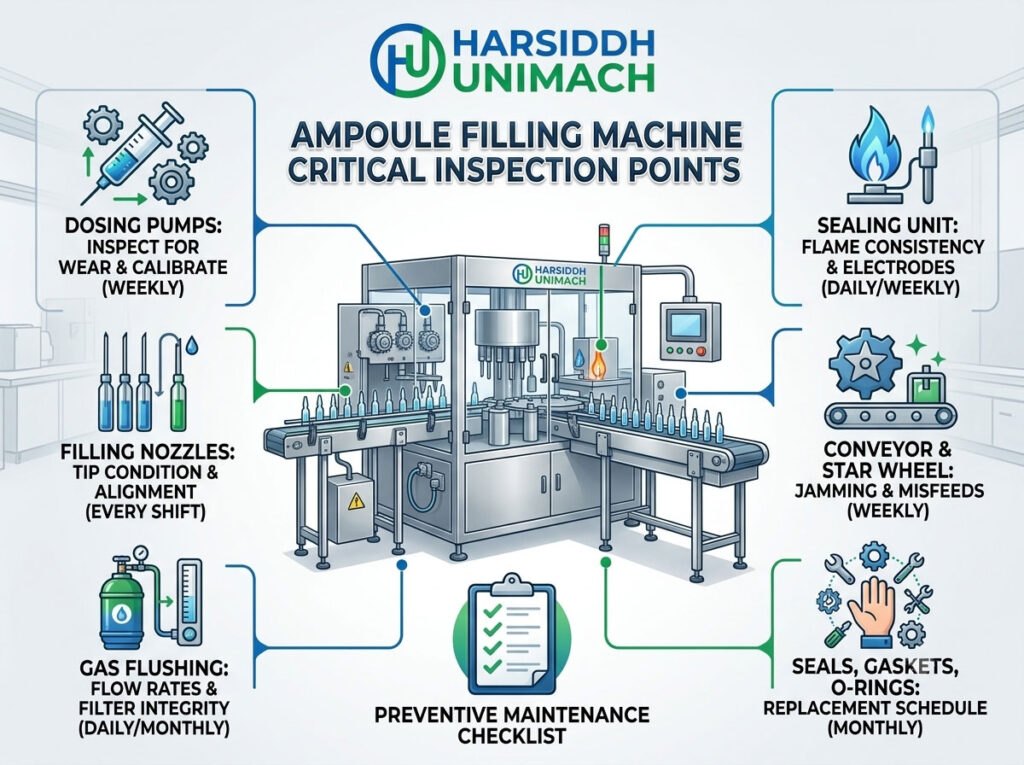
An ampoule filling and sealing machine combines precise liquid dosing with open-flame glass sealing, all at production speed and often in a cleanroom. That combination makes it one of the more demanding machines to maintain. A worn pump seal leads to fill drift. A partly blocked burner nozzle produces weak or uneven seals. A loose transport part chips glass and creates particles.
Regular, structured maintenance prevents these problems. It keeps fill volumes accurate, seals consistent, glass breakage low and the machine in its qualified state, while reducing unplanned stoppages.
This article provides a practical maintenance checklist for ampoule filling and sealing machines. It explains the critical components to inspect, what to look for on each, a suggested schedule, a troubleshooting guide and a recommended spare parts list.
Maintenance intervals and methods should always follow the machine manufacturer’s manual and your own procedures. Gas system work must be carried out by trained, authorised personnel in line with applicable safety rules.
Why Ampoule Machine Maintenance Matters
- Fill accuracy: worn dosing parts cause drift and rejects.
- Seal quality: burner condition directly affects seal integrity.
- Glass integrity: worn handling parts cause chipping, breakage and particles.
- Sterility assurance: well-maintained machines need fewer interventions in the critical zone.
- Safety: gas, flame and moving parts must be kept in safe condition.
- Uptime: planned maintenance reduces unplanned breakdowns.
Component 1: Infeed Hopper or Trough
Function: holds ampoules and feeds them into the transport system.
Inspect for:
- smooth ampoule flow without jamming or bridging
- worn or damaged guides that could scratch or chip glass
- correct width setting for the ampoule size
- cleanliness, with no glass fragments
Component 2: Ampoule Transport System
Function: moves ampoules through filling, nitrogen and sealing stations, often using racks, index plates, star wheels or a walking-beam mechanism.
Inspect for:
- wear in pockets, grooves and rack slots
- smooth, accurate indexing without jerks
- alignment of ampoules with filling needles and burners
- loose fasteners or damaged parts
Why it matters: misalignment causes needles to touch ampoule necks and seals to form off-centre.
Component 3: Dosing Pumps and Valves
Function: measure and deliver each dose.
Piston Pumps
- inspect pistons and cylinders for scoring or wear
- check seals and O-rings for wear or leaks
- check valve operation and timing
- verify dose accuracy on every head
Peristaltic Pumps
- inspect tubing for wear, flattening or cracking
- check roller condition and pressure
- verify dose accuracy, as tubing changes with use
Machines such as an automatic peristaltic based ampoule filling machine need regular tubing inspection and replacement.
Component 4: Filling Needles
Function: deliver product into the ampoule without wetting the neck.
Inspect for:
- straightness and damage
- blockages or residue
- correct height and centring for the ampoule size
- secure fitting
Why it matters: a wet neck causes poor seals, carbon deposits and leaks.
Component 5: Nitrogen Flushing System
Function: displaces oxygen in the ampoule before and/or after filling.
Inspect for:
- correct gas pressure and flow at each nozzle
- filter condition
- leaks in lines and connections
- nozzle cleanliness and alignment
Our article on how nitrogen flushing improves sterility and stability in ampoule filling machines explains the system’s role.
Component 6: Burners (Pre-Heating and Sealing)
Function: heat and seal the ampoule neck.
Inspect for:
- clean, unobstructed burner nozzles
- consistent flame shape and colour
- correct burner position and angle for the ampoule size
- secure mounting
- signs of heat damage to nearby parts
Why it matters: burner condition is the single biggest factor in seal quality. Partly blocked nozzles give uneven flames, causing weak spots, capillaries or carbon deposits.
Component 7: Gas Supply and Safety Devices
Function: supply fuel gas and oxygen (or air) safely and at stable pressure.
Inspect for (by authorised personnel):
- leaks at hoses, fittings and regulators
- hose condition: cracks, hardening or damage
- regulator and flow meter function
- flashback arrestors and safety valves fitted and functional
- gas shut-off and interlock operation
Why it matters: gas safety protects people and the facility. Stable pressure also ensures consistent seals.
Component 8: Ampoule Rotation Mechanism
Function: rotates ampoules during heating so the neck heats evenly.
Inspect for:
- worn rollers or drive belts
- consistent rotation speed
- correct contact with ampoules
Why it matters: uneven rotation leads to uneven seals.
Component 9: Outfeed and Collection
Function: transfers sealed ampoules out of the machine.
Inspect for:
- smooth transfer without glass-to-glass impact
- worn guides or chutes
- correct tray or conveyor alignment
Component 10: Drive System
Function: powers and synchronises machine movements.
Inspect for:
- gearbox oil level and leaks
- chain or belt tension and wear
- cam and follower condition on mechanical machines
- servo motor and drive alarms on servo machines
- unusual noise, vibration or heat
Component 11: Airflow Protection
Function: protects open ampoules in the filling and sealing zone, often with a laminar airflow unit.
Inspect for:
- airflow velocity within specified limits
- HEPA filter condition and integrity, according to your testing programme
- pre-filter condition
- pressure differential readings
Component 12: Sensors, Controls and Electricals
Inspect for:
- sensor cleanliness and function (ampoule presence, no-ampoule no-fill)
- HMI alarms and counters working correctly
- secure electrical connections
- correct parameters and backups for programmable controls
Component 13: Safety Guards and Emergency Stops
Inspect for:
- guards in place and undamaged
- interlocks stopping the machine when guards open
- emergency stops working
- heat shields around burners intact
Suggested Maintenance Schedule
| Frequency | Tasks |
|---|---|
| Every shift / daily | Clean burner area and remove glass debris; check flame appearance; check dose accuracy on all heads; check needle alignment; check nitrogen flow; check guards and emergency stops; check for gas smell or leaks |
| Weekly | Inspect transport parts for wear; inspect pump seals or tubing; clean burner nozzles as needed; check rotation rollers; check sensors |
| Monthly | Check gearbox oil, chains and belts; inspect gas hoses and fittings (authorised personnel); check nitrogen filters; check airflow readings |
| Periodically (per manual and procedures) | Replace wear parts such as seals, tubing, rollers and hoses; HEPA filter testing; calibrate instruments; review control backups |
Adjust frequencies to your operating hours, products and experience.
Troubleshooting Guide
| Problem | Components to Check |
|---|---|
| Fill volume drifting | Pump seals or tubing, valves, air in product line |
| Wet ampoule necks | Needle height and centring, drips, fill speed |
| Weak or uneven seals | Burner nozzles, gas pressure, burner position, rotation |
| Carbon deposits on seals | Wet necks, gas mixture, burner condition |
| Capillary (“hair”) seals | Burner position, heat level, rotation |
| Glass breakage or chipping | Transport parts, infeed guides, outfeed, alignment |
| Needles touching necks | Transport alignment, bent needles |
| Inconsistent nitrogen | Pressure, filters, nozzles, leaks |
| Frequent minor stops | Infeed flow, sensors, transport wear |
| Unusual noise | Drive system, bearings, cams, chains |
A Printable Daily Checklist
Many plants turn the daily tasks into a simple checklist that operators sign at the start of each shift:
| Check | OK / Not OK | Initials |
|---|---|---|
| Area clean, no glass debris around burners and transport | ||
| Flame shape and colour normal on all burners | ||
| No gas smell; gas pressures within range | ||
| Nitrogen pressure and flow within range | ||
| Needles straight, centred and clean | ||
| Dose check on every head within limits | ||
| Test ampoules sealed correctly (visual check) | ||
| Transport and infeed running smoothly | ||
| Airflow indicator within range | ||
| Guards, interlocks and emergency stops working |
Any “Not OK” result should be reported to maintenance and recorded before production starts.
Building a Preventive Maintenance Programme
A good programme goes beyond a checklist:
- Start from the manual: list every task and interval the manufacturer recommends.
- Add your experience: adjust intervals based on breakdown history and wear patterns.
- Assign responsibilities: operators for daily checks, technicians for weekly and monthly tasks, specialists for gas and filtration work.
- Schedule tasks: plan them around production, ideally during changeovers or planned shutdowns.
- Record and review: keep records of every task and review them regularly to spot recurring problems.
- Train people: make sure everyone understands the tasks they perform and why they matter.
Over time, trend data such as dose drift, seal rejects and breakage rates will show whether maintenance intervals are right. Rising rejects between maintenance visits are a sign that intervals should be shortened or parts replaced earlier.
Recommended Spare Parts
Keeping critical spares on hand prevents long stoppages:
- pump seals and O-rings, or peristaltic tubing sets
- filling needles in each size used
- burner nozzles and tips
- gas hoses and fittings (approved types only)
- rotation rollers and belts
- transport wear parts for each ampoule size
- nitrogen filters
- sensors and fuses
- chains, belts and bearings
Our article on vial filling machine spare parts inventory explains how to plan spare parts stock, and the same approach applies to ampoule machines.
Maintenance Across Ampoule Machine Types
The same components appear across most ampoule machines, though their arrangement and number of heads differ:
- Lab-scale machines, such as an automatic lab-scale ampoule filling and sealing machine or a single head ampoule filling and sealing machine
- Production machines, such as a four head ampoule filling and sealing machine or an automatic eight head ampoule filling and sealing machine
- High-speed machines, such as an automatic high-speed vertical ampoule filling and sealing machine
- Closed ampoule machines, such as an eight head closed ampoule filling and sealing machine, which add an opening station that also needs inspection
Browse our ranges of ampoule filling machines for closed ampoules and ampoule filling machines for open ampoules.
Maintaining the Whole Ampoule Line
The filler is only one part of the line. Upstream and downstream equipment needs maintenance too:
- a rotary ampoule washing machine: nozzles, grippers, pumps and filters
- a sterilizing tunnel for ampoules and vials: heaters, belt, HEPA filters and temperature sensors
- a visual ampoule and vial inspection machine: lighting, rotation and background
An integrated automatic ampoule filling line allows maintenance to be planned for the whole line.
Maintenance and GMP
Maintenance on pharmaceutical equipment is a GMP activity:
- follow written procedures
- use approved spare parts and lubricants
- record all maintenance work
- assess the impact of repairs and changes through change control where required
- clean and clear the area after maintenance before production resumes
Maintenance During Changeovers
Size changeovers are a good opportunity for quick inspections of needles, transport parts and burners. Our article on ampoule filling machine changeover and reducing downtime between sizes explains how to combine changeovers with maintenance checks. For general best practices that apply across filling machines, see our article on vial filling machine maintenance best practices to prevent unscheduled downtime.
Frequently Asked Questions
How often should ampoule burners be cleaned? Inspect them every shift and clean nozzles as needed, typically at least weekly, depending on use and gas quality.
What causes carbon deposits on ampoule seals? Often wet necks, an incorrect gas mixture or dirty burners.
Who should maintain the gas system? Only trained, authorised personnel, following safety procedures.
How do I know when to replace pump seals or tubing? When dose accuracy drifts, leaks appear, or at the interval recommended by the manufacturer.
Does maintenance affect validation? Routine maintenance with approved parts usually does not, but significant repairs or changes should be assessed through change control.
Keep Your Ampoule Machine Performing With Harsiddh
Harsiddh Unimach manufactures ampoule washers, sterilising tunnels, open and closed ampoule filling and sealing machines and complete ampoule lines, and supports customers with spare parts, training and service. Our team can help you build a maintenance plan and spare parts list for your machines. For help choosing new equipment, see our ampoule filling machine buyer’s guide.
Contact us through our contact page or send your requirements through our inquiry form.