
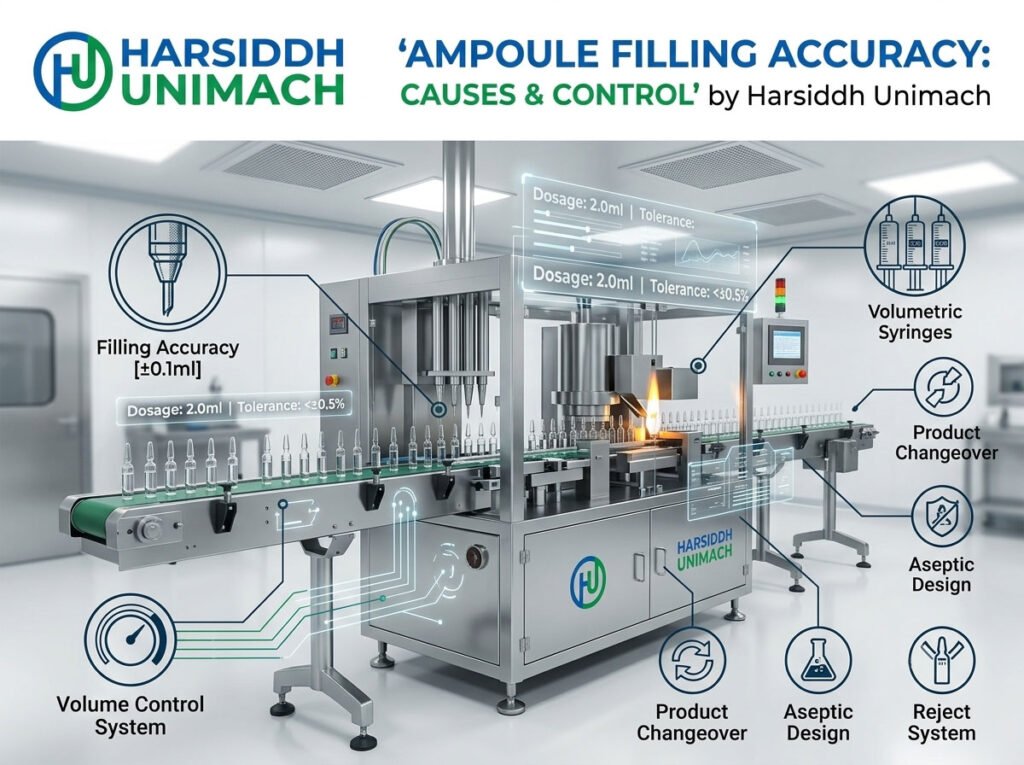
By Harsiddh Unimach Pvt. Ltd. | Pharmaceutical Machinery Manufacturer, Ahmedabad, India
In injectable manufacturing, every ampoule must carry the labelled volume of product. Too little and the patient may receive an under-dose. Too much and you waste an expensive active ingredient, risk spillage in the neck area and can contaminate the sealing zone. That is why filling accuracy is one of the first things a quality team checks on an ampoule filling machine.
Even a well-built machine can show volume variation if the process around it is not controlled. In this guide, we explain what filling accuracy means, the most common causes of volume variation in ampoule filling, and the practical steps your plant can take to keep every ampoule within tolerance.
What Is Filling Accuracy in an Ampoule Filling Machine?
Filling accuracy describes how close the actual volume dispensed into each ampoule is to the target fill volume. It has two parts that are often confused:
- Accuracy (closeness to target): the average fill volume compared with the set volume. A machine that consistently fills 1.05 ml when 1.00 ml is required is repeatable but not accurate.
- Precision (repeatability): how tightly the individual fills cluster around their own average. A machine can be accurate on average but still produce a wide spread from ampoule to ampoule.
Good process control needs both. When you evaluate fill performance, you should look at the mean, the spread (standard deviation or range) and the number of ampoules falling outside your internal limits. Pharmacopoeial requirements for volume in container also apply to injectables, so your tolerance and overfill policy should be defined together with your quality and regulatory team.
The filling system of a Harsiddh Unimach ampoule filling and sealing machine uses high-precision volumetric syringes (piston pumps) with an adjustable stroke length. This is the foundation of accuracy. The rest of this article looks at what disturbs it.
Why Volume Variation Matters
Before looking at the causes, it helps to understand the cost of variation:
- Patient safety and compliance: under-filled ampoules can fail volume-in-container tests and may deliver less than the labelled dose.
- Product loss: over-filling every ampoule “to be safe” adds up quickly on high-value injectables, especially at 12,000 to 18,000 ampoules per hour on multi-head machines.
- Sealing defects: over-filled ampoules can wet the neck, which leads to carbon deposits, burnt product and poor seals during flame sealing.
- Rejections and rework: variation increases rejects at inspection and creates more investigation work for the quality team.
Plants that already work on reducing product loss, as explained in our guide on how to minimize product loss during high-speed injectable vial filling, will find that tight fill control is one of the biggest savings available.
Ampoule Fill Variation: Symptom, Cause, Action
Main Causes of Volume Variation in Ampoule Filling
1. Air Entrapment in the Product Path
Air bubbles in the syringe, tubing or manifold are one of the most common causes of inconsistent fills. Because air is compressible, a piston stroke that contains a bubble delivers less liquid than expected. Typical sources of air are:
- loose tri-clover or tubing connections on the suction side,
- an incorrectly primed pump after cleaning or changeover,
- foaming products that are drawn too fast,
- a supply tank that runs low, so the pump draws air.
If you see random low fills that correct themselves, suspect air in the product line first.
2. Syringe, Piston and Seal Wear
Piston-type syringes depend on a tight clearance between the piston and the barrel. As seals and pistons wear, small amounts of product can leak back on the discharge stroke. The result is a slow drift towards lower fill volumes, and it often shows first on one head of a multi-head machine. Worn parts also increase the chance of particle generation, which is a quality risk on its own.
3. Valve and Non-Return Valve Problems
The filling pump relies on valves to make the product flow in one direction only. A sticky, worn or partially blocked valve allows back-flow or incomplete discharge. This leads to variation between strokes and between heads. Dried product residue after a poorly cleaned changeover is a frequent cause.
4. Product Properties: Viscosity, Temperature and Foaming
Not all injectable liquids behave like water. Viscous solutions flow more slowly through nozzles and tubing. Temperature changes affect viscosity and density, so a fill setting that works in the morning may drift in a hot afternoon. Surface-active products can foam during filling, which creates false volume and bubbles. Fill speed and nozzle design must be matched to the product, as discussed in our article on how diving nozzles improve injectable filling performance.
5. Incorrect Stroke Adjustment and Setting Errors
In a volumetric system, the fill volume is set by adjusting the stroke length of each syringe. If the stroke is not locked properly, or if operators set each head by eye instead of by measurement, heads will fill differently. Vibration during running can also loosen poorly locked adjustments over a long batch.
6. Nozzle Condition and Needle Position
A partially blocked, bent or dirty nozzle changes the flow pattern and can cause dripping or splashing. If the needle is not centred in the ampoule neck, liquid can touch the glass wall and be lost. A dripping nozzle also causes weight differences because a drop is released after the dose has been measured.
7. Ampoule Dimensional Variation
Glass ampoules are not perfectly identical. Variation in neck diameter, ovality and wall thickness affects how well the ampoule centres under the needle. Poor centring causes splashing, neck wetting and, in extreme cases, missed fills. This is why a good machine includes precise neck centring at the filling station. Better glass quality and a strict incoming inspection plan reduce this source of variation.
8. Machine Synchronisation and Speed
When the ampoule rack, star wheel, filling pump and needle movement are not perfectly synchronised, the dose may be delivered while the ampoule is still moving. Running the machine faster than the product can handle also increases splashing and bubbles. A single-point synchronised drive helps, but mechanical timing still needs periodic checks.
9. Gas Flushing Interference
Nitrogen pre-gassing and post-gassing protect oxygen-sensitive products, but gas flow that is too strong can disturb the liquid surface, cause foaming or blow droplets out of the neck. Gas pressure and timing must be tuned along with the fill volume.
10. Environmental and Utility Factors
Machine levelling, floor vibration, pressure fluctuations in utilities and room temperature can all add small errors. Individually they may look minor, but together they can push a stable process out of its normal range.
How to Control Filling Accuracy: A Practical Approach
Controlling volume variation works best when you combine good machine design, correct setup, disciplined operation and regular verification.
Step 1: Choose the Right Machine Configuration
Start with a machine suited to your product, ampoule size and output. Harsiddh Unimach offers automatic ampoule filling and sealing machines in single, two, four, six and eight head versions. For example, you can view the Four Head Ampoule Filling and Sealing Machine for medium-scale production or the Eight Head Ampoule Filling Sealing Machine for high-capacity lines.
If your product needs gentle, non-contact dosing or you want electronic control of the stroke, consider the Servo Based Ampoule Filling and Sealing Machine. For products where the fluid path should be a single-use or easily replaceable part, the Peristaltic Based Ampoule Filling Machine is worth evaluating. For R&D and pilot batches, the Small Scale Ampoule Filling Sealing Machine for Lab lets you set up fill parameters before scaling up.
Step 2: Use Proper Priming and De-Aeration
Always prime the full product path after cleaning or any component change. Run the pump until all air is purged, and check the tubing for bubbles. Keep the supply tank above the minimum level and avoid turbulence when returning product to the tank.
Step 3: Set and Lock the Stroke Correctly
Set the stroke for every syringe using a measured dose, not by appearance. After adjustment, lock each setting securely. Record the final setting on the batch record so the next operator can reproduce it. On multi-head machines, check that all heads are within the same tolerance before starting the batch.
Step 4: Verify Fill Volume During the Run
A simple, disciplined in-process check is the best defence against drift. A typical routine includes:
- Start-of-batch check: collect a sample from each head and verify volume (by weight with a calibrated balance and the product density, or by volume with a calibrated measuring device).
- Periodic checks: repeat at fixed intervals, for example every 30 to 60 minutes, based on your risk assessment.
- Event-based checks: repeat after any stop, jam, nozzle adjustment, change of operator or refilling of the supply tank.
- Trend recording: plot the results so you can see slow drift before it reaches the limit.
Your exact sampling plan and limits should follow your validated procedures and applicable pharmacopoeial and regulatory requirements.
Step 5: Maintain Pumps, Valves and Nozzles
Preventive maintenance protects accuracy more effectively than emergency repair. Inspect syringes, pistons, seals, valves, tubing and nozzles at planned intervals, and replace wear parts before they fail. Our ampoule filling machine maintenance checklist lists the critical components that deserve regular attention. Keeping an adequate stock of spare syringes, seals and nozzles also avoids long stoppages.
Step 6: Control the Product and the Environment
Keep product temperature as stable as practical during the batch. For viscous or foaming products, trial the fill speed and nozzle type during development, and fix them in the process parameters. Place the machine on a levelled, stable base and protect it from vibration.
Step 7: Protect Ampoule Quality at Input
Specify glass dimensions clearly with your supplier and inspect incoming lots for neck diameter and ovality. The machine’s neck centring and ampoule rack work best when the glass stays within a known tolerance. The “No Ampoule, No Filling” function on Harsiddh Unimach machines prevents the pump from dispensing when an ampoule is missing, which avoids waste and keeps the machine clean.
Step 8: Reduce Setup Errors During Changeover
A large share of accuracy problems appears right after a size or product change. Use clear checklists, labelled change parts and recorded settings. Our guide on reducing ampoule filling machine changeover downtime explains how a structured changeover improves both speed and repeatability. The same engineering thinking applies to other fillers, as shown in our article on liquid filling machine changeover time.
Step 9: Balance Speed and Accuracy
Running at maximum speed is not always the most profitable choice. If a faster setting increases rejects and re-checks, the effective output falls. Calculate real output rather than nameplate speed. The method in our article on calculating actual production output for filling lines can be applied to ampoule lines as well.
Troubleshooting Guide: Symptoms and Likely Causes
| Symptom | Likely cause | Suggested action |
|---|---|---|
| Random low fills | Air in the product path | Re-prime, check connections and tank level |
| Gradual drift to lower volume | Syringe or seal wear | Inspect and replace piston seals |
| One head different from others | Stroke setting, valve or nozzle problem | Re-measure, clean valve, check nozzle |
| Over-filling with neck wetting | Poor centring or excessive dose | Check needle position and ampoule glass dimensions |
| Dripping after dose | Nozzle residue or valve back-flow | Clean nozzle, inspect valve and suck-back |
| Foam during filling | Fill speed too high for the product | Reduce speed, review nozzle and gas flow |
| Variation after changeover | Setup or change-part error | Follow changeover checklist and re-verify |
Link Filling Accuracy to the Rest of the Line
Accurate filling is only one step in a complete injectable line. Ampoules must be washed and sterilised before filling, sealed correctly after filling and inspected before packing. If you are planning a full line, explore our Injectable Ampoule Filling Line, the Washing Machine range and the Inspection Machines that help detect particulate, fill-level and sealing defects. For liquid products packed in other containers, see our Liquid Filling Machine and Vial Filling Machines categories.
The same focus on dose accuracy applies to closures. If your plant also fills vials, read our article on how crimping force affects container closure integrity, and browse our Capping Machines for suitable sealing solutions.
You can also find more engineering support, machine options and application notes on Harsiddh Engineering, our sister website for ampoule and pharmaceutical machinery.
Frequently Asked Questions
What is a good filling accuracy for an ampoule filling machine?
The acceptable tolerance depends on your product, ampoule size, pharmacopoeial requirements and internal specification. Smaller volumes usually have a wider relative variation than larger volumes. Define your limits with your quality team and verify them during machine qualification.
How often should fill volume be checked?
Check at the start of every batch, at regular intervals during the run and after any event that can change the setting, such as a stoppage, nozzle change or refilling. Your risk assessment and validated procedure decide the exact frequency.
Why does one head fill differently from the others?
The most common reasons are a different stroke setting, a worn seal, a sticky valve or a partly blocked nozzle on that head. Measure each head separately, then inspect the pump, valve and nozzle of the outlier.
Can product viscosity change the fill volume?
Yes. Thicker products flow slower and can leave a residue at the nozzle, while thin or foaming products can splash. Test the fill speed and nozzle with the actual product during trials.
Does a servo-based machine improve accuracy?
A servo-driven filling system gives precise and repeatable control of the stroke and makes parameter changes easier to record. The final accuracy still depends on correct priming, maintenance and product behaviour.
Conclusion
Volume variation in ampoule filling rarely comes from a single fault. It usually builds up from small issues such as air in the line, worn seals, loose stroke settings, product behaviour and inconsistent glass. The good news is that each cause has a clear control: proper priming, planned maintenance, measured and locked settings, in-process checks and a disciplined changeover routine.
With the right machine and a strong process, you can protect product quality, reduce wastage and keep every ampoule within specification.
Looking for a reliable ampoule filling and sealing solution? Explore our complete Ampoule Filling Machine range or contact our engineering team for a tailored technical proposal. You can also call +91 9825099693 or email info@harsiddhunimach.com.