
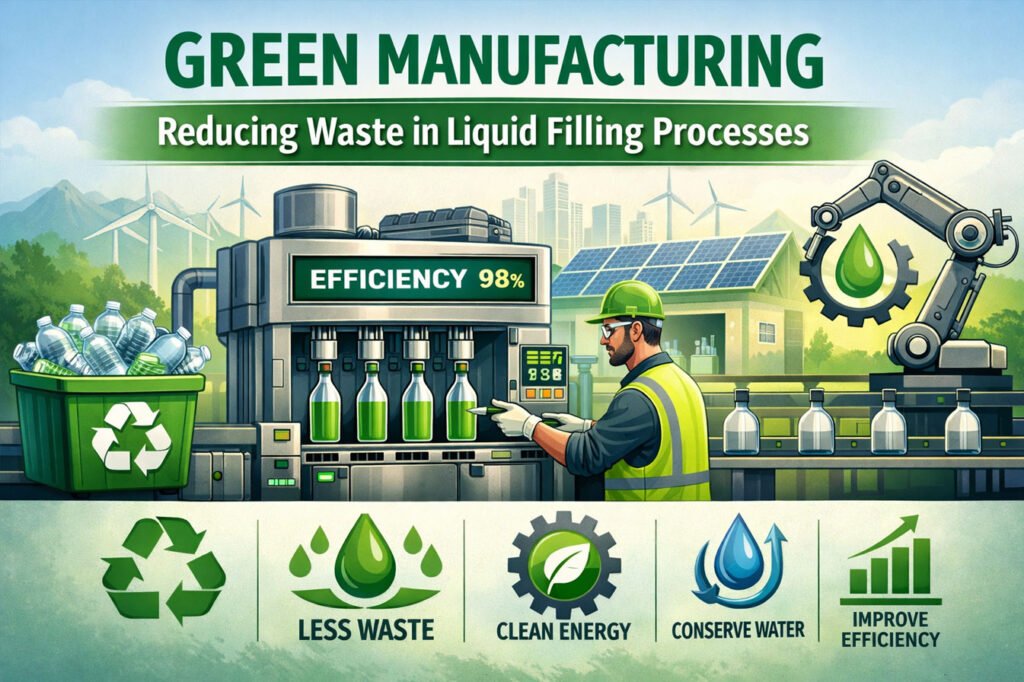
For years, sustainability in manufacturing was treated as a public-relations topic — something for the annual report rather than the shop floor. That has changed. Rising raw material costs, stricter environmental rules, Extended Producer Responsibility (EPR) obligations on plastic packaging and pressure from global buyers who must report their own supply-chain footprint have made waste reduction a core operational goal.
Liquid filling is one of the best places to start. Whether you fill syrups, injectables, oils, cosmetics, sanitisers or household chemicals, the filling line is where expensive product meets packaging, water, compressed air and electricity — and where small inefficiencies repeat thousands of times every shift. The good news is that most of what reduces waste in liquid filling also reduces cost. Green manufacturing, done properly, pays for itself.
This guide explains where waste really comes from in a liquid filling process, the machine technologies and operating practices that eliminate it, and how to build a practical roadmap for a greener, more profitable line.
Where Waste Hides in a Liquid Filling Line
Before you can reduce waste, you need to see it. In most plants, waste falls into six categories.
1. Product giveaway (overfilling)
Every container that is filled above its declared volume gives product away for free. To stay safely above the legal minimum, many plants deliberately set fill targets high to compensate for machine variation. If a line fills 100 ml bottles with an average overfill of just 2 ml, that is 2% of the product leaving the factory unpaid — across millions of units a year, the loss is substantial. Overfill is often the single largest and least visible form of waste.
2. Spillage, drips and foaming
Drips from nozzles after filling, splashes from fast dosing and foaming products that overflow the container neck all waste product. They also create a second problem: contaminated containers and conveyors that must be cleaned, consuming water, chemicals and labour.
3. Rejected and broken containers
Under-filled, over-filled, mislabelled, poorly capped or broken containers are rejected, and the product, packaging and energy used to make them are lost. Glass breakage on high-speed lines is especially costly, since it can stop the line and force line clearance.
4. Changeover and start-up losses
Every product or format change involves draining, flushing and priming the product path, plus a number of test fills before the line is back in specification. On lines with frequent changeovers, these losses can add up to more product than everyday production waste.
5. Cleaning water and chemicals
Container washing, clean-in-place (CIP) cycles and manual cleaning of tanks, hoses and nozzles consume large volumes of purified water, detergents and heat. In pharmaceutical plants, where water for injection and purified water are costly to generate, this is a significant environmental and financial burden.
6. Energy and compressed air
Motors, heaters, sterilising tunnels, vacuum pumps and — most of all — compressed air consume energy continuously. Compressed air is one of the most expensive utilities in any factory, and small leaks or unnecessary blow-offs can waste a large share of what the compressor produces.
Technology Strategies to Reduce Waste
Choose the right filling principle for the product
The single most important decision for reducing waste is matching the filling technology to the product. Gravity, piston, gear pump, peristaltic, load cell and flow meter systems each have strengths and limits in accuracy, viscosity range, cleanability and foaming behaviour. A mismatch — such as using a gravity filler for a viscous product — leads to chronic inaccuracy and spillage. Our guide on liquid filling machine technologies compared explains how to choose.
For thin, free-flowing liquids, a gravity based liquid filling machine offers a simple, low-energy solution. For high-value or sensitive products, a peristaltic based liquid filling machine keeps the product inside a closed tube, which cuts cleaning water and eliminates cross-contamination. For medium-viscosity liquids and oils, a servo based gear pump filling machine delivers smooth, accurate dosing with minimal pulsation.
Use servo-controlled dosing to cut overfill
Servo-driven filling systems control dose volume electronically rather than mechanically. That means tighter fill accuracy, consistent results from the first container to the last, and the ability to set targets much closer to the declared volume without risk of underfilling. The Automatic Servo Based Liquid Filling Machine is a good example: fill volumes are changed from the HMI, and every nozzle can be fine-tuned individually.
Where weight is the critical parameter, load cell filling goes one step further by measuring each container as it fills. The Automatic Load Cell Based Liquid Filling Machine is particularly effective for high-value products and larger containers where even a small overfill per unit costs real money.
Prevent drips and foaming at the nozzle
Anti-drip and suck-back nozzles, diving nozzles that fill from the bottom of the container and rise with the liquid level, and programmable fill speed profiles (slow-fast-slow) together eliminate most spillage and foaming. The result is cleaner containers, cleaner conveyors and less product on the floor.
Build in “no container, no fill” logic
Sensors that detect a missing container, an incorrectly positioned bottle or a missing cap prevent the machine from dispensing product into thin air or onto the conveyor. This simple feature, standard on modern automatic machines, prevents a common source of spillage and cleaning work.
Integrate filling and capping
Every transfer between machines is an opportunity for spills, tip-overs and contamination. A monoblock design such as the Automatic Liquid Bottle Filling and Capping Machine (Monoblock) fills and caps on a single platform, reducing handling, floor space, energy use and the risk of uncapped containers spilling between stations.
Rethink container cleaning
Washing containers with water is necessary for many products — particularly injectables — but not for all. For many oral liquids and non-sterile products, an automatic bottle airjet and vacuum cleaning machine removes dust and loose particles with ionised air and vacuum, using no water at all. Where water washing is required, modern machines like the linear bottle washing machine use controlled spray sequences and recirculation to minimise consumption. The right choice depends on your product, container and regulatory requirements, so it pays to balance cleanliness against water use from the start.
Catch defects early with inspection
The later a defect is caught, the more value has been added to the product before it is thrown away. Inspection at the right points in the line — fill level, cap presence, label position — prevents bad containers from moving on to labelling and cartoning. Explore our inspection machines to see how this can be built into your process.
Operational Practices That Reduce Waste
Machines are only half of the story. How a line is operated decides how much of its potential is actually realised.
Shorten and standardise changeovers
Tool-less change parts, quick-release nozzles, stored recipes and well-documented procedures reduce both the time and the product lost at every changeover. Purging and priming volumes can also be minimised by designing the product path to be as short and small as possible. Our article on improving liquid filling machine changeover time covers proven engineering methods.
Plan production to minimise changeovers
Production scheduling also matters. Grouping products of similar colour, viscosity or formulation reduces the cleaning needed between batches. Running light-coloured or allergen-free products before darker or more complex ones can turn a full clean into a simple flush.
Optimise cleaning cycles
Many plants run CIP and manual cleaning cycles that were validated years ago and never reviewed. Measuring actual soil levels, using conductivity and temperature sensors, and recovering final rinse water for the next pre-rinse can reduce water and chemical use without compromising cleanliness. Any change in a regulated environment must, of course, be validated before it is adopted.
Fix compressed air leaks and right-size utilities
A regular compressed air leak survey is one of the cheapest sustainability projects available. Equally, many lines are supplied with higher pressures or larger flows than they actually need. Our guide to liquid filling machine utility requirements helps you size air, power and water correctly from the start.
Maintain machines proactively
Worn seals, tired pump tubing and drifting sensors gradually increase overfill, drips and rejects. A preventive maintenance plan based on running hours, with critical spare parts kept in stock, keeps the line performing as designed. Monitoring fill weight trends is often the earliest warning that maintenance is due.
Protect high-value product
In pharmaceutical and biotech production, the product is frequently worth more than the machine that fills it. Minimising hold-up volume in tubing, recovering product at the end of a batch and controlling start-up fills all protect yield. Our guide on how to minimise product loss during high-speed vial production explores these techniques in detail.
Packaging: The Other Half of Sustainability
Waste reduction does not stop at the product. Packaging choices have a large impact on a company’s environmental footprint and on its EPR obligations:
- Lightweight containers: thinner-walled bottles use less plastic or glass, but they need gentle handling, accurate cap torque and stable conveying to avoid deformation and breakage.
- Recyclable materials: mono-material bottles, caps and labels are easier to recycle than mixed structures.
- Right-sized packaging: containers sized correctly for the fill volume reduce material use and shipping volume.
- Accurate labelling: mislabelled products often end up destroyed, so precise label application and verification prevent a hidden source of waste.
Modern filling, capping and labelling machines can be configured to handle lighter and more sustainable packaging reliably, so packaging changes do not have to mean lower line performance.
Measuring Progress: Green KPIs for Filling Lines
What gets measured gets managed. Useful sustainability indicators for a liquid filling line include:
- Average overfill (% of declared volume) — the most direct measure of product giveaway.
- Line yield (%) — good units produced versus product and containers consumed.
- Reject rate (%) — broken down by cause: fill, cap, label, breakage.
- Changeover loss (litres per changeover) — product purged and test-filled.
- Water use per 1,000 units — including washing and cleaning.
- Energy use per 1,000 units (kWh) — including compressed air.
Tracking these indicators monthly makes improvement visible, helps justify investment and provides credible data for customer and ESG reporting.
The Business Case for Green Liquid Filling
Sustainability investments in filling equipment are rarely made for environmental reasons alone — and they don’t need to be. Reducing overfill directly increases the number of saleable units per batch. Lower reject rates improve OEE. Water, chemical and energy savings reduce utility bills every month. Fewer spills mean less cleaning labour and safer floors. Together, these benefits often deliver a faster payback than a simple capacity upgrade.
To evaluate the numbers for your own plant, our guide on how to calculate filling machine ROI shows how to include savings from reduced waste alongside higher output.
A Practical Roadmap to Greener Liquid Filling
- Measure your baseline. Weigh samples to determine actual overfill, record rejects by cause, and meter water, air and power at the line.
- Tackle overfill first. It is usually the largest and fastest saving. Recalibrate, tighten targets and, where variation is too high, upgrade to servo or load cell dosing.
- Eliminate spillage. Fit anti-drip nozzles, enable no-container-no-fill logic and adjust fill speed profiles for foaming products.
- Reduce changeover losses. Standardise procedures, minimise product path volume and plan production sequences sensibly.
- Optimise cleaning and utilities. Review cleaning cycles, consider waterless air cleaning where appropriate, and fix compressed air leaks.
- Upgrade strategically. When replacing equipment, include waste, water and energy performance in your selection criteria, not just speed and price.
How Harsiddh Unimach Can Help
Harsiddh Unimach Pvt. Ltd. designs and manufactures liquid filling, washing, capping, inspection and labelling machines for pharmaceutical, cosmetic, food and chemical manufacturers. Our engineers can help you identify where waste occurs in your current process and recommend the right equipment to reduce it. Explore our full range of liquid filling machines, see our liquid filling machines on Harsiddh Engineering and our bottle filling machines for oral liquids, or learn more about Harsiddh Engineering.
Frequently Asked Questions
What is green manufacturing in liquid filling? It is the practice of reducing product, packaging, water, energy and chemical waste throughout the filling process, using accurate filling technology, efficient cleaning methods and disciplined operating practices.
What is the biggest source of waste in liquid filling? In many plants, it is product giveaway from overfilling. Because the overfill is spread across every container, it often goes unnoticed, yet it can add up to a significant share of production.
How do servo filling machines reduce waste? Servo systems control each dose electronically, giving tighter accuracy and repeatability. This allows fill targets to be set closer to the declared volume, reducing giveaway while avoiding underfills.
Can I reduce water use in container cleaning? Yes. Where product requirements allow, airjet and vacuum cleaning machines clean containers without water. Where washing is necessary, optimised spray sequences and water recovery can reduce consumption.
Does green manufacturing increase production costs? Usually the opposite. Most waste reduction measures — less overfill, fewer rejects, lower utility consumption — directly reduce operating costs and often pay back faster than capacity upgrades.
Ready to make your filling line greener and more profitable? Contact our team or send an inquiry to discuss your requirements.