
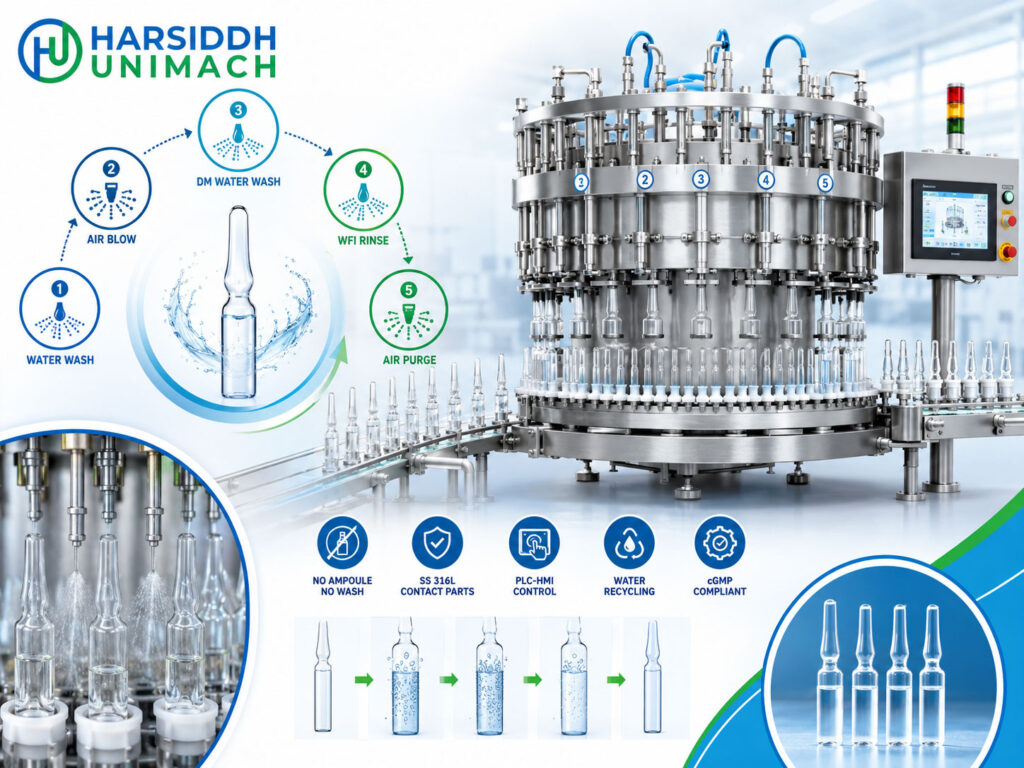
Before an ampoule can be filled with an injectable medicine, it must be completely clean. Glass ampoules leave the glass factory carrying fine glass particles from cutting and forming, dust from packing and transport, and fibres from cartons. If these contaminants are not removed, they end up in the product — causing rejects at inspection, batch investigations and potential harm to patients.
Ampoule washing machines remove this contamination by flushing each ampoule inside and out with jets of water and compressed air. But ampoules are not easy to wash: they are small, thin-walled and have narrow necks that needles must enter precisely without breaking the glass. The working principle of an ampoule washer is built around solving these challenges.
In this article, we explain how ampoule washing machines work — both automatic rotary washers and semi-automatic multijet washers — describe the washing sequence step by step, cover external washing, and explain the key settings, utilities and troubleshooting tips. For an overview of where and why ampoule washers are used, see our article on ampoule washing machine use.
What Does an Ampoule Washing Machine Do?
An ampoule washing machine:
- Removes particles — glass fragments, dust and fibres — from inside and outside the ampoule
- Rinses ampoules with water of the specified quality, finishing with Water for Injection for parenteral products
- Removes residual water using filtered compressed air
- Delivers clean ampoules to the sterilising tunnel or trays for depyrogenation
Washing does not sterilise ampoules. It prepares them for the dry-heat sterilisation and depyrogenation that follows. For the full context, read our guide to the sterile container washing process.
The Core Working Principle
All ampoule washers share the same basic principle: invert the ampoule, insert a fine needle through the neck and deliver alternating jets of water and air to the interior, while external nozzles clean the outside. Inversion allows water and particles to drain out immediately by gravity. Alternating water and air creates a scrubbing effect and ensures that dirty water is blown out before the next rinse.
The two main machine types differ in how ampoules are handled and how many are washed at once.
Automatic Rotary Ampoule Washing Machine
How it works
- Infeed: ampoules are loaded onto an infeed tray or turntable, usually in an upright position. A feed system separates them and guides them to the washing mechanism.
- Gripping and inversion: grippers or a rotating carrier pick up each ampoule and invert it so the neck faces downward.
- Needle entry: washing needles, mounted on a mechanism that moves with the rotating carrier, rise and enter each ampoule neck. Because ampoule necks are narrow, needle alignment must be precise.
- Washing stations: as the carrier rotates, each ampoule passes through a sequence of stations delivering water and air internally, while external spray nozzles clean the outside.
- Return upright and discharge: after the final air blow, ampoules are returned to the upright position and discharged — either into trays or directly into a sterilising tunnel on integrated lines.
Advantages
- Continuous, automatic operation with minimal manual handling
- Consistent washing results
- Compact footprint
- Can be integrated with a tunnel and ampoule filling machine
See the Automatic Rotary Ampoule Washing Machine and our rotary ampoule washing machine.
Semi-Automatic Multijet Ampoule Washing Machine
How it works
- Loading: the operator loads a tray or rack of ampoules — often in a matrix of many positions — and places it inverted over a multi-needle washing head.
- Washing cycle: the machine delivers water and air through all needles simultaneously according to a programmed sequence, washing every ampoule in the tray at once. External sprays may clean the outer surfaces.
- Unloading: the operator removes the tray and transfers ampoules for sterilisation.
Advantages
- Low investment
- Washes many ampoules per cycle
- Simple to operate and maintain
- Ideal for small batches, R&D and pilot plants
Limitations
- Manual loading and unloading, which requires good aseptic practice and protective airflow
- Lower throughput than automatic machines for continuous production
- Not usually integrated directly with a tunnel
See the Semi-Automatic Multijet Ampoule Washing Machine and our semi-automatic multijet ampoule washing machine.
The Washing Sequence Step by Step
A typical internal washing sequence alternates media:
| Step | Medium | Purpose |
|---|---|---|
| 1 | Recirculated or purified water | Remove loose particles |
| 2 | Compressed air | Blow out water and loosened debris |
| 3 | Purified water | Further rinse |
| 4 | Compressed air | Clear water before final rinse |
| 5 | Water for Injection (WFI) | Final rinse with highest quality water |
| 6 | Filtered compressed air | Remove residual water |
External washing with water sprays usually runs alongside internal washing so that dust on the outer surfaces does not contaminate cleanrooms downstream.
Exact sequences vary by machine and process requirements, and are defined during process development and validation.
Why Ampoules Are Harder to Wash Than Vials
- Narrow necks require thin, precisely aligned needles
- Thin glass is easily cracked by misaligned needles or rough handling
- Small internal volume means water must drain quickly and completely
- Static charge can make fine glass particles cling to inner surfaces
These factors make needle alignment, gentle handling and correct pressures critical. A washer that works well for vials will not necessarily wash ampoules effectively, which is why dedicated ampoule washing machines use finer needles, more precise guidance and pressures suited to thin glass. For comparison, see how vial washers handle these challenges in rotary vs linear vial washing machines.
Open vs Closed Ampoules
The internal washing process described above applies to open (funnel-type) ampoules, which have an open neck for needles to enter.
Closed ampoules are supplied sealed by the glass manufacturer, protecting the interior from contamination until filling. Because the interior is sealed, they are not washed internally in the same way; instead, they typically undergo external cleaning and sterilisation before the filling machine opens the tip, fills and reseals them. See our range of ampoule filling machines for closed ampoules.
External Ampoule Washing After Sealing
A separate type of washing takes place after filling and sealing. An external ampoule washing machine cleans the outside of sealed ampoules to remove product residue, carbon deposits from sealing and handling marks, then dries them. This improves appearance, label adhesion and inspection results. See the Automatic Ampoule External Washing Machine.
Where the Washer Fits in the Ampoule Line
- Ampoule washing – rotary or multijet washer
- Sterilisation and depyrogenation – a sterilizing tunnel for ampoules and vials or a hot-air oven
- Filling and sealing – for example, our eight head ampoule filling and sealing machine
- External washing (optional)
- Inspection – on a visual ampoule and vial inspection machine
- Labelling and packing
On compact integrated systems, such as the automatic ampoule filling line (compact line), washing, sterilising, filling and sealing are combined in one synchronised unit. To learn how the filling stage works, read what is an ampoule filling machine and how does it work.
Utilities Required
- Purified water and WFI at specified pressure and temperature
- Compressed air — oil-free and filtered, with sterile-grade filtration for air contacting the ampoule interior
- Electrical power for drives, pumps and controls
- Drainage for wastewater
- Recirculation tank and filtration, if the machine reuses water in early stages
Key Settings and Parameters
| Parameter | Why It Matters |
|---|---|
| Water pressure | Determines jet cleaning force; too high may damage thin glass |
| Air pressure | Affects drying and particle removal |
| Needle alignment and depth | Ensures jets reach the ampoule base without striking glass |
| Station dwell time | Controls contact time with each medium |
| Water quality and temperature | Defines surface cleanliness |
| Filter condition | Affects pressure and risk of particle carry-over |
| Machine speed | Must match the tunnel and filler |
Validation and Monitoring
- Particle challenge studies demonstrate the washer’s ability to remove particles
- Critical parameters — pressures, flows, temperatures, sequence — are verified during qualification
- Water and air quality are monitored as part of the utilities programme
- Inspection results after filling provide ongoing feedback; a rise in glass particles may point to washer issues or breakage
Troubleshooting Common Problems
| Problem | Likely Cause | Solution |
|---|---|---|
| Particles remaining in ampoules | Blocked or bent needles, low pressure, clogged filters | Inspect and replace needles, check pressures and filters |
| Broken ampoules | Misaligned needles, wrong change parts, rough handling | Align needles, fit correct parts, adjust handling |
| Water left inside | Insufficient air blow, low air pressure | Increase air time or pressure, check filters |
| Uneven results between positions | Partially blocked needles | Clean or replace affected needles |
| Pressure alarms | Pump or filter problems, utility supply issues | Service pumps, replace filters, check supply |
Changeover Between Ampoule Sizes
Ampoules range from small 1 ml sizes to larger 10 ml and 20 ml formats, each with different heights and neck diameters. Changing sizes on an automatic rotary washer typically involves:
- Emptying the machine of all ampoules from the previous batch
- Changing infeed parts, guides and grippers for the new diameter
- Changing or adjusting needles for the new neck size and height
- Adjusting needle stroke so jets reach the ampoule base
- Checking external spray nozzle positions
- Running trial ampoules and inspecting results before production
On multijet washers, changeover usually means switching to a tray and needle head matched to the new ampoule size. In both cases, clearly labelled change parts and recorded settings make changeovers faster and more consistent.
Operator Safety
- Wear appropriate gloves when handling glass and clearing broken ampoules
- Keep guards closed while the machine is running
- Stop the machine before adjusting needles or clearing jams
- Take care with hot water and pressurised lines
Maintenance Best Practices
- Inspect needles daily and at every changeover; replace bent or blocked needles immediately
- Monitor and record water and air pressures
- Replace water and air filters on schedule
- Check grippers and change parts for wear
- Clean recirculation tanks and spray nozzles regularly
- Follow a preventive maintenance plan based on running hours
Choosing an Ampoule Washing Machine
- Output: automatic rotary washers suit continuous production; multijet washers suit small batches
- Ampoule sizes: confirm change parts for all sizes
- Line integration: decide whether the washer must feed a tunnel directly
- Utilities: check water, WFI and compressed air availability
- Documentation: ensure qualification support is available
Explore our full range of ampoule washing machines, all washing machines on Harsiddh Engineering and our washing machine category. For broader selection advice, read how to select the right pharmaceutical washing machine for your plant.
Frequently Asked Questions
What is the working principle of an ampoule washing machine? Ampoules are inverted, and fine needles deliver alternating jets of water and compressed air inside them while external nozzles clean the outside, finishing with a WFI rinse and filtered air drying.
What is the difference between rotary and multijet ampoule washers? Rotary washers are automatic and wash ampoules continuously as they rotate. Multijet washers are semi-automatic and wash a tray of ampoules at once.
Why are ampoules washed upside down? So water and loosened particles drain out immediately instead of collecting inside.
Are closed ampoules washed internally? Generally not, because they are sealed. They are cleaned externally and sterilised, then opened, filled and resealed by the filling machine.
What is external ampoule washing? Cleaning the outside of filled and sealed ampoules to remove residue and marks before inspection and labelling.
Need an ampoule washing machine for your line? Contact our team or send an inquiry to discuss your requirements.