
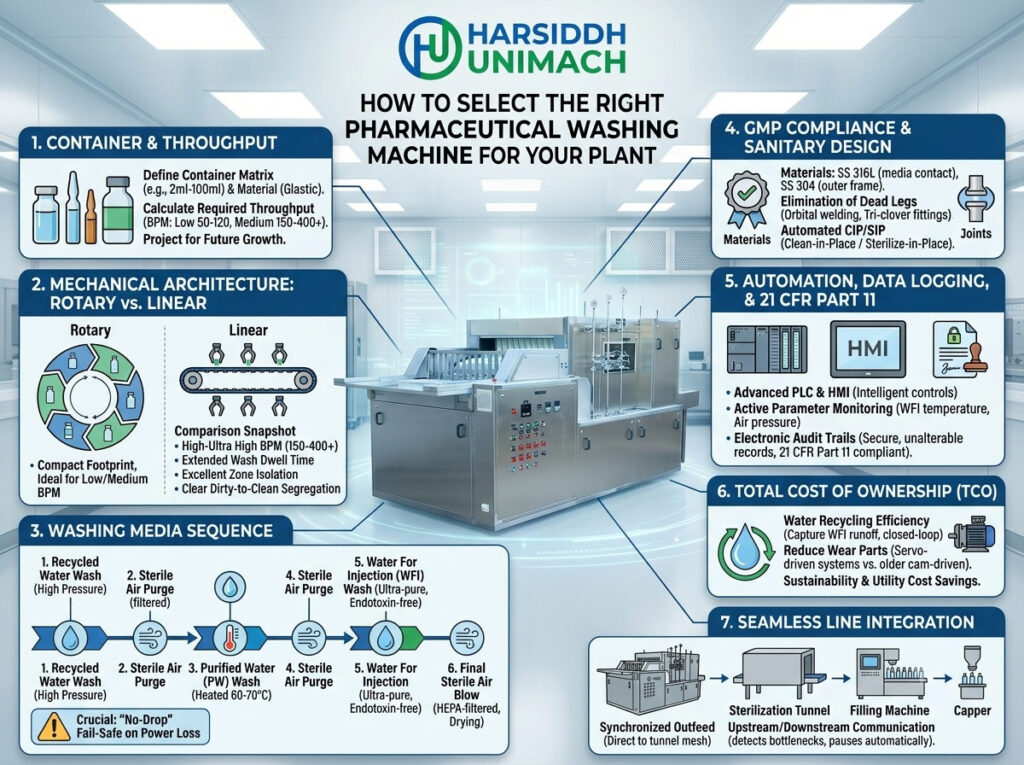
Every pharmaceutical container — whether a vial for an injection, an ampoule for an emergency drug or a bottle for a cough syrup — must be clean before it is filled. Containers arrive from glass and plastic manufacturers carrying dust, fibres, glass particles and packaging residues. If these contaminants are not removed, they end up in the product, causing rejects at inspection, batch investigations and, at worst, risk to patients.
That is why the washing machine is one of the most important — and most underestimated — purchases in a pharmaceutical plant. The right machine delivers consistently clean containers at the speed your line needs, with sensible utility consumption and easy validation. The wrong machine creates bottlenecks, wastes water and leaves particles behind.
This guide explains the main types of pharmaceutical washing machines, the questions to ask before buying and how to match a machine to your containers, products and plant. You can browse the full range in our washing machine category and the washing machines on Harsiddh Engineering.
Step 1: Start With Your Containers
The container is the first and most important factor. Each container type has its own shape, size and handling requirements, and washing machines are designed accordingly.
Vials
Glass vials for injectables are washed inside and out, usually with water and compressed air, and then sent to a depyrogenation tunnel. Vial washers must handle fragile glass gently and deliver a very high level of cleanliness. Explore our vial washing machines.
Ampoules
Ampoules are smaller, more fragile and have narrow necks, so needles must enter accurately and jets must reach the inside without breaking the glass. Explore our ampoule washing machines, and read about the ampoule washing machine working principle and typical uses of ampoule washing machines.
Bottles
Glass and plastic bottles for oral liquids, syrups and dry syrups may be washed with water or cleaned with air, depending on the product and container. Explore our bottle washing machines.
Step 2: Understand the Product and Its Cleanliness Requirements
The route of administration largely determines how clean containers must be.
Sterile injectables
For parenteral products, containers must be washed to a very high standard, typically with a final rinse of Water for Injection, followed by filtered compressed air and depyrogenation. Washing is a critical step in the contamination control strategy and must be validated.
Oral liquids and dry syrups
For non-sterile oral products, containers must be clean and free of loose particles, but requirements are different. Depending on the container and product, water washing or waterless air-jet cleaning may be appropriate.
Ophthalmic and other special products
Eye drops and other sensitive products may require washing standards close to those for injectables, along with careful handling of plastic containers.
Our guide to the sterile container washing process explains how washing sequences are designed for high-cleanliness applications.
Step 3: Know the Main Types of Washing Machines
Linear vial washers
Vials move in a straight line, typically through an ultrasonic bath and several internal and external washing stations, before being discharged directly into the sterilising tunnel. They suit medium to high outputs and integrated sterile lines. See our linear vial washing machine.
Rotary vial washers
Vials are held individually by grippers on a rotating platform, inverted and washed as they travel around a circle. Rotary washers are compact and economical, suiting small to medium outputs. See our rotary vial washing machine.
To compare the two in detail, read rotary vs linear vial washing machines: which is better for sterile production?
Semi-automatic multijet washers
Containers are loaded manually onto a multi-needle washing head, where multiple vials or ampoules are washed simultaneously with water and air. These machines suit small batches, pilot plants and R&D. See the Semi-Automatic Multijet Vial Washing Machine and our semi-automatic multijet ampoule washing machine.
Rotary ampoule washers
Ampoules are fed onto a rotating system, inverted and washed internally and externally with alternating media, then discharged to trays or a tunnel. See the Automatic Rotary Ampoule Washing Machine.
Linear bottle washers
Bottles are gripped, inverted and passed through water and air washing stations in a straight line — suitable for continuous bottle lines. See the Automatic Linear Bottle Washing Machine.
Semi-automatic rotary bottle washers
Bottles are loaded onto a rotating platform and washed by needles and nozzles, offering an economical solution for smaller outputs. See our semi-automatic rotary bottle washing machine.
Air-jet and vacuum cleaning machines
Instead of water, bottles are inverted and cleaned with ionised compressed air while a vacuum extracts dislodged particles. This waterless method suits many oral liquid and dry syrup bottles where water washing is not required. See the Automatic Bottle Airjet and Vacuum Cleaning Machine and our airjet cleaning machines.
External washers
External washers clean the outside of filled and sealed vials or ampoules, removing product residue and fingerprints before labelling.
Quick Selection Table
| Container and Application | Recommended Machine Type |
|---|---|
| Vials, sterile injectables, medium to high output | Linear vial washer with ultrasonic bath |
| Vials, sterile injectables, small to medium output | Rotary vial washer |
| Vials or ampoules, R&D or small batches | Semi-automatic multijet washer |
| Ampoules, production | Rotary ampoule washer |
| Glass bottles, oral liquids, continuous line | Linear bottle washer |
| Bottles, small output | Semi-automatic rotary bottle washer |
| Plastic or glass bottles where water washing is not needed | Air-jet and vacuum cleaning machine |
| Filled and sealed vials or ampoules before labelling | External washing machine |
Step 4: Calculate the Required Output
The washer must keep pace with the filling machine. Calculate:
- Required line output in containers per minute
- A capacity margin — typically the washer is rated slightly faster than the filler so the line can recover from brief stoppages
- Future growth — will output increase in the next few years?
An undersized washer limits the whole line; an oversized one wastes capital and floor space.
Step 5: Check Container Size Range and Changeover
List every container size you will run. Then ask:
- Can the machine handle all sizes with change parts?
- How many change parts are needed for each size?
- How long does a changeover take?
- Are needle sets and grippers easy to change and clearly identified?
- Are settings stored as recipes?
Frequent changeovers favour machines with quick, tool-less parts and recipe control.
Step 6: Plan Utilities
Washing machines are among the largest utility consumers on a line. Confirm:
- Purified water and WFI – quantity, pressure and temperature required
- Compressed air – flow, pressure and quality (oil-free, filtered for container contact)
- Electrical power – including pumps, heaters and ultrasonic generators
- Drainage – capacity for wastewater
- Recirculation – whether the machine reuses final rinse water in early stages to save water
Ask suppliers for consumption figures at your rated output, and include them in your cost comparison.
Step 7: Consider Integration With the Line
For sterile lines, the washer should connect smoothly to the depyrogenation tunnel, ideally with a protected, direct transfer. For bottle lines, it should link to unscramblers upstream and fillers downstream. Consider:
- Height and alignment with adjacent machines
- Matching speeds and controls
- Space for operators and maintenance access
- Cleanroom layout and pressure zones
Step 8: Evaluate GMP Design and Validation Support
Look for:
- SS 316L for water and container-contact parts, SS 304 for frames
- Drainable design with no stagnant water pockets
- Filtered compressed air with appropriate filter grades
- Pressure and flow monitoring with alarms
- Interlocks that stop the machine when critical parameters are out of range
- Easy access for cleaning and inspection
- Documentation: drawings, material certificates, FAT/SAT protocols and IQ/OQ support
For sterile applications, ask how the supplier supports washing validation, such as particle challenge testing.
Step 9: Think About Automation Level
- Semi-automatic machines are cost-effective for small batches but rely on manual loading and unloading.
- Automatic machines provide consistent results, higher output and fewer interventions — essential for commercial sterile production.
Higher automation reduces operator handling of clean containers, which supports contamination control.
Step 10: Compare Total Cost of Ownership
The purchase price is only part of the story. Consider:
- Water and WFI consumption
- Compressed air and energy use
- Changeover time
- Maintenance and spare parts (needles, filters, grippers, seals)
- Reject rates downstream caused by poor washing
- Service availability and response time
A slightly more expensive machine that uses less WFI, changes over faster and reduces particle rejects often costs less over its lifetime.
Common Selection Mistakes
- Choosing on price alone without considering utilities and rejects
- Ignoring future container sizes and products
- Undersizing capacity, so the washer limits the line
- Overlooking integration with the tunnel or filler
- Using water washing where air cleaning would do — or the reverse, under-cleaning sterile containers
- Neglecting documentation, delaying validation
Questions to Ask Suppliers
- Which container sizes can the machine handle, and what change parts are needed?
- What output does it achieve for my containers?
- What is the washing sequence, and how many stations are there?
- How much water, WFI and compressed air does it consume?
- How is final rinse water kept separate from recirculated water?
- How does it connect to my tunnel or filler?
- What monitoring, alarms and interlocks are included?
- What documentation and validation support is provided?
- What spare parts should I keep, and how quickly can you supply them?
- Can I see a reference installation or a factory trial with my containers?
Example Scenarios
A new injectable unit filling vials at moderate volumes may choose a rotary vial washer linked to a tunnel and a four head filling and stoppering machine.
A large sterile plant producing high volumes will usually choose a linear vial washer with ultrasonic pre-cleaning, directly connected to the tunnel.
A small R&D facility may need only a semi-automatic multijet washer for vials and ampoules.
An oral liquids plant filling PET bottles may use an air-jet and vacuum cleaning machine rather than water washing.
A syrup plant using glass bottles may choose a linear bottle washer for continuous production.
Running a Factory Trial
Before finalising a purchase, ask the supplier for a factory trial using your own containers. A trial lets you:
- Confirm that every container size feeds, grips and inverts smoothly
- Check washing results visually and, for sterile applications, with particle testing
- Observe changeover time and ease of adjustment
- Measure actual water and air consumption at your required speed
- Train key operators before the machine arrives on site
A well-planned trial reduces surprises during installation and shortens qualification.
Maintaining Your Washing Machine
Once installed, consistent performance depends on:
- Inspecting needles and nozzles at every changeover
- Monitoring pressures and flows
- Replacing filters on schedule
- Checking grippers and seals
- Cleaning tanks and baths regularly
- Following a preventive maintenance plan based on running hours
Frequently Asked Questions
What is the most important factor when selecting a washing machine? The container type and the cleanliness requirement of the product. These decide the machine type, washing sequence and utilities needed.
When should I choose air-jet cleaning instead of water washing? For many oral liquid and dry syrup bottles where water washing is not required, air-jet and vacuum cleaning removes loose particles without water. Sterile injectable containers require water washing.
What is the difference between linear and rotary vial washers? Linear washers move vials in rows along a straight line, often with ultrasonic cleaning and direct tunnel connection. Rotary washers hold vials individually on a rotating platform and are more compact.
Are semi-automatic washers suitable for production? They suit small batches and R&D. For commercial production, automatic washers provide better consistency and fewer manual interventions.
How do I reduce water consumption? Choose machines that recirculate final rinse water for early washing stages and use air cleaning where appropriate.
Need help choosing the right washing machine for your plant? Contact our team or send an inquiry to discuss your containers and requirements.