
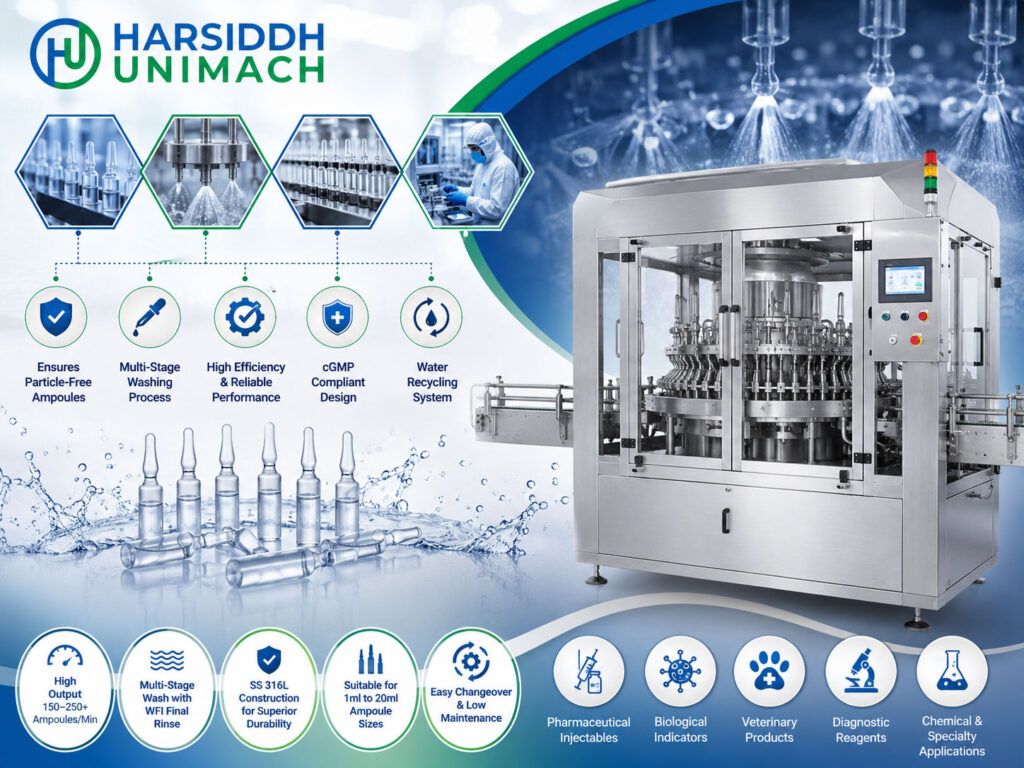
Glass ampoules are one of the most dependable containers for liquids that must stay sterile, stable and uncontaminated. Injectable medicines, veterinary products, cosmetic serums, laboratory reagents and essential oils are all packed in ampoules. But before any of these products can be filled, the ampoules themselves must be cleaned — and that is the job of the ampoule washing machine.
An ampoule washer removes glass particles, dust, fibres and other contaminants from new ampoules, preparing them for sterilisation and filling. Without effective washing, particles end up in the finished product, leading to rejects, complaints, recalls and — in the case of injectables — risks to patients.
In this article, we look at the practical uses of ampoule washing machines: who uses them, why, in which industries and applications, what benefits they bring and how to choose the right machine for each use. To understand how the machines actually work, read our companion article on the ampoule washing machine working principle.
Why Ampoules Must Be Washed
New ampoules arrive from glass manufacturers clean by industrial standards, but not by pharmaceutical standards. During forming, cutting, annealing, packing and transport, they can collect:
- Glass particles and fragments from cutting and handling
- Dust and fibres from cartons, trays and the environment
- Residues from manufacturing and packaging
- Microbial contamination from handling and storage
Washing removes these contaminants and reduces the load on the sterilisation and depyrogenation step that follows. It is a foundational step in aseptic packaging — explained further in our complete guide to aseptic packaging for liquid injectables.
The Main Uses of Ampoule Washing Machines
1. Injectable pharmaceutical manufacturing
The most important use of ampoule washers is in the production of injectable medicines — vitamins, analgesics, anaesthetics, antibiotics in solution, hormones, emergency drugs and many generic injectables. Here, washing is a GMP-critical step:
- Removing particles to meet requirements for visible particulate matter
- Final rinsing with Water for Injection for parenteral products
- Feeding clean ampoules directly into a sterilising tunnel on integrated lines
In high-volume plants, automatic rotary washers such as the Automatic Rotary Ampoule Washing Machine and our rotary ampoule washing machine run continuously as part of complete lines.
2. Veterinary injectables
Animal health products — vaccines, vitamins, antibiotics and other injectables — also require clean, particle-free ampoules. Veterinary plants use the same washing technology and standards as human pharmaceutical plants for injectable products.
3. Research and development
Formulation laboratories, stability testing units and clinical supply teams fill ampoules in small batches. They need washers that are flexible, compact and economical — often semi-automatic multijet machines that wash a tray of ampoules at a time. See the Semi-Automatic Multijet Ampoule Washing Machine and our semi-automatic multijet ampoule washing machine.
4. Hospital and institutional production
Some hospitals and institutional units prepare special injectable products in small quantities. Compact washers support these operations without the need for full production lines.
5. Cosmetics and personal care
Cosmetic serums, hair treatments and skin ampoules are increasingly popular. While cosmetic requirements differ from pharmaceutical standards, clean, particle-free ampoules are still essential for product quality, safety and brand reputation.
6. Diagnostics and laboratory reagents
Reagents, calibration standards and reference solutions are often supplied in ampoules to protect them from contamination and evaporation. Clean ampoules prevent particles or residues from affecting test results.
7. Essential oils, fragrances and specialty liquids
Perfume samples, essential oils and specialty chemicals packed in ampoules also benefit from washing to ensure a clean appearance and avoid contamination.
Benefits of Using an Ampoule Washing Machine
Product safety and quality
Removing particles and residues protects patients and end users and reduces the risk of product complaints.
Regulatory compliance
For injectables, washing is part of the validated process that regulators expect. Automated washing provides consistent, documentable results.
Fewer rejects
Effective washing reduces particle rejects at final inspection — saving product, packaging and investigation time. See our best practices for ampoule and vial inspection.
Consistency
Machines deliver the same washing sequence, pressures and timing to every ampoule — something manual washing cannot match.
Productivity
Automatic washers handle large volumes with minimal labour. Even semi-automatic machines wash many ampoules per cycle.
Integration
Washers can feed directly into a sterilising tunnel and filling machine, reducing manual handling and contamination risk.
Efficient use of water
Modern washers recirculate water in early stages and use high-quality water only for the final rinse, controlling utility costs.
Regulatory Expectations for Washing Injectable Ampoules
For injectable products, regulators expect container preparation to be a controlled, validated process. In practice, this means:
- Defined washing parameters — the sequence of water and air stages, pressures, flows and temperatures — documented in procedures
- Appropriate water quality, with Water for Injection used for the final rinse of containers for parenteral products
- Filtered compressed air for air that contacts ampoule interiors
- Validation studies demonstrating that washing reduces particles to acceptable levels
- Routine monitoring of critical parameters during production
- Qualified equipment with installation and operational qualification records
Automatic washing machines make it much easier to meet these expectations, because they repeat the same validated sequence on every ampoule and can monitor and alarm critical parameters.
Does Every Ampoule Need Internal Washing?
Not always. The answer depends on the ampoule type:
- Open (funnel-type) ampoules have an open neck and must be washed inside and out before sterilisation and filling.
- Closed ampoules are sealed by the glass manufacturer, protecting the interior until use. They are not washed internally in the same way; instead, they are typically cleaned externally and sterilised, and the filling machine opens the tip just before filling.
Choosing between open and closed ampoules affects the washing equipment you need, so it should be considered early in line planning.
External Washing: A Second, Different Use
Ampoule washing is not only about preparing new ampoules. After filling and sealing, many plants also wash the outside of sealed ampoules to remove product residue, carbon deposits from the sealing flame and handling marks. External washing improves appearance, inspection accuracy and label adhesion. It is a separate step from pre-filling washing and is often performed on dedicated external washing equipment.
The Cost of Poor Washing
Inadequate washing has consequences that reach far beyond the washing room:
- Higher particle rejects at visual inspection, wasting filled product and packaging
- Batch investigations that consume quality and production time
- Delayed batch release while issues are resolved
- Customer complaints if particles reach the market
- Recalls in serious cases, with major financial and reputational impact
- Regulatory observations during inspections
Compared with these costs, investing in a reliable, well-maintained ampoule washer is one of the most cost-effective quality measures an injectable manufacturer can make.
Where Washing Fits in the Ampoule Process
A typical ampoule production sequence is:
- Receiving and inspecting ampoules
- Washing — internal and external, with water and air
- Sterilisation and depyrogenation — in a sterilizing tunnel for ampoules and vials or hot-air oven
- Filling and sealing — on machines from our range of ampoule filling machines for open ampoules
- Leak testing and inspection — such as on a visual ampoule and vial inspection machine
- Labelling — on labeling machines for ampoules
- Packing
For compact plants, integrated systems such as the Automatic Ampoule Filling Line (Compact Line) combine washing, sterilising, filling and sealing in a single synchronised unit.
Choosing the Right Washer for Your Application
| Application | Typical Volume | Recommended Washer |
|---|---|---|
| High-volume injectable production | High | Automatic rotary washer integrated with tunnel |
| Medium injectable production | Medium | Automatic rotary washer |
| Veterinary injectables | Medium to high | Automatic rotary washer |
| R&D, stability and clinical batches | Low | Semi-automatic multijet washer |
| Hospital / institutional units | Low | Semi-automatic multijet washer |
| Cosmetic ampoules | Low to medium | Multijet or rotary washer, depending on volume |
| Diagnostics and reagents | Low to medium | Multijet or rotary washer |
Matching washer to filler
The washer should match the capacity of the filling and sealing machine it supplies:
- Small-scale fillers, such as our single head ampoule filling and sealing machine, pair well with multijet washers. Learn more in working principle of a small-scale ampoule filling and sealing machine.
- Production fillers, such as our six head ampoule filling and sealing machine, need automatic rotary washers with matching output.
Our comparison of single head, 2 head, 4 head and 6 head ampoule filling and sealing machines can help you plan the right filler-washer combination.
Factors to Consider When Choosing an Ampoule Washer
- Required output – ampoules per hour or per batch
- Ampoule sizes – change parts available for all sizes you run
- Cleanliness requirements – injectable, cosmetic or reagent standards
- Water and WFI availability – and consumption at your required output
- Compressed air quality – oil-free and filtered
- Integration – standalone or linked to a tunnel and filler
- Space – floor area in the washing room
- Documentation – qualification support for GMP use
- Service and spares – availability of needles, filters and parts
Common Misconceptions About Ampoule Washing
“New ampoules are already clean enough.” New ampoules can carry glass particles and dust from manufacturing and transport. For injectables, washing is essential.
“Washing sterilises ampoules.” Washing removes particles and reduces contamination, but sterilisation and depyrogenation happen in the tunnel or oven afterwards.
“Any washer will do for ampoules.” Ampoules have narrow necks and thin walls, requiring fine, precisely aligned needles and suitable pressures. Dedicated ampoule washers are designed for this.
“Manual washing is acceptable for production.” Manual washing cannot deliver the consistency, documentation and contamination control required for pharmaceutical production.
Getting the Most From Your Ampoule Washer
- Inspect and replace needles regularly
- Monitor water and air pressures
- Replace filters on schedule
- Use correct change parts for each ampoule size
- Train operators on loading, changeover and alarm response
- Track particle rejects at inspection as an indicator of washing performance
Planning Washing Capacity for Growth
When selecting a washer, think beyond today’s output. Many manufacturers start with one product and a modest batch size, then add products, ampoule sizes and higher volumes over the next few years. A washer that is already running at full capacity on day one will soon limit the whole line.
Practical steps include:
- Choosing a washer rated slightly above the current filler’s output
- Confirming that change parts are available for future ampoule sizes
- Sizing water, WFI and compressed air supplies for future demand
- Leaving floor space for a higher-capacity washer or an additional line
- Keeping a semi-automatic multijet washer for development work and small special batches, even after installing an automatic line
Real-World Example
A mid-sized injectable manufacturer producing vitamin and analgesic ampoules was experiencing frequent particle rejects at inspection. Investigation showed that ampoules were being washed manually in trays before sterilisation, with inconsistent results between operators and shifts. By introducing an automatic rotary ampoule washer linked to a sterilising tunnel and a six head filling and sealing machine, the company achieved consistent washing, reduced manual handling and saw particle rejects fall substantially — while increasing output.
Frequently Asked Questions
What is an ampoule washing machine used for? It cleans new glass ampoules inside and out to remove particles, dust and residues before sterilisation and filling.
Which industries use ampoule washing machines? Pharmaceutical and veterinary injectable manufacturers, R&D laboratories, hospitals, cosmetic producers, diagnostic reagent manufacturers and specialty liquid packers.
Is washing necessary for new ampoules? Yes, especially for injectables. New ampoules can carry glass particles and dust that must be removed.
Which washer is best for small batches? Semi-automatic multijet washers are ideal for R&D, clinical and small-batch production.
Can an ampoule washer be connected to a filling line? Yes. Automatic rotary washers are commonly integrated with sterilising tunnels and ampoule filling and sealing machines.
Looking for the right ampoule washing machine for your application? Explore our ampoule washing machines and complete injectable ampoule filling line solutions, contact our team or send an inquiry.