
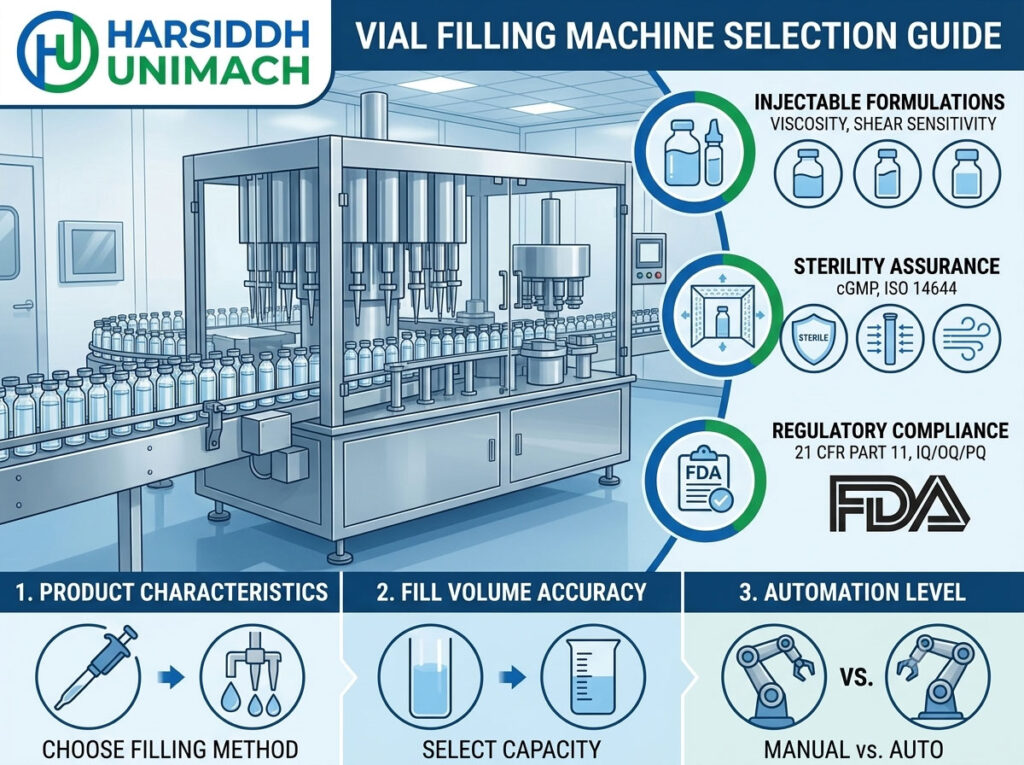
Choosing the wrong vial filling machine doesn’t just cost you money — it costs you batch rejections, contamination risk, and regulatory headaches that can shut down a production line for weeks. For injectable products, where fill accuracy and sterility are non-negotiable, the filling machine is arguably the single most important equipment decision a pharmaceutical manufacturer makes.
This guide walks through exactly how to evaluate and select a vial filling machine for injectable products — from filling technology and automation level to compliance requirements and total cost of ownership. If you’d like a broader look at the decision process first, see our related post on how to select the right filling machine for injectable manufacturing.
Why Vial Filling Machine Selection Matters for Injectables
Injectable drugs carry a higher risk profile than oral or topical products. A fill volume error, a contaminated stopper, or an inconsistent seal can mean a failed batch, a recall, or in the worst case, patient harm. Regulatory bodies like the US FDA, EU EMA, and India’s CDSCO hold injectable manufacturing to strict standards under cGMP guidelines, and much of that scrutiny centers on the filling process itself.
A well-chosen vial filling machine does three things simultaneously:
- Delivers consistent fill accuracy within tight tolerances, batch after batch
- Maintains sterility throughout the filling, stoppering, and sealing sequence
- Scales with your production volume without becoming a bottleneck or a compliance liability
Getting this decision right the first time avoids costly retrofits, revalidation cycles, and production downtime later.
Types of Vial Filling Machines
Before comparing specific machines, it helps to understand the broad categories available. Most injectable filling systems fall into one of these types.
1. Volumetric (Piston-Based) Filling Machines
Volumetric fillers use a piston-cylinder mechanism to draw and dispense a fixed volume of liquid. They’re highly accurate for low-to-medium viscosity liquids and are a common choice for standard injectable solutions.
Best for: Consistent-viscosity liquids, mid-to-high volume production, cost-sensitive setups
2. Peristaltic Pump Filling Machines
Peristaltic fillers push liquid through flexible tubing using rotating rollers, meaning the product never contacts the machine’s internal mechanical parts — only the disposable tubing does.
Best for: Sterile and biologic products, applications requiring minimal product contact and easy changeover between products
3. Time-Pressure Filling Systems
These systems fill by applying controlled air or gas pressure to a liquid reservoir for a precise duration. They’re gentler on shear-sensitive formulations like biologics and proteins.
Best for: Shear-sensitive biologics, viscous or foam-prone liquids
4. Rotary Vial Filling Machines
Rotary systems use a continuously rotating turntable to move vials through fill, stopper, and sometimes cap stations in one integrated motion — built for high-speed, high-volume output, and are often deployed as part of a complete injectable liquid vial filling line.
Best for: Large-scale manufacturers running high-volume injectable lines
Key Factors to Consider When Choosing a Vial Filling Machine
1. Product Characteristics
The physical and chemical properties of your injectable product should drive your first filtering decision. Consider:
- Viscosity: Thin solutions behave very differently under a piston filler than viscous suspensions or oil-based injectables
- Shear sensitivity: Biologics, vaccines, and protein-based formulations can denature under high mechanical stress, ruling out aggressive pumping mechanisms
- Foaming tendency: Some liquids foam easily during filling, which affects both fill accuracy and machine choice
- Particulates or suspensions: Products with suspended particles need filling mechanisms that won’t clog or separate the formulation
2. Fill Volume Range and Accuracy Requirements
Injectable products span a wide range of fill volumes — from under 1 mL for concentrated biologics to 50 mL or more for infusion-related products. Look for a machine that:
- Covers your full required volume range without needing a mechanical rebuild
- Holds accuracy within pharmacopeial tolerances (typically ±1-2% or tighter, depending on product and regulatory region)
- Maintains that accuracy consistently across long production runs, not just at startup
3. Sterility Assurance and Aseptic Design
For sterile injectables, the filling machine must support your aseptic processing strategy. Key considerations include:
- Isolator or RABS (Restricted Access Barrier System) compatibility for aseptic filling lines
- Clean-in-place (CIP) and sterilize-in-place (SIP) capability to reduce manual intervention and contamination risk
- Minimal product-contact parts, ideally single-use or easily autoclavable components
- Laminar airflow integration at the fill zone to maintain Grade A conditions during exposure
4. Automation Level
Vial filling machines range from semi-automatic benchtop units to fully automatic, integrated fill-finish lines. Your choice depends on production volume, labor cost considerations, and validation complexity:
- Semi-automatic machines: Suited to R&D, clinical trial batches, and low-volume production
- Fully automatic machines: Necessary for commercial-scale manufacturing, offering higher throughput and reduced human contact (a key contamination control factor)
- Integrated fill-finish lines: Combine filling, stoppering, capping, and sometimes inspection into a single continuous system — ideal for high-volume injectable manufacturers seeking to minimize manual transfer steps, similar to what you’ll find in a complete injectable liquid vial filling line
5. Format Flexibility
Many manufacturers run multiple products or vial sizes on the same line. Evaluate:
- Range of vial diameters and heights the machine can handle
- Changeover time between formats — quick tool-less changeovers reduce downtime significantly (for a deeper look at this, see vial filling machine changeover: best practices for faster product and format changes)
- Compatibility with different stopper and cap types (rubber stoppers, crimp caps, flip-off seals), which typically ties into your choice of capping machines
6. Regulatory Compliance and Validation Support
Your filling machine needs to support, not complicate, your regulatory submissions. Look for:
- Compliance with cGMP, 21 CFR Part 11 (for electronic records/signatures where applicable), and relevant regional pharmacopeial standards
- Comprehensive documentation packages: IQ/OQ/PQ (Installation, Operational, and Performance Qualification) protocols
- Data logging and traceability features that support batch record requirements
- A manufacturer with a track record of supporting audits and regulatory inspections
For a closer look at what to check before production begins, see vial filling machine validation: key parameters manufacturers should check before production.
7. Integration with Existing Line Equipment
A filling machine rarely operates in isolation. Confirm compatibility with:
- Upstream washing and depyrogenation tunnels
- Downstream capping, labeling, and inspection systems
- Your facility’s existing automation and SCADA/MES systems, if applicable
8. Total Cost of Ownership
Purchase price is only one part of the equation. Factor in:
- Changeover and format-part costs
- Maintenance requirements and spare parts availability
- Energy and utility consumption
- Validation and revalidation costs over the machine’s lifecycle
- Expected downtime during scheduled maintenance
Semi-Automatic vs. Fully Automatic: Which Should You Choose?
This is one of the most common decision points manufacturers face, so it’s worth addressing directly.
Choose semi-automatic if:
- You’re producing clinical trial batches or small commercial runs
- Your product portfolio changes frequently, requiring flexibility over raw speed
- Capital budget is a primary constraint
Choose fully automatic if:
- You’re scaling to commercial production volumes
- Labor cost and contamination risk from manual handling are significant concerns
- You need consistent, validated output for regulatory submissions at scale
Many manufacturers start with semi-automatic systems during early-stage production and transition to fully automatic lines as volume grows — a path worth planning for even at the initial purchase stage, since some machine platforms scale more easily than others.
Common Mistakes to Avoid When Selecting a Vial Filling Machine
- Choosing based on price alone — the cheapest machine often costs more over time through downtime, poor accuracy, or premature replacement.
- Ignoring future scalability — a machine that fits today’s volume but can’t scale forces an expensive re-purchase within a few years.
- Underestimating changeover complexity — if you run multiple products or vial sizes, slow changeovers quietly erode your effective capacity.
- Overlooking after-sales support — validation assistance, spare parts availability, and technical support matter as much as the machine’s specifications.
- Skipping a site trial or vendor demonstration — running your actual product on the machine before purchase reveals compatibility issues no spec sheet will show.
A Practical Selection Checklist
Before finalizing your decision, confirm the machine meets these criteria against your specific product and production needs:
- ✅ Matches your product’s viscosity and shear-sensitivity profile
- ✅ Covers your full fill volume range with the required accuracy
- ✅ Supports your aseptic processing method (isolator, RABS, or open clean room)
- ✅ Offers the automation level appropriate to your current and near-future volume
- ✅ Handles your full range of vial formats with reasonable changeover time
- ✅ Comes with complete IQ/OQ/PQ documentation and regulatory support
- ✅ Integrates with your existing upstream and downstream equipment
- ✅ Has a transparent total cost of ownership, not just an attractive sticker price
- ✅ Is backed by a manufacturer with proven after-sales support
Once your line is running, ongoing quality checks matter just as much as the initial purchase decision — see vial filling machine inspection points: what to monitor during pharmaceutical production for guidance.
Why Manufacturers Choose Harsiddh Unimach Pvt. Ltd.
At Harsiddh Unimach Pvt. Ltd., we design vial filling machines and complete filling systems engineered specifically for the demands of injectable pharmaceutical production. Our approach centers on three principles that matter most to manufacturers navigating this decision:
- Precision at scale — filling accuracy that holds steady across long production runs, not just in demo conditions
- Compliance-ready engineering — machines built with cGMP, documentation, and validation support in mind from day one
- Flexibility for growth — formats and automation levels that scale with your production needs, so today’s purchase doesn’t become tomorrow’s bottleneck
Whether you’re setting up a new injectable line or upgrading an existing one, our team can help you evaluate the right filling technology for your specific product and volume requirements.
Frequently Asked Questions
What is the most accurate type of vial filling machine for injectables? Volumetric piston-based fillers are generally considered the most accurate option for consistent-viscosity liquids, while peristaltic and time-pressure systems offer better accuracy for shear-sensitive or foam-prone biologics.
How do I know if I need a semi-automatic or fully automatic vial filling machine? The decision typically comes down to production volume and consistency needs. Semi-automatic machines suit clinical or low-volume batches, while fully automatic systems are built for commercial-scale, high-consistency output.
What certifications should a vial filling machine manufacturer provide? Look for cGMP compliance documentation, IQ/OQ/PQ protocols, and — where applicable — 21 CFR Part 11 compatibility for electronic batch records.
Can one vial filling machine handle multiple vial sizes? Most modern machines support a range of vial diameters and heights through adjustable format parts, though changeover time varies significantly between manufacturers — this is worth testing before purchase.
Final Thoughts
Selecting a vial filling machine for injectable products is a decision that ripples through your entire production and compliance strategy for years. The right choice balances product-specific technical requirements, current and future production volume, regulatory compliance, and total cost of ownership — not just the upfront price tag.
If you’re evaluating filling systems for your next injectable production line, Harsiddh Unimach Pvt. Ltd. can help you match the right technology to your product and scale.
Get in touch: 🌐 Website: www.harsiddhunimach.com 📧 Email: info@harsiddhunimach.com
Related machines & categories:
- Vial Filling Machines
- Injectable Liquid Vial Filling Line
- Washing Machine
- Capping Machines
- Inspection Machines
Related blog posts:
- How to Select the Right Filling Machine for Injectable Manufacturing
- Vial Filling Machine Changeover: Best Practices for Faster Product and Format Changes
- Vial Filling Machine Validation: Key Parameters Manufacturers Should Check Before Production
- Vial Filling Machine Inspection Points: What to Monitor During Pharmaceutical Production