
In the pharmaceutical manufacturing industry, few operations are as critical, complex, and highly scrutinized as the aseptic filling of injectable liquids. Because injectable drugs—whether they are traditional small-molecule formulations, sensitive biologics, or life-saving vaccines—bypass the human body’s natural defense mechanisms, the margin for error in their production is absolute zero.
A compromised batch does not just result in a loss of revenue; it triggers severe regulatory actions, damages brand reputation irreparably, and most importantly, endangers patient lives.
Selecting the right injectable liquid vial filling line is one of the most significant Capital Expenditure (CapEx) decisions a pharmaceutical plant manager or engineering director will make. You are not simply buying a machine; you are investing in a decades-long infrastructure that must remain compliant with ever-evolving Good Manufacturing Practice (GMP) regulations.
This comprehensive guide breaks down the critical technical, operational, and regulatory factors you must evaluate to choose the optimal vial filling line for your facility, ensuring maximum throughput, uncompromised sterility, and long-term profitability.
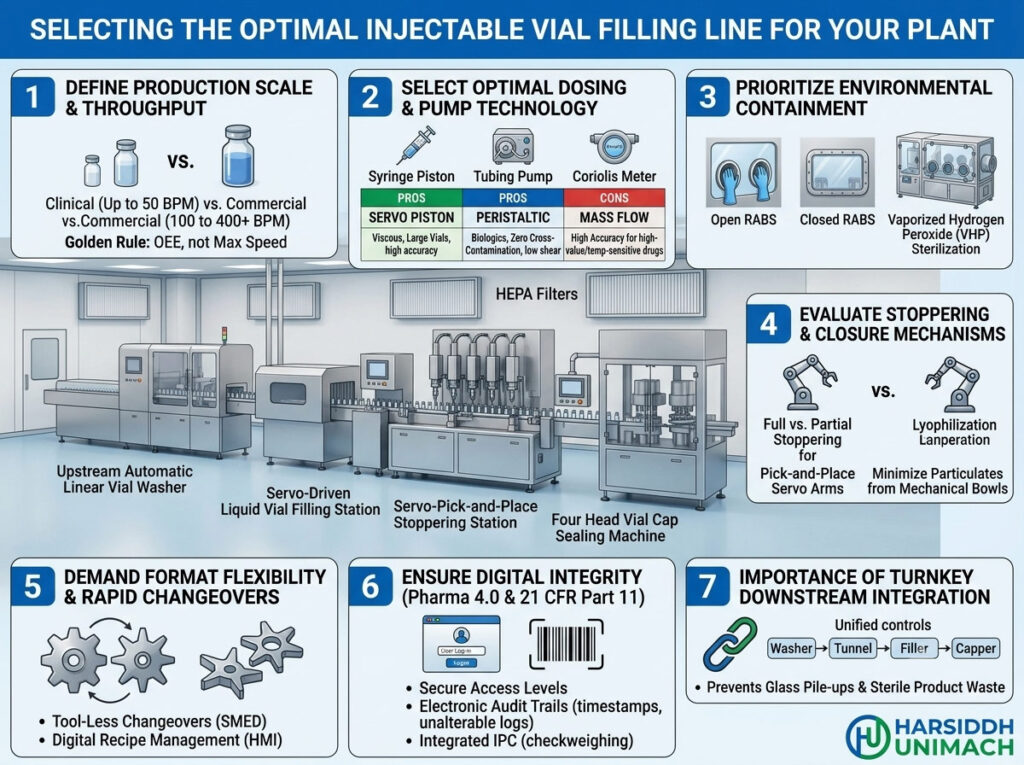
1. Define Your Production Scale and Throughput Strategy
The first step in equipment selection is a rigorous analysis of your current production demands and your projected growth over the next five to ten years. A machine built for clinical trials will cripple a commercial manufacturing facility, while an ultra-high-speed line is an unnecessary financial burden for a boutique contract development and manufacturing organization (CDMO).
Clinical vs. Commercial Scale
- Small Batch / Clinical Trials (Up to 50 Vials Per Minute): These lines prioritize flexibility and rapid changeovers over raw speed. They often utilize single-use fluid paths to prevent cross-contamination between different trial drugs and require a very small cleanroom footprint.
- Medium to High-Speed Commercial (100 to 400+ Vials Per Minute): These lines are built for continuous, multi-shift operations. They require robust automation, integrated automated CIP/SIP (Clean-In-Place/Sterilize-In-Place) capabilities, and sophisticated downstream synchronization to prevent bottlenecks.
The Golden Rule of Throughput: Always calculate your required speed based on Overall Equipment Effectiveness (OEE), not just the machine’s maximum mechanical speed. A machine rated for 300 BPM might only output 200 BPM if it suffers from frequent micro-stops or lengthy format changeovers.
2. Select the Optimal Dosing and Pumping Technology
The heart of the filling line is its dosing mechanism. The physical and chemical characteristics of your drug product (viscosity, shear sensitivity, foaming tendency, and value) dictate the type of pump you must use. There is no universal solution; you must match the technology to the formulation.
A. Servo-Driven Volumetric Piston Pumps
This is the industry workhorse for a vast array of pharmaceuticals. Driven by advanced closed-loop servo motors, stainless steel (SS 316L) or ceramic pistons draw and dispense liquid with extreme precision.
- Best For: Highly viscous products, oils, suspensions, and large-volume fills.
- Advantages: Exceptional volumetric accuracy (±0.1% to ±0.5%), highly durable, capable of multi-stage speed profiling (e.g., fast fill initially, slow finish to prevent foaming).
B. Peristaltic Pumps
In a peristaltic system, rollers squeeze a flexible silicone or thermoplastic tube, pushing the liquid forward. The drug product only ever touches the inside of the disposable tube, never the machine’s mechanical parts.
- Best For: Sensitive biologics, live vaccines, and multi-product CDMOs.
- Advantages: Zero risk of cross-contamination, eliminates the need for complex CIP/SIP validations (since the fluid path is simply discarded and replaced), and highly gentle on shear-sensitive protein structures.
C. Mass Flow / Coriolis Meters
This technology measures the actual mass of the fluid passing through a U-shaped tube rather than relying on volume.
- Best For: Products whose density changes with temperature fluctuations, or ultra-high-value products where absolute weight precision is mandated.
- Advantages: Extremely high accuracy, few moving parts, easy to clean.
| Dosing Technology | Primary Advantage | Best Application | Maintenance Level |
| Servo Piston | Unmatched repeatability, handles high viscosity | Syrups, suspensions, large vials | Medium (requires seal checks, CIP) |
| Peristaltic | Zero cross-contamination, disposable path | Biologics, clinical trials, toxic drugs | Low (tubing replacement) |
| Mass Flow | High accuracy regardless of fluid density | High-value, temperature-sensitive drugs | Low (no moving parts in fluid path) |
3. Prioritize Environmental Containment and Barrier Technology
Global regulatory bodies, led by the FDA and the EMA (particularly with the recent updates to EU GMP Annex 1), are aggressively pushing the industry away from open cleanrooms and towards strict physical separation between human operators and the exposed drug product.
Your filling line must be engineered to integrate seamlessly with advanced barrier technologies.
Open RABS (Restricted Access Barrier Systems)
The filling machine is enclosed in a rigid physical barrier with glove ports for operator intervention. HEPA-filtered air is pushed over the filling zone and exhausted directly into the surrounding cleanroom.
- Requirement: The surrounding room must still be a high-grade ISO 5 / Grade B environment.
Closed RABS (cRABS)
Similar to Open RABS, but the air is recirculated or exhausted through dedicated HVAC ducting, providing better protection for the operator when handling potent compounds.
Isolator Systems
The gold standard for modern aseptic processing. An isolator completely seals the filling line from the surrounding environment. It utilizes an automated Vaporized Hydrogen Peroxide (VHP) cycle to biologically decontaminate the interior before production begins.
- Requirement: Because the system is entirely closed, the surrounding room can often be downgraded to a Grade C or D environment, saving millions in cleanroom HVAC operating costs over the facility’s lifespan.
- Selection Criteria: If you choose an isolator, your filling machine must be constructed of materials (like premium SS 316L and specific VHP-resistant polymers) that can withstand constant exposure to corrosive hydrogen peroxide gas.
4. Evaluate the Stoppering and Closure Mechanisms
Filling the vial is only half the process; sealing the sterile environment is equally critical. The stoppering station must be flawless, as a misplaced or crushed rubber stopper will compromise the vial’s hermetic seal, leading to immediate batch rejection.
Key Stoppering Considerations:
- Full vs. Partial Stoppering: If your product requires lyophilization (freeze-drying), the filling line must be capable of inserting the stopper only halfway, leaving the side-vents open for moisture vapor to escape during sublimation. Once the freeze-drying cycle is complete, the stoppers are pressed fully into place inside the lyophilizer.
- Pick-and-Place vs. Vacuum: Modern high-speed machines utilize servo-driven pick-and-place arms that physically grip the stopper and seat it perfectly into the vial neck. This is far superior to older systems that rely on the vial “catching” the stopper as it passes underneath a chute.
- Particulate Management: The mechanical bowls that sort and feed the rubber stoppers must be designed to minimize friction, as rubber shedding introduces highly dangerous particulates into the aseptic core.
5. Demand Format Flexibility and Rapid Changeovers
In the era of personalized medicine and agile contract manufacturing, rigid, single-purpose filling lines are obsolete. You need a machine that can adapt to different vial sizes rapidly.
When evaluating a machine, scrutinize its format changeover process (often referred to as SMED – Single-Minute Exchange of Dies).
- Tool-Less Changeovers: Can an operator swap out the vial transport star-wheels, guide rails, and dosing nozzles using quick-release clamps and thumb-screws, or do they require Allen wrenches and screwdrivers? Tools introduced into an aseptic area are a contamination risk.
- Digital Recipe Management: Modern lines use PLC-driven HMI touchscreens. When an operator switches from a 5ml to a 50ml vial, they should simply select the “50ml Recipe” on the screen. The machine’s servo motors should automatically adjust the conveyor width, nozzle diving depth, and fill volume without manual mechanical tweaking.
6. Ensure Digital Integrity (Pharma 4.0 and 21 CFR Part 11)
A state-of-the-art mechanical design is useless if the machine’s software fails an FDA audit. Your filling line must function as an intelligent node within your facility’s broader SCADA or ERP network.
- 21 CFR Part 11 Compliance: The machine’s operating software must support multiple user access levels (Operator, Supervisor, Admin) protected by secure passwords or biometrics.
- Electronic Audit Trails: Every single action—whether an operator changes a fill volume, acknowledges a low-pressure alarm, or aborts a run—must be automatically logged with a secure timestamp and user ID. These records must be unalterable and easily exportable for QA review.
- Integrated IPC (In-Process Control): Look for machines that offer 100% or statistical IPC weighing. The machine automatically pauses, weighs the empty vial (tare), fills it, weighs it again (gross), and calculates the exact net dose. If the dose drifts out of tolerance, the PLC automatically adjusts the dosing pump in real-time, preventing out-of-spec rejects.
7. The Importance of Turnkey Downstream Integration
An injectable vial filling machine does not operate in a vacuum. It is sandwiched between the upstream Automatic Linear Vial Washer and Depyrogenation Tunnel, and the downstream Four Head Vial Cap Sealing Machine.
Purchasing these components from different vendors often results in a “Frankenstein” line. The software protocols clash, the conveyors don’t align perfectly, and when a vial jams in the transition zone, each vendor blames the other.
To maximize OEE and simplify validation, source a turnkey line from a single manufacturer. A unified line ensures that if the downstream capping machine detects a backup, it automatically signals the upstream filler to pause, preventing catastrophic glass pile-ups and wasted sterile product.
8. Manufacturer Validation, FAT, and After-Sales Support
Finally, you must evaluate the manufacturer as rigorously as the machine itself. The true cost of a filling line includes its installation, validation, and maintenance.
- Validation Documentation: The manufacturer must provide exhaustive IQ (Installation Qualification), OQ (Operational Qualification), and PQ (Performance Qualification) protocols to satisfy your regulatory auditors.
- Factory Acceptance Testing (FAT): Never take delivery of a machine until it has been fully tested with your actual vials, stoppers, and a placebo liquid at the manufacturer’s facility.
- Lifecycle Support: Ensure the manufacturer offers robust after-sales support, rapid spare parts availability, and comprehensive on-site training for your cleanroom operators.
Elevate Your Aseptic Processing with Harsiddh Unimach Pvt. Ltd.
Choosing the right injectable liquid vial filling line is a complex matrix of engineering, regulatory compliance, and operational strategy. You need more than an equipment vendor; you need a dedicated pharmaceutical engineering partner.
At Harsiddh Unimach Pvt. Ltd., operating out of our advanced manufacturing hub in Ahmedabad, we specialize in the design, fabrication, and validation of world-class pharmaceutical packaging machinery. We understand that your success is defined by uncompromised sterility, precision, and relentless efficiency.
The Harsiddh Unimach Advantage:
- Turnkey Aseptic Solutions: We engineer complete, synchronized lines—from high-speed automatic vial washing and depyrogenation to state-of-the-art servo-driven liquid filling, stoppering, and hermetic cap sealing.
- Custom-Engineered Precision: We build our filling lines to meet your exact specifications, integrating your choice of servo-piston or peristaltic dosing, and ensuring full compatibility with advanced RABS and Isolator technologies.
- Uncompromising Compliance: Constructed entirely with premium SS 316L contact parts, orbital-welded piping for zero dead-legs, and highly secure 21 CFR Part 11 compliant software, our machines are designed to breeze through stringent global audits.
Do not let outdated filling technology jeopardize your sterile products or throttle your facility’s growth. Invest in precision engineering that scales with your ambitions and safeguards your patients.
Discover the future of pharmaceutical packaging today. Explore our complete technical catalogs and machine specifications by visiting our official website at www.harsiddhunimach.com.
To request a detailed, custom quotation, discuss integration with your existing cleanroom architecture, or schedule a technical consultation with our engineering team, reach out to us directly at info@harsiddhunimach.com. Partner with Harsiddh Unimach—where precision engineering meets pharmaceutical perfection.