
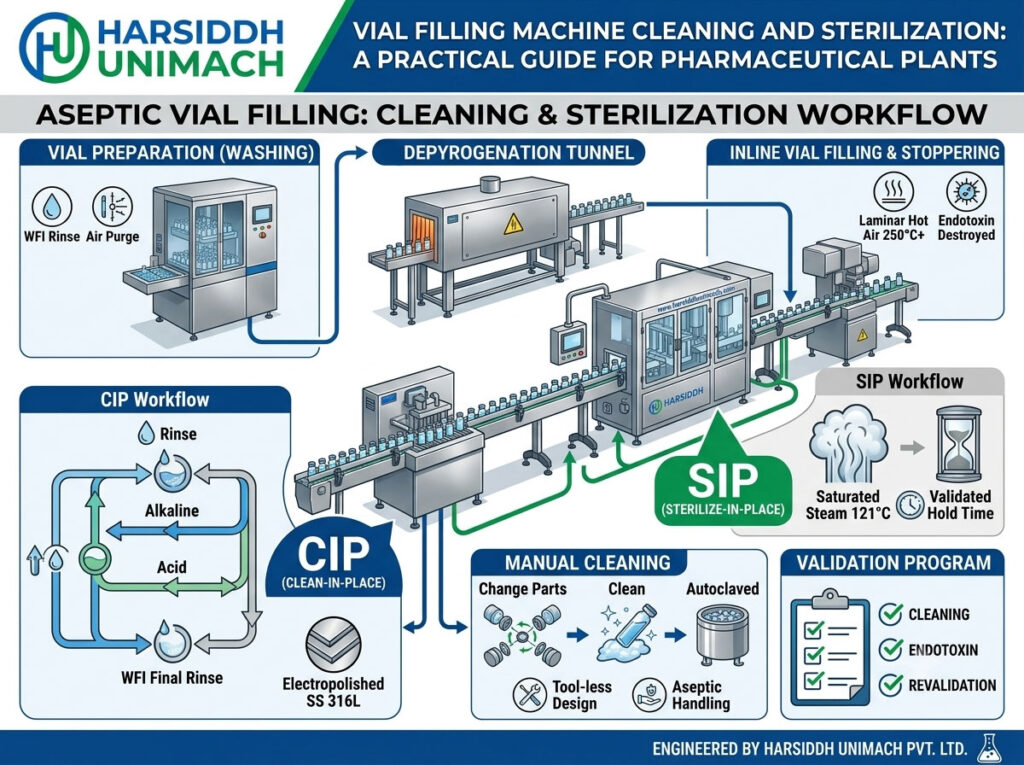
A vial filling machine handles sterile injectable products that will be injected directly into patients. Any residue from a previous product, any cleaning agent left behind, or any microorganism on a product-contact surface could end up in a vial. That is why cleaning and sterilisation are among the most important routine activities in an injectable plant.
They are also among the most time-consuming. Dismantling, cleaning, sterilising and reassembling product-contact parts can take a large share of changeover time. Doing it well, consistently and efficiently, is essential for both compliance and productivity.
This practical guide explains how to clean and sterilise a vial filling machine. It covers what needs cleaning, cleaning methods, a step-by-step sequence, sterilisation options, aseptic assembly, hold times, validation, documentation and the machine design features that make the job easier.
Cleaning agents, methods, parameters and acceptance criteria must be defined and validated by each manufacturer for its own products and equipment. This article describes general practice; your QA and validation teams should approve the specific procedures.
Why Cleaning and Sterilisation Matter
- Patient safety: prevents contamination with microorganisms, endotoxins, particles and residues.
- Cross-contamination control: removes residues of previous products, which is critical in multi-product plants.
- Product quality: prevents residues of cleaning agents from reacting with the product.
- Compliance: GMP requires cleaning and sterilisation to be validated, documented and performed according to written procedures.
- Efficiency: efficient procedures shorten changeovers and increase available production time.
What Needs Cleaning and Sterilising
Product-Contact Parts
Parts that touch the product directly carry the highest risk and usually require both cleaning and sterilisation:
- product tank or buffer vessel
- product tubing and hoses
- pumps (piston pumps or peristaltic tubing)
- manifolds and distribution blocks
- filling needles or nozzles
- filters and connectors in the product path
Parts in Contact With Sterile Components
Parts that touch stoppers or the inside of the critical zone also need attention:
- stopper bowl, track and placement heads
- vial-contact parts in the critical zone, such as star wheels and guides near open vials
Non-Contact Surfaces and Environment
Machine surfaces, frames and the surrounding area are cleaned and disinfected according to the cleanroom’s procedures to control the environment.
Cleaning Methods
Manual Cleaning (Cleaning Out of Place)
Product-contact parts are removed from the machine and cleaned in a washroom or parts washer. This is the most common approach for vial filling machine parts.
Advantages: thorough access to all surfaces; suitable for complex parts. Considerations: depends on operator technique, so procedures and training must be detailed; parts must be handled carefully to avoid damage.
Automated Parts Washers
Parts washers clean components in controlled cycles with defined temperatures, detergent concentrations and rinse sequences.
Advantages: consistent, repeatable cleaning; easier to validate than purely manual methods.
Clean-in-Place (CIP)
CIP circulates cleaning solutions through tanks and product lines without dismantling them. It suits larger fixed systems, such as product tanks and transfer lines.
Advantages: less handling, reduced labour, consistent cycles. Considerations: must be designed into the system and validated, including spray coverage and drainage.
A Typical Cleaning Sequence
The exact steps depend on the product and validated procedure, but a typical sequence is:
- End of batch: drain remaining product from the system.
- Dismantle: remove product-contact parts in a defined order, inspecting them for damage.
- Pre-rinse: rinse with water to remove most of the product residue.
- Detergent wash: wash with a suitable cleaning agent at the specified concentration, temperature and contact time.
- Rinse: rinse thoroughly to remove detergent.
- Final rinse: rinse with high-quality water, such as purified water or water for injection, as specified.
- Dry: dry parts as specified to prevent microbial growth.
- Inspect: visually inspect for cleanliness and damage.
- Wrap or load: wrap or place parts in containers for sterilisation.
- Record: document cleaning in the equipment log and batch records.
Clean the machine surfaces and surrounding area according to your cleanroom procedures at the same time.
Sterilisation Methods
Moist Heat Sterilisation (Autoclave)
The most common method for removable product-contact parts. Cleaned parts are wrapped or placed in suitable containers and sterilised with saturated steam under pressure in an autoclave, using a validated cycle.
Key points:
- load configuration must be validated so steam reaches all surfaces
- parts must be suitable for autoclave conditions
- wrapping must allow steam penetration and maintain sterility after the cycle
Steam-in-Place (SIP)
SIP sterilises fixed systems, such as tanks and product lines, with steam without dismantling them. It must be designed into the system with appropriate drainage and temperature monitoring.
Dry Heat Sterilisation and Depyrogenation
Dry heat is used for glass containers and some heat-resistant parts. Vials are depyrogenated in a sterilizing tunnel for ampoules and vials after washing on equipment such as an automatic rotary vial washing machine or a linear vial washer.
Gaseous Decontamination
Isolators and some barrier systems are decontaminated with gaseous agents, such as vaporised hydrogen peroxide, before use. This treats internal surfaces of the enclosure and the equipment inside. Our article on the rise of RABS and isolators in modern vial filling machines explains how barrier systems work.
Pre-Sterilised Single-Use Components
Some product paths use pre-sterilised, single-use tubing assemblies and connectors, removing the need to clean and sterilise those parts on site. They must still be qualified and handled aseptically.
Aseptic Assembly
After sterilisation, parts must be assembled onto the machine without contaminating them.
- Assemble parts in the protected critical zone under unidirectional airflow or within the barrier system.
- Follow a defined assembly sequence.
- Use sterile gloves and tools, and avoid touching product-contact surfaces.
- Minimise the time between unwrapping and assembly.
- Document assembly and any deviations.
Machine design has a big influence on aseptic assembly. Parts that are quick to connect, with few fittings and clear orientation, reduce handling and contamination risk.
Hold Times
Two hold times are typically defined and validated:
- Dirty hold time: the maximum time equipment can remain uncleaned after use before cleaning becomes less effective.
- Clean hold time: the maximum time cleaned (or sterilised) parts can be stored before use while remaining in an acceptable state.
Plan schedules so parts are used within their validated hold times.
Cleaning and Sterilisation Validation
Cleaning Validation
Cleaning validation shows that the cleaning procedure consistently removes product residues, cleaning agent residues and microbial contamination to acceptable levels. It typically involves:
- defining acceptance limits based on product and toxicological considerations
- selecting worst-case products and locations
- sampling, such as swabbing and rinse samples
- analytical testing
- repeating to show consistency
Sterilisation Validation
Sterilisation validation shows that sterilisation cycles reliably achieve the required sterility assurance. It typically includes:
- temperature mapping of loads or systems
- biological indicators to confirm lethality
- defined load patterns
- periodic requalification
Validation of the filling machine itself is covered in our article on vial filling machine validation and key parameters to check before production.
Documentation
Typical records include:
- cleaning logs for each piece of equipment
- sterilisation cycle records and load lists
- assembly records
- hold time tracking
- deviation records for any problems
- training records for staff performing cleaning
Machine Design Features That Help
Cleaning and sterilisation are much easier when the machine is designed for them. Look for:
| Feature | Benefit |
|---|---|
| Quick-release product-contact parts | Faster dismantling and assembly |
| Few, simple parts in the product path | Less to clean, inspect and assemble |
| Smooth, polished product-contact surfaces | Easier cleaning, less residue |
| Fully draining design | No product pooling |
| Autoclavable materials | Parts can be steam-sterilised |
| Sanitary connections | Quick, cleanable joints |
| Separation of mechanics from the product zone | Less contamination risk |
| Peristaltic option with disposable tubing | No pump cleaning for product changes |
| Spare product path sets | Offline cleaning, shorter changeovers |
For the GMP design principles behind these features, see our article on the importance of GMP compliance in pharmaceutical machinery.
Machines such as a six head liquid vial filling and stoppering machine or a liquid vial filling machine with rubber stoppering should be evaluated for cleanability before purchase. For product paths that avoid pump cleaning, consider peristaltic designs such as an automatic peristaltic based liquid filling machine.
Cleaning Across the Vial Line
Cleaning and sterilisation apply to every machine in the line, not just the filler:
- Washers and tunnels: cleaned according to their procedures; the tunnel’s HEPA filters and airflow are maintained and monitored.
- Powder fillers: such as an injectable dry powder vial filling and rubber stoppering machine, need dry cleaning methods appropriate for powders, with dosing parts removed and cleaned.
- Cap sealers: such as a vial cap sealing machine with 1, 4, 6 or 8 heads, are cleaned to prevent aluminium particles and dust.
- External washers: an automatic external vial washing machine is cleaned to prevent residue build-up.
- Integrated lines: an automatic liquid vial filling line is cleaned section by section according to a coordinated procedure.
Ampoule lines follow similar principles, with washers such as a rotary ampoule washing machine and fillers such as a four head ampoule filling and sealing machine.
Cleaning, Sterilisation and Changeovers
On multi-product lines, cleaning and sterilisation drive changeover time. Ways to reduce the impact include:
- keeping a second, sterilised set of product-contact parts ready
- using disposable product paths where suitable
- campaign planning to group similar products
- standardising and simplifying assembly
Our article on vial filling machine changeover best practices covers this in more detail, and our article on GMP compliance in filling lines explains the wider GMP context.
Planning the Cleaning and Sterilisation Schedule
Cleaning and sterilisation involve several departments: production, the washroom, the autoclave area and QA. Good planning keeps the line from waiting.
- Schedule autoclave cycles so sterilised parts are ready when the changeover starts, within their clean hold time.
- Allocate washroom capacity for peak changeover periods.
- Track parts with labels or tags showing their status: dirty, cleaned, sterilised, expiry of hold time.
- Coordinate with QA for release of cleaning and sterilisation records.
- Review bottlenecks regularly; often the autoclave or washroom, not the filler, limits changeover speed.
Engineering approaches such as quick-release fittings, spare part sets and disposable product paths are explained further in our article on liquid filling machine changeover time and engineering methods.
Common Mistakes to Avoid
- Cleaning procedures that are too vague for consistent results
- Exceeding dirty or clean hold times
- Damaging parts during cleaning or handling
- Incomplete drying before sterilisation or storage
- Poor wrapping that compromises sterility after autoclaving
- Touching product-contact surfaces during assembly
- Changing cleaning agents or methods without change control
- Inadequate training of cleaning staff
Frequently Asked Questions
How often should a vial filling machine be cleaned? At least between batches and products, and as defined by your validated procedures and campaign lengths.
Which parts need sterilisation? Typically all product-contact parts and parts in contact with sterile components in the critical zone. Your risk assessment and procedures define the full list.
Is CIP suitable for vial filling machines? CIP suits fixed systems such as tanks and product lines. Removable parts such as pumps and needles are usually cleaned out of place.
What is a clean hold time? The validated maximum time cleaned or sterilised parts can be stored before use.
Can disposable tubing replace cleaning? Pre-sterilised single-use paths remove the need to clean those parts, but they must be qualified and handled aseptically.
Choose Easy-to-Clean Equipment From Harsiddh
Harsiddh Unimach designs vial washers, sterilising tunnels, filling and stoppering machines, cap sealers and complete vial lines with cleaning and sterilisation in mind: quick-release product-contact parts, smooth surfaces and designs that separate mechanics from the product zone. Our team can help you choose equipment that supports efficient, compliant cleaning.
Contact us through our contact page or send your requirements through our inquiry form.