
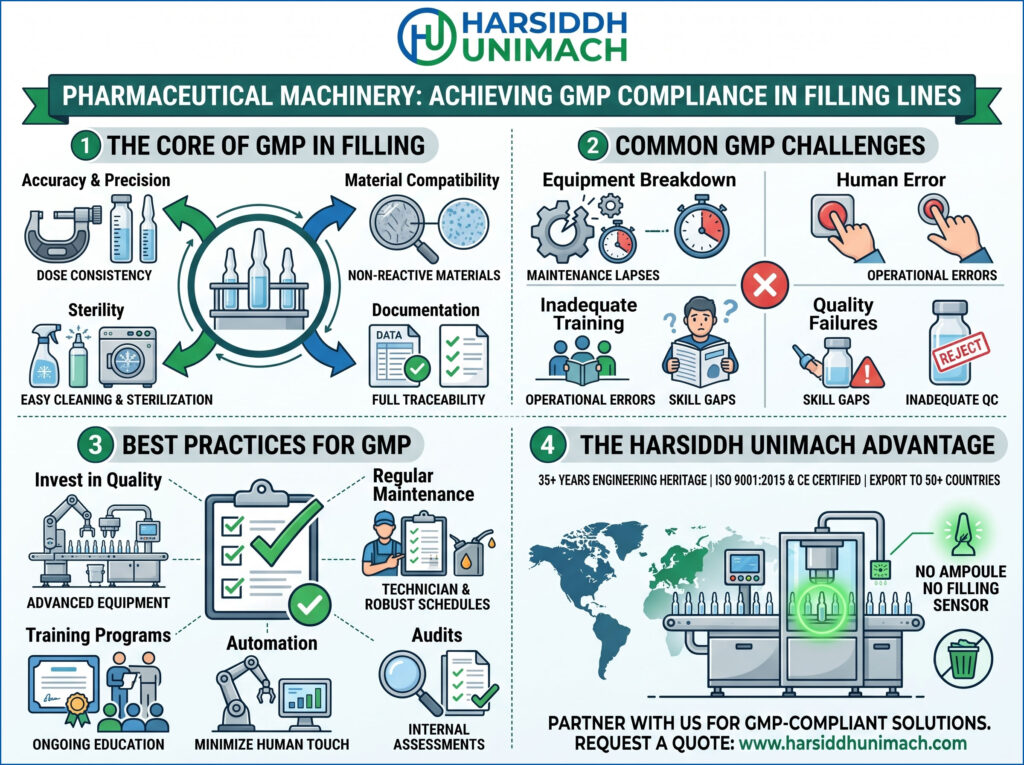
Of all the steps in pharmaceutical manufacturing, filling is one of the most sensitive. It is the moment when the finished product leaves the controlled environment of a tank or hopper and enters the container the patient will use. Any mistake at this point, whether a wrong dose, a contaminated container or a mix-up between products, goes straight into the pack.
That is why Good Manufacturing Practice (GMP) pays such close attention to filling lines. GMP is the set of principles and rules that ensure medicines are consistently produced and controlled to the quality standards appropriate for their intended use. For filling lines, GMP shapes how machines are designed, how they are cleaned, how batches are changed, how the environment is controlled, how people work and how everything is recorded.
This article explains why GMP compliance is so important in filling lines, what the main GMP risks at the filling step are and how each GMP principle applies in practice. For a general look at GMP in machine design, see our article on the importance of GMP compliance in pharmaceutical machinery.
GMP requirements differ between regulators and product types, and they are updated over time. Treat this article as a general overview and confirm specific requirements with your quality assurance and regulatory teams.
Why the Filling Step Carries Special GMP Risk
Several features make filling a high-risk step:
- The product is exposed. During filling, the product is often open to the surrounding air, even if only briefly. Particles or microorganisms can enter.
- The dose is set here. The quantity in each container is determined at the filler. If it is wrong, the patient receives the wrong dose.
- Many products share equipment. Filling lines are often used for several products, creating a risk of cross-contamination and mix-ups.
- Speed magnifies errors. A fast line can produce thousands of faulty units before a problem is noticed.
- Correction is difficult. Once a container is filled and sealed, problems such as contamination usually cannot be corrected. The product must be rejected.
GMP compliance in filling lines is about controlling these risks so that every container is right first time.
The Main GMP Risks at the Filling Step
| GMP Risk | What Can Go Wrong | Typical Controls |
|---|---|---|
| Incorrect dose | Underfill or overfill | Accurate dosing, in-process checks, calibrated balances |
| Microbial contamination | Microorganisms enter product or container | Controlled environment, sterilised parts, aseptic technique (for sterile products) |
| Particulate contamination | Glass, rubber, metal or fibre particles | Clean containers, hygienic machine design, inspection |
| Cross-contamination | Residue from a previous product | Validated cleaning, dedicated or disposable parts |
| Mix-ups | Wrong product, container or component used | Line clearance, labelled materials, segregation |
| Container closure failure | Leaks, loose stoppers or caps | Correct stoppering and sealing, closure checks |
| Data errors | Incomplete or inaccurate batch records | Clear documentation, data integrity controls |
The sections below show how GMP principles address each of these risks.
GMP Principle 1: Equipment Designed for Its Purpose
GMP requires equipment to be designed, located and maintained to suit the operations carried out. For filling machines, this means:
Suitable Materials
Product-contact parts must not react with, add to or absorb from the product. Stainless steel grades suitable for pharmaceutical use are standard for metal parts, with approved polymers and elastomers for seals, tubing and gaskets. Material certificates should be available for qualification.
Hygienic Design
- Smooth surfaces with a suitable finish on product-contact parts
- No dead legs, crevices or pockets where product can stagnate
- Parts that drain fully
- Lubricants kept away from the product, or food-grade lubricants where contact is possible
- Open designs that allow cleaning and inspection
Accurate, Repeatable Dosing
The filling system must deliver the labelled quantity consistently. The right technology depends on the product. Thin liquids may use a gravity based liquid filling machine, while a peristaltic based liquid filling machine keeps the product inside disposable tubing, which is useful where cross-contamination risk is high. Sterile injectables in vials are filled on machines such as an automatic injectable liquid vial filling and stoppering machine.
Built-In Error Prevention
- No-container, no-fill and no-container, no-stopper functions
- Detection and rejection of missing stoppers or caps where specified
- Recipes and access levels to prevent unauthorised changes to critical settings
GMP Principle 2: Qualified and Validated Equipment
GMP requires that equipment be qualified before use. Qualification provides documented evidence that the filling line is installed correctly, operates as intended and performs consistently.
- Design Qualification (DQ): confirms the design meets your User Requirement Specification.
- Installation Qualification (IQ): confirms correct installation, utilities, materials and documentation.
- Operational Qualification (OQ): confirms the machine works across its operating range, including alarms and interlocks.
- Performance Qualification (PQ): confirms consistent performance with the real product, containers and conditions.
For filling machines, fill accuracy, stopper or cap placement, speed and reject function are typical parameters tested. Our article on vial filling machine validation and key parameters to check before production covers this in more detail.
Once qualified, the line must stay in a qualified state through change control, maintenance, calibration and periodic review.
GMP Principle 3: Clean Equipment and Validated Cleaning
Cleaning is central to GMP in filling lines, because residue from one product can contaminate the next.
What GMP Expects
- Written cleaning procedures for each machine and part
- Cleaning methods that are shown, through cleaning validation, to remove product residue, cleaning agent residue and microbial contamination to acceptable levels
- Records of each cleaning, including who performed it and when
- Defined hold times: how long equipment can stay dirty before cleaning, and how long clean equipment can be held before use
How Machine Design Helps
- Quick-release product-contact parts make thorough cleaning easier.
- Disposable product paths, such as peristaltic tubing, can remove the need to clean and validate cleaning of the pump itself.
- Fully draining designs prevent product from remaining in the system.
- Clean-in-place or sterilise-in-place features on some systems allow cleaning without dismantling, where suitable for the application.
For sterile products, product-contact parts are usually also sterilised before use, and the sterilisation process must be validated.
GMP Principle 4: Line Clearance to Prevent Mix-Ups
Mix-ups are among the most serious GMP failures, because they can put the wrong medicine in a patient’s hands. Line clearance is the GMP control that prevents them.
Before a new batch starts, line clearance confirms that:
- all product, containers, closures, labels and documents from the previous batch have been removed
- the line has been cleaned as required
- the correct materials and documents for the new batch are present
- the machine is set up correctly for the new product and format
Line clearance is usually checked by a second person and recorded. Filling machines that are easy to see into and have few places where containers, stoppers or caps can lodge make line clearance faster and more reliable.
GMP Principle 5: A Controlled Environment
GMP requires that filling takes place in an environment appropriate to the product.
Sterile Products
Sterile injectables require the highest level of environmental control. The critical filling zone is protected, often with unidirectional (laminar) airflow, restricted access barrier systems or isolators. Containers are washed and depyrogenated before entering the filling zone, for example using a rotary vial washing machine and a sterilizing tunnel for ampoules and vials. Environmental monitoring confirms the area stays within its limits.
Integrated lines such as an automatic liquid vial filling line reduce handling between steps. For sterile powders, an injectable dry powder vial filling and rubber stoppering machine fills and closes vials in one machine. Ampoules are filled and flame-sealed on machines such as an automatic four head ampoule filling and sealing machine or a four head ampoule filling and sealing machine.
Our cGMP compliance guide for sterile vial filling machinery explains sterile filling requirements in more depth.
Non-Sterile Products
Oral liquids, creams, ointments and eye drops still require a clean, controlled environment, although the level of control differs. Eye drops are usually sterile products in their own right, filled on dedicated equipment such as an automatic eye and ear drop filling machine or an automatic eye and ear drop filling line. Creams and ointments are filled on machines such as an automatic lami tube filling machine or other cream and ointment filling machines, where hygiene and protection from contamination remain essential.
GMP Principle 6: Trained and Qualified People
People are a major source of both contamination and error. GMP requires that everyone working on a filling line is trained for their role.
- Operators must know how to set up, run, clean and clear the line, and how to perform in-process checks.
- Maintenance staff must understand GMP impacts of their work, such as using approved parts and lubricants and recording all work.
- In sterile areas, staff must be trained and qualified in gowning and aseptic technique.
- Training records must show that each person is trained and competent before working independently.
Well-designed machines help by reducing the need for manual interventions, especially in the critical zone of sterile lines.
GMP Principle 7: In-Process Controls
GMP requires checks during production to confirm the process is under control. Typical in-process controls on filling lines include:
- fill weight or volume checks at defined intervals
- stopper and cap placement checks
- seal integrity checks where applicable
- visual checks for defects and particles
- environmental monitoring in controlled areas
Results must be recorded, and out-of-limit results must trigger defined actions, such as adjusting the machine, isolating affected product and informing QA.
GMP Principle 8: Complete, Accurate Documentation
GMP is often summarised as “if it is not written down, it did not happen”. For filling lines, key documents include:
| Document | GMP Purpose |
|---|---|
| Batch manufacturing and packaging records | Record of how each batch was filled |
| SOPs | Instructions for operation, cleaning, line clearance and maintenance |
| Equipment logbooks | History of use, cleaning and maintenance |
| Qualification reports | Evidence the equipment is fit for use |
| Calibration records | Confidence in measurements |
| Deviation and CAPA records | Investigation and correction of problems |
| Training records | Evidence staff are competent |
Records must be accurate, complete, legible and made at the time of the activity. Where electronic systems are used, data integrity controls such as user access and audit trails apply, as defined by your quality system.
GMP Principle 9: Managing Deviations and Change
Even well-run filling lines have problems. GMP requires that deviations be recorded, investigated and corrected, with preventive actions to stop them recurring. Changes to equipment, parts, software, materials or processes must go through change control, with their impact on quality assessed before implementation.
Our article on strategies for ensuring compliance and efficiency in pharmaceutical filling lines explains how good deviation and change management also improves line performance.
Why GMP Compliance Matters for Your Business
GMP compliance in filling lines is first about patient safety, but it also has clear business benefits:
- Market access: regulators and customers require GMP compliance before products can be sold.
- Fewer recalls: controlled filling reduces the risk of costly recalls.
- Lower waste: right-first-time filling means fewer rejects and less rework.
- Smoother inspections: well-documented, well-controlled lines are easier to inspect.
- Customer confidence: contract manufacturers in particular depend on a strong GMP record to win and keep clients.
For a wider view of compliance across the packaging line, including capping, sealing and labelling, see our article on the importance of compliance in pharmaceutical packaging machinery.
Filling Line GMP Checklist
Use this checklist to review your filling line:
- Are product-contact materials suitable and certified?
- Is the machine hygienically designed and easy to clean?
- Is fill accuracy suitable for the product and regularly checked?
- Is the line qualified, and kept qualified through change control and maintenance?
- Are cleaning procedures written and validated?
- Is line clearance performed, checked and recorded for every batch?
- Is the filling environment appropriate and monitored?
- Are operators and maintenance staff trained, with records?
- Are in-process controls defined, performed and recorded?
- Are batch records complete and accurate?
- Are deviations investigated and corrected?
- Are instruments calibrated?
Common GMP Gaps in Filling Lines
- Cleaning procedures that have not been validated for all products
- Line clearance performed in a hurry or without a second check
- Machine settings changed without change control
- Worn parts left in service, causing fill drift or particles
- Incomplete or late batch record entries
- Too many manual interventions in sterile filling zones
- Training records that do not match the tasks people actually perform
Frequently Asked Questions
Is a filling machine “GMP compliant” when it is delivered? A machine can be designed to support GMP, but compliance also depends on how it is installed, qualified, operated, cleaned and maintained at your site.
What is the difference between GMP and cGMP? cGMP stands for “current” Good Manufacturing Practice, emphasising that manufacturers must keep up with current expectations and technology. In practice, both terms refer to the same principles.
Do non-sterile filling lines need GMP compliance? Yes. GMP applies to all pharmaceutical manufacturing, although the specific controls differ between sterile and non-sterile products.
How often should cleaning be revalidated? This depends on your quality system and any changes to products, equipment or cleaning methods. Your QA team defines the approach.
Can disposable parts reduce GMP effort? Disposable product paths can reduce cleaning and cleaning validation work, but they must still be qualified and controlled.
Build a GMP-Ready Filling Line With Harsiddh
Harsiddh Unimach designs and manufactures filling machines for injectables, oral liquids, eye drops, creams, powders and more, with hygienic construction, accurate dosing and documentation to support your qualification. Our team can help you choose the right filling technology and line configuration for your products and GMP requirements.
Reach us through our contact page or share your requirements through our inquiry form.