
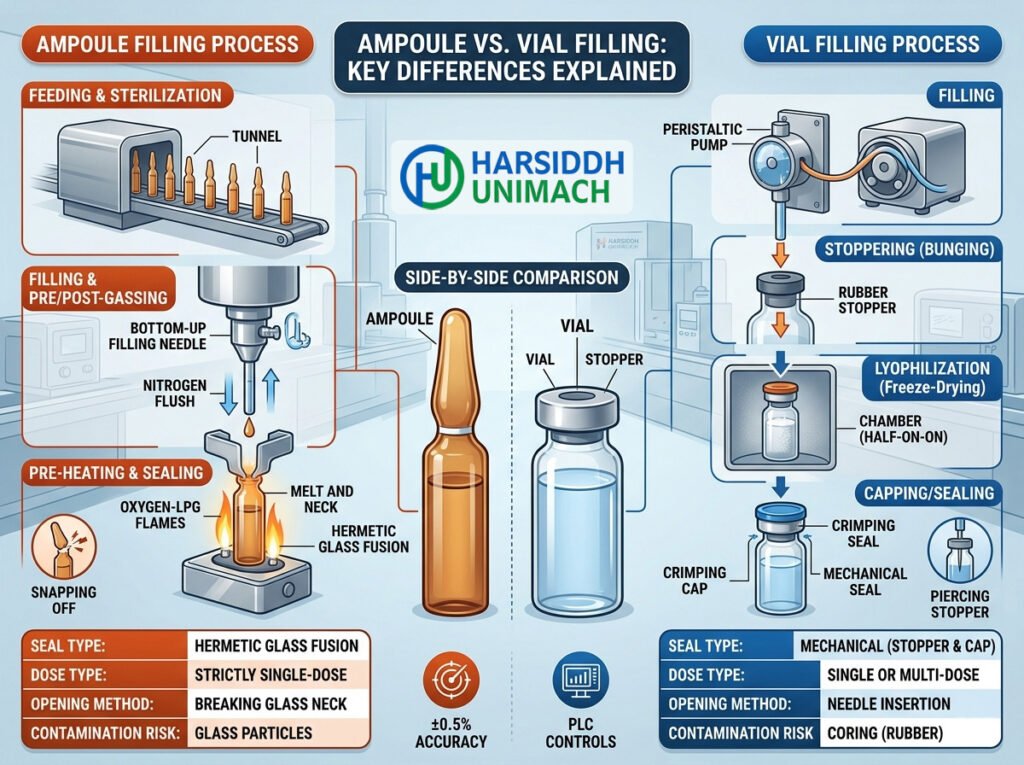
When a pharmaceutical company develops a new injectable product, one of the earliest packaging decisions is also one of the most important: should it be filled into ampoules or vials? Both are glass containers for sterile liquids, both are filled on specialised machines, and both are trusted worldwide. Yet they differ in almost every practical respect — how they are closed, how they are filled, which products they suit, how patients and healthcare workers use them, and what equipment a manufacturer needs to produce them.
Choosing the wrong format can mean higher costs, stability problems, regulatory challenges or a production line that cannot grow with the business. In this guide, we compare ampoule and vial filling side by side and explain how to decide which is right for your product and your plant.
What Is an Ampoule?
An ampoule is a small, all-glass container that is sealed by melting its own neck with a flame after filling. There is no stopper or cap — the glass itself forms the closure. To use the drug, the healthcare worker snaps off the neck at a pre-scored point and draws the contents into a syringe. Once opened, the ampoule cannot be resealed, so it is always a single-dose container.
Typical ampoule sizes range from 1 ml to 20 ml. They are widely used for vitamins, analgesics, anaesthetics, emergency drugs and many generic injectables. For a full explanation of how ampoules are filled and sealed, read what is an ampoule filling machine and how does it work.
What Is a Vial?
A vial is a glass (or sometimes plastic) container closed with a rubber stopper and secured with an aluminium crimp seal, often with a plastic flip-off cap. To use the drug, the healthcare worker removes the flip-off cap and pierces the stopper with a needle. Because the stopper reseals after puncture, vials can be single-dose or multi-dose.
Vials range from 2 ml to 100 ml or more and can hold liquids, sterile powders and freeze-dried (lyophilised) products. They are the preferred format for biologics, vaccines, antibiotics and most high-value injectables.
Ampoule vs Vial: Key Differences at a Glance
| Factor | Ampoule | Vial |
|---|---|---|
| Closure | Glass sealed by flame | Rubber stopper + aluminium crimp seal |
| Dose type | Single-dose only | Single-dose or multi-dose |
| Product forms | Liquids only | Liquids, sterile powders, lyophilised products |
| Typical volume | 1–20 ml | 2–100 ml and above |
| Contact materials | Glass only | Glass and elastomer (stopper) |
| Opening | Snap the neck | Pierce the stopper with a needle |
| Glass particle risk on opening | Possible | Very low |
| Packaging component cost | Lower | Higher (stopper + seal + cap) |
| Filling line complexity | Fewer stations | More stations (stoppering, capping) |
| Suitability for biologics and vaccines | Limited | Excellent |
The Differences in Detail
1. Container closure and product contact
The biggest advantage of the ampoule is that the drug touches nothing but glass. There is no rubber stopper that could release extractables or leachables into the formulation, and no closure that could loosen during storage. For simple, stable formulations that are sensitive to interaction with elastomers, this is a real benefit.
Vials, by contrast, depend on the stopper and crimp seal for container closure integrity. Modern coated stoppers and controlled crimping deliver excellent integrity, but the stopper material must be carefully selected and validated for compatibility with the product.
2. Single-dose vs multi-dose use
Ampoules are strictly single-use. Vials can be designed for single-dose or multi-dose use, which makes them suitable for products given in variable amounts, for hospital use and for formats where several doses are drawn from one container — such as many vaccines.
3. Product types
Ampoules are used for liquids only. Vials can also hold sterile dry powders and lyophilised products that are reconstituted before use. This flexibility is one reason vials dominate in antibiotics, biologics and newer therapies.
4. Safety and convenience in use
When an ampoule is snapped open, tiny glass particles can occasionally fall into the solution, which is why filter needles are often recommended when drawing up from ampoules. Opening also carries a small risk of cuts to the user. Vials avoid these issues: the needle passes through a clean rubber stopper, and the container can be handled safely.
5. Packaging cost
An ampoule needs no separate closure components, so packaging material costs per unit are generally lower. Vials require stoppers, aluminium seals and flip-off caps, each of which adds cost and must be purchased, stored, sterilised and controlled.
6. Filling line design and speed
Ampoule lines are relatively compact: washing, sterilising, filling and flame-sealing. Vial lines need extra stations for stopper insertion and crimp capping, and often for lyophilisation. High-speed equipment is available for both formats, but the number of machines, the floor area and the validation scope are usually greater for vials.
7. Market expectations
Ampoules remain very popular in many domestic and emerging markets for cost-effective generics. Vials are often preferred in regulated markets and for premium, biological or multi-dose products. Many manufacturers therefore produce both formats.
How Ampoule Filling Works
An ampoule filling line follows this sequence:
- Washing – ampoules are cleaned inside and out with purified water, WFI and compressed air.
- Sterilisation and depyrogenation – ampoules pass through a hot-air tunnel.
- Pre-gassing – nitrogen displaces air inside the ampoule for oxygen-sensitive products.
- Filling – needles dive into the ampoule neck and dispense the dose.
- Post-gassing – nitrogen protects the headspace.
- Sealing – the neck is heated by gas-oxygen burners and sealed, usually by pull sealing for pharmaceutical products.
- Inspection and labelling – sealed ampoules are checked for leaks, particles and fill level, then labelled.
Ampoule filling and sealing machines are available from single-head to eight-head designs. Examples include the Automatic Six Head Ampoule Filling & Sealing Machine and the eight head ampoule filling and sealing machine. You can also explore our ampoule filling machines for open ampoules and our ampoule washing machine range.
How Vial Filling Works
A liquid vial filling line follows this sequence:
- Washing – vials are cleaned with water and air jets, for example on a linear vial washing machine.
- Sterilisation and depyrogenation – vials pass through a hot-air tunnel.
- Filling – nozzles dispense an accurate dose, often with nitrogen purging.
- Stoppering – rubber stoppers are fed, oriented and inserted, either fully or partially (for lyophilisation).
- Lyophilisation (if required) – partially stoppered vials are freeze-dried, then fully stoppered inside the freeze dryer.
- Capping – aluminium seals are crimped over the stopper.
- Inspection and labelling – vials are checked and labelled.
Our article on understanding the complete vial filling and stoppering process explains each step in detail. Typical equipment includes the Four Head Liquid Vial Filling & Stoppering Machine, the liquid vial filling machine with rubber stoppering, the Automatic Four Head Vial Cap Sealing Machine and our 1, 4, 6 and 8 head vial cap sealing machines.
For sterile powders, vials are filled on dedicated equipment such as our injectable powder filling machines — something that is simply not possible with ampoules.
To learn more about the vial equipment options available, read types of vial filling machines used in pharmaceutical manufacturing.
Engineering Differences Between Ampoule and Vial Filling Machines
Although both machine types dose liquid into glass containers, the engineering challenges are different.
Ampoule machines must fill through a narrow neck without wetting it, because any liquid on the neck can char during sealing and cause weak or leaking seals. Precise needle positioning, controlled fill speed and drip-free dosing are essential. The sealing station is the heart of the machine: burner design, gas mixture control, ampoule rotation and pull-sealing timing all decide seal quality.
Vial machines have wider openings, which makes filling easier and faster, but they must handle closure components reliably. Stopper feeding, orientation and insertion must be consistent, and the capping station must apply the right crimping force — too little risks leaks, too much can crack the vial neck. Vial machines also need more change parts to handle different vial diameters, stopper sizes and seal types.
Common requirements for both include accurate dosing, nitrogen purging for oxygen-sensitive products, no-container-no-fill sensing, GMP-compliant SS 316L contact parts, and full documentation for IQ, OQ and PQ.
Quality Control: What Changes Between Formats
Quality checks also differ. For ampoules, the most important test after filling is leak testing, because a fine capillary in a poorly formed seal may not be visible to the eye. Dye ingress and vacuum-based leak tests are commonly used, alongside visual inspection for particles, fill level and seal shape — especially burnt tips, bulbs and uneven closures.
For vials, the focus shifts to container closure integrity at the stopper and crimp. Inspectors check for missing or raised stoppers, loose or wrinkled seals and correct crimp formation, in addition to particles and fill level. For lyophilised vials, cake appearance is checked too.
In both cases, the earlier a defect is detected, the less product and packaging is wasted, so inline checks such as no-stopper detection on vial lines and seal monitoring on ampoule lines add real value.
How to Choose Between Ampoule and Vial Filling
Ask these questions when deciding:
- What is the product form? Powders and lyophilised products need vials. Liquids can go in either.
- Is it single-dose or multi-dose? Multi-dose products need vials.
- How sensitive is the formulation? If it reacts with elastomers, an all-glass ampoule may be better. If it is a biologic or vaccine, vials are usually the standard.
- What is the fill volume? Small doses of 1–10 ml suit ampoules well; larger volumes are generally filled into vials.
- Which markets are you supplying? Check customer and regulatory expectations for your target markets.
- What is your cost target? Ampoules generally have lower packaging costs; vials offer more flexibility and often command a higher value.
- What is your growth plan? If you expect to add powders, biologics or multi-dose products later, investing in vial capability early may pay off.
Our guide on how to select the right filling machine for injectable manufacturing provides a broader framework for equipment selection.
Can One Plant Handle Both Formats?
Yes, and many do. Some washing machines and sterilising tunnels can handle both ampoules and vials with suitable change parts, but filling and closing equipment is usually format-specific. Many manufacturers run separate dedicated lines — one injectable ampoule filling line and one injectable liquid vial filling line — to keep changeovers simple and validation clear. For the full range of vial equipment, see our vial filling machines for liquid vials.
How Harsiddh Unimach Can Help
Harsiddh Unimach Pvt. Ltd. manufactures complete solutions for both formats — ampoule washing, filling and sealing machines, as well as vial washing, filling, stoppering, capping, inspection and labelling equipment. Whether you are launching your first injectable product or adding a second format to an existing plant, our engineers can help you select the right machines for your products, volumes and markets. Learn more about Harsiddh Engineering.
Frequently Asked Questions
What is the main difference between an ampoule and a vial? An ampoule is an all-glass container sealed by melting its neck and is always single-use. A vial is closed with a rubber stopper and aluminium seal, can be single- or multi-dose, and can hold liquids, powders or lyophilised products.
Which is better: ampoule or vial? Neither is better in every case. Ampoules suit simple, single-dose liquid products where low packaging cost and all-glass contact matter. Vials suit multi-dose products, powders, biologics and vaccines.
Can powders be filled into ampoules? No. Sterile powders and lyophilised products are filled into vials, which can be stoppered and later reconstituted.
Are ampoule filling machines cheaper than vial filling machines? A complete ampoule line generally needs fewer stations because it has no stoppering or capping, which can reduce investment. Final cost depends on speed, automation level and line configuration.
Why do ampoules need nitrogen flushing? Nitrogen displaces oxygen before and after filling, protecting oxygen-sensitive products until the ampoule is sealed. The same practice is also used in vial filling.
Not sure whether ampoules or vials suit your product? Contact our team or send an inquiry to discuss your requirements.