
Look around any home and you will find dozens of products that passed through a liquid filling machine: cough syrup, shampoo, cooking oil, hand sanitiser, eye drops, floor cleaner, lotion and bottled water. Every one of those containers was filled with a measured amount of liquid — quickly, accurately and hygienically — by equipment designed for that exact job.
If you are starting a manufacturing business, expanding from manual filling, or simply trying to understand the options, liquid filling machines can seem confusing. There are many technologies, automation levels and configurations, and each supplier uses slightly different terms. This beginner’s guide explains everything in plain language: what a liquid filling machine is, how it works, the main types, the industries that use them and how to choose the right one.
What Is a Liquid Filling Machine?
A liquid filling machine is equipment that automatically dispenses a precise quantity of liquid into containers such as bottles, jars, vials, pouches, cans or tubes. The machine replaces slow, inconsistent manual pouring with a controlled process that delivers the same volume or weight into every container.
A typical liquid filling machine has three jobs:
- Measure the correct amount of product, by volume, weight or level.
- Transfer that product cleanly from a supply tank into the container.
- Do it repeatedly at a consistent speed with minimal spillage and waste.
Liquid filling machines range from simple tabletop units filling a few hundred bottles an hour to fully automatic lines filling many thousands of containers per hour, integrated with washing, capping, labelling and packing equipment. You can see the variety of designs in our liquid filling machine category.
Why Use a Liquid Filling Machine?
Even small manufacturers quickly find that manual filling holds them back. A filling machine offers:
- Accuracy: consistent fill volumes reduce product giveaway and help meet legal metrology requirements for declared quantity.
- Speed: machines fill far faster than people, increasing output without adding staff.
- Hygiene: closed product paths and stainless steel contact parts reduce contamination — essential for pharmaceuticals, food and cosmetics.
- Less waste: controlled dosing and drip-free nozzles reduce spills and rejects.
- Professional presentation: every container is filled to the same visible level, which matters to customers on the shelf.
- Scalability: machines can be upgraded or integrated into larger lines as the business grows.
How Does a Liquid Filling Machine Work?
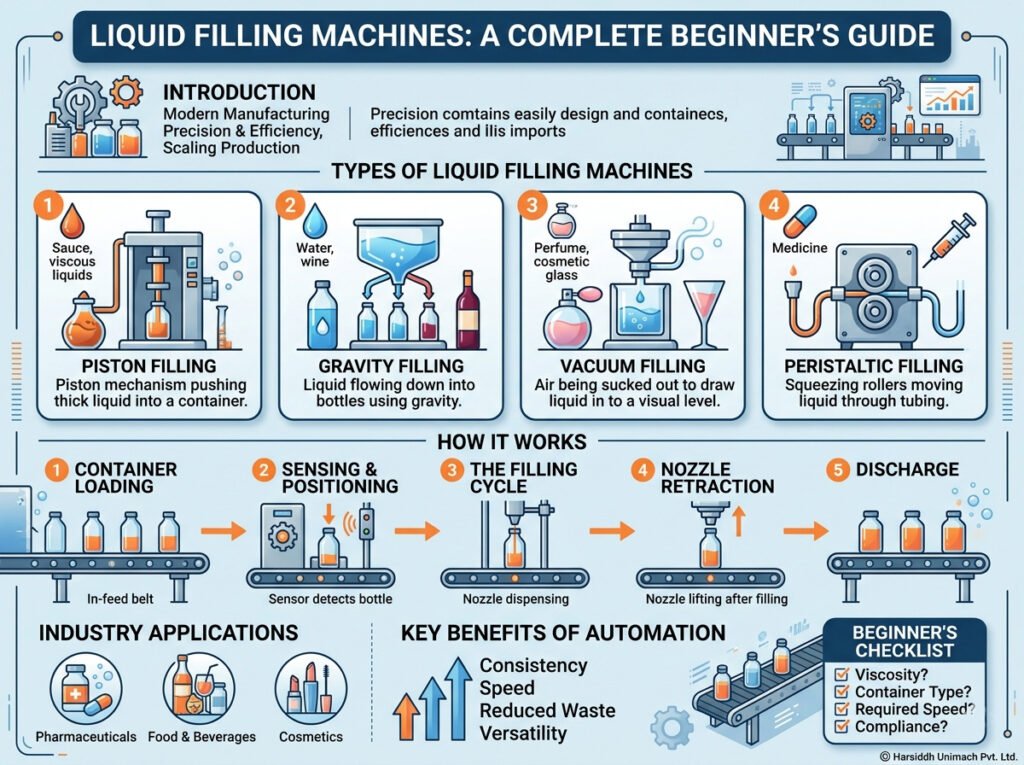
The details vary by technology, but most automatic liquid filling machines follow the same basic sequence:
- Container infeed: empty containers are placed on a conveyor, often fed automatically by a bottle unscrambler that orients loose bottles and lines them up.
- Positioning: sensors detect the containers, and stopper gates or a star wheel hold them precisely under the filling nozzles.
- Nozzle entry: nozzles move down to the container mouth, or dive inside for bottom-up filling of foamy products.
- Dosing: the machine dispenses the set volume or weight of product.
- Drip control: anti-drip or suck-back systems stop product from dripping after the dose.
- Release: the filled containers move on to capping, sealing and labelling.
For a deeper walkthrough, read our article on how a liquid filling machine works step by step.
Main Parts of a Liquid Filling Machine
- Product tank or hopper: holds the liquid, sometimes with a level sensor, stirrer or heating jacket.
- Dosing system: the “heart” of the machine — a piston, pump, gravity valve or load cell that measures each dose.
- Filling nozzles: deliver product into the container; designs vary for thin, thick, foamy or hot products.
- Conveyor: carries containers through the machine.
- Sensors: detect containers and enable “no bottle, no fill” operation.
- Control system: a PLC and touchscreen HMI on automatic machines, used to set fill volumes, speeds and recipes.
- Frame and guarding: usually stainless steel, designed for easy cleaning and operator safety.
Types of Liquid Filling Machines by Technology
Choosing the right filling principle is the most important decision, because it determines accuracy, speed and which products the machine can handle. Our detailed comparison of liquid filling machine technologies covers each in depth; here is a summary.
Gravity fillers
Liquid flows from an overhead tank into the container under gravity, with timed valves controlling the dose. Gravity fillers are simple and economical, and work best for thin, free-flowing liquids such as water, juices, solvents and some chemicals.
Piston fillers
A piston draws a measured volume of product into a cylinder and then pushes it into the container. Piston fillers are accurate and handle a wide range of viscosities — from thin liquids to creams and pastes. Servo-driven versions like the Automatic Servo Based Piston Filling Machine allow volumes to be changed from the touchscreen.
Volumetric (syringe) fillers
A common design for syrups and oral liquids in the pharmaceutical industry, volumetric fillers use multiple syringe-type pumps to deliver identical doses through several nozzles at once. See our volumetric bottle liquid filler as an example.
Gear pump fillers
A servo-controlled gear pump delivers smooth, continuous flow, making these machines well suited to oils, detergents and medium-viscosity liquids.
Peristaltic fillers
Rollers squeeze a flexible tube to move the liquid. The product never touches the pump itself — only the tube — so cleaning is simple and cross-contamination is eliminated. Peristaltic fillers are ideal for small volumes, sterile products and high-value liquids such as eye drops and injectables.
Load cell (weight-based) fillers
Each container sits on a weighing cell while it fills, and the machine stops at the target weight. This is the most accurate approach for larger containers, dense liquids and products sold by weight. View our load cell based liquid filling machine. Not sure whether you need weight or volume? Our guide to weight-based vs volumetric filling explains the trade-offs.
Flow meter fillers
A mass or magnetic flow meter measures the liquid as it passes, closing the valve once the target volume is reached. These fillers have few moving parts and suit clean, homogeneous liquids.
Types by Automation Level
- Manual and tabletop fillers: the operator places each container and starts each fill. Low cost, ideal for start-ups and very small batches.
- Semi-automatic fillers: the machine controls the dose, but containers are loaded and removed by hand. A good step up from manual work.
- Fully automatic fillers: containers are conveyed, positioned, filled and released without operator intervention. Best for consistent, medium to high-volume production.
- Monoblock machines: filling and capping (and sometimes more) are combined on one base, saving space and reducing transfers.
Types by Viscosity
The thickness of your product strongly influences machine choice:
- Thin liquids (water, alcohol, sanitisers, juices): gravity, flow meter, volumetric or peristaltic fillers.
- Medium-viscosity liquids (syrups, oils, shampoos, liquid soaps): piston, gear pump or servo-based fillers.
- Thick liquids and semi-solids (honey, gels, creams, lotions): piston fillers with large-bore nozzles, sometimes with heated hoppers. The Automatic Viscous Liquid Filling Machine is designed for these products, and our servo based oil and viscous filling machine handles a wide range of oils.
Industries That Use Liquid Filling Machines
Pharmaceuticals
Oral syrups, suspensions, eye and ear drops, and injectables all depend on precise, hygienic filling. Pharmaceutical machines are built to GMP standards with SS 316L contact parts and validation documentation. Examples include the Automatic Liquid Syrup Filling Machine and the Automatic Eye/Ear Drop Filling Machine. See also our range of bottle filling machines for oral liquids.
Cosmetics and personal care
Shampoos, conditioners, lotions, serums, perfumes and hair oils need accurate filling and attractive, consistent fill levels. A cosmetic bottle filling machine can handle a variety of bottle shapes and viscosities.
Food and beverages
Edible oils, sauces, honey, vinegar, milk and drinking water are filled on machines designed for food-grade hygiene and frequent cleaning.
Chemicals and home care
Detergents, disinfectants, floor cleaners, lubricants and agrochemicals may be corrosive, foamy or flammable, requiring compatible materials, special nozzles and, in some cases, flameproof construction.
The Complete Liquid Filling Line
A filling machine rarely works alone. A typical bottle line includes:
- Bottle unscrambling – orienting and feeding empty bottles.
- Bottle cleaning or washing – air-jet cleaning or water washing.
- Filling – the liquid filling machine.
- Capping – screw caps, ROPP caps, press-on caps or pumps applied by capping machines.
- Induction sealing – foil seals for tamper evidence and leak protection.
- Labelling – applied by labeling machines for round, flat or oval bottles.
- Packing – cartoning, inserting leaflets or measuring cups, and case packing.
Planning the line as a whole ensures that all machines run at matched speeds and that changeovers are simple.
How to Choose the Right Liquid Filling Machine
Before contacting suppliers, prepare answers to these questions:
- What products will you fill? Note viscosity, foaming, temperature, particles and whether the product is corrosive or flammable.
- What containers will you use? List all bottle sizes, shapes, materials and neck diameters.
- What fill volumes do you need? Specify the minimum and maximum, and the accuracy required.
- What output do you need? Calculate bottles per minute based on your sales forecast, not just today’s demand.
- What standards apply? Pharmaceutical products need GMP construction and validation documents; food products need food-grade materials.
- How often will you change products? Frequent changeovers favour servo machines with stored recipes and tool-less change parts.
- What is your budget and growth plan? A semi-automatic machine may suit you today, but a machine that can be upgraded or integrated later protects your investment.
Our guide on how to choose the right filling machine for your production line covers these decisions in more detail.
Basic Care and Maintenance
A well-maintained filling machine stays accurate for many years. Simple habits make a big difference:
- Clean all product-contact parts after each batch or product change.
- Check nozzles, seals and tubing regularly and replace them before they wear out.
- Verify fill accuracy at the start of every shift by weighing sample containers.
- Lubricate moving parts as recommended by the manufacturer.
- Keep critical spare parts in stock to avoid long stoppages.
- Train operators properly — most filling problems come from incorrect setup.
Common Beginner Mistakes to Avoid
- Buying for today’s volume only: a machine running at full capacity from day one leaves no room for growth.
- Ignoring product behaviour: testing your actual product on the machine before purchase reveals foaming, dripping or viscosity issues early.
- Overlooking downstream equipment: a fast filler is wasted if capping or labelling cannot keep up.
- Choosing on price alone: after-sales support, spare parts availability and documentation matter just as much over the life of the machine.
How Harsiddh Unimach Can Help
Harsiddh Unimach Pvt. Ltd. manufactures a wide range of liquid filling machines — gravity, piston, volumetric, gear pump, peristaltic and load cell — along with washing, capping, sealing and labelling equipment to complete your line. Whether you are buying your first semi-automatic filler or planning a high-speed automatic line, our team can recommend the right solution for your products and budget. Explore our liquid filling machines on Harsiddh Engineering.
Frequently Asked Questions
What is a liquid filling machine used for? It is used to fill measured quantities of liquid into containers such as bottles, jars, vials and pouches, across industries including pharmaceuticals, cosmetics, food, beverages and chemicals.
Which type of liquid filling machine is best? It depends on the product. Gravity fillers suit thin liquids, piston fillers suit a wide viscosity range, peristaltic fillers suit small and sterile doses, and load cell fillers suit products sold by weight.
What is the difference between semi-automatic and automatic filling machines? In semi-automatic machines, operators load and remove containers while the machine controls the dose. Automatic machines convey, position and fill containers without manual handling.
Can one machine fill different bottle sizes? Yes. Most machines handle a range of volumes and container sizes with adjustable settings and change parts. Servo machines make changeovers especially quick.
How accurate are liquid filling machines? Accuracy depends on the technology, product and fill volume. Servo piston, peristaltic and load cell fillers offer the highest precision, while gravity fillers are suited to applications where speed and simplicity matter more.
Ready to find the right liquid filling machine for your product? Contact our team or send an inquiry to discuss your requirements.