
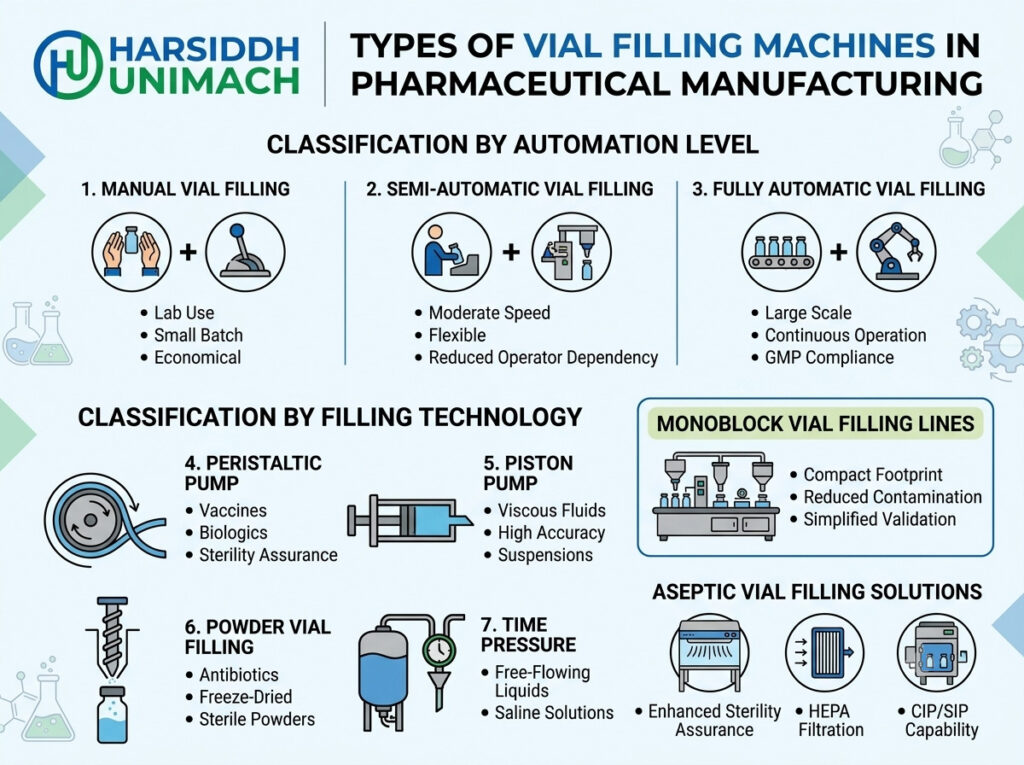
Vials are one of the most versatile containers in pharmaceutical packaging. They hold sterile solutions, suspensions, powders and freeze-dried products; they can be single-dose or multi-dose; and they are used for everything from antibiotics and vaccines to biologics and specialty injectables. It is no surprise, then, that there are many different types of vial filling machines.
For buyers, this variety can be confusing. A “vial filling machine” might mean a compact laboratory unit, a semi-automatic filler for small batches, a high-speed rotary machine or a complete integrated line. Machines also differ in dosing technology, product type, number of filling heads and the level of sterility protection they provide.
This guide classifies vial filling machines in a clear, practical way so you can understand the options and identify which type suits your products and plant. To understand the underlying working principle first, see our article on the vial filling machine working principle and process flow in pharmaceuticals.
How Vial Filling Machines Are Classified
There is no single way to classify vial filling machines. Instead, each machine can be described by several characteristics:
- Level of automation – manual, semi-automatic or fully automatic
- Type of motion – linear (intermittent) or rotary (continuous)
- Dosing technology – piston, peristaltic, time-pressure or weight-based
- Product type – liquid, powder or products for lyophilisation
- Functions combined – filling only, filling and stoppering, monoblock or complete line
- Number of filling heads – from one to many
- Scale – laboratory, pilot, small production or high-speed commercial
- Sterility protection – open laminar airflow, RABS or isolator
Let’s look at each in turn.
1. By Level of Automation
Manual and laboratory fillers
Basic laboratory fillers dispense a set volume when triggered by the operator, who places and removes each vial. They suit research, formulation development and very small batches.
Semi-automatic vial filling machines
The machine controls dosing — and sometimes stoppering — while operators load vials onto a turntable or conveyor and remove them afterwards. Semi-automatic machines are an affordable step up for small production volumes.
Fully automatic vial filling machines
Vials are fed, positioned, filled, stoppered and discharged automatically. Operators supervise rather than handle vials. Fully automatic machines deliver consistent quality, higher output and fewer interventions — essential for commercial sterile production.
2. By Type of Motion
Linear (intermittent motion) machines
Vials move along a straight conveyor and are stopped in groups under the filling nozzles. After filling, the group moves on and the next group enters. Linear machines are flexible, easy to access and suit small to medium outputs. Many standard filling and stoppering machines, such as the Four Head Liquid Vial Filling & Stoppering Machine, use this approach.
Rotary (continuous motion) machines
Vials travel around a rotating star wheel while nozzles move with them, filling on the move. Rotary machines offer smoother handling and higher speeds, making them ideal for medium to high outputs. See the Automatic Rotary Vial Filling Machine.
3. By Dosing Technology
Piston pump fillers
A piston draws product into a cylinder and pushes it out through the nozzle. Piston fillers are accurate across a wide range of volumes and viscosities and are robust in continuous production. Servo-driven versions allow volume adjustment from the HMI. See our servo based piston filling machine.
Peristaltic pump fillers
Rollers compress a flexible tube to move the product, which contacts only the tubing. Single-use tubing sets remove cleaning validation between batches and eliminate cross-contamination, making peristaltic fillers popular for biologics, potent drugs and multi-product facilities. See our peristaltic based liquid filling machine.
For a detailed comparison of these two technologies, read peristaltic vs piston pumps: choosing the right filling system for your vial line.
Time-pressure fillers
Product flows from a pressurised vessel through a valve opened for a precise time. These systems are gentle on sensitive products but require tight control of pressure, temperature and viscosity.
Weight-based (gravimetric) fillers
Each vial is weighed during filling, and dosing stops at the target weight. This approach is used for larger volumes or where direct weight control is needed.
4. By Product Type
Liquid vial filling machines
The most common type, designed for solutions and suspensions. They include dosing pumps, filling nozzles and usually a stoppering station. Browse our vial filling machines for liquid vials.
Powder vial filling machines
Sterile powders, such as many antibiotics, are filled using vacuum-pressure powder wheels. Vacuum draws powder into precisely sized bores, and compressed air discharges each dose into a vial before it is stoppered. See our injectable powder filling machines and the injectable dry powder vial filling with rubber stoppering machine (single wheel).
Machines for lyophilised products
For freeze-dried products, vials are filled with liquid and partially stoppered, leaving a gap for water vapour to escape during lyophilisation. After freeze-drying, stoppers are pushed fully home inside the dryer. Filling machines for these products must place stoppers precisely at the partial position and transfer vials gently to the freeze dryer loading system.
5. By Functions Combined
Filling-only machines
These machines only dose product, with stoppering and capping on separate machines. They are less common in sterile production today because separate transfers increase contamination risk.
Filling and stoppering machines
The most widely used configuration in sterile production, combining dosing and immediate stoppering on one machine in the Grade A zone. See our liquid vial filling machine with rubber stoppering.
Monoblock filling, stoppering and capping machines
Monoblock machines add crimp capping on the same base, reducing floor space and transfers. Capping can also be performed on a separate glass vial capping machine where line layout or segregation requires it.
Integrated and compact lines
A complete line combines washing, depyrogenation, filling, stoppering and capping in one synchronised system. Compact lines bring these steps together in a smaller footprint — for example, the automatic liquid vial filling line (compact line).
6. By Number of Filling Heads
The number of heads — nozzles and pumps working in parallel — largely determines output:
- Single and two head machines – laboratories, pilot plants and small production
- Four head machines – small to medium commercial production
- Six and eight head machines – medium to high-volume production
- Multi-head rotary machines – high-speed commercial lines
More heads increase output but also mean more parts to set up, calibrate and maintain.
7. By Scale of Operation
Laboratory and R&D machines
Compact machines for formulation development, stability batches and clinical supplies, designed for minimal product loss and easy cleaning. See the Pilot Scale Vial Filling Machine for R&D.
Small production machines
Flexible machines for start-ups, contract manufacturers and niche products with modest volumes.
High-speed commercial machines
Machines designed for long runs and high output, typically integrated with washing, sterilising, capping and inspection equipment.
Our article on small vial machines vs high-speed vial lines helps you match capacity to demand.
8. By Sterility Protection
Open machines under laminar airflow
The filling zone is protected by unidirectional HEPA-filtered airflow, with the machine located in a cleanroom. Interventions are performed by gowned operators.
RABS (Restricted Access Barrier Systems)
Rigid walls and glove ports separate operators from the open product. Interventions are made through gloves rather than open doors, significantly reducing contamination risk.
Isolators
Fully enclosed, decontaminated environments that provide the highest level of separation between operator and product, often used for potent or high-value products.
Read more about the rise of RABS and isolators in modern vial filling machines.
Related Formats: Pre-Filled Syringes and Cartridges
Although they are not vials, pre-filled syringes and cartridges are filled on closely related equipment, often in nested ready-to-use formats. For ready-to-administer products, see our PFS filling and stoppering machine.
Comparison Table: Common Vial Filling Machine Types
| Machine Type | Typical Use | Key Advantage | Main Limitation |
|---|---|---|---|
| Laboratory / pilot filler | R&D, clinical batches | Minimal product loss, flexibility | Low output |
| Semi-automatic filler | Small production | Low investment | Manual handling |
| Linear automatic fill & stopper | Small to medium production | Flexible, easy access | Moderate speed |
| Rotary automatic fill & stopper | Medium to high production | Smooth, fast handling | Higher cost |
| Monoblock fill-stopper-cap | Space-limited plants | Fewer transfers, compact | Less flexible layout |
| Integrated / compact line | Complete sterile production | Minimal handling, synchronised | Higher investment |
| Powder vial filler | Sterile powders | Accurate powder dosing | Specialised application |
| Peristaltic filler | Biologics, multi-product | Single-use product path | Tubing replacement cost |
| Piston filler | General injectables | Robust, wide viscosity range | Cleaning validation needed |
How to Choose the Right Type
Answer these questions to narrow down the options:
- What is the product form? Liquid, powder or lyophilised?
- What is the product’s value and sensitivity? High-value and sensitive products favour peristaltic dosing and barrier technology.
- What output do you need? Calculate based on annual demand and realistic efficiency.
- How many products and vial sizes will you run? Frequent changeovers favour servo-driven machines with stored recipes.
- How much space is available? Monoblock and compact lines save cleanroom space.
- What sterility protection is required? Consider your contamination control strategy and target markets.
- What is your growth plan? Choose a machine that can grow with demand or be integrated into a larger line later.
For a step-by-step approach, read our vial filling machine selection guide.
Matching Machine Types to Typical Users
- Research institutes and formulation labs: laboratory or pilot-scale fillers with peristaltic dosing for minimal product use and fast cleaning.
- Start-up injectable units: semi-automatic or two-to-four head linear filling and stoppering machines, often paired with a compact washer and tunnel.
- Contract manufacturers: flexible servo-driven machines with quick changeovers, recipe storage and single-use product paths to handle many customers’ products.
- Generic injectable manufacturers: automatic linear or rotary filling and stoppering machines integrated with washing, sterilising and capping.
- Biologics and vaccine producers: peristaltic or time-pressure dosing, gentle handling, nitrogen protection and RABS or isolator technology.
- Antibiotic powder producers: dedicated powder wheel filling and stoppering machines, often with separate liquid lines for diluents.
Common Mistakes When Choosing a Machine Type
- Choosing on speed alone without considering changeovers, cleaning and product variety.
- Ignoring future products such as biologics or lyophilised formats that may need different dosing or stoppering.
- Underestimating barrier requirements for target markets.
- Overlooking downstream capacity, so capping or inspection becomes the bottleneck.
Features to Look For in Any Type
Regardless of type, a good vial filling machine should offer:
- Accurate, repeatable dosing with easy calibration
- Diving nozzles and drip control
- Nitrogen purging options for oxygen-sensitive products
- Reliable stopper feeding and placement with presence detection
- No-vial-no-fill logic
- SS 316L product-contact parts and cleanable, GMP-compliant design
- Quick, tool-less changeover parts
- Recipe-based controls and alarm history
- Full documentation for IQ/OQ
Frequently Asked Questions
What are the main types of vial filling machines? They can be classified by automation (manual, semi-automatic, automatic), motion (linear or rotary), dosing technology (piston, peristaltic, time-pressure, weight-based), product (liquid, powder, lyophilised), function, number of heads, scale and sterility protection.
What is the difference between linear and rotary vial filling machines? Linear machines stop vials in groups under the nozzles, while rotary machines fill vials continuously as they move on a star wheel, enabling higher speeds.
Which vial filling machine is best for biologics? Machines with peristaltic dosing, single-use product paths, gentle handling and barrier protection such as RABS or isolators are often preferred.
Can one machine fill both liquids and powders? Generally no. Liquid and powder filling use different dosing systems, so separate machines are normally used.
What is a monoblock vial filling machine? A machine that combines filling, stoppering and capping on a single base, saving space and reducing transfers.
Not sure which type of vial filling machine is right for you? Browse our vial filling machines, contact our team or send an inquiry to discuss your requirements.