
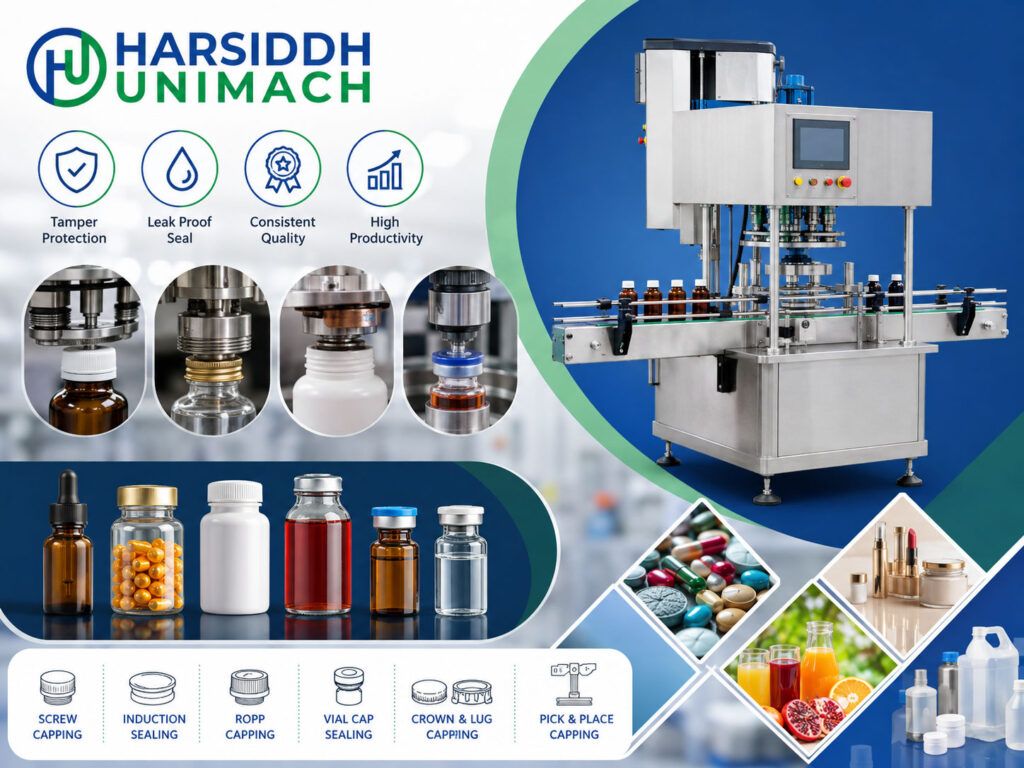
A filled container is only as good as its closure. The seal keeps the product sterile, prevents leaks, protects against moisture and oxygen, shows whether the pack has been opened and lets the user open and reclose it safely. In pharmaceuticals, closure integrity is a critical quality attribute; a poor seal can mean contamination, recalls and risk to patients.
“Cap sealing” covers several quite different technologies, each suited to specific containers and products. Choosing the wrong one can lead to leaks, damaged containers, unhappy customers or failed audits.
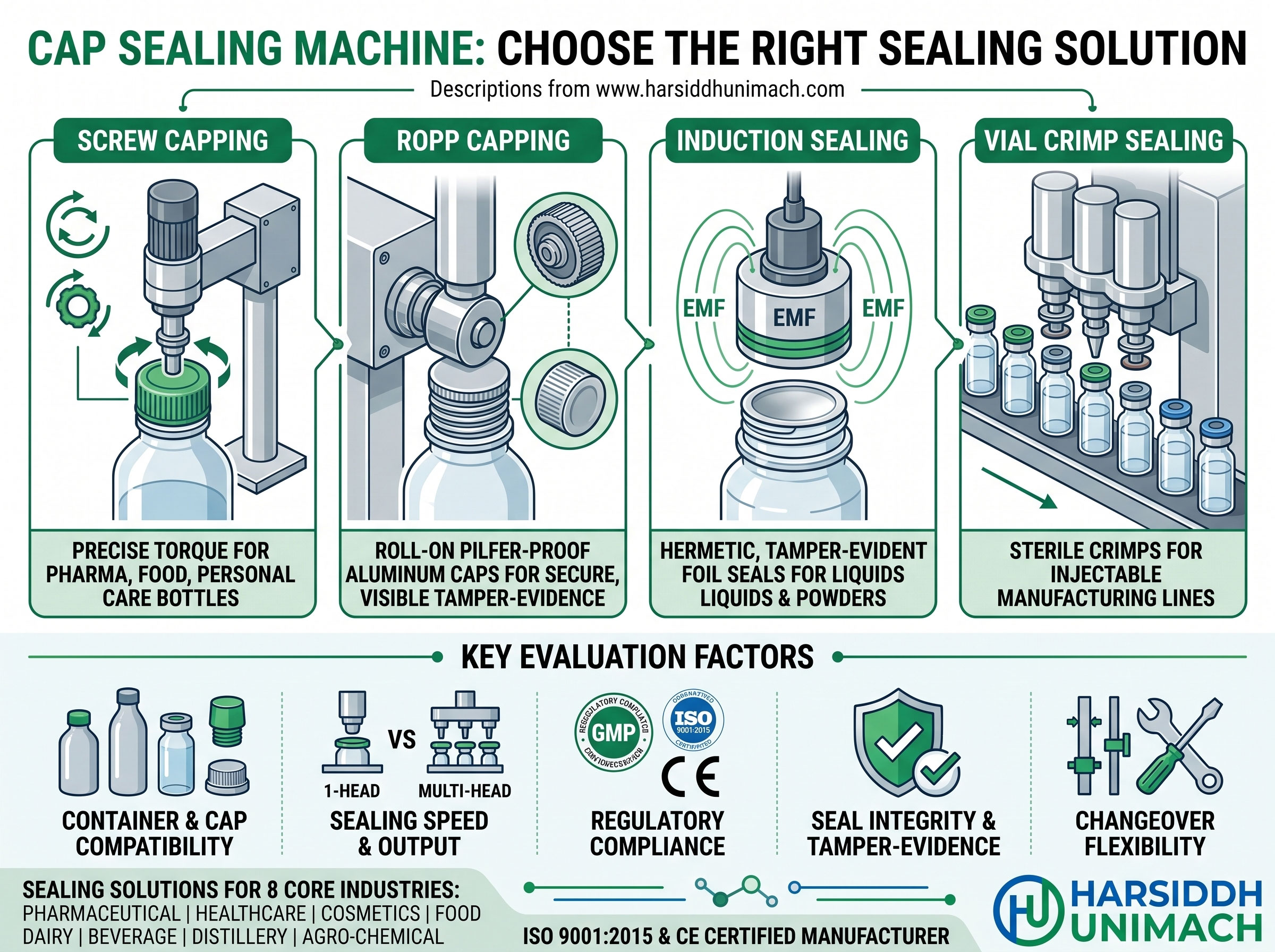
In this guide, we compare the main cap sealing solutions, explain how each works and where it fits, and give a practical framework for choosing the right machine for your product.
The Main Cap Sealing Solutions
| Solution | How It Seals | Typical Containers | Typical Products |
|---|---|---|---|
| Vial aluminium seal crimping | Aluminium cap crimped under the vial neck over a rubber stopper | Glass vials | Injectables, lyophilised products |
| ROPP capping | Aluminium shell rolled into threads and a tamper band formed on the bottle | Glass and some PET bottles | Syrups, oral liquids, spirits |
| Screw capping | Pre-threaded cap tightened to a set torque | Plastic and glass bottles, jars | Syrups, cosmetics, chemicals, food |
| Lug capping | Metal lug cap twisted onto interrupted threads | Glass jars | Food, honey, herbal preparations |
| Induction sealing | Foil liner bonded to the container lip by electromagnetic heating | Plastic and glass bottles | Liquids, tablets, oils, chemicals |
Each solution may be used alone or in combination. For example, many bottles receive a screw cap and an induction seal.
1. Vial Aluminium Seal Crimping
How it works
After a vial has been filled and stoppered, an aluminium cap (often with a plastic flip-off top) is placed over the stopper. Crimping rollers or a crimping head roll the aluminium skirt under the vial’s neck flange, holding the stopper firmly in place. The combination of rubber stopper and crimped aluminium seal provides container closure integrity.
Key considerations
- Crimping force – too low gives a loose seal; too high can crack the glass or deform the stopper. Our article on vial capping machine: how crimping force affects container closure integrity explains this in detail.
- Stopper position – stoppers must be fully seated before crimping.
- Cap feeding – caps must be oriented and placed squarely.
- Particle control – aluminium particles from crimping should be managed in sterile environments.
Machines
- Semi-Automatic Vial Cap Sealing Machine – small batches
- Automatic Four Head Vial Cap Sealing Machine – medium output
- Vial cap sealing machine (1, 4, 6, 8 head)
- Vial capper and glass vial capping machines
For the full process, read our vial cap sealing machine working principle.
2. ROPP Capping
How it works
ROPP (Roll-On Pilfer-Proof) caps are plain aluminium shells placed over a threaded bottle neck. A capping head presses the top of the cap while thread rollers form the thread into the aluminium by following the bottle’s threads, and pilfer rollers tuck the bottom edge under the neck bead to form a tamper-evident band. When the cap is first opened, the band breaks.
Key considerations
- Clear tamper evidence
- Good seal with suitable liners
- Requires accurate bottle neck dimensions
- Roller pressures must be set correctly
Machines
- Automatic Four Head Bottle ROPP Capping Machine
- Bottle screw and ROPP capping machine
- Semi-automatic ROPP capping machine
Read our bottle ROPP capping machine working principle.
3. Screw Capping
How it works
Pre-threaded plastic or metal caps are placed on the bottle and rotated by a chuck or spindles until a set torque is reached. A liner or wad inside the cap is compressed against the bottle lip to form the seal.
Key considerations
- Very versatile across bottle sizes and materials
- Torque control is critical: too low leaks, too high strips threads or makes opening difficult
- Tamper-evident caps with breakaway bands are available
- Often combined with induction sealing for a hermetic seal
Machines
Screw caps can be applied by inline cappers such as the linear capping machine, or by rotary chuck cappers. Read our bottle screw capping machine working principle.
4. Lug Capping
How it works
Metal lug caps have small inward tabs (lugs) that engage interrupted thread segments on a glass jar. A partial turn tightens the cap, compressing a sealing compound against the rim. Steam flushing may create a vacuum for products such as preserves.
Key considerations
- Suited to glass jars and wide-mouth containers
- Quick opening with a partial turn
- Vacuum and safety button options for tamper evidence
See the lug capping machine.
5. Induction Sealing
How it works
The cap contains a multilayer liner with an aluminium foil layer. After capping, the bottle passes under an induction coil. The electromagnetic field heats the foil, melting a heat-seal layer that bonds the foil to the container lip. When the cap is removed, the foil remains sealed over the opening.
Key considerations
- Provides a hermetic seal against leaks, moisture and oxygen
- Clear tamper evidence
- Requires correct liner selection for the container material
- Power and conveyor speed must be matched to cap size and liner
Machines
Sealing Solutions by Dosage Form
| Dosage Form | Typical Container | Common Sealing Solution |
|---|---|---|
| Liquid injectables | Glass vials | Rubber stopper + aluminium seal crimping |
| Dry powder injectables | Glass vials | Rubber stopper + aluminium seal crimping |
| Liquid injectables | Ampoules | Flame sealing (on the filling machine) |
| Syrups and oral liquids | Glass or PET bottles | ROPP or screw cap, often with induction seal |
| Dry syrups | Glass or PET bottles | ROPP or screw cap with induction seal |
| Tablets and capsules | HDPE or PET bottles | Screw cap with induction seal |
| Creams and ointments | Tubes or jars | Tube heat sealing or crimping; screw or lug cap on jars |
| Herbal and Ayurvedic products | Glass jars or bottles | Lug or screw caps |
| Oils and household liquids | Plastic bottles | Screw or flip-top caps with induction seal |
Understanding Closure Integrity
Closure integrity means that the closed container keeps the product protected from microbial contamination, leakage, moisture and gases throughout its shelf life. For sterile products, it is essential for patient safety. Closure integrity depends on several factors working together:
- Container and closure design – compatible dimensions and tolerances
- Component quality – stoppers, caps, liners and seals made consistently
- Correct machine settings – crimping force, torque, roller pressures, induction power
- Clean sealing surfaces – no product or particles on necks and rims
- Verification – appropriate tests defined in your quality system
The sealing machine is one part of this system. Choosing the right machine and setting it correctly for your specific container and closure is what turns good components into a reliable seal.
Liners and Closure Components
The liner or seal inside the cap is as important as the machine:
- Pulp or foam liners – provide a compression seal under screw and ROPP caps
- Induction liners – multilayer liners with foil and heat-seal layers, which must match the container material
- Sealing compounds – used in lug caps
- Rubber stoppers – the primary seal for vials, held in place by the crimped aluminium seal
When changing closure suppliers or materials, re-check machine settings and test seals before full production.
Moving from Semi-Automatic to Automatic Sealing
Many manufacturers start with semi-automatic cap sealers and move to automatic machines as volumes grow. Consider upgrading when:
- Operators cannot keep pace with the filler
- Seal consistency varies between operators
- Labour costs or ergonomic concerns are increasing
- Audits or customers expect more consistent, documented sealing
Automatic machines bring consistent force or torque on every container, higher output and better integration with the line. Semi-automatic machines often remain useful for small batches and trials.
Comparing Sealing Solutions
| Factor | Vial Crimping | ROPP | Screw Cap | Lug Cap | Induction Seal |
|---|---|---|---|---|---|
| Tamper evidence | Flip-off cap and crimp | Breakaway band | With TE band | Vacuum button | Foil seal |
| Hermetic seal | Yes, with stopper | Good, with liner | Depends on liner | Good, with compound | Yes |
| Reclosable | No | Yes | Yes | Yes | Cap reclosable, foil not |
| Main containers | Vials | Glass/PET bottles | Bottles, jars | Glass jars | Bottles, jars |
| Typical pharma use | Injectables | Syrups, oral liquids | Syrups, solids, cosmetics | Herbal products | Solids, liquids |
How to Choose the Right Sealing Solution
Step 1: Start with the container
- Vials → rubber stopper plus aluminium seal crimping
- Glass bottles with ROPP necks → ROPP capping
- Plastic bottles → screw caps, often with induction sealing
- Glass jars with lug finish → lug capping
- Tubes → heat sealing or crimping on the tube filler
Step 2: Consider product protection
- Need for sterility or closure integrity
- Sensitivity to moisture or oxygen
- Risk of leakage during transport
Step 3: Consider tamper evidence and user needs
- Regulatory or customer requirements for tamper evidence
- Ease of opening, including for elderly patients
- Child resistance where required
- Reclosability
Step 4: Match output and automation
| Output Need | Typical Choice |
|---|---|
| Small batches, R&D | Semi-automatic cap sealers |
| Medium production | Single or four head automatic machines |
| High production | Six or eight head rotary machines, integrated lines |
Step 5: Plan line integration
Cap sealing machines must match filler speed and work smoothly with infeed and outfeed. For bottles, capping and induction sealing are often placed in sequence. For vials, cap sealing usually follows the filling and stoppering machine, often with external washing afterwards.
For a broader view of capping in pharma lines, read choosing the right capping machine for your pharmaceutical production line. Browse the capping machines on Harsiddh Engineering and the capping machines for glass and PET bottles.
Quality Checks for Sealed Containers
- Vials – visual crimp inspection, cap rotation test where specified, container closure integrity testing as defined by your quality procedures
- ROPP and screw caps – removal torque, visual check of tamper bands, leak tests
- Lug caps – lug position, removal torque, vacuum button
- Induction seals – peel test, visual check of foil bonding, leak tests
Common Sealing Problems and Solutions
| Problem | Likely Cause | Solution |
|---|---|---|
| Loose vial seals | Low crimping force, stopper not seated | Adjust force, check stoppering |
| Cracked vials | Excessive crimping force | Reduce force, check vial dimensions |
| ROPP threads not formed | Low thread roller pressure | Adjust rollers |
| Broken ROPP bands | Excessive pilfer roller pressure | Reduce pressure |
| Leaking screw caps | Low torque, damaged liner, product on neck | Adjust torque, check liners, improve filling cut-off |
| Weak induction seals | Low power, high speed, wrong liner | Adjust power and speed, verify liner |
| Burnt induction seals | Excessive power | Reduce power |
Frequently Asked Questions
What is a cap sealing machine? A machine that closes filled containers securely, by crimping aluminium seals on vials, forming ROPP caps, tightening screw or lug caps, or bonding induction seals.
Which sealing solution is best for injectable vials? A rubber stopper followed by an aluminium seal crimped by a vial cap sealing machine.
What is the difference between ROPP and screw caps? ROPP caps are formed on the bottle from plain aluminium shells; screw caps are pre-threaded and simply tightened.
Why combine screw caps with induction sealing? Induction seals add a hermetic, tamper-evident foil seal under the cap, preventing leaks and protecting against moisture and oxygen.
How do I choose the right cap sealing machine? Start with the container, then consider product protection, tamper evidence, user needs, output and line integration.
Need help choosing the right cap sealing solution? Contact our team or send an inquiry with your container, closure and output details.