
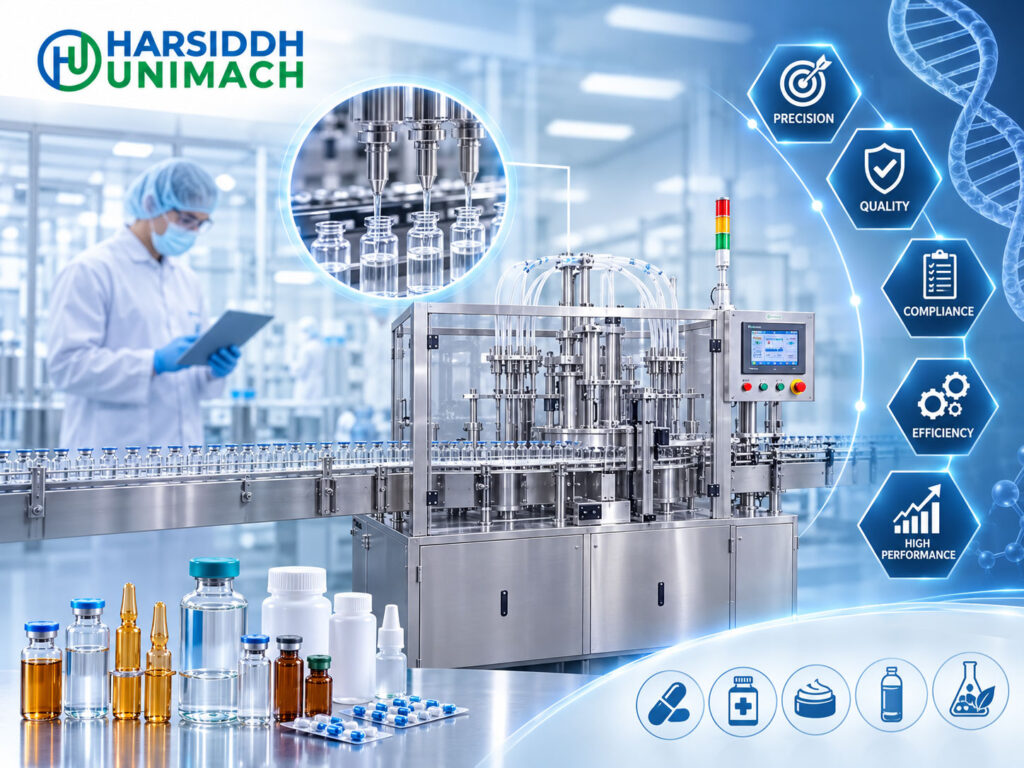
Choosing a filling machine is rarely a standalone decision. In pharmaceutical production, the filler sits in the middle of a chain of machines: equipment that prepares containers before filling, and equipment that closes, inspects, labels and packs them afterwards. The filling machine you choose shapes almost every other machine on the line, and a line is only as strong as its weakest link.
This guide takes a line-level view of pharmaceutical machinery. It explains how the choice of filling machine influences the machines around it, describes typical line layouts for the main dosage forms, and shows how to plan a balanced, integrated line. If you are still deciding which filling machine you need, start with our guide on how to choose the right filling machine for your pharmaceutical production line.
Why Think in Lines, Not Machines
| If You Focus Only on the Filler | If You Plan the Whole Line |
|---|---|
| A fast filler waits for a slow capper or labeller | All machines are matched in speed |
| Transfers between machines cause jams and breakage | Container handling is designed end to end |
| Controls and data are fragmented | Machines communicate and share data |
| Utilities are planned machine by machine | Utilities are sized for the whole line |
| Qualification is complex and repetitive | Documentation is coordinated |
The result of line-level planning is higher real output, fewer stoppages and simpler operation.
The Five Functional Zones of a Filling Line
Almost every pharmaceutical filling line can be divided into five zones:
- Container preparation – feeding, cleaning, washing, depyrogenation
- Filling – dosing the product
- Closing – stoppering, capping, sealing, crimping
- Inspection – checking fill, closure, particles and defects
- Labelling and packing – labels, codes, cartons, cases
The filling machine sits at the centre, but each zone must be chosen to work with it.
Zone 1: Container Preparation
Bottles
Bottles are oriented and fed by an unscrambler, such as the bottle unscrambler, and cleaned by washing or air-jet cleaning.
Vials and ampoules
Containers for injectables must be washed and depyrogenated. A washer, such as the rotary vial washing machine, removes particles; a sterilizing tunnel for ampoules and vials depyrogenates and cools them before they enter the filling area.
How the filler influences this zone
- Washer and tunnel output must match the filler’s speed
- Container heights and transfers must align
- Cleaning methods must suit the product (for example, air cleaning for dry products)
For guidance on washers, read how to select the right pharmaceutical washing machine for your plant and browse our washing machines.
Zone 2: Filling
The filling machine is chosen according to dosage form, container, product properties and output. Examples include the liquid vial filling machine with rubber stoppering for injectables and the volumetric liquid bottle filling machine for oral liquids.
Key line-level questions for the filler:
- What is its realistic output with our product?
- How are containers transferred in and out?
- Does it combine closing (monoblock) or need a separate closing machine?
- What signals does it share with upstream and downstream machines?
Zone 3: Closing
The closing method follows directly from the container:
| Container | Closing Machinery |
|---|---|
| Vials | Rubber stoppering (often on the filler) plus aluminium cap sealing |
| Ampoules | Flame sealing on the filling machine |
| Bottles | Screw, ROPP or lug capping; often induction sealing |
| Tubes | Heat sealing or folding and crimping on the tube filler |
| Pre-filled syringes | Plunger stoppering |
| Solid dose bottles | Capping and induction sealing |
For vials, the vial cap sealing machine (1, 4, 6, 8 head) crimps aluminium seals after stoppering. For bottles, induction sealing machines add a foil seal under the cap.
Read choosing the right capping machine for your pharmaceutical production line and cap sealing machine: choose the right sealing solution. Browse our capping machines.
How the filler influences this zone
- Closing speed must match filling speed
- Product on necks from poor filling cut-off causes closing defects
- Monoblock fillers may remove the need for a separate closing machine
Zone 4: Inspection
Inspection confirms that each container is correctly filled and closed and free of defects. Depending on the product:
- Visual inspection of injectables for particles, cracks and fill level, such as on the visual ampoule and vial inspection machine
- Checkweighing for fill weight
- Closure checks for cap presence and seal integrity
- Label and code verification
Browse our inspection machines.
Zone 5: Labelling and Packing
Labels carry essential product information, batch numbers and expiry dates, and increasingly serialization codes. Labelling machines are chosen by container type, for example the vial sticker labeling machine for vials. For the labelling principle, read our sticker labeling machine working principle and browse our labeling machines.
Packing then follows: cartoning with leaflets, tray loading, shrink wrapping and case packing.
Typical Line Layouts by Dosage Form
Liquid injectable vial line
Vial washer → sterilizing tunnel → filling and stoppering → cap sealing → external washing → visual inspection → labelling → cartoning
Ampoule line
Ampoule washer → sterilizing tunnel → filling and sealing → (sterilisation and leak testing where applicable) → visual inspection → labelling → packing
Dry powder injectable line
Vial washer → sterilizing tunnel → powder filling and stoppering → cap sealing → external washing → inspection → labelling → packing
Oral liquid line
Bottle unscrambler → washing or air cleaning → filling → capping → measuring cup placement → induction sealing → labelling → cartoning
Cream and ointment tube line
Tube feeding → filling → sealing or crimping → coding → (labelling if required) → cartoning
Solid dose bottle line
Bottle unscrambler → air cleaning → tablet or capsule counting and filling → desiccant insertion → capping → induction sealing → labelling → cartoning
Planning a Balanced Line
1. Identify the bottleneck
Every line has one machine that limits output. Ideally, this should be the most valuable or most critical machine, often the filler, with all other machines running slightly faster.
2. Add buffers
Short accumulation conveyors between machines absorb brief stoppages so one machine’s pause does not stop the whole line.
3. Design transfers carefully
Transfers between machines are common sources of jams and breakage. Heights, speeds, guides and star wheels must be matched.
4. Integrate controls
Machines should exchange basic signals, such as “ready”, “stop” and “full”, so they start, stop and slow down together.
5. Plan utilities for the whole line
Power, compressed air, vacuum, nitrogen, water and HVAC must be sized for all machines running at once.
6. Coordinate documentation and qualification
A coordinated documentation package and integrated FAT and SAT make qualification faster and simpler.
Choosing a Line Layout
The physical arrangement of machines affects floor space, operator movement and cleanroom design:
| Layout | Description | Advantages | Considerations |
|---|---|---|---|
| Straight (inline) | Machines in one straight row | Simple, easy to understand, good access | Needs a long room |
| L-shaped | Line turns once, usually at a transfer | Fits rectangular rooms, separates zones | Extra transfer point to design carefully |
| U-shaped | Line turns back on itself | Compact, infeed and outfeed near each other, fewer operators | Access to inner side must be planned |
For sterile lines, the layout must also respect cleanroom zoning: container washing in a less critical area, the tunnel passing through the wall into the filling room, filling and stoppering under unidirectional airflow, and cap sealing and inspection outside the critical zone.
Cleanroom and Contamination Considerations for Sterile Lines
For injectables, the line design must support contamination control:
- Clear separation between non-sterile and sterile areas, with the depyrogenation tunnel often acting as the bridge
- Unidirectional airflow over open containers during filling and stoppering
- Restricted access barriers or isolators around critical zones in many modern facilities
- Minimal operator intervention in the critical zone, through automation and good machine design
- Cleanable machine surfaces and drives placed outside the product zone where possible
Requirements should be defined with your quality team in line with current applicable regulatory guidance.
Commissioning a New Line
Bringing a new line into production usually follows these stages:
- Factory acceptance tests (FAT) – each machine, or the integrated line, is tested at the supplier’s site
- Delivery and installation – machines positioned and connected to utilities
- Site acceptance tests (SAT) – performance confirmed in your facility
- Installation and operational qualification (IQ/OQ) – documented verification
- Performance qualification (PQ) – production-scale runs with your product
- Training and handover – operators and maintenance staff trained
- Ramp-up – gradual increase to full production while monitoring performance
Planning these stages early, with clear responsibilities between you and your suppliers, avoids delays.
Future-Proofing Your Line
A pharmaceutical line often runs for many years. To keep it useful as products and volumes change:
- Choose machines with recipe management and wide format ranges
- Leave space and utility capacity for additional or larger machines
- Select connectable controls that can link to plant systems later
- Prefer upgradeable machines, for example fillers that can accept extra heads or nitrogen systems
- Plan for serialization and inspection upgrades as regulations evolve
Single Supplier or Multiple Suppliers?
| Approach | Advantages | Considerations |
|---|---|---|
| Single supplier for the whole line | One point of responsibility, matched machines, coordinated documentation | Fewer choices for individual machines |
| Multiple suppliers | Freedom to choose the best machine for each step | Integration responsibility falls on the buyer |
Many manufacturers choose a single supplier for the core line (preparation, filling, closing) and add specialist equipment where needed, with clear agreements on interfaces.
Measuring Line Performance
Once a line is running, measure it as a whole rather than machine by machine. Record planned production time, stoppages and their causes, speed losses and rejects for the complete line. Overall Equipment Effectiveness (OEE) for the line, rather than for the filler alone, shows the real output customers receive. Reviewing this data regularly reveals which machine or transfer is limiting performance and where improvement effort will pay off most.
Staffing and Training
A well-designed line also needs the right people. Integrated lines are often run by fewer operators than separate machines, but those operators need broader skills: setting up several machines, handling changeovers across the line, responding to alarms and carrying out in-process checks. Maintenance teams need to understand mechanical, electrical, pneumatic and control systems. Plan training before the line arrives, involve operators in the FAT where possible and provide clear, visual instructions at each machine.
Common Line-Level Mistakes
- Buying a fast filler without upgrading closing or labelling
- Ignoring transfer design between machines from different suppliers
- Underestimating utility demand when all machines run together
- Leaving no space for future expansion
- Planning qualification machine by machine instead of as a line
A Line Planning Checklist
- Filling machine selected for dosage form, container and output
- Container preparation equipment matched to filler speed
- Closing method and machine defined
- Inspection requirements and equipment agreed
- Labelling, coding and packing equipment selected
- Bottleneck identified and other machines sized above it
- Buffers and transfers designed
- Controls integrated between machines
- Utilities sized for the whole line
- Layout and cleanroom zoning confirmed
- FAT, SAT and qualification planned
- Training and spare parts arranged
Frequently Asked Questions
Why should a filling machine be chosen as part of a complete line? Because the filler’s speed, container handling and closing method affect every other machine. A well-matched line delivers higher real output and fewer stoppages.
What machines make up a typical pharmaceutical filling line? Container preparation (feeding, washing, depyrogenation), filling, closing, inspection, labelling and packing equipment.
What is the bottleneck in a filling line? The machine that limits overall output. Other machines should run slightly faster so they never hold back the bottleneck.
Is it better to buy a complete line from one supplier? It simplifies responsibility and integration, but some manufacturers prefer to combine specialist machines from different suppliers.
How do buffers help a filling line? They absorb short stoppages so one machine’s pause does not stop the whole line.
Planning a complete pharmaceutical filling line? Contact our team or send an inquiry with your products, containers and output targets, and we will help design a balanced, integrated solution.