
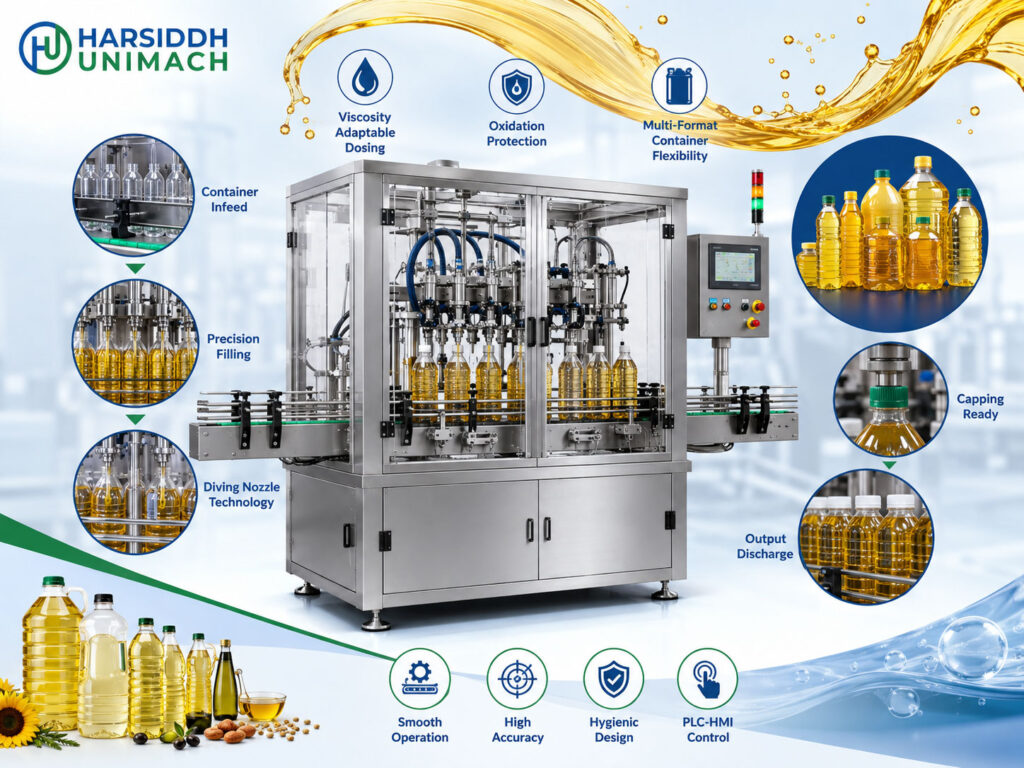
Edible oils are among the highest-volume food products packed anywhere in the world. Refineries and packing plants fill sunflower, soybean, groundnut, mustard, palm, rice bran, cottonseed, sesame, coconut and olive oil into millions of bottles, pouches, jars, tins and jerrycans. For these plants, the filling machine is part of a larger system that starts at the bulk storage tank and ends with a sealed, labelled, coded pack ready for distribution.
This article explains the edible oil filling machine working principle from a plant perspective: how oil travels from storage to the filler, how its quality is protected along the way, which filling technologies suit different pack sizes and outputs, what food-safe design looks like, and how the filler fits into a complete, high-volume packing line.
If you are interested specifically in household cooking oil packs and how different oils behave in the filler, read our companion article on the cooking oil filling machine working principle.
The Edible Oil Packing System at a Glance
- Bulk storage tanks – refined oil is stored before packing
- Transfer and filtration – oil is pumped to the packing hall through filters
- Day tank or buffer tank – holds oil close to the filler at a stable level
- Filling machine – doses oil into each container
- Capping – closures applied
- Induction sealing – foil seals for leak protection and tamper evidence
- Labelling and coding – brand labels, batch and date codes
- Secondary packing – cartons, shrink wrap and palletising
The filling machine is the heart of this system, but its performance depends heavily on what happens before and after it.
Step 1: From Storage Tank to Filler
Transfer pumps
Refined oil is pumped from bulk storage to the packing area. Transfer pumps should handle oil gently and deliver a steady flow without introducing air.
Filtration
Oil usually passes through filters before reaching the filler to remove any particles picked up in storage or transfer. Clean oil protects pumps, valves and nozzles and ensures a clear product in transparent bottles.
Day tank or buffer tank
A smaller tank near the filler holds oil at a constant level. This:
- Provides a steady supply to the filling pumps
- Decouples the filler from changes in transfer flow
- Allows level control so the filler never runs dry
Temperature management
Some oils, especially palm oil and coconut oil, thicken or solidify at cooler temperatures. Heated tanks and lines may be needed to keep them fluid. Other oils simply benefit from stable temperatures so viscosity, and therefore filling behaviour, stays consistent through the shift.
Step 2: Protecting Oil Quality During Packing
Edible oils can deteriorate through oxidation, which affects flavour, odour and shelf life. Exposure to air, light, heat and certain metals can speed this up. Packing plants protect oil quality by:
- Closed tanks and pipework – limiting contact with air
- Nitrogen blanketing of storage or day tanks in some plants, displacing air above the oil
- Short hold times between refining, storage and packing
- Avoiding overheating when warming oils that thicken
- Suitable materials – stainless steel contact parts rather than materials that may promote oxidation
- Prompt sealing after filling
The specific measures depend on the oil and the plant’s quality standards.
Step 3: The Filling Machine
Filling technologies for edible oil
| Technology | How It Works | Strengths | Typical Packs |
|---|---|---|---|
| Servo piston | Piston draws and delivers a programmed volume | High accuracy, digital settings | Small and medium bottles |
| Servo gear pump | Gears deliver oil; dose set by revolutions | Smooth flow, quick volume changes, handles oil well | Bottles, jars, pouches |
| Weight (gravimetric) | Fills until load cell reaches target weight | Compensates for temperature and density changes | Tins, jerrycans, large bottles |
| Flow meter | Measures volume or mass passing through | Accurate, flexible | Various, often larger packs |
Servo-driven machines are especially popular in edible oil plants because they allow fast switching between pack sizes using stored recipes. See the Automatic Servo Based Oil Filling Machine, the servo based oil and viscous filling machine and the servo based gear pump filling machine.
For a deeper comparison of measuring by volume versus weight, read weight-based vs volumetric filling.
The filling cycle
- Containers are positioned under the nozzles by gates or star wheels.
- Sensors confirm each container is present.
- Nozzles enter the container neck.
- The pump or valve delivers the dose, with speed profiles to avoid splashing.
- Anti-drip nozzles close and, where used, a drip tray moves under the nozzles.
- Filled containers move to capping.
Drip control
Oil on bottle necks and surfaces is a constant enemy in oil packing. It causes caps to slip, seals to fail, labels to peel and packs to look unattractive. Positive shut-off nozzles, suck-back and drip trays are essential features of any edible oil filler.
Step 4: Matching the Filler to Pack Sizes
Edible oil plants typically run a wide range of packs:
| Pack | Typical Filling Approach | Notes |
|---|---|---|
| Small PET bottles | Multi-head servo piston or gear pump | High speed, frequent pack changes |
| Large PET bottles | Gear pump or flow meter | Longer fill times; more heads for output |
| Jars | Gear pump or piston | Wide mouths, fast filling |
| Spout pouches | Gear pump or piston through the spout | Pouches held by spout; see the spout pouch filling machine |
| Tins | Weight filling | Accurate on large volumes |
| Jerrycans | Weight filling | Robust handling for heavy containers |
Some plants use separate lines for small and large packs; others use flexible servo machines that handle a range of sizes with quick changeovers.
Step 5: Capping, Sealing, Labelling and Coding
Capping
Bottles and jars are capped with screw caps or flip-top closures. Consistent torque and clean necks prevent leaks during transport.
Induction sealing
A foil liner in the cap is heated by an electromagnetic field and bonded to the bottle lip. This creates a hermetic seal that prevents leaks, protects against oxygen and provides tamper evidence. See the Automatic Continuous Induction Bottle Sealing Machine and the induction sealing machine.
Labelling and coding
Brand labels, nutritional information, batch codes and dates are applied, for example on a bottle sticker labeling machine or other labeling machines for round bottles. Clean, dry bottle surfaces are essential for good label adhesion.
A Complete High-Volume Edible Oil Line
- Bottle unscrambler – feeds bottles upright, such as the bottle unscrambler
- Bottle rinsing or air cleaning – where required; returnable or glass containers may use a linear bottle washing machine
- Filling – servo piston, gear pump or weight filler
- Capping
- Induction sealing
- Labelling and coding
- Inspection – fill level, cap presence, label presence
- Shrink wrapping or cartoning
- Palletising
For smaller plants, a liquid bottle filling and capping machine (monoblock) combines filling and capping on one frame, saving space and reducing transfers.
Planning Line Capacity
When designing an edible oil packing line, start with the total volume to be packed per shift and the mix of pack sizes. Small packs need many containers per hour and therefore more filling heads or faster machines, while large packs need fewer containers but longer fill times. Balance the filler, capper, sealer and labeller so that no single machine becomes a bottleneck, and allow short conveyor buffers between them. Leaving space for an additional filler or larger machine later makes it easier to grow as demand increases.
Food-Safe Design
Edible oil filling equipment must meet food hygiene expectations:
- Food-grade contact materials, typically stainless steel and approved seals
- Smooth, cleanable surfaces with no dead zones where oil can stagnate
- Easy dismantling of nozzles, valves and pumps for cleaning
- Drainable pipework so old oil does not remain in the system
- Protection from contamination – covers, closed systems and clean surroundings
Always follow the food safety regulations and standards that apply in your market.
Edible Oil Machines from Harsiddh
- Automatic Edible Oil Filling Machine
- Automatic Palm Oil Filling Machine
- Automatic Mustard Oil Filling Machine
- The servo based oil filling machine described above, for plants that need flexible, recipe-driven pack changes
Browse all our liquid filling machines. For thicker oils and other viscous products, read our high viscous liquid filling machine working principle.
Declared Quantity and Accuracy Checks
Edible oil packs may declare their contents by volume or by weight, depending on the market and the regulations that apply. Plants often check fills by weight because it is fast and precise, converting to volume where needed using the oil’s density at the filling temperature. Because density varies with temperature and oil type, the conversion should use values appropriate to actual conditions.
Good practice includes:
- Checking fills from every head or station at start-up
- Sampling at defined intervals through the shift
- Using in-line checkweighers on high-volume lines to reject out-of-limit packs
- Trending results to spot pump wear or temperature effects early
- Recording results for traceability
Always follow the packaging and labelling rules that apply in your market.
Changeover Between Oils and Packs
When switching oil types, such as from mustard oil to a milder oil, plants drain and recover oil from the day tank, lines and filler, flush or clean the product path to prevent flavour and odour carry-over, then fit nozzles and guides for the next pack and recall the correct servo recipe. Test containers are filled and checked before production resumes. Planning the production sequence, for example running milder oils before stronger ones, can reduce the cleaning needed between batches.
Key Settings and Their Effects
| Setting | What It Controls | Effect If Wrong |
|---|---|---|
| Day tank level | Steady supply | Air in pumps, inconsistent fills |
| Oil temperature | Viscosity | Fill variation, slow flow, clouding |
| Fill volume, revolutions or target weight | Dose per pack | Under- or overfilling |
| Fill speed profile | Flow into container | Splashing, slow output |
| Nozzle shut-off and suck-back | Clean cut-off | Oily necks, leaking caps, peeling labels |
| Cap torque | Closure tightness | Leaks or hard-to-open caps |
| Induction sealer power and speed | Seal quality | Weak or burnt seals |
Troubleshooting Common Problems
| Problem | Likely Cause | Corrective Action |
|---|---|---|
| Fill variation through the day | Temperature or tank level changes | Stabilise temperature, maintain day tank level |
| Oily necks and containers | Drips, poor shut-off | Improve nozzle shut-off and suck-back |
| Leaking packs | Oil on neck, poor capping or sealing | Clean necks, check torque and induction sealing |
| Labels peeling | Oil on bottle surface | Improve drip control, keep bottles dry |
| Cloudy oil in bottles | Low temperature, particles | Control temperature, check filtration |
| Off-odours | Oxidation, contamination | Review storage, hold times and cleaning |
| Pump volume drift | Wear | Inspect and service pumps |
Maintenance Tips
- Inspect pumps, seals and nozzles regularly.
- Clean the day tank, lines and filler during planned stops, especially when changing oil types.
- Replace filters on schedule.
- Calibrate load cells on weight fillers.
- Check induction sealer coils and settings.
- Verify fill accuracy at start-up and at regular intervals.
Frequently Asked Questions
What is the working principle of an edible oil filling machine? Oil is supplied from a day tank to servo piston, gear pump or weight filling stations, which dose a measured volume or weight into each container through anti-drip nozzles. Containers then move on to capping, induction sealing and labelling.
Which filling technology is best for edible oil? Servo piston and gear pump fillers suit bottles, jars and pouches; weight filling is often preferred for tins and jerrycans.
How do packing plants protect oil quality? By limiting exposure to air, light and heat through closed tanks, short hold times, nitrogen blanketing in some cases, suitable materials and prompt sealing.
Why is induction sealing used on edible oil bottles? It prevents leaks, protects against oxygen and provides tamper evidence.
Can one filler handle different pack sizes? Yes. Servo-driven fillers can switch between pack sizes quickly using stored recipes and suitable change parts.
Planning an edible oil packing line? Contact our team or send an inquiry with your oil types, pack sizes and output requirements.